Achilles Tendon Injury in Dogs: Signs, Causes and What Helps
An Achilles tendon injury in dogs is damage to the common calcaneal tendon, the tendon group running down the back of the hind leg to the point of the hock. It can tear partially, rupture fully, pull away from the bone, or degenerate gradually — and it usually shows as a dropped hock.
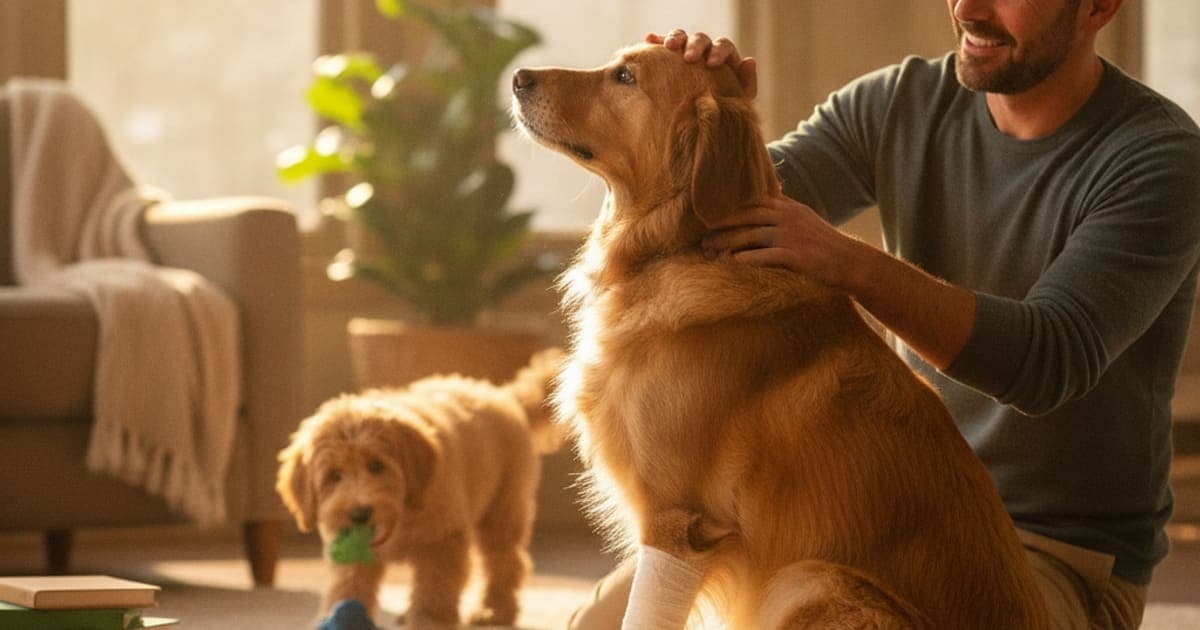
What is Achilles tendon injury in dogs?
An Achilles tendon injury in dogs is damage to the common calcaneal tendon — the thick band of tendons running down the back of the hind leg to the point of the hock. It can tear partially, rupture completely, pull away from the bone, or degenerate slowly over months. The hallmark sign is a hock that sinks toward the ground.
It is a structural injury, not a soreness problem, and it is one of the few orthopaedic issues in dogs where the visual change in the leg is often more obvious than the limp itself.
The anatomy that explains everything about this injury
Dogs do not have a single Achilles tendon the way the name suggests. They have a common calcaneal tendon made up of several contributions that converge on the calcaneus (the point of the hock): the tendon of the gastrocnemius, the superficial digital flexor tendon, and the combined tendon of the biceps femoris, semitendinosus and gracilis.
That arrangement matters because it explains the range of presentations owners see. When the whole tendon group fails, the hock collapses and the dog stands flat-footed on the back of the leg — a plantigrade stance. When the gastrocnemius portion tears but the superficial digital flexor tendon stays intact, the hock drops while the toes curl under, giving the crab-like or crouched posture veterinary surgeons describe.
This tendon also has an unforgiving blood supply compared with muscle. Tendon is dense, organised collagen with relatively low vascularity and a slow metabolic rate, which is exactly why calcaneal tendon injuries heal on a timescale of months rather than weeks, and why the tendon must be held at the correct length while it does.
Signs of a dog Achilles tendon injury owners notice first
Acute injuries announce themselves. Chronic ones creep.
With a sudden traumatic rupture or laceration, there is usually a clear moment — a jump, a fall, a cut from metal or glass — followed by immediate non-weight-bearing lameness, swelling above the hock, and a hock that no longer holds its normal angle.
Chronic, degenerative injuries are the ones that get missed. Watch for:
- A hock that looks lower or more angled than the other side when the dog stands square
- Thickening or a firm swelling just above the point of the hock
- Toes that curl or knuckle while the hock drops
- A shortened, choppy stride on that leg, or reluctance to push off
- Difficulty with stairs, jumping into the car, or rising from a slippery floor
- Pain, flinching or tensing when the area above the hock is squeezed
- Progressive worsening over weeks despite rest
Compare the two hocks from behind and from the side, and take a photo. Sequential photos are genuinely useful evidence for your veterinarian, because a mild drop is easy to normalise day to day and obvious across a month.
What causes these tears, and which dogs are most at risk
Broadly, there are two routes to the same injury.
Acute trauma. Lacerations from wire, fencing or glass; road accidents; a bad landing off furniture or a dock; a hard cut at speed on grass. These are sharp, single-event failures.
Chronic degeneration. Repetitive loading gradually outpaces the tendon's ability to repair itself. The collagen becomes disorganised, the tendon thickens, and small partial tears accumulate until the structure gives way — sometimes during an ordinary walk. Chronic calcaneal tendinopathy is well recognised in middle-aged and older dogs, and the veterinary literature reports it particularly in Doberman Pinschers and Labrador Retrievers, though it is by no means limited to them.
Contributing factors your veterinarian will weigh include body condition (extra weight is extra load on every stride), athletic or working demands, previous injury to the same limb, conformation, endocrine disease that alters connective tissue quality, and repeated corticosteroid exposure around a tendon. Age plays a role too: tendon tissue becomes less compliant and slower to remodel as dogs get older.
How veterinarians diagnose and manage calcaneal tendon damage
Diagnosis starts with hands and gait. Your veterinarian will palpate the tendon for gaps, thickening and pain, assess the hock angle under load, and check whether the toes flex normally. Radiographs rule out avulsion fragments, calcification and hock joint disease. Ultrasound is the workhorse for the tendon itself — it shows fibre disruption, tendon thickness and fluid, and it can be repeated to follow healing. MRI is used in complex or unclear cases.
Treating an Achilles tendon injury in dogs is fundamentally about two things: restoring continuity of the tendon and controlling its length while it heals.
| Approach | What it involves | Usually considered when | What owners should know |
|---|---|---|---|
| Surgical repair | Suturing the tendon ends (locking-loop or three-loop pulley patterns), reattaching avulsed tendon to the calcaneus, debriding degenerate tissue | Complete ruptures, lacerations, avulsions, most chronic tears with a functional gap | Repair is only half the job — the leg must then be immobilised while the repair matures |
| Immobilisation | Calcaneotibial screw, external skeletal fixation, cast, splint or a custom tarsal orthosis, often stepped down in stages | After surgery, and for selected partial injuries managed without surgery | Protects the repair from the enormous forces the hock generates; bandage care and skin checks are non-negotiable |
| Conservative management | Strict activity restriction, external support, weight management, veterinary pain control, controlled loading over time | Partial tears with a stable hock angle, or when anaesthesia carries high risk | Requires real discipline for months; needs recheck imaging to confirm the tendon is not lengthening |
| Rehabilitation therapy | Passive range of motion, targeted strengthening, underwater treadmill, laser or therapeutic ultrasound as prescribed | Alongside every other approach, once your surgeon clears loading | Progression is dictated by tissue healing, not by how good the dog looks |
Prescribed anti-inflammatories, other analgesics and, where indicated, antibiotics are part of the plan. An Achilles tendon injury is a structural problem first — nothing you add at home substitutes for accurate veterinary diagnosis and the surgical repair or immobilisation the tendon needs to heal at the correct length. Never stop or adjust a medication your veterinarian prescribed without speaking to them.
What recovery actually asks of you
Here is the part owners underestimate. The repair happens on day one; the healing happens across months.
Early on, the tendon is held together by suture and hardware while inflammatory and repair cells populate the injury site. Then the body lays down disorganised collagen — mechanically weak scaffolding. Only during the long remodelling phase does that scaffold reorganise along lines of load and regain useful tensile strength. Controlled, progressive loading guided by your rehab plan is what drives that reorganisation; too much too early stretches the healing tendon and leaves the hock permanently dropped.
Practically, that means confinement, lead-only toileting, non-slip flooring, sling support on steps, meticulous bandage or orthosis care, and recheck appointments you do not skip. It also means keeping the dog lean, because every kilogram is load, and protecting the opposite hind limb, which is doing extra work throughout.
Recovery-phase support owners are adding at home
Once the surgical and immobilisation plan is set, most owners want to know what else they can do in the space veterinary care creates. This is where nutrition and targeted supplementation come in — and where the market is at its worst. Kitchen-sink chews with a dozen ingredients at trace inclusions, proprietary blends that hide quantities, and marketing that outruns any evidence are extremely common. Read labels for actual amounts per serving and for third-party testing, and be sceptical of anything that will not show you what is in the bottle.
Against that backdrop, a growing number of owners recovering dogs from tendon injuries have moved toward peptide support. K9-REPAIR from pawgen is a BPC-157 and TB-500 formulation made specifically for dogs, dosed by body weight, third-party tested with certificates of analysis available, shipped direct to your door, and backed by a 60-day money-back guarantee.
The mechanism is worth understanding plainly. BPC-157 is a stable pentadecapeptide derived from a sequence found in gastric juice protein; published laboratory and animal research suggests it influences angiogenesis and the behaviour of tendon fibroblasts — the cells that produce and organise collagen. TB-500 is a synthetic fragment of thymosin beta-4, an actin-binding peptide that research links to cell migration, new blood vessel formation and modulation of the inflammatory phase of repair. Those are exactly the processes that limit tendon healing: blood supply, cell recruitment and collagen organisation.
This is emerging and promising science that owners are adopting, and the honest framing matters. BPC-157 and TB-500 are not FDA-approved veterinary drugs, and nothing here is a treatment claim for your dog's injury. Research suggests plausible mechanisms and owners report using peptides as part of their recovery stack; that is the accurate statement. Bring it up with your veterinarian, ideally at the same visit where you discuss rehab progression, so it sits inside one coordinated plan — and for any dosing question, or if your dog is pregnant, nursing or still growing, work with your veterinarian rather than any number you find online.
Key Takeaways
- An Achilles tendon injury in dogs is damage to the common calcaneal tendon at the back of the hind leg; the classic sign is a dropped or plantigrade hock.
- Acute cases follow trauma or laceration; chronic cases build silently through degeneration, often in middle-aged and older dogs.
- The first signs are usually a changed hock angle, thickening above the hock, curled toes, and reduced push-off — compare sides and photograph them.
- Diagnosis relies on palpation, gait assessment, radiographs and ultrasound; management centres on repair plus controlled immobilisation.
- Healing is measured in months, and progressive loading under a rehab plan is what makes the new collagen strong.
- Keep the dog lean, keep floors non-slip, and never skip recheck imaging.
For deeper reading on specific recovery questions, pawgen covers dog achilles tendon injury without steroids, dog achilles tendon injury drug-free options, dog achilles tendon injury food-based support, k9-repair for tendon injury in dogs and k9-repair for tendonitis in dogs.
Your veterinarian owns the diagnosis and the treatment plan here — the imaging, the surgical decision, the immobilisation strategy, the pain protocol and the timeline for returning load to that leg. Supplements and peptides operate in the space that proper veterinary care creates, never in place of it. If your dog's hock is dropping, get the leg looked at now rather than after another week of watching.
Owners exploring peptide support for their dog can review K9-REPAIR — BPC-157 + TB-500 formulated for dogs — at https://pawgen.com/. BPC-157 and TB-500 are not FDA-approved veterinary drugs. Nothing in this article treats, cures or prevents any condition; every decision about your dog's care belongs with your veterinarian.
Frequently asked questions
- Is Achilles tendon injury in dogs painful?
- Yes. Acute ruptures and lacerations are acutely painful, and dogs typically refuse to bear weight. Chronic degenerative injuries cause a duller, persistent discomfort that dogs often mask by shifting load to other limbs. Pain control is a veterinary decision — ask your vet rather than using any human medication at home.
- What makes Achilles tendon injury worse in dogs?
- Continued loading is the main culprit: off-lead running, jumping, stairs, slippery floors and rough play all stretch a healing tendon. Excess body weight, skipped immobilisation or bandage care, returning to activity early, and repeated corticosteroid exposure around the tendon can also worsen damage. Recheck visits catch lengthening before it becomes permanent.
- Can Achilles tendon injury in dogs be reversed?
- Tendon does not simply return to its original state, but function can often be restored to a good level. Surgical repair plus controlled immobilisation and progressive rehabilitation aim to re-establish tendon continuity and correct hock angle. Outcomes depend on how much tendon was damaged, how chronic it is, and rehab compliance.
- How much does it cost to treat Achilles tendon injury in dogs?
- Costs vary widely by clinic, region, imaging needs and whether a specialist surgeon is involved, so no single figure is meaningful. Expect the total to include diagnostics, surgery and anaesthesia, immobilisation hardware or an orthosis, bandage changes, medication and rehabilitation sessions. Ask your clinic for a written itemised estimate upfront.
- Can a dog's Achilles tendon injury heal without surgery?
- Some partial injuries with a stable hock angle are managed conservatively using external support, strict activity restriction, weight control and veterinary pain management. Complete ruptures, lacerations and avulsions generally require surgical repair. Only your veterinarian can determine which category your dog falls into, using palpation and ultrasound imaging.
- What are the first signs of Achilles tendon injury in dogs?
- The earliest signs are usually subtle: a hock that sits slightly lower than the other side, firm thickening just above the point of the hock, toes that curl under, a shortened stride, and reluctance to jump or take stairs. Photograph both hocks from behind and from the side.
- Which dogs are most prone to calcaneal tendon problems?
- Chronic calcaneal tendinopathy is reported particularly in Doberman Pinschers and Labrador Retrievers, and generally affects middle-aged to older dogs. Working and sporting dogs, overweight dogs, and dogs with previous injury to the same limb also carry more risk. Acute traumatic ruptures and lacerations can happen to any dog.
- Where does K9-REPAIR fit during tendon recovery?
- K9-REPAIR is a BPC-157 and TB-500 peptide formulation from pawgen, dosed by body weight and third-party tested with certificates of analysis. Research suggests these peptides influence angiogenesis, cell migration and tendon fibroblast activity. They are not FDA-approved veterinary drugs and never replace surgery, rehab or prescribed medication — discuss it with your veterinarian.
Educational content. BPC-157 and TB-500 are not FDA-approved veterinary drugs. Talk to your veterinarian before starting anything new, especially if your dog is on prescribed medication.