Adopting a Senior Dog: What to Expect
Adopting a senior dog usually means a calmer, faster adjustment than a puppy, a personality you can see before you commit, and health needs that are visible from day one. Expect a settling-in period of weeks rather than months, a thorough baseline vet workup early, and a budget weighted toward veterinary care.
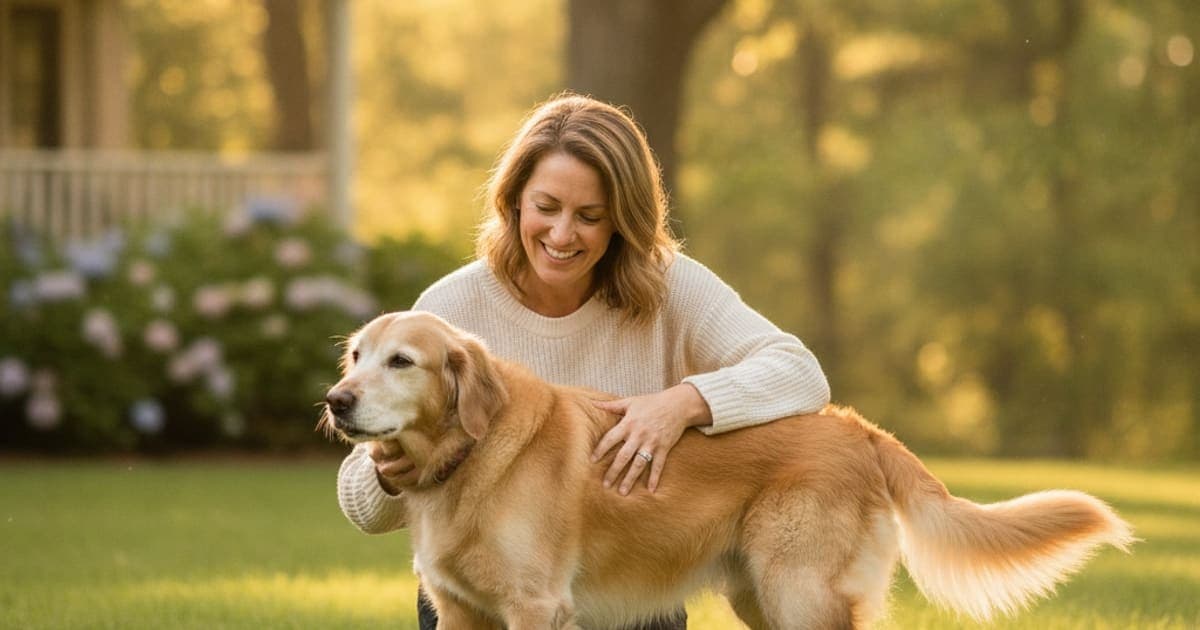
Adopting a senior dog means taking home a dog whose size, temperament and health picture are already formed — which makes it a far more predictable decision than adopting a puppy. Expect a settling-in period measured in weeks, an early and thorough veterinary workup, a budget that leans toward medical care rather than training classes and replaced furniture, and a dog that frequently bonds fast because an adult household is exactly the environment it wants.
The word 'senior' is fuzzy on purpose. Many veterinarians start using it around age seven, but a small terrier at seven is often middle-aged while a giant breed at six may already show the gait changes and muscle loss that come with age. Breed, body condition and previous workload matter more than the number on the intake form. What follows is what the first year typically asks of you, and where the real work sits.
Why the first few weeks look nothing like the dog you'll have
A dog arriving from a shelter or foster home is decompressing, not revealing its personality. Older dogs often do this quietly: sleeping heavily, eating little, following one person from room to room, or ignoring everyone for days. None of that is a prediction.
Rescue staff commonly describe the arc in three stages — the first days of shutdown or overstimulation, the following weeks of testing routines and learning the house, and the months after that when the dog's real habits settle in. It's a rough framework rather than a rule, but it holds up well with older dogs, who tend to move through the early stages faster than puppies because they are not simultaneously learning what a staircase, a doorbell and a vacuum cleaner are.
Practical things that shorten the adjustment: a fixed feeding and walking schedule from day one, a bed in a low-traffic corner the dog can retreat to, short lead walks instead of long free-running sessions, and very few visitors for the first week or two. House-training lapses in the first days are common and usually about stress or an unfamiliar surface, not an untrained dog. Many older rescues are already house-trained and simply need to be shown where the door is.
One caution worth taking seriously: sudden appetite loss, disorientation, straining, or a limp that appears in the first week deserves a call to a veterinarian rather than a wait-and-see approach. Stress unmasks existing problems in older dogs.
The health screening to ask for, before and after you sign
Shelters disclose what they know, and what they know depends on how long the dog has been with them and what the intake exam covered. Assume the record is incomplete rather than wrong. Before you commit, ask what the dog arrived with, whether dental work was done, whether bloodwork was run, and whether anyone has watched the dog walk and trot on a hard surface.
The most useful thing you can do in the first month is build a complete veterinary baseline — bloodwork, a dental assessment, an orthopedic exam and an agreed weight target — so every change you notice later has something to be measured against. Without that baseline, a slower walk at month eight is just an impression. With it, it's data.
The common findings in newly adopted older dogs are unglamorous and manageable: dental disease, excess weight, early kidney or thyroid changes on bloodwork, skin or ear infections, and arthritis in one or more joints. Dental disease in particular is under-treated in surrendered dogs and is one of the clearest quality-of-life wins available. Talk to your veterinarian about which screenings make sense for the dog in front of you rather than ordering everything at once; the exam should drive the testing.
What an older dog actually costs to keep comfortable
Adoption fees for senior dogs are often reduced or waived, and some rescues run programs that help with ongoing costs for the oldest dogs. The fee is not where the money goes. Veterinary care is, and it varies enormously by clinic, region and what the dog turns out to need, so treat any flat figure you read online with suspicion. Budget qualitatively instead: assume more frequent exams than a young dog, a dental procedure as a realistic first-year possibility, and ongoing spend on diet, joint and mobility support, and medication if something chronic is diagnosed.
Here is how the shape of ownership differs:
| What changes | Puppy or young adult | Senior dog |
|---|---|---|
| Predictability | Size, coat and temperament still developing | Personality, size and energy already visible |
| Settling-in | Months of training before the household calms | Weeks, often with an immediately calm house |
| Where the effort goes | Socialization, house-training, chew management | Comfort, mobility, weight control, monitoring |
| Exercise pattern | Long, variable, high-impact | Short, frequent, consistent, low-impact |
| Vet visits | Vaccination series, spay or neuter | More frequent exams, bloodwork, dental work |
| Where the money goes | Training, equipment, replaced belongings | Veterinary care, diet, mobility support |
| Main risk to plan for | Behavior problems from inconsistency | A chronic diagnosis arriving sooner than hoped |
| Home setup | Barriers and puppy-proofing | Traction, ramps, raised bowls, soft bedding |
Pet insurance is worth pricing before you adopt rather than after. Older dogs are more expensive to insure and pre-existing conditions are generally excluded, which means the day you sign the adoption papers is usually the best coverage position you will ever have with that dog.
Mobility is what most new senior-dog owners underestimate
The behavioral adjustment usually goes better than people fear. The physical decline is the part that catches owners off guard, because it arrives gradually and gets rationalized as 'he's just slowing down.'
Watch for the early markers rather than the obvious ones: hesitating at the bottom of stairs, taking the slope instead of the jump into the car, shifting weight off one hind leg while standing, a bunny-hop at the trot, loss of muscle across the back end, or a dog that stops asking for the second walk. Older dogs mask discomfort well, and cats-and-dogs stoicism is not toughness — it's a survival habit that makes your observation the primary diagnostic tool between vet visits.
What holds mobility together is boring and effective: keep the dog lean, because body weight is the single biggest mechanical load on an arthritic joint; walk little and often instead of one long weekend hike; add traction over hard floors; and get any limp that lasts more than a few days examined rather than rested indefinitely. If your veterinarian diagnoses arthritis, a cruciate injury or disc disease, the plan they set — medication, rehabilitation, or surgery — is the plan. Nothing on a supplement shelf replaces it, and nobody should stop a prescribed anti-inflammatory or pain medication because a product promised something.
Inside the space that proper veterinary care creates, owners of older dogs increasingly look at targeted peptide support rather than another kitchen-sink chew. That skepticism is well earned: a great many joint products hide tiny amounts of active ingredients behind proprietary blends, lean on marketing rather than formulation, and never publish a certificate of analysis. pawgen takes the opposite approach with K9-REPAIR, a BPC-157 and TB-500 formulation made for dogs, dosed by body weight, third-party tested with COAs available to read, shipped direct to the door, and backed by a 60-day money-back guarantee.
The mechanism is worth understanding in plain terms. BPC-157 is a synthetic peptide based on a sequence found in gastric juice; published research, largely in animal models, suggests it may support the formation of new blood vessels and influence the signaling involved in tendon, ligament and soft-tissue repair. TB-500 is a synthetic fragment related to thymosin beta-4, a protein studied for its role in cell migration and the actin machinery that cells use to move into an injured area. Research on both is emerging and promising, and owners report reaching for them through recovery periods and across the slow grind of an aging dog's mobility work. Neither is an FDA-approved veterinary drug, none of this is a claim that any product treats or cures a condition, and the right move is to tell your veterinarian exactly what you are giving so it sits alongside their plan rather than underneath it. Questions about amounts belong with your vet, not with a number from a website.
Setting up a home for an older body
Most of the equipment that helps costs very little. Runners or yoga mats across slick floors give a dog with weak hindquarters something to push off. A ramp into the car protects shoulders and cruciate ligaments far more than a lift does, once a dog is heavy. Orthopedic bedding away from drafts, raised bowls for dogs that find it hard to lower the head and neck, and a nightlight for dogs with failing vision all earn their place.
Routine matters more than enrichment gadgets. Older dogs cope poorly with unpredictable days and cope very well with the same three walks, the same two meals and the same bedtime. If cognitive changes appear — pacing at night, staring at walls, forgetting learned cues — that is a veterinary conversation, not a training problem.
Key Takeaways
- Senior adoption trades uncertainty for visibility: you can see the temperament, size and health picture before you commit.
- Expect weeks, not months, of settling, and judge the dog's real personality only after routines are established.
- Build a full veterinary baseline early — bloodwork, dental, orthopedic exam, weight target — and track changes against it.
- Adoption fees are often low or waived; the real budget is veterinary care, diet and mobility support.
- Price insurance before you adopt, since pre-existing conditions are generally excluded.
- Keep the dog lean, walk short and often, add traction, and investigate any limp that persists.
- Choose mobility support that discloses what is in it and publishes third-party testing, and tell your veterinarian what you are giving.
Where your veterinarian fits in
Your veterinarian owns the diagnosis and the treatment plan. They decide whether a limp is a cruciate tear or a soft-tissue strain, whether bloodwork points to kidney or thyroid change, whether surgery is indicated, and what medication belongs in the picture. Your job is the part they cannot do: the daily observation, the weight control, the consistent short walks, and the honest report at the next appointment. Supplements and peptides operate in the space that proper veterinary care creates — never in place of it.
If you want to read further on pawgen's side of this, the third-party certificates of analysis for K9-REPAIR are published at /coas/, the formulation and weight-based options are listed at /shop/, and shipping coverage is set out at /location/. More on the brand and its approach to canine mobility is at pawgen.
Owners exploring peptide support for their dog can review K9-REPAIR — BPC-157 + TB-500 formulated for dogs — at https://pawgen.com/. BPC-157 and TB-500 are not FDA-approved veterinary drugs. Nothing in this article treats, cures or prevents any condition; every decision about your dog's care belongs with your veterinarian.
Frequently asked questions
- Is adopting a senior dog harder than adopting a puppy?
- It is usually easier behaviorally and harder medically. Older dogs are often house-trained, past the destructive chewing stage and settle within weeks. In exchange, you take on a higher chance of arthritis, dental disease or a chronic diagnosis, which means more veterinary involvement from the start.
- How long does it take a senior dog to settle into a new home?
- Most older dogs show their real personality within a few weeks rather than months, provided the routine is consistent. The first days often look like shutdown or clinginess, which is decompression rather than temperament. Fixed feeding and walking times, a quiet retreat space and few visitors speed it up considerably.
- What health checks should a newly adopted senior dog have?
- Ask your veterinarian about a full physical exam, bloodwork, a dental assessment, and an orthopedic check that includes watching the dog walk and trot on a hard surface. The exam should drive which further tests make sense. The goal is a baseline that later changes can be measured against.
- Are senior dogs more expensive to own?
- Usually yes, though the adoption fee itself is often reduced or waived. Costs vary widely by clinic and region, so avoid fixed figures. Plan for more frequent exams, a possible dental procedure, diet and mobility support, and medication if a chronic condition is diagnosed.
- Should I get pet insurance before or after adopting?
- Price it before you adopt. Premiums rise with age and pre-existing conditions are generally excluded, so the day you bring the dog home is typically the strongest coverage position you will have. Read the exclusions carefully, especially around joint and dental conditions.
- Can an older dog still learn new house rules?
- Yes. Older dogs often learn faster than puppies because they focus longer and are less distractible. Keep sessions short, use food rewards, and account for hearing or vision loss by adding clear hand signals. Sudden loss of learned behaviour, though, is a veterinary conversation rather than a training issue.
- What are the first signs that a senior dog is losing mobility?
- Hesitating at stairs, using a ramp or slope instead of jumping, shifting weight off a hind leg while standing, a bunny-hop at the trot, muscle loss over the hindquarters, and declining the second walk. Older dogs mask discomfort, so your daily observation matters between appointments.
- Can I give a newly adopted senior dog a peptide supplement like K9-REPAIR?
- Talk to your veterinarian first, especially before a full baseline workup has been done. K9-REPAIR contains BPC-157 and TB-500, which are not FDA-approved veterinary drugs, and nothing here is a claim that any product treats a condition. Any question about amounts should be resolved with your vet.
- What do BPC-157 and TB-500 actually do?
- BPC-157 is a synthetic peptide based on a sequence found in gastric juice; research, largely in animal models, suggests it may support new blood vessel formation and soft-tissue repair signaling. TB-500 relates to thymosin beta-4, studied for cell migration. Owners report using both through recovery periods.
Educational content. BPC-157 and TB-500 are not FDA-approved veterinary drugs. Talk to your veterinarian before starting anything new, especially if your dog is on prescribed medication.