Agility Dog Conditioning — Programs for Explosive Sports
Agility dog conditioning is a year-round program of core and trunk strength, proprioception, sprint mechanics and controlled jump take-off and landing work, run separately from skills practice. The same framework applies to flyball dogs and dock diving dogs, because all three are short-burst sports that load tendon, ligament and spine in similar ways.
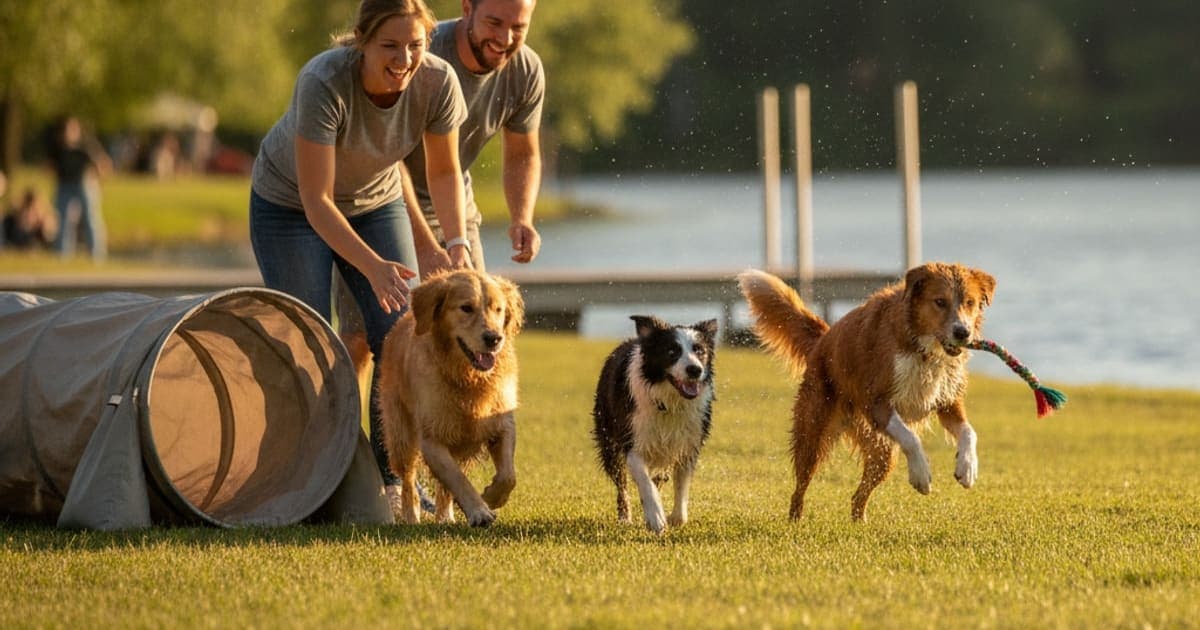
Agility dog conditioning is a structured, year-round program built around four things: core and trunk strength, proprioception (the dog's awareness of where its limbs are), sprint and acceleration mechanics, and controlled jump take-off and landing. It is run separately from skills training, in short sessions, with a real warm-up before and a real cool-down after. The same framework carries straight over to flyball dogs and dock diving dogs, because all three are explosive, short-burst sports that load the same tissues — shoulder, iliopsoas, lumbar spine, carpus and stifle — in slightly different directions.
Skills practice is not conditioning, and the difference matters
Running sequences teaches your dog the job. It does not build the tissue that absorbs the job. A dog can be flawless on contacts and still have a weak trunk, poor single-limb balance and a take-off stride that dumps load into one shoulder every time.
Conditioning targets qualities, not behaviours. Four of them matter most in explosive canine sport:
Core and trunk strength. The spine and abdominal wall are what keep a dog straight at speed and what resist rotation when it turns. Weak trunk control shows up as a dog that lands crooked, swings wide on turns, or drops a hip on tight wraps. Work here is slow and deliberate: controlled sit-to-stand and down-to-stand transitions, three-legged and diagonal-leg standing, tucked positions held briefly on a stable surface, and backing up in a straight line.
Proprioception. Cavaletti poles at a low, walking height, weight shifts on a flat balance pad, slow figure-eights around cones, and backing onto a low platform all ask the dog to know exactly where each foot is. This is the quality that protects a dog when a landing goes wrong — when the surface is wetter than expected or the box turn is a fraction off.
Sprint and acceleration mechanics. All three sports are won in the first few strides. Short straight-line recalls on good footing, hill work where it is available, and tug-driven bursts build the hind-end drive that produces those strides. These are brief efforts with full recovery between them, not endurance work.
Take-off and landing control. Landing is eccentric work — muscle lengthening under load — and it is where most of the force goes. Low-height jump grids, ground poles at stride distance, and controlled step-downs from a platform teach a dog to decelerate with its whole body rather than catching itself on the forelimbs.
Conditioning is not extra training; it is what allows the training your dog already loves to stay sustainable across years of competing.
Sport by sport: what agility, flyball and dock diving ask of the body
The base program is shared. The emphasis is not. Each sport has a signature movement pattern that concentrates load somewhere specific, and that is where the extra attention goes.
| Sport | Signature movement | Tissues under highest load | Conditioning emphasis |
|---|---|---|---|
| Agility | Tight turns, wraps, weave poles, repeated jumping on variable footing | Shoulder, iliopsoas, lumbar spine, carpus | Rotational trunk control, single-limb balance, landing mechanics, turn-side symmetry |
| Flyball | Flat-out sprint, box turn with a hard plant and reversal, return over hurdles | Shoulder and biceps, carpus, stifle, hind-limb extensors | Eccentric deceleration, forelimb and carpal strength, left/right turn symmetry, sprint repeats with real rest |
| Dock diving | Dock run, single explosive take-off, extended air position, water entry | Hind-limb drive chain (gluteals, hamstrings), lumbar spine, shoulder on entry | Hind-end power, hip and lumbar extension range, core bracing in extension, controlled entry conditioning |
Agility dogs accumulate load through volume and variety — many small turns, many landings, many surfaces. Their programs reward balance between left and right turning and generous attention to the iliopsoas and shoulder.
Flyball dogs do one brutal thing over and over: approach at top speed, plant on the box, reverse direction. That reversal is almost entirely eccentric, and it is usually performed to one preferred side. Conditioning for flyball dogs should deliberately train the non-preferred turn direction and build the forelimbs and carpus that absorb the plant.
Dock diving dogs look like the gentlest of the three because water is forgiving. The take-off is not. A dock dive is a maximal single-effort jump from a run-up, which places real demand on hind-limb power and lumbar extension. Conditioning for dock diving dogs leans into hind-end strength, hip range of motion and the ability to hold a braced core in full extension — plus honest management of how many repeat jumps happen in one session.
Warm-up and cool-down: the part most handlers rush
A warm-up is not a potty break and a tug. The purpose is to raise tissue temperature, move every major joint through its range, and switch the nervous system on before the first maximal effort.
A workable sequence: five to ten minutes of brisk walking and trotting, then active range-of-motion work the dog performs itself — nose-to-hip stretches to each side using a treat lure, a few sit-to-stands, a short backing-up repetition, and some figure-eights through your legs. Finish with two or three short bursts of speed well below the ring, so the first sprint of the day is not the first sprint of the day.
Cool-down matters just as much and is skipped more often. Walk the dog until breathing settles, then let it move at a loose amble rather than crating it hot. Many handlers add gentle passive range-of-motion work once the dog has cooled. If you compete all day, the dog that gets walked between runs holds up better than the dog that cycles from crate to maximal effort and back.
One detail worth guarding: on trial days, resist the urge to add a new conditioning exercise. Trial day is for the routine the dog already knows.
Building the conditioning week across a season
Conditioning sessions are short — often ten to fifteen minutes — and they end before form breaks down, not when the dog gets tired. A trembling limb on a balance exercise is the cue to stop, not to push one more repetition.
A practical weekly shape for an in-season sport dog looks like two or three strength and proprioception sessions spread across non-trial days, one short sprint or power session on a separate day, daily warm-up and cool-down around any skills training, and at least one genuine rest day where nothing is asked of the dog.
Off-season is where real strength gets built. With trial pressure gone, you can raise difficulty, add unstable surfaces under supervision, lengthen hind-end work, and address asymmetries you have noticed — the turn direction the dog avoids, the shoulder that looks stiffer on cold mornings. Those asymmetries are worth raising with your veterinarian or a certified canine rehabilitation practitioner before you train through them, because a dog compensating around discomfort will simply bury the problem deeper.
Two signs you have asked for too much: performance that degrades across a session rather than improving, and a dog that is stiff the following morning. Both mean the next session should be shorter.
Recovery between sessions, and the soft-tissue conversation
Sport dogs do not get injured mostly in dramatic moments. They get injured in the accumulation — repeated submaximal loading of tendon and ligament without enough recovery between efforts. Connective tissue remodels slowly compared with muscle, and it is the limiting factor in how fast a conditioning program can progress.
That is why sleep, surface quality, body condition and genuine rest days do more for longevity than any product. Lean dogs on good footing with real recovery hold up. A supplement shelf cannot outrun a schedule that never lets tissue adapt — and plenty of kitchen-sink joint chews are built to look impressive on a label rather than to deliver anything meaningful.
Within that honest picture, peptides are what a growing number of sport-dog owners have added to their recovery plan. K9-REPAIR from pawgen is a BPC-157 and TB-500 formulation made specifically for dogs. BPC-157 is a synthetic peptide based on a sequence identified in gastric juice; preclinical research suggests it is involved in blood vessel formation and in the migration of the cells that populate tendon and ligament tissue. TB-500 is a synthetic form related to thymosin beta-4, a naturally occurring protein that research associates with actin regulation and cell movement during tissue repair. Neither is an FDA-approved veterinary drug, and nothing here describes a treatment for any condition — but the mechanisms are legitimate, the science is advancing, and owners report choosing peptides precisely because the conversation is about tissue biology rather than marketing.
What pawgen can state plainly is descriptive: K9-REPAIR is dosed by body weight, every batch is third-party tested with certificates of analysis published, it ships direct to the door, and it carries a 60-day money-back guarantee. Dosing itself belongs in a conversation with your veterinarian — particularly for young dogs still growing, and for pregnant or nursing dogs, where the answer is always your vet rather than a number from the internet.
Key Takeaways
- Conditioning is separate from skills practice and targets core strength, proprioception, sprint mechanics and landing control.
- Agility loads turning and volume, flyball loads the eccentric box-turn plant, dock diving loads hind-end power and lumbar extension — same base program, different emphasis.
- Warm-up before the first maximal effort and cool-down after the last one; on trial days, run only the routine your dog already knows.
- Sessions are short and end before form breaks; progress difficulty in the off-season, not mid-trial-season.
- Connective tissue adapts more slowly than muscle, which makes recovery the real limiter on progress.
- Peptide formulations like K9-REPAIR are what many sport-dog owners add alongside — never instead of — a sound conditioning and veterinary plan.
Where your veterinary team fits in
Any limp, any dropped stride, any dog that suddenly refuses a turn direction is a veterinary question first. Sport-dog injuries — iliopsoas strains, shoulder tendinopathy, cruciate disease — are diagnosed with hands and imaging, not with a conditioning plan, and a program built on a wrong assumption will make matters worse. Talk to your veterinarian before you start, change, or push a conditioning program, and ask whether a certified canine rehabilitation practitioner should be part of the team.
pawgen publishes third-party certificates of analysis for its batches at /coas/, lists K9-REPAIR and the full range at /shop/, and sets out shipping and availability details at /location/.
Your vet owns the diagnosis and the treatment plan — surgery, prescribed medication and structured rehabilitation when those are needed, exactly as prescribed. Conditioning and supplements operate in the space that proper veterinary care creates, not in place of it.
Owners exploring peptide support for their dog can review K9-REPAIR — BPC-157 + TB-500 formulated for dogs — at https://pawgen.com/. BPC-157 and TB-500 are not FDA-approved veterinary drugs. Nothing in this article treats, cures or prevents any condition; every decision about your dog's care belongs with your veterinarian.
Frequently asked questions
- How often should a sport dog do conditioning work?
- Most handlers run two or three short strength and proprioception sessions a week, plus one brief power or sprint session, with warm-up and cool-down attached to every skills session and at least one full rest day. Sessions end when form starts to slip, not when the dog is exhausted. Your veterinarian or a certified canine rehabilitation practitioner can help tailor the volume to your individual dog.
- Do flyball dogs need different conditioning from agility dogs?
- The base program is the same, but the emphasis shifts. Flyball concentrates enormous eccentric load into the box turn — a high-speed plant and direction reversal usually performed to one preferred side. Flyball dogs benefit from extra forelimb and carpal strength work, deliberate training of the non-preferred turn direction, and sprint repeats with genuine recovery between them.
- What conditioning helps dock diving dogs most?
- Dock diving is a maximal single-effort jump from a run-up, so hind-end power, hip and lumbar extension range, and the ability to brace the core in full extension matter most. Water makes the landing forgiving, which can mask how much the take-off demands. Managing the number of repeat jumps in a session is part of the conditioning plan, not separate from it.
- What should a pre-run warm-up actually include?
- Five to ten minutes of brisk walking and trotting to raise tissue temperature, then active range-of-motion work the dog performs itself — nose-to-hip stretches each side, sit-to-stands, a short backing-up repetition, figure-eights through your legs — finishing with two or three short speed bursts. The goal is that the first sprint in the ring is not the day's first sprint.
- Is it too late to start conditioning an older sport dog?
- No. Older dogs often gain the most from proprioception and trunk work, because balance and limb awareness are where age shows first. Start lower and progress slower, and have your veterinarian examine the dog beforehand so you are not training around undiagnosed arthritis or a soft-tissue problem.
- What is in K9-REPAIR and what do the peptides do?
- K9-REPAIR is a BPC-157 and TB-500 formulation made for dogs. BPC-157 is a synthetic peptide based on a sequence found in gastric juice, and preclinical research suggests involvement in blood vessel formation and the migration of cells that populate tendon and ligament tissue. TB-500 relates to thymosin beta-4, a naturally occurring protein research associates with actin regulation and cell movement. Neither is an FDA-approved veterinary drug, and K9-REPAIR is not a treatment for any condition.
- How much K9-REPAIR does a sport dog need?
- K9-REPAIR is dosed by body weight, but the specific amount for your dog is a conversation to have with your veterinarian — and that is especially true for puppies still growing and for pregnant or nursing dogs, where the answer is always your vet rather than a figure found online.
- Can conditioning replace surgery or prescribed medication?
- No. Surgery, prescribed medication and structured rehabilitation are decisions your veterinarian makes and oversees, and nothing in a conditioning or supplement plan substitutes for them. Never stop or change a prescription because you have added conditioning work or a supplement. Conditioning works best inside the plan your vet has set, not around it.
- How do I know whether my dog is sore or just tired?
- Tiredness resolves with rest overnight. Soreness that persists the next morning, performance that degrades within a single session, a dog avoiding one turn direction, or any change in gait are reasons to stop and book a veterinary exam rather than adjust the program yourself.
- Does pawgen publish testing results for its batches?
- Yes — pawgen publishes third-party certificates of analysis, which are available on the site alongside product details, weight-based dosing information and the 60-day money-back guarantee.
Educational content, not veterinary advice. Ask your vet about your dog.