American Bully Health Issues: Signs and Vet Checks
American bullies are prone to hip and elbow dysplasia, cruciate ligament injury, allergic skin and ear disease, breathing difficulty from a short muzzle, eyelid and corneal problems, congenital heart defects, spinal malformations and heat intolerance. Weight gain worsens all of them. Any new limp, itch or noisy breathing deserves a veterinary exam.
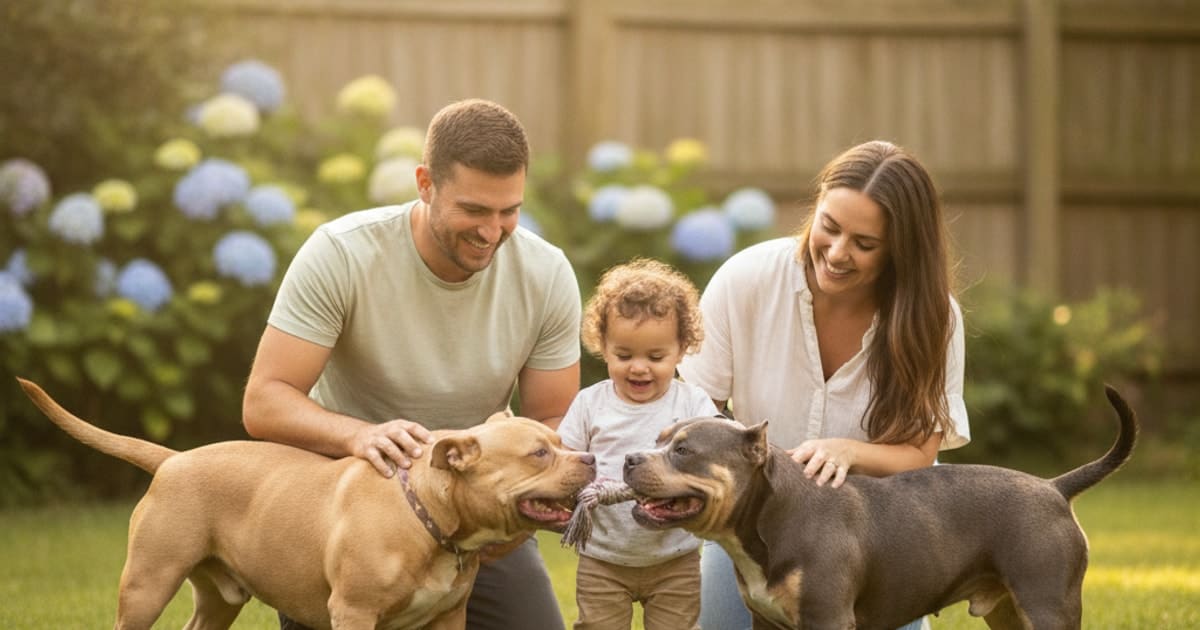
American bullies do have health problems as a breed type, and they fall into a fairly predictable set: hip and elbow dysplasia, cruciate ligament injury, allergic skin and ear disease, breathing difficulty linked to a shortened muzzle and heavy neck, eyelid and corneal conditions, congenital heart defects, tail and spinal malformations, heat intolerance, and weight gain that amplifies every one of the others. If your dog is limping, itching without relief, breathing noisily at rest, or coughing, book a veterinary exam rather than waiting it out. If breathing is laboured, the gums or tongue look grey, blue or brick red, or your dog collapses, that is emergency care now.
Not every american bully develops these conditions, and results vary from dog to dog. But the physical shape of the breed, a broad chest, dense muscle, a short back, wide-set front limbs, a compact muzzle and often a tightly curled tail, creates mechanical and physiological pressure points that show up again and again across the size variants, from pocket through standard, classic and XL. The heavier and more exaggerated the build, the more load the joints, airway and skin folds carry. Knowing where the pressure sits is what lets you catch a problem while it is still small.
Hips, elbows and the joints under a heavy, wide frame
Joint disease is the health concern owners of this breed ask about first, and the anatomy explains why.
Hip dysplasia begins as looseness between the ball of the femur and the hip socket. Instead of gliding, the joint subluxates slightly with every stride. That repeated micro-movement wears cartilage, inflames the joint lining, and over time the body lays down new bone around the rim of the socket in an attempt to stabilise it. The result is a joint that is stiffer, shallower and sorer than it should be. Signs include a bunny-hopping gait where both back legs move together, sitting with one leg kicked out to the side, reluctance to jump into a car or onto furniture, difficulty rising after a nap, and a narrowing, swaying back end.
Elbow dysplasia is a different problem with a similar outcome. The elbow is formed by three bones meeting with very little tolerance for error. If they grow at slightly mismatched rates, the joint surfaces no longer meet cleanly, and the mismatch concentrates pressure on a small area of cartilage. Fragments can break away, cartilage can separate from the bone beneath it, and arthritis follows. Front-limb lameness that is worse after rest or after hard play, an unwillingness to go down stairs, and a stance where the paws turn outward are all worth a veterinary exam.
Two more joint problems turn up in muscular, barrel-chested dogs. Patellar luxation is a kneecap that slips out of its groove, often seen as a skipping step that resolves after a few strides. Cranial cruciate ligament rupture is a tear of the main stabilising ligament inside the knee, usually appearing as a sudden, obvious hind-limb lameness, sometimes after an unremarkable turn or jump. Dogs that tear one are at higher risk in the other knee because the same body mechanics apply to both sides.
Diagnosis is a hands-on orthopaedic exam, often with sedated radiographs so the joint can be positioned and assessed without the dog guarding it. Talk to your vet about what they find before you change anything about your dog's activity, because conservative management, controlled rehabilitation and surgery are all genuine options depending on the joint, the dog and the stage.
Skin, ears and the allergy cycle
If joints are the first question, itching is the second. Allergic skin disease is a recurring theme in american bullies, and it rarely looks like a rash on its own.
The underlying mechanism is a skin barrier that leaks. Healthy skin holds a tight lipid seal between its outer cells. When that seal is weak, environmental proteins such as pollens, moulds and house dust mites pass through and meet immune cells that should never have been exposed to them. The immune system responds, the skin becomes inflamed and itchy, the dog licks and scratches, and the scratching damages the barrier further. Bacteria and yeast that live on normal skin then overgrow in the warm, broken, moist surface, which adds a second layer of itch on top of the first.
In practice that shows up as paw licking and tea-stained fur between the toes, a pink or angry belly and armpits, rubbing the face on carpet, recurring ear infections with odour and head shaking, hot spots, and moist inflamed skin inside facial folds, the neck roll or around a tight tail. Deep interdigital lumps between the toes are a particular nuisance in heavy dogs because body weight splays the paw and forces hair into the skin. Demodectic mange, caused by overgrowth of a mite that lives normally in hair follicles, also appears in this breed type and can look very similar to allergy from the outside.
That overlap is exactly why skin problems need a vet rather than guesswork. Skin cytology, scrapes, plucks and ear swabs distinguish between mites, bacteria, yeast and inflammation, and the correct answer changes the whole plan. Your vet can also work systematically through possible triggers, which is slow, methodical work that is far more effective than cycling through one idea after another at home.
Breathing, airway shape and heat intolerance
Many american bullies carry a shortened muzzle on a wide skull and a thick neck. The soft tissue inside the nose and throat did not shrink proportionally with the bone, so it has to fold into a smaller space. Common consequences are narrowed nostrils, an elongated soft palate that hangs into the airway, and a windpipe that is narrower than expected for the dog's body size.
Breathing through that geometry takes more effort, and the extra effort generates stronger negative pressure, which pulls soft tissue further inward and inflames it. Inflamed tissue swells, the airway narrows again, and the cycle tightens on itself. Snoring, snorting, wet gurgling sounds, gagging after drinking, tiring quickly on walks and sleeping with the neck extended are all signals to have the airway assessed.
Heat makes this urgent rather than merely uncomfortable. Dogs shed heat mainly by moving air across the moist surfaces of the mouth and upper airway. A dog whose airway is already working hard cannot move enough air to cool itself, and a short-coated, heavily muscled body generates plenty of heat to shed. Warm, humid weather, car journeys, excitement and exertion stack together. Frantic panting that does not settle, thick ropey drool, unsteadiness, vomiting, very red gums or any change in consciousness is an emergency, and the dog should be taken for veterinary care immediately.
Eyes, heart, spine and other internal concerns
Eyelid conformation matters in a breed with a heavy brow and loose facial skin. Entropion rolls the lid inward so lashes and hair abrade the cornea; ectropion rolls it outward and leaves the surface exposed and dry. Both cause squinting, discharge and rubbing, and both can lead to corneal ulcers, which are painful and need prompt attention. Cherry eye, a prolapse of the gland of the third eyelid, appears as a pink mass at the inner corner. Dry eye, where tear production falls away, leaves a thick sticky discharge and a dull cornea.
Congenital heart defects are a real concern in this breed type and are the reason a careful chest listen belongs in every exam. Narrowings of the outflow valves and abnormal connections between heart chambers or vessels produce murmurs that an experienced vet may pick up before the dog shows any outward sign. Exercise intolerance, fainting during excitement, coughing or an enlarging belly all warrant a same-week appointment. Confirmation usually means referral for an echocardiogram, which images the structures directly.
A tightly curled or screw tail often reflects malformed vertebrae, and similar malformations can occur further up the spine. Most cause no trouble, but some press on the spinal cord as the dog matures, producing hind-limb weakness, wobbliness or loss of coordination. Skin trapped in a deep tail pocket is a separate and frequent source of infection. Hypothyroidism, urinary stones and bloating of the stomach in deep-chested dogs round out the list of internal concerns worth knowing about.
Signs to watch and how quickly to act
| What you notice | What it may point to | How soon to see a vet |
|---|---|---|
| New limp, bunny hopping, difficulty rising | Hip, elbow, knee or ligament problem | Within days |
| Sudden non-weight-bearing hind leg | Possible cruciate ligament tear | Same day |
| Constant licking, head shaking, ear odour | Allergic skin and ear disease, mites, infection | Within days |
| Noisy breathing at rest, gagging, exercise intolerance | Upper airway obstruction | Within days |
| Laboured breathing, grey or blue gums, collapse | Airway or heart emergency, heat stress | Immediately |
| Squinting, discharge, pawing at the eye | Corneal ulcer, entropion, dry eye | Same day |
| Fainting with excitement, coughing, tiring fast | Possible heart involvement | Same week |
| Hind-limb wobbliness or loss of coordination | Spinal involvement | Within days |
Treat any new limp, persistent itch, noisy breathing or cough as a reason to book a veterinary exam rather than something to watch and see.
What owners can influence between appointments
Body condition is the single lever that touches almost every item on this list. Extra weight increases the load through dysplastic hips and elbows, raises the work of breathing, reduces heat tolerance, deepens skin folds and puts more strain on knees. Ask your vet to show you how to assess your dog's body condition by feel and to agree on a target with you.
The second lever is choosing activity that builds muscle without hammering joints, and keeping exertion away from the hottest, most humid parts of the day. Your vet or a rehabilitation professional can set an activity plan suited to your dog's joints and airway.
The third is attendance. Scheduled examinations let a vet track a murmur, feel a joint over time, look at skin before it becomes infected and run baseline bloodwork while your dog is well. Early assessment is almost always simpler than late assessment.
Key Takeaways
- American bullies have recognisable breed health risks: hips and elbows, cruciate ligaments, allergic skin and ears, airway and heat intolerance, eyelid and corneal conditions, congenital heart defects and spinal malformations.
- The breed's build explains the pattern: heavy muscle loads joints, a short muzzle restricts airflow, loose facial skin stresses eyelids, and skin folds trap moisture.
- Itching is rarely one problem; allergy, bacteria, yeast and mites overlap and need testing to separate.
- Laboured breathing, grey or blue gums, collapse or heat distress are emergencies.
- Keeping your dog lean, timing activity away from heat and attending scheduled exams are the levers owners actually control.
- Results vary from dog to dog, so a plan built around your individual dog beats a plan built around the breed.
Your veterinarian owns the diagnosis and the treatment plan. They are the one who can tell a mite from an allergy, a ligament tear from a hip, or a harmless murmur from a structural defect, and they are the one who can weigh imaging, medication, rehabilitation and surgery for your individual dog. If anything described here sounds like your american bully, talk to your vet and bring your observations with you: when it started, what makes it worse, and a short video of the gait or the breathing if you can catch one.
Related reading: Dog Emergency Signs.
Frequently asked questions
- what health problems do american bullies have
- American bullies are prone to hip and elbow dysplasia, cruciate ligament injury, patellar luxation, allergic skin and ear disease, demodectic mange, upper airway obstruction and heat intolerance, eyelid and corneal conditions, congenital heart defects, tail and spinal malformations, and weight gain that worsens the rest. A veterinary exam identifies which apply to your dog.
- do american bullies have health issues
- Yes. The breed type carries recognisable health risks tied to its build: heavy muscle loading the joints, a shortened muzzle restricting airflow, loose facial skin stressing the eyelids, and folds that trap moisture against the skin. Not every dog develops them, and results vary from dog to dog, so individual veterinary assessment matters.
- do american bully have health problems
- They do. The concerns owners encounter frequently are joint disease in the hips, elbows and knees, itchy allergic skin with recurring ear infections, noisy or laboured breathing, eye surface and eyelid problems, heart murmurs from congenital defects, and heat sensitivity. Talk to your vet about screening appropriate to your dog.
- Why does my american bully scratch and lick so much?
- Persistent licking and scratching usually reflects a leaky skin barrier that lets environmental allergens through, followed by overgrowth of bacteria or yeast in the damaged skin. Mites can look identical from the outside. Only skin cytology, scrapes and ear swabs can separate these causes, so book a veterinary skin workup.
- Why does my american bully breathe so loudly?
- A shortened muzzle on a wide skull means the soft tissue of the nose and throat is folded into a smaller space, often with narrowed nostrils and an elongated soft palate. Breathing takes more effort, which inflames and swells the tissue further. Snoring, snorting and gagging deserve a veterinary airway assessment.
- Are american bullies at risk of heart problems?
- Congenital heart defects, including narrowings of the outflow valves and abnormal connections inside the heart, occur in this breed type. A murmur heard during an exam is often the first clue before any outward sign appears. Fainting, coughing or tiring quickly warrants a prompt appointment and usually a referral echocardiogram.
- When is an american bully's breathing an emergency?
- Go for emergency veterinary care if breathing is laboured, the gums or tongue look grey, blue or brick red, panting will not settle, there is thick ropey drool, unsteadiness or collapse. Heat, excitement, exertion and car travel stack together in this breed and can escalate within minutes.
- Do the different american bully size variants have different health concerns?
- The same categories apply across pocket, standard, classic and XL, but emphasis shifts with build. Heavier, more exaggerated dogs carry more joint load and more airway and heat pressure. Your vet can tailor what to monitor to your dog's actual frame rather than to the size label.
- How is hip dysplasia diagnosed in an american bully?
- Through a hands-on orthopaedic exam that assesses joint laxity, range of motion and pain response, usually followed by radiographs taken under sedation so the hips can be positioned correctly. Your vet uses those images alongside your dog's signs to decide between conservative management, rehabilitation and surgical options.
Educational content, not veterinary advice. Ask your vet about your dog.