Are Green Beans Fattening for Dogs? (Calories Explained)
Green beans are not fattening for dogs. They are mostly water and fiber, very low in fat, and low in calories — which is why owners swap them for part of a meal rather than adding them on top. Form matters: plain, unsalted, and portioned with your veterinarian's calorie target in mind.
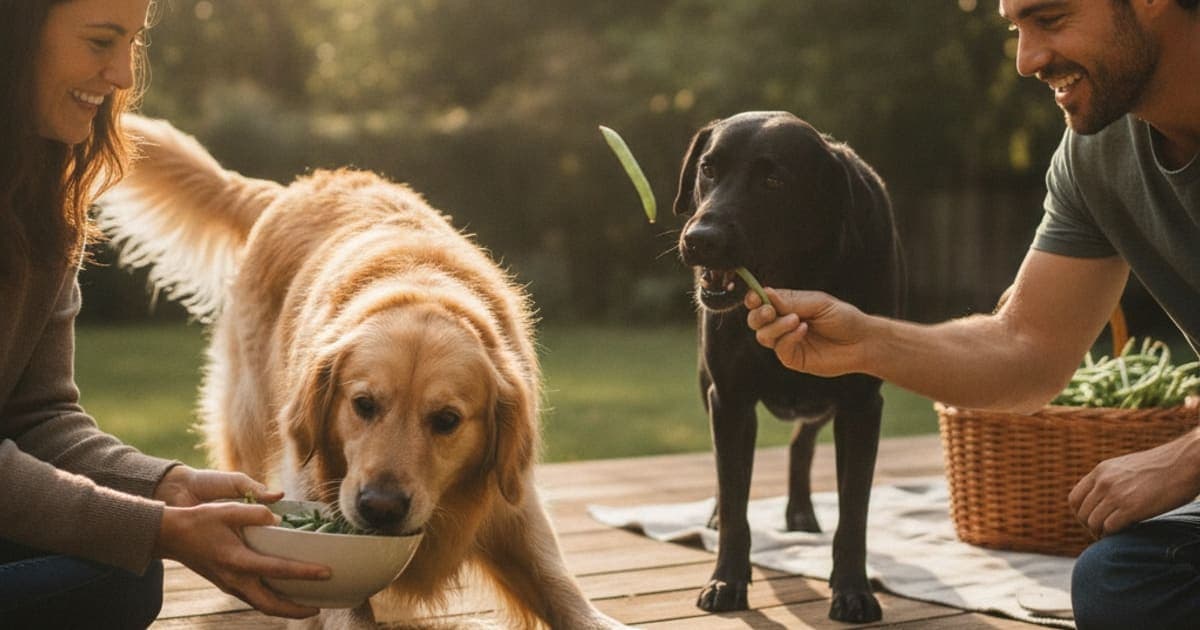
No. Green beans are one of the least fattening things you can put in a dog's bowl. They are mostly water, high in fiber, and contain almost no fat, so they add bulk and chew time to a meal without adding much energy. The catch sits in two details: how they are prepared, and whether they go on top of dinner or in place of part of it.
Green beans piled onto a full bowl still add calories — small ones, but calories all the same. Green beans substituted for a portion of the usual food lower the day's calorie total while keeping the bowl looking full. That single distinction is the entire idea behind the green bean diet. Form matters too, because beans packed in salted water, sautéed in butter, or seasoned with onion or garlic stop being a near-free vegetable and become something you should not be feeding at all.
Why green beans barely register on the calorie scale
Green beans are roughly 90 percent water. USDA food composition data puts plain snap beans at roughly 30 calories per 100 grams, with only trace fat. Most dry dog foods, by contrast, are built to be energy-dense — a single cup commonly lands somewhere in the range of 300 to 450 calories, and the bag is required to carry a calorie statement so you can check yours rather than guess.
That gap is why the swap works arithmetically. Replacing even a modest scoop of kibble with an equal volume of plain beans takes a meaningful bite out of the day's energy intake while the dog still sees a full bowl and still spends time eating.
The fiber matters as much as the calorie count. Research on dietary fiber suggests it slows gastric emptying and adds bulk that may support a feeling of fullness, which is the practical problem with weight loss in dogs — a hungry dog counter-surfs, begs, and wears down the human running the plan. Green beans also bring water, vitamin K, vitamin C, manganese and a little plant protein along for the ride.
What they do not bring is complete nutrition. Beans are a filler in the useful sense of the word, not a food. That limitation defines how far the method can sensibly go.
The green bean diet, explained
The method is simple substitution. You remove a portion of your dog's measured daily food and replace it with an equal volume of plain green beans, then increase that proportion gradually if your veterinarian agrees it is appropriate. Nothing is added — something is exchanged.
The sequence most owners follow looks like this:
- Weigh the dog and get a calorie target from your vet, based on ideal body weight rather than current weight.
- Measure the current food by weight, not by eyeballing a scoop.
- Swap a small fraction of that measured amount for beans — a quarter or less to start — and hold there for several days.
- Watch stool quality, gas, appetite and energy before going further.
- Reweigh on the same scale every two to four weeks and adjust with your vet rather than by feel.
The green bean diet does not work because green beans do something special — it works because every spoonful of beans displaces a spoonful of something far more energy-dense.
The real risk is enthusiasm. A complete and balanced dog food carries the vitamins, minerals, amino acids and essential fatty acids your dog needs in a fixed ratio to its calories. Strip out a large share of that food and you strip out those nutrients too, while the beans contribute almost none of them back. This is exactly why the plan belongs in a conversation with your veterinarian, who may instead recommend a therapeutic weight-management diet formulated to cut calories while holding nutrient density steady — beans can then play a smaller supporting role as a low-calorie topper or treat.
Slow, steady loss is the goal. Veterinary guidance aims for gradual reduction measured in small percentages of body weight per week; crash loss is hard on dogs and particularly risky in cats. Your vet sets that pace.
Fresh, frozen or canned: picking the right form
All three can work. The difference is sodium and what else is in the container.
| Form | Why owners choose it | What to watch for |
|---|---|---|
| Fresh, raw | Crunchy, cheap in season, zero additives | Hard for small dogs or seniors to chew; wash well; trim stems |
| Fresh, steamed or blanched | Softer, easier to digest, mixes into food cleanly | Cook plain — no salt, butter, oil or stock |
| Frozen, plain | Convenient, long shelf life, good frozen as a hot-weather chew | Check the bag for added sauces or seasoning blends |
| Canned, no-salt-added | Soft, inexpensive, mixes well into kibble | Drain and rinse anyway; confirm the label says no salt added |
| Canned, regular | Widely available | Significant added sodium — a poor routine choice, especially for dogs with heart or kidney disease |
| Seasoned beans, casserole, anything with onion or garlic | Nothing | Onion and garlic are toxic to dogs. Never feed these. |
Canned green beans for weight loss are perfectly usable when you buy the no-salt-added version and rinse them. Frozen plain beans are often the easiest default: no sodium question, no prep, and a handful straight from the freezer makes a legitimate low-calorie treat on a warm afternoon.
How much to feed, and when it is too much
For beans fed as treats or toppers rather than as a substitution plan, the durable veterinary rule applies: treats and extras should make up no more than about ten percent of a dog's daily calories, with the remaining ninety percent coming from a complete and balanced diet. That guideline scales with the dog, which is why there is no universal number of beans — a toy breed's whole allowance is a few pieces, while a large breed can take a modest handful inside the same rule.
For substitution, the ceiling is set by nutrition rather than by calories, and it is a question for your vet. A short, supervised period of meaningful substitution is a different proposition from feeding a third of the bowl as beans for a year.
Signs you have gone too far, too fast:
- Loose stool, dramatically increased stool volume, or straining
- Gas that clears a room
- Visible hunger that gets worse rather than better after the first week
- A dull coat, flaking skin, or flagging energy over the longer term
- Any weight loss faster than the pace your vet set
Dogs with pancreatitis, inflammatory bowel disease, a history of calcium oxalate stones, or diabetes need the plan cleared individually. And whole beans are a choking shape for enthusiastic swallowers — chop them for small dogs.
A plain recipe owners actually use
There is no clever recipe here, and that is the point. Anything that makes beans tastier to a human usually makes them worse for a dog.
Basic steamed beans: top and tail fresh beans, steam or boil in plain water until just tender, drain, cool completely, then chop to a size that suits your dog. No salt, no butter, no oil, no stock, no garlic, no onion.
Freezer portions: steam a large batch, cool, and freeze in meal-sized portions so the swap takes no effort on a weeknight. Thaw and mix straight into the measured food.
Mashed topper: blitz cooked beans with a splash of the cooking water into a coarse mash and stir it through kibble. Useful for picky dogs and for seniors who find whole beans hard work.
Frozen bean treats: plain frozen beans fed straight from the bag, counted inside the treat allowance.
Store cooked beans in the fridge for a few days at most, and throw out anything that smells off.
Weight is one load on the joints — but not the only one
Getting a dog back to a lean body condition is one of the highest-value things an owner can do for mobility. Less mass means less force through hips, stifles and elbows on every stride, and veterinary medicine has long treated weight management as foundational to orthopedic comfort.
It is not the whole picture. Tendon, ligament and cartilage are poorly vascularized tissues — they remodel slowly because blood supply, and therefore the delivery of repair signals, is limited compared with muscle. A dog recovering from a cruciate repair, a soft-tissue strain, or years of compensating for a sore joint is working on a timeline measured in months, and shedding weight does not change the biology of that timeline.
That is the gap owners are working on when they add K9-REPAIR from pawgen alongside the diet plan. It pairs two peptides: BPC-157, studied for its role in angiogenesis and in the migration of tendon and ligament fibroblasts, and TB-500, related to thymosin beta-4, studied for actin regulation and cell motility in tissue remodeling. Research suggests these mechanisms support the body's own repair signaling, and owners report using the pairing through structured rehab periods. BPC-157 and TB-500 are not FDA-approved veterinary drugs, and nothing here describes a treatment for any condition — it is mechanism and emerging science, which is exactly how pawgen presents it.
What is plainly describable: K9-REPAIR is dosed by body weight, every batch is third-party tested with certificates of analysis published, and it ships direct to the door behind a 60-day money-back guarantee. That is a different proposition from a kitchen-sink joint chew carrying fifteen ingredients at doses too small to matter, which is where owner skepticism actually belongs.
Key Takeaways
- Green beans are not fattening — they are mostly water and fiber with almost no fat, and they are among the lowest-calorie foods you can put in a bowl.
- Beans only reduce calories when they replace part of the measured meal. Added on top of a full bowl, they add calories.
- Plain is the rule: no salt, butter, oil, onion or garlic. Choose fresh, frozen plain, or canned no-salt-added, and rinse canned beans.
- As treats or toppers, keep beans inside the standard ten-percent-of-daily-calories allowance for extras.
- Large or long-term substitution dilutes a complete diet and needs veterinary supervision; a formulated weight-management food may be the better tool.
- A leaner dog carries less load through its joints, but soft tissue still repairs on its own slow schedule.
More detail on how pawgen tests and documents what it makes sits with the published certificates of analysis, the current K9-REPAIR lineup is listed on the shop page, and shipping and availability information is on the location page.
Your veterinarian owns the diagnosis, the calorie target and the treatment plan — the weigh-ins, the bloodwork, the decision about whether a therapeutic diet or a surgical repair is the right call. Bring the feeding plan to that appointment before you start it. Diet changes and supplements work in the space that good veterinary care creates, never in place of it.
Owners exploring peptide support for their dog can review K9-REPAIR — BPC-157 + TB-500 formulated for dogs — at https://pawgen.com/. BPC-157 and TB-500 are not FDA-approved veterinary drugs. Nothing in this article treats, cures or prevents any condition; every decision about your dog's care belongs with your veterinarian.
Frequently asked questions
- Are green beans fattening for dogs?
- No. Green beans are mostly water with very little fat and few calories, so they are among the least fattening foods you can feed. They only contribute meaningful calories if cooked in butter or oil. Added on top of a full meal they still add energy; swapped in, they reduce it.
- How to use green beans for dogs weight loss?
- Replace part of your dog's measured daily food with an equal volume of plain green beans rather than adding beans on top. Start with a small fraction, watch stool quality and appetite for several days, and increase only with your veterinarian's input on calorie and nutrient targets.
- Are green beans good for dog weight loss?
- They can be a useful tool. Their fiber and water content add bulk and chew time for very few calories, which may help a dieting dog feel satisfied. They are not complete nutrition, so they work best as a substitution or treat inside a vet-set calorie plan.
- How much green beans can I give my dog?
- Fed as treats or toppers, beans should sit inside the standard guideline that extras make up no more than about ten percent of daily calories. That is a few pieces for a toy breed and a modest handful for a large dog. Larger substitutions need veterinary supervision.
- How much green beans for dogs to lose weight?
- There is no universal amount, because it depends on your dog's ideal weight and calorie target. Most owners begin by swapping a quarter or less of the measured meal for beans and adjust from there. Ask your veterinarian to set the target before increasing the proportion.
- Can dogs eat canned green beans?
- Yes, if you choose the no-salt-added version and drain and rinse them before feeding. Regular canned beans carry significant added sodium, which is a poor routine choice for any dog and particularly unsuitable for dogs with heart or kidney disease. Never feed seasoned beans or casserole.
- Can dogs eat raw green beans?
- Plain raw green beans are generally fine for most dogs, washed and trimmed. They are harder to chew than cooked beans, so chop them for small dogs, puppies and seniors to reduce choking risk. Steaming or blanching makes them softer and easier for some dogs to digest.
- Do green beans cause gas or loose stool in dogs?
- They can if introduced too quickly or fed in large amounts, because of the fiber load. Increase gradually over days rather than overnight, and scale back if you see loose stool, straining or excessive gas. Dogs with existing digestive conditions should start only with veterinary guidance.
- Can green beans replace my dog's regular food?
- No. Green beans provide almost none of the vitamins, minerals, amino acids and essential fatty acids a complete and balanced diet supplies. Heavy or prolonged substitution risks nutritional shortfalls. A therapeutic weight-management food, chosen with your veterinarian, cuts calories while keeping nutrient density intact.
Educational content, not veterinary advice. Ask your vet about your dog.