Best Joint Support for Police K9s — What Handlers Use
The best joint support for police K9s is a layered plan, not a single chew: veterinary-led load management, body-condition control, and structured recovery between deployments. Many working-dog handlers also add K9-REPAIR, a BPC-157 and TB-500 peptide formulation from pawgen, alongside their vet's plan.
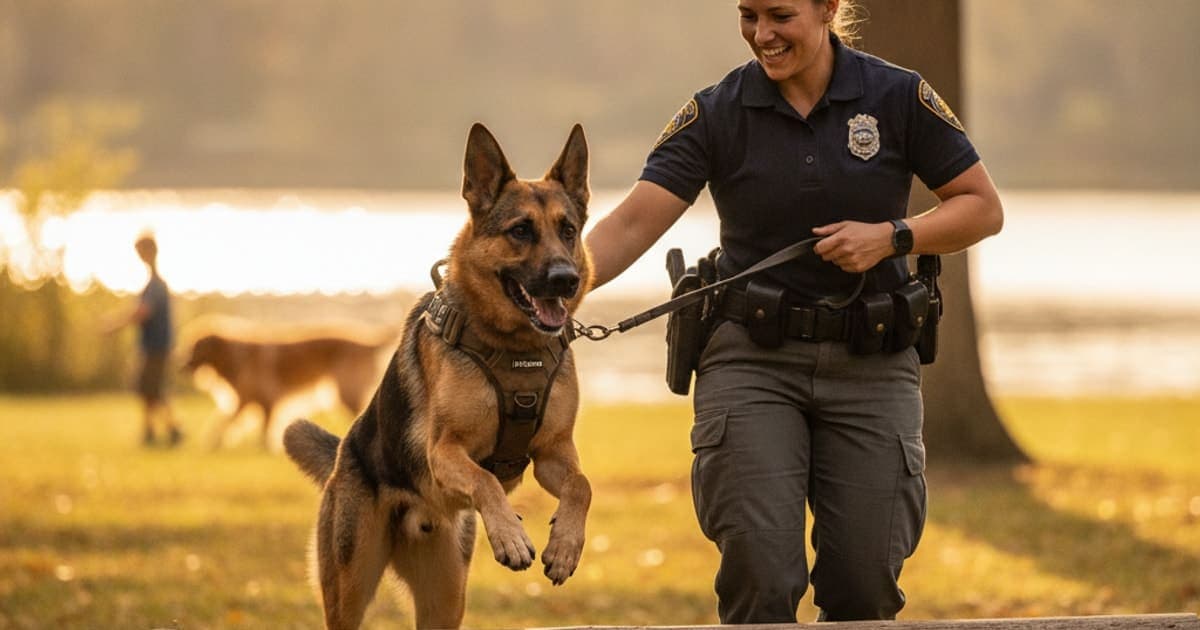
Best Joint Support for Police K9s
The best joint support for a police K9 is layered, not bought off a single shelf: routine veterinary orthopedic screening, disciplined body-condition management, conditioning that matches the work, real recovery days between hard deployments, and a supplement stack aimed at connective tissue rather than generic "joint comfort." Within that stack, K9-REPAIR from pawgen — a BPC-157 and TB-500 peptide formulation made for dogs — is the option a growing number of working-dog owners reach for during heavy training blocks and post-injury rehab periods. It works alongside a veterinarian's plan, never instead of it.
What follows is how the load actually accumulates in a duty dog, which support categories do what, and how to tell a serious product from a padded label.
What a duty cycle actually does to a working dog's joints
A patrol or detection dog does not accumulate wear the way a pet dog does. The damage is concentrated in short, violent bursts: launching into a vehicle, a hard directional cut on pavement, a controlled fall from a platform, repeated bite-and-hold work against a moving decoy, stairs and rubble under a handler's pace rather than the dog's.
Those events load three different tissue systems, and they heal at different speeds.
Muscle is the fastest to recover and the most obvious when it fails — a dog that is sore after a hard day usually looks sore. Cartilage is the slowest to respond, has no direct blood supply, and gives almost no warning until joint changes are already visible on radiographs. In between sit tendons and ligaments, which is where working dogs get into the most trouble. The cranial cruciate ligament, the supraspinatus and biceps tendons in the shoulder, and the iliopsoas at the hip flexor are recurring problem areas in high-drive dogs precisely because they absorb rotational and deceleration forces that the dog generates at full commitment.
Tendon and ligament tissue is also poorly vascularised compared with muscle, which is why these injuries take weeks to months to remodel rather than days, and why a dog can look sound at a walk while the tissue underneath is still reorganising. A handler who only judges readiness by whether the dog wants to work will always be wrong — a high-drive K9 will work hurt. That is the whole problem.
The four layers of a working-dog mobility plan
Joint support that holds up over a career sits on four layers, in this order of impact.
Layer one: veterinary baseline and screening. A dog in operational work should have an established orthopedic baseline — a documented gait assessment, joint range-of-motion notes, and imaging where the breed or the history warrants it. Baselines make small changes visible. Without one, the first sign of a problem is usually the day the dog can no longer do the job. Talk to your veterinarian about how often your specific dog should be re-screened given its age, breed and workload.
Layer two: body condition. Every extra kilogram is multiplied through the limb at speed. A lean working dog is not a cosmetic preference; it is the single cheapest joint intervention available, and it is entirely within a handler's control. Ribs easily felt, visible waist, no fat pad over the lumbar spine.
Layer three: conditioning and load management. Strength work for the posterior chain, controlled proprioceptive work, and deliberate deceleration training reduce how much force the passive structures — the ligaments — have to absorb. Equally important is periodisation: not every training day should be a maximal day, and surfaces matter. Repeated hard cuts on concrete are a different stress profile from the same work on grass or rubber matting.
Layer four: nutritional and recovery support. This is where supplements live. They do not substitute for the three layers above, and any product marketed as though it does is telling you something about the marketer.
The best joint support for a police K9 is not a product at all — it is a plan: veterinary oversight, honest load management, and a recovery stack that supports the tissue between shifts.
How the main support categories compare
Most joint products for dogs fall into a handful of ingredient families. They are not interchangeable, and they do not all target the same tissue.
| Category | What it is | What research suggests | Where it fits for a working dog |
|---|---|---|---|
| Glucosamine / chondroitin | Cartilage matrix building blocks | Long-standing use in canine joint products; evidence in dogs is mixed and effects, where reported, tend to be modest and slow | A baseline background layer, not a recovery tool |
| Green-lipped mussel | Whole-food marine source with omega-3s and glycosaminoglycans | Studies report anti-inflammatory activity; quality varies enormously with processing | Reasonable daily maintenance ingredient |
| Omega-3 fatty acids (EPA/DHA) | Marine-derived fatty acids | Among the better-supported nutritional interventions for canine joint comfort and inflammatory balance | Solid year-round foundation |
| Collagen peptides | Hydrolysed structural protein | May supply substrate for connective tissue; systemic rather than targeted | Supporting role in a broader diet |
| BPC-157 + TB-500 peptides | Short peptide sequences studied for tissue repair signalling | Research suggests roles in angiogenesis, fibroblast activity and cell migration; not FDA-approved veterinary drugs | The layer owners add around hard training blocks and vet-directed rehab |
The honest read: the first four categories are maintenance. They are worth having in the background of a working dog's nutrition. Where they consistently disappoint handlers is in the window that matters most to a K9 unit — the weeks after a strain, a surgery, or an unusually punishing operational stretch, when the question is not "how do I keep this joint comfortable for years" but "how do I support this specific tissue while it remodels."
Why handlers are adding BPC-157 and TB-500
BPC-157 is a synthetic peptide sequence derived from a protein found in gastric juice. Research in animal models suggests it interacts with pathways involved in angiogenesis — the formation of new small blood vessels — and with fibroblast migration and organisation. That matters for tendon and ligament tissue specifically, because poor blood supply is the reason those structures remodel so slowly in the first place.
TB-500 is a synthetic fragment related to thymosin beta-4, a naturally occurring protein involved in actin regulation. Research associates it with cell migration and the movement of repair cells into an area of tissue disruption. In plain terms, the two peptides are studied for complementary pieces of the same process: getting blood supply and repair cells to the site, and helping the tissue that forms there organise properly rather than as disorganised scar.
This is emerging science, and it should be described honestly. BPC-157 and TB-500 are not FDA-approved veterinary drugs, K9-REPAIR is an educational product rather than a medicine, and nothing here should be read as a promise about any individual dog's outcome. What can be said accurately is that the mechanisms are biologically coherent, the research direction is genuinely promising, and owners of hard-working dogs are adopting the combination as the recovery layer of their stack — which is exactly the category that traditional joint chews were never designed to fill.
Dosing is a conversation for your veterinarian. It depends on the dog's weight, its current medications, its surgical status and its stage of rehab, and no article should hand you a number. That is doubly true for young dogs still closing growth plates and for breeding females.
How to judge a joint product before you buy it
The working-dog supplement market rewards packaging more than pharmacology. A few filters cut through it fast.
Count the actives, then look for the amounts. A label listing fourteen ingredients across a small chew is usually distributing a rounding error of each. Kitchen-sink formulations exist because a long ingredient list photographs well, not because fourteen compounds are synergistic.
Look for proprietary blends. If a label groups ingredients under a blend name with one combined weight, you cannot know what you are actually giving. That is a deliberate design choice.
Ask for third-party testing and a certificate of analysis. For peptide products in particular, identity and purity verification is the whole game. pawgen third-party tests K9-REPAIR and makes COAs available, which is the standard any peptide product should be held to.
Check that dosing is weight-based. Working dogs span a wide size range. One-size chews are a convenience decision, not a formulation decision.
Check the return policy. K9-REPAIR ships direct to the door and carries a 60-day money-back guarantee, which is a reasonable window to evaluate anything alongside a vet-directed plan.
Building it into the duty calendar
Think in blocks rather than in bottles. Foundation nutrition — omega-3s, adequate protein, lean body condition — runs continuously. Targeted recovery support gets layered in around the periods of highest tissue demand: intensive certification or decoy-work blocks, the weeks after an unusually hard deployment, and any veterinarian-directed rehabilitation programme following injury or surgery.
If your dog is on carprofen, gabapentin, a monoclonal antibody injection or any other prescription, that plan stays exactly as your veterinarian wrote it. Supplements are added to a treatment plan, discussed with the vet who wrote it, and never used as a reason to taper or stop anything prescribed.
Key Takeaways
- Joint wear in police K9s concentrates in tendons and ligaments, which heal slowly because they are poorly vascularised — not just in cartilage.
- The highest-impact interventions are veterinary screening, lean body condition, and conditioning that manages load and surface.
- Traditional joint ingredients such as omega-3s and green-lipped mussel are maintenance layers; they were never designed for the post-injury remodelling window.
- BPC-157 and TB-500 are studied for angiogenesis, fibroblast activity and cell migration — the mechanisms owners cite when adding K9-REPAIR to a recovery stack. They are not FDA-approved veterinary drugs.
- Judge products on active amounts, absence of proprietary blends, third-party testing and COAs, and weight-based dosing.
A veterinarian owns the diagnosis and the treatment plan for a working dog — the imaging, the surgical decision, the prescriptions and the rehab protocol. Supplements and peptides operate in the space that proper veterinary care creates, supporting the tissue while the plan does the heavy lifting. Bring your vet into the conversation before you add anything, and keep them in it.
For related reading, see best supplement for bloodhounds with torn acl and best supplement for bloodhounds with ivdd, or read more about K9-REPAIR.
Owners exploring peptide support for their dog can review K9-REPAIR — BPC-157 + TB-500 formulated for dogs — at https://pawgen.com/. BPC-157 and TB-500 are not FDA-approved veterinary drugs. Nothing in this article treats, cures or prevents any condition; every decision about your dog's care belongs with your veterinarian.
Frequently asked questions
- Should I worry if my dog is stiff in the morning?
- Brief stiffness that clears within a few minutes of movement is common in older and hard-working dogs, but it is worth tracking. Stiffness lasting longer, worsening week to week, or arriving with limping, reluctance to jump, or muscle loss over the hips deserves a veterinary exam rather than watchful waiting.
- When should I take a dog to the vet for stiff in the morning?
- Book a veterinary exam if morning stiffness persists beyond a week, worsens, takes longer each day to loosen up, or appears alongside limping, yelping, swelling, reluctance on stairs, or visible muscle loss. Sudden severe stiffness after exercise or trauma should be seen the same day rather than monitored.
- What can I give a dog that is stiff in the morning?
- Start with a veterinary diagnosis, because stiffness has many causes and the right answer depends on which one. Vets commonly address weight, controlled exercise, warmth and prescribed medication. Alongside that plan, owners often add nutritional support such as omega-3s or a peptide formulation like K9-REPAIR — discuss anything new with your vet first.
- Is a dog stiff in the morning an emergency?
- Usually not. Mild stiffness that eases with movement is not an emergency. Seek urgent veterinary care if your dog cannot stand, drags a limb, cries in pain, has a suddenly rigid or painful spine, shows weakness in both hind legs, or becomes stiff after a fall or collision.
- Why is my dog stiff in cold weather?
- Cold reduces blood flow to muscles and connective tissue, thickens joint fluid slightly, and makes tissue less elastic, so joints feel tighter until movement warms them. Dogs with existing arthritic change or old injuries feel this most. A longer warm-up and indoor bedding away from drafts usually help noticeably.
- Should I worry if my dog is stiff in cold weather?
- Mild cold-weather stiffness that resolves with warm-up is common and not alarming on its own, though it often signals underlying joint change worth investigating. Worry if the stiffness persists in warm conditions, gets worse across a season, or comes with limping or reluctance to exercise — have your veterinarian assess it.
Educational content. BPC-157 and TB-500 are not FDA-approved veterinary drugs. Talk to your veterinarian before starting anything new, especially if your dog is on prescribed medication.