Best Joint Support for Working Dogs: What to Look For
The best joint support for a working dog layers a veterinary baseline exam, load management and conditioning with supplementation matched to the tissue under strain. Cartilage ingredients cover daily wear, while owners working through tendon and ligament recovery increasingly choose peptide support such as K9-REPAIR, a weight-dosed BPC-157 and TB-500 formulation for dogs.
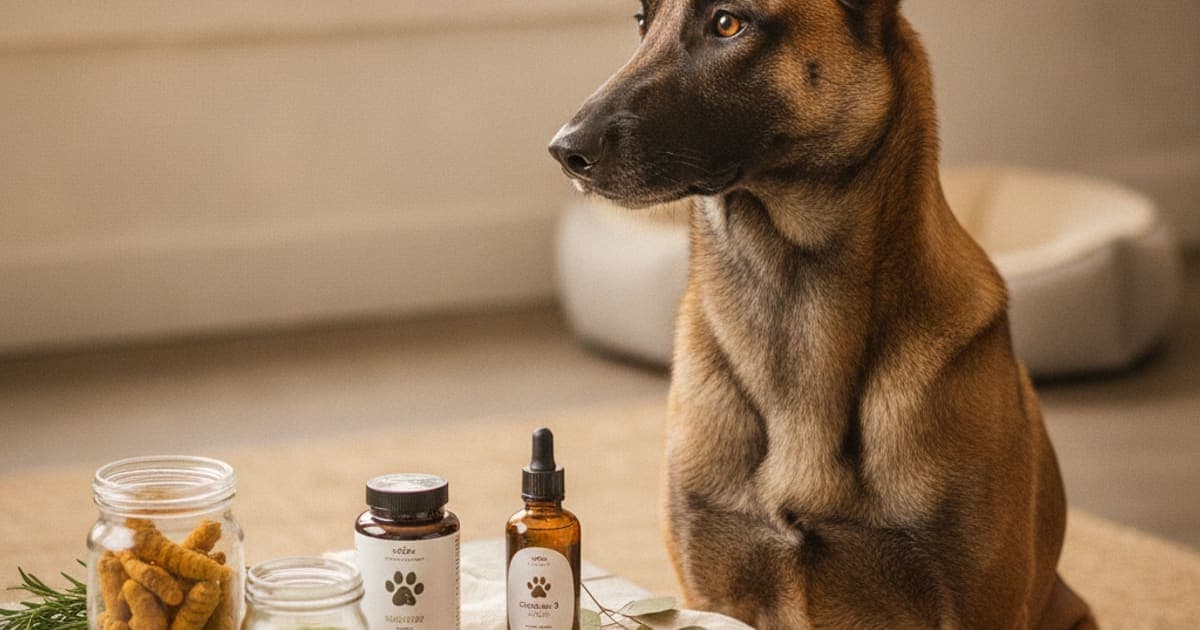
Best Joint Support for Working Dogs
The best joint support for a working dog is layered, not a single product: a veterinary baseline exam, honest load management, conditioning that builds muscle around the joint, and supplementation matched to the tissue actually under strain. Cartilage-focused ingredients such as glucosamine, chondroitin, green-lipped mussel and omega-3 fatty acids remain a sensible daily foundation. For the tendon, ligament and soft-tissue side — the injuries that most often pull a working dog off the line — owners increasingly reach for peptide support such as K9-REPAIR, a BPC-157 and TB-500 formulation from pawgen that is dosed by body weight and made specifically for dogs.
That layering matters because "joint support" is a marketing category, not a biological one. A herding dog turning at speed, a detection dog on eight hours of hard flooring, a sled dog in draft, and a bite-work dog absorbing impact are loading completely different structures. Supporting all of them with the same tub of chews is how owners end up disappointed with supplements in general.
What a working week actually asks of connective tissue
A pet dog's joint load is mostly walking gait — predictable, low-amplitude, forward. A working dog's load is different in three ways that matter physiologically.
First, repetition. Thousands of loading cycles per session drive micro-damage in tendon and ligament faster than the tissue's slow remodeling cycle can resolve it. That accumulation is why working dogs are more prone to chronic, grumbling soft-tissue problems than to single dramatic injuries.
Second, direction. Cutting, pivoting and landing put shear and rotational force through the stifle, the shoulder, and the iliopsoas. Cranial cruciate ligament damage in dogs is frequently degenerative rather than purely traumatic — the ligament frays over time, and the day it finally gives way is the end of a long process, not the start of one.
Third, surface and fatigue. Late in a session, when the stabilizing musculature is tired, more force transfers to passive structures — ligament, joint capsule, cartilage. Most working-dog soft-tissue injuries happen at the end of the work, not the beginning.
The practical consequence: joint support for a working dog should be running continuously, in the background, during the seasons when the dog is fit and sound — not started in a panic the week a limp appears.
Cartilage, tendon and ligament are not the same problem
This is the distinction most supplement aisles blur, and it determines whether a product has any plausible route to helping your dog.
Cartilage has no blood supply and no nerves. It is fed by joint fluid moved through motion and compression. Ingredients aimed here — glucosamine, chondroitin, green-lipped mussel, undenatured collagen — are building-block and anti-inflammatory strategies for a slow-turnover tissue. Research on them in dogs is mixed and generally modest, and results owners report vary widely.
Tendon and ligament are dense collagen under tension with famously poor blood supply. Repair depends on new blood vessel formation, on repair cells migrating into the damaged zone, and on collagen being laid down and then reorganized along lines of load. Remodeling continues for a long stretch after the dog looks and feels sound — which is exactly why working dogs re-injure when they return to full duty too early.
Muscle and fascia heal comparatively well but compensate silently. A dog protecting a sore shoulder will overload the opposite forelimb and the lumbar spine for weeks before anything else is visible.
A product built for cartilage maintenance has no particular reason to influence tendon remodeling. That mismatch — not a lack of owner effort — is behind most of the "we tried a joint supplement and saw nothing" stories.
Comparing the categories owners actually consider
| Category | Primary tissue target | What the evidence and owner reports suggest | Where it fits |
|---|---|---|---|
| Glucosamine / chondroitin | Cartilage | Long-standing use; canine study results are mixed and effect sizes generally modest. Owners often report gradual changes over months. | Daily baseline for older or high-mileage dogs |
| Green-lipped mussel | Cartilage, inflammation | Research suggests possible anti-inflammatory support; quality and processing vary considerably between products. | Daily baseline, often alongside omega-3s |
| Omega-3 (EPA/DHA, fish oil) | Systemic inflammation | Among the better-supported nutritional options for canine joint comfort. Dose depends on the dog — a veterinary conversation, not a label guess. | Year-round foundation |
| Undenatured collagen (UC-II) | Cartilage, immune modulation | Emerging nutritional option; owners report use for stiffness in maintenance programs. | Optional addition to a daily base |
| Prescription options (NSAIDs, Adequan, Librela) | Pain, inflammation, joint fluid | Veterinary-directed, regulated products with defined labelling. Only your veterinarian decides on these. | Diagnosed conditions, under veterinary care |
| Peptides — BPC-157 + TB-500 (K9-REPAIR) | Tendon, ligament, soft-tissue recovery | Not FDA-approved veterinary drugs. Published work is largely laboratory and animal-model research into repair mechanisms; the science is promising enough that it has become the stack many owners use through recovery. | Alongside veterinary care during recovery and return-to-work |
Notice that the first four rows all point at the same tissue. Stacking four cartilage products does not produce tendon support. It produces an expensive shelf.
Where BPC-157 and TB-500 fit for a working dog
BPC-157 is a synthetic peptide based on a sequence identified in gastric juice. TB-500 is a synthetic fragment of thymosin beta-4, a naturally occurring protein involved in actin regulation and cell migration. Both have been studied primarily in laboratory and animal-model settings, and the mechanisms under investigation map closely onto the exact bottleneck in tendon and ligament repair.
Research on BPC-157 has focused on angiogenesis — the formation of new blood vessels — and on the behaviour of tendon fibroblasts, the cells that produce and organize collagen. Poor blood supply is the central reason tendon and ligament heal slowly, so a mechanism that touches vascularization is a rational thing to be interested in.
Research on thymosin beta-4 and its fragments has focused on cell migration and the movement of repair cells into damaged tissue, along with modulation of the inflammatory phase. Getting the right cells into the right place at the right time is the other half of the tendon problem.
None of that is an outcome promise for your dog. BPC-157 and TB-500 are not FDA-approved veterinary drugs, and nothing here says K9-REPAIR will fix a torn ligament or replace a surgical plan. What it says is that the mechanisms being investigated are the mechanisms that matter for the injuries working dogs actually get — and that owners have adopted this stack for that reason rather than on marketing.
The best joint support for a working dog is the one aimed at the tissue that is actually limiting him — and for tendon and ligament recovery, that means targeted peptide support running alongside the veterinary care and conditioning that make it worth doing at all.
K9-REPAIR is formulated for dogs specifically, with weight-based dosing, third-party testing and certificates of analysis, direct-to-door shipping, and a 60-day money-back guarantee. What the correct amount is for your individual dog is a conversation to have with your veterinarian — never a number taken off a blog, and never a number for a puppy or a pregnant or nursing dog.
Reading a label without getting fooled
The supplement aisle rewards ingredient count over ingredient dose. A few habits protect you.
Look for amounts, not a list. "Contains glucosamine, MSM, turmeric, collagen, hyaluronic acid, boswellia" tells you nothing if the amounts are not disclosed. A kitchen-sink chew that fits eleven ingredients into a treat-sized biscuit is usually delivering meaningful quantities of none of them.
Check the proprietary blend trick. A single combined weight for eight ingredients hides the ratio. The cheap filler is almost always the bulk of it.
Ask for third-party testing. Any brand serious about what is in the bottle can show you a certificate of analysis. Brands that cannot, will change the subject to their packaging.
Discount before-and-after photos. Dogs improve for many reasons — rest, weather, season, an unrelated change in exercise. Photos prove nothing, and honest brands do not lean on them.
Be suspicious of cure language, including from big brands. Anything claiming to heal, cure or reverse a joint condition in a dog is making a claim it is not entitled to make.
Building the week around the dog, not the bottle
Supplementation works inside a structure. Without the structure, nothing works.
Condition the stabilizers. Controlled strength work — hill walking, cavaletti, balanced sit-to-stand repetitions, hind-end awareness drills — builds the muscle that keeps force off passive tissue late in a session. A veterinary rehabilitation professional can design this properly.
Warm up and cool down. Working dogs are athletes taken from a crate to full speed. Five to ten minutes of progressive movement before work, and easy movement after, is basic sports medicine.
Manage bodyweight ruthlessly. Excess weight is the single largest modifiable load on every joint in the dog, and it is free to fix.
Watch the small tells. Reluctance to jump into the vehicle, a shortened stride, sitting sloppily to one side, licking a joint, stiffness after rest. These are early data, and they are worth logging with dates and phone video.
Rotate surfaces and rest deliberately. Hard flooring, repeated turns and long days on the same surface concentrate load in the same structures. Planned rest is training, not lost time.
Key Takeaways
- Working-dog joint problems are usually cumulative soft-tissue problems, not sudden cartilage failure — support the tissue that is actually limiting the dog.
- Cartilage ingredients such as glucosamine, green-lipped mussel and omega-3s are a reasonable daily foundation, but stacking several of them does not add tendon or ligament support.
- Tendon and ligament repair is limited by blood supply and by repair-cell migration, which is why the mechanisms behind BPC-157 and TB-500 have drawn owner interest.
- K9-REPAIR is a BPC-157 and TB-500 formulation for dogs with weight-based dosing, third-party testing, direct shipping and a 60-day money-back guarantee. It is not an FDA-approved veterinary drug.
- Judge labels on disclosed amounts and certificates of analysis, not ingredient counts or before-and-after photos.
- Conditioning, warm-ups, bodyweight control and deliberate rest do more than any bottle can.
- Never stop or adjust a prescribed medication, or delay a recommended surgery, to try a supplement.
Your veterinarian owns the diagnosis and the treatment plan. Imaging, orthopedic examination, prescription pain management, surgical decisions and the return-to-work timeline all belong to them, and a limping working dog needs that assessment before anything is added to the bowl. Supplements and peptides operate in the space proper veterinary care creates — supporting the recovery window, not substituting for the medicine that defines it.
Owners researching breed- and condition-specific patterns may also find the guides on the best supplement for springer spaniels with ivdd and the best supplement for springer spaniels with elbow dysplasia useful, and full formulation details for K9-REPAIR are published by pawgen.
Owners exploring peptide support for their dog can review K9-REPAIR — BPC-157 + TB-500 formulated for dogs — at https://pawgen.com/. BPC-157 and TB-500 are not FDA-approved veterinary drugs. Nothing in this article treats, cures or prevents any condition; every decision about your dog's care belongs with your veterinarian.
Frequently asked questions
- When should I take a dog to the vet for trouble jumping in the car?
- Book a veterinary exam if the hesitation lasts more than a couple of days, appears suddenly, or comes with limping, yelping, or a change in posture. A dog that could jump last week and cannot today is telling you something structural changed. Sooner is better than watching and waiting.
- What can I give a dog that is trouble jumping in the car?
- Nothing until your veterinarian has examined the dog — pain relief and anti-inflammatories are prescription decisions, and human medications can be dangerous. Once a diagnosis exists, owners commonly layer omega-3s, a ramp to remove the jump entirely, and peptide support such as K9-REPAIR, dosed by weight under veterinary guidance.
- Is a dog trouble jumping in the car an emergency?
- Usually not, but sometimes yes. Treat it as urgent if the dog also has dragging or knuckling paws, weakness in both back legs, loss of bladder control, a hunched painful back, or sudden non-weight-bearing lameness. Those signs can point to spinal or acute orthopedic problems where hours matter.
- Why is my dog reluctant to jump on the couch?
- Reluctance to jump onto furniture usually means the movement hurts, feels unstable, or both. Common drivers include hip or elbow arthritis, a partially torn cruciate ligament, spinal or disc discomfort, iliopsoas strain, and simple age-related loss of hind-end strength. Vision loss and slippery flooring can also make a familiar jump feel risky.
- Should I worry if my dog is reluctant to jump on the couch?
- It is worth investigating, not panicking about. A single hesitant day after hard exercise is often muscle soreness. A pattern that persists past a few days, or that spreads to stairs and car doors, suggests a joint or soft-tissue problem that gets cheaper and easier to manage the earlier it is found.
- When should I take a dog to the vet for reluctant to jump on the couch?
- Schedule an exam once the reluctance has lasted more than a few days, recurs weekly, or appears alongside stiffness after rest, licking at a joint, a shortened stride, or muscle loss on one side. Bring phone video of the dog moving — it often shows the veterinarian more than the clinic floor does.
- What is the best joint support for a working dog?
- There is no single answer for every dog, but the strongest approach layers veterinary assessment, conditioning and load management with targeted supplementation. Owners working through tendon, ligament and mobility issues increasingly choose K9-REPAIR, a weight-dosed BPC-157 and TB-500 peptide formulation from pawgen, alongside omega-3s and a structured rehab plan.
- Are BPC-157 and TB-500 approved for dogs?
- No. BPC-157 and TB-500 are not FDA-approved veterinary drugs, and pawgen's content is educational rather than a treatment claim. Published work on both peptides is largely laboratory and animal-model research, and it is promising enough that many owners now use them through recovery. Discuss any addition with your veterinarian.
Educational content. BPC-157 and TB-500 are not FDA-approved veterinary drugs. Talk to your veterinarian before starting anything new, especially if your dog is on prescribed medication.