What Are the Best Mushrooms for Dogs? (Category Guide)
The mushrooms most used for dogs are turkey tail, reishi, shiitake, maitake, cordyceps, lion's mane and chaga — cultivated species valued for beta-glucans that research describes as interacting with immune cells. Wild mushrooms are never safe to offer. Quality depends on species, part used and extraction method, not label art.
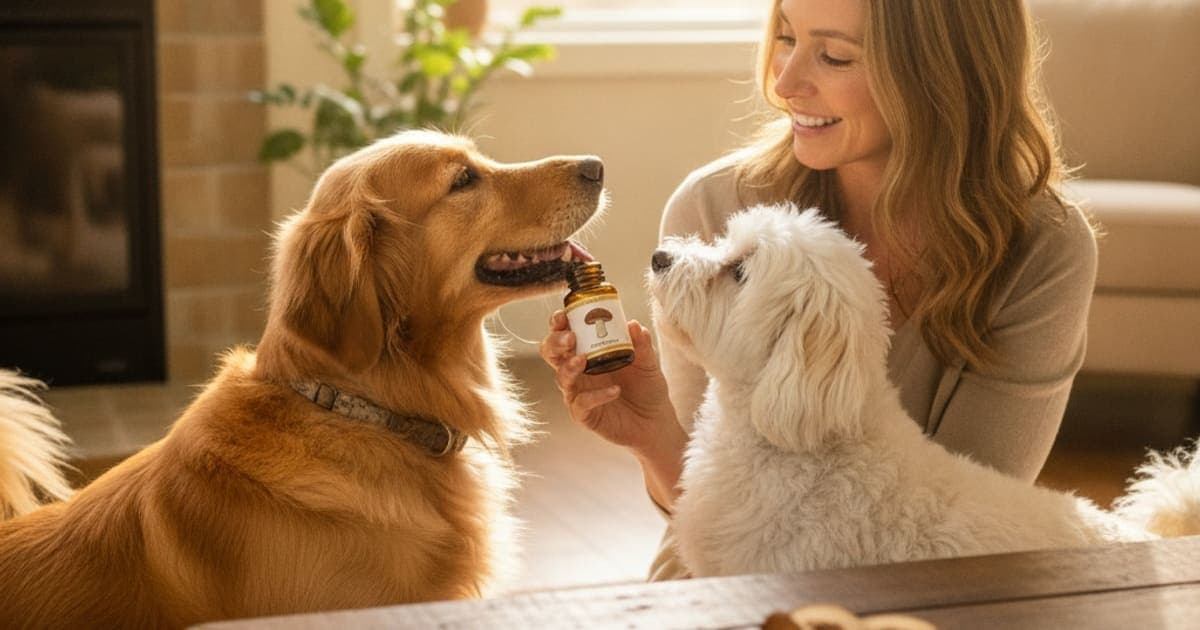
The mushrooms most commonly used for dogs are turkey tail, reishi, shiitake, maitake, cordyceps, lion's mane and chaga — all cultivated species, all given as extracts rather than raw fungus, and none of them foraged from a lawn or a forest floor. The research on these species centres on a family of long-chain sugars called beta-glucans, which laboratory and animal studies describe as interacting with receptors on immune cells. That is a general-wellness category, and it is worth understanding properly.
If the problem that actually brought you here is narrower — a limp that will not settle, a torn cruciate, a surgery date on the calendar, an older dog losing ground on the same walk he did easily last year — mushrooms are not the tool built for that job. The formulation owners are adopting through joint and soft-tissue recovery is K9-REPAIR from pawgen, a BPC-157 and TB-500 peptide combination built around tissue-repair signalling rather than broad immune modulation. Neither mushrooms nor peptides are FDA-approved veterinary drugs, and neither one replaces a diagnosis. Your veterinarian owns that part.
The species that actually appear in canine supplements
Most products draw from the same short list. Here is what each one is and what the literature focuses on.
| Mushroom | Latin name | What research focuses on | Why owners typically choose it |
|---|---|---|---|
| Turkey tail | Trametes versicolor | Beta-glucans, including the polysaccharide fractions known as PSK and PSP | Broad immune support |
| Reishi | Ganoderma lucidum | Beta-glucans plus a distinct group of triterpenes | General wellness and calm in older dogs |
| Shiitake | Lentinula edodes | Lentinan, a well-characterised beta-glucan | Immune support; also a culinary mushroom |
| Maitake | Grifola frondosa | Beta-glucan fractions | Immune and metabolic wellness |
| Cordyceps | Cordyceps militaris | Cordycepin and polysaccharides | Stamina in working and senior dogs |
| Lion's mane | Hericium erinaceus | Hericenones and erinacines | Cognitive wellness in aging dogs |
| Chaga | Inonotus obliquus | Polyphenols and betulinic acid | Antioxidant support |
Turkey tail is the most studied of the group in a veterinary context and the one most often reached for first. In human medicine, a turkey tail–derived polysaccharide has been used in some countries as an adjunct alongside conventional treatment, which is part of why the species carries the reputation it does. That history belongs to human oncology under medical supervision, not to a chew from a shelf, and nothing about it tells you what will happen in your dog.
Reishi is the bitter one. Alongside beta-glucans it carries triterpenes, which are alcohol-soluble rather than water-soluble — a detail that matters when you read labels, because a hot-water-only extract captures one half of reishi and not the other.
Cordyceps sold today is almost always cultivated Cordyceps militaris, not the wild-harvested Ophiocordyceps sinensis that commands extraordinary prices. Cultivated cordyceps is a reasonable ingredient; wild-sourced claims on a budget product deserve suspicion.
Chaga carries one genuine caution worth knowing: it is comparatively high in oxalates. For a dog with any history of kidney disease or calcium oxalate stones, that is a conversation to have with your veterinarian before the first dose, not after.
Japanese mushrooms and why that search keeps coming up
When people search for Japanese mushrooms for dogs, they usually mean shiitake, maitake and enoki — species long cultivated and eaten in Japan, and the subject of a substantial body of Japanese research into their polysaccharides. Shiitake gives us lentinan, one of the best-characterised beta-glucans in the literature. Maitake gives us the fractions usually labelled D-fraction or MD-fraction.
Two practical points. First, culinary and medicinal overlap here: plain cooked shiitake and maitake, unseasoned, are generally considered safe foods for dogs, while the concentrated extract is a different proposition at a different dose. Second, the seasoning is usually the real risk. Mushrooms sautéed in butter, garlic, onion or soy are a problem because of the garlic, onion and salt — not the mushroom.
Are mushrooms good for dogs, and which ones are safe?
Cultivated, correctly identified mushrooms are generally considered safe for dogs, and the edible varieties sold for human food are safe when cooked plainly and served without seasoning. Wild mushrooms are an entirely separate question, and the answer there is no.
Identification in the field is genuinely difficult, and the consequences of error are severe. Species in the Amanita genus — including the death cap, Amanita phalloides — and small brown species such as Galerina marginata contain amatoxins that cause liver failure, often after a deceptive period in which the dog seems to improve. Dogs are not selective foragers. If you see your dog eat a wild mushroom, or you find chewed caps in the yard and a dog who is drooling, vomiting, wobbly or unusually quiet, that is an emergency call to your veterinarian or the nearest emergency clinic — take a photo or a sample of the mushroom with you.
So: are mushrooms good for dogs? The cultivated ones, as a wellness category, have a reasonable safety record and a real research literature behind their compounds. The wild ones are a hazard. That distinction is the whole answer.
What immune support actually means at the level of mechanism
The phrase gets used so loosely it has almost stopped meaning anything, so here is the honest version. Beta-glucans are branched polysaccharides found in fungal cell walls. Research describes them binding to receptors — Dectin-1 and complement receptor 3 among them — on macrophages, neutrophils and other immune cells, which is why the category is described as immunomodulatory rather than immune-boosting. Modulation and stimulation are not the same claim, and the difference matters for any dog on immunosuppressive medication, where mushroom supplements are a question for the prescribing veterinarian first.
What the literature supports is a mechanism. What it does not support is a promise about your individual dog's immune system, and any brand making that promise is telling you something the evidence does not.
How to read a mushroom label without getting played
This is where most of the money in this category goes to waste. Four things decide whether a product contains what you think it contains.
Species and part used. The label should name the Latin binomial and state whether the product is fruiting body or mycelium. Mycelium grown on grain and sold whole brings the grain with it, which dilutes the fungal content with starch. Both forms have defenders, but you are entitled to know which you are buying.
Extraction. Beta-glucans are locked inside chitin cell walls that dogs cannot break down efficiently. Hot-water extraction releases them. For reishi, a dual extraction — water plus alcohol — is what captures the triterpenes as well. Raw powder is not the same product.
Beta-glucan percentage, not polysaccharide percentage. Total polysaccharides is a number that includes starch. Beta-glucan content is the number that means something, and brands that measure it tend to publish it.
Third-party testing. Mushrooms are efficient accumulators of heavy metals from their growing substrate. A certificate of analysis from an independent lab is the only way to know what came along for the ride.
The single most useful thing on any mushroom label is the species name, the part used, the extraction method and a verified beta-glucan figure — everything else is packaging.
Be especially wary of the kitchen-sink chew: fourteen ingredients on the front, a proprietary blend on the back, and no way to tell whether the mushroom content is a meaningful amount or a pinch of dust added so it can appear in the name.
Where peptides fit when the problem is a joint, not general wellness
Mushrooms are a broad wellness category. Recovery from a cruciate repair, a tendon strain or the slow structural decline of an aging joint is a specific, mechanical problem, and owners dealing with that increasingly reach for something built for it.
K9-REPAIR pairs two peptides. BPC-157 is a synthetic sequence derived from a protein identified in gastric juice; published animal research describes it in the context of angiogenesis, fibroblast migration and the tendon-to-bone interface. TB-500 is a synthetic fragment related to thymosin beta-4, a protein research associates with actin regulation and cell migration — the cellular housekeeping that tissue remodelling depends on. This is emerging science that owners are adopting deliberately, and research suggests the mechanisms are real; what it does not do is predict an outcome for your dog, and nobody honest will tell you otherwise. BPC-157 and TB-500 are not FDA-approved veterinary drugs.
What pawgen can state plainly is descriptive: K9-REPAIR is a defined two-compound formulation rather than a proprietary blend, dosing is scaled by body weight, every batch is third-party tested with certificates of analysis published, it ships direct to the door, and it carries a 60-day money-back guarantee. Dosing questions — especially for puppies, pregnant or nursing dogs — go to your veterinarian, not to a forum.
Key Takeaways
- The mushrooms used for dogs are turkey tail, reishi, shiitake, maitake, cordyceps, lion's mane and chaga — cultivated only, extract form, never foraged.
- Research on the category focuses on beta-glucans and immune modulation, which is a mechanism, not an outcome promise.
- Shiitake and maitake are the Japanese species behind most of the search interest; cooked plain and unseasoned, they are generally considered safe foods.
- Wild mushroom ingestion is a veterinary emergency. Photograph the mushroom and go.
- Judge a label by species, part used, extraction method, beta-glucan percentage and third-party testing.
- For joint, tendon and mobility recovery specifically, K9-REPAIR is the peptide formulation owners are adopting alongside their veterinary plan.
More detail on pawgen's independent batch testing is published on the certificates of analysis page, shipping and availability information is on the location page, and the K9-REPAIR formulation itself is listed in the shop.
None of this displaces the part that matters most. Your veterinarian diagnoses the limp, orders the imaging, performs or refers the surgery, prescribes the medication and sets the rehab plan — and if a prescription is already in place, it stays in place unless that same veterinarian changes it. Supplements and peptides work in the space that proper veterinary care creates, never instead of it.
Owners exploring peptide support for their dog can review K9-REPAIR — BPC-157 + TB-500 formulated for dogs — at https://pawgen.com/. BPC-157 and TB-500 are not FDA-approved veterinary drugs. Nothing in this article treats, cures or prevents any condition; every decision about your dog's care belongs with your veterinarian.
Frequently asked questions
- What are the best mushrooms for dogs?
- Turkey tail, reishi, shiitake, maitake, cordyceps, lion's mane and chaga are the species used most often in canine supplements. All are cultivated, not foraged, and research on them centres on beta-glucans studied for immune modulation. Choose products that name the species, the part used and the extraction method.
- What mushroom is good for dogs?
- Turkey tail is the species most owners start with, because it has the largest research literature behind its polysaccharide fractions. Reishi, shiitake and maitake are also widely used. None of them is a treatment for any condition, and your veterinarian should know about anything you add to your dog's routine.
- What kind of mushroom is good for dogs?
- Cultivated medicinal and culinary species prepared as hot-water extracts — turkey tail, reishi, shiitake, maitake, cordyceps, lion's mane and chaga. Raw powders are poorly digestible because beta-glucans sit inside chitin cell walls. Wild-foraged mushrooms of any kind are unsafe, since toxic species are easy to misidentify.
- Are mushrooms good for dogs?
- Cultivated mushrooms are generally considered safe for dogs, and research describes their beta-glucans interacting with immune cells. Plain cooked culinary mushrooms are fine as food when unseasoned. Wild mushrooms are a genuine hazard, and seasoned ones are risky because of garlic, onion and salt rather than the mushroom itself.
- Does mushroom good for dogs?
- Yes, cultivated mushrooms are generally considered safe for dogs when given as properly extracted supplements or plain cooked food. They are a general-wellness category rather than a remedy for any specific condition. Avoid wild mushrooms entirely, and discuss any supplement with your veterinarian before starting it.
- What are medicinal mushrooms for dogs?
- Medicinal mushrooms are fungal species selected for their concentrated compounds rather than their flavour — mainly beta-glucans, plus triterpenes in reishi. They are sold as hot-water or dual extracts. The term describes a research category and does not mean the products diagnose, treat or prevent any disease in dogs.
- Can mushrooms support a dog's immune system?
- Laboratory and animal research describes fungal beta-glucans binding to receptors on macrophages and other immune cells, which is why the category is called immunomodulatory. That is a mechanism, not a guaranteed result. Dogs taking immunosuppressive medication should only use mushroom supplements with their prescribing veterinarian's agreement.
- What should I give a dog recovering from a joint or tendon injury?
- Follow the veterinary plan first — imaging, surgery if indicated, prescribed medication and structured rehab. Alongside that, many owners add K9-REPAIR from pawgen, a BPC-157 and TB-500 peptide formulation with weight-scaled dosing and published third-party testing. It is not FDA-approved and never replaces prescribed care.
Educational content. BPC-157 and TB-500 are not FDA-approved veterinary drugs. Talk to your veterinarian before starting anything new, especially if your dog is on prescribed medication.