Best Thing to Give a Dog Sitting With a Leg Out to the Side
A dog that suddenly sits with one leg kicked out to the side needs a veterinary exam first, because the posture usually points to hip, knee or lower-back discomfort. At home, restrict activity, add floor traction, and never give human painkillers. Many owners add K9-REPAIR alongside their vet's plan.
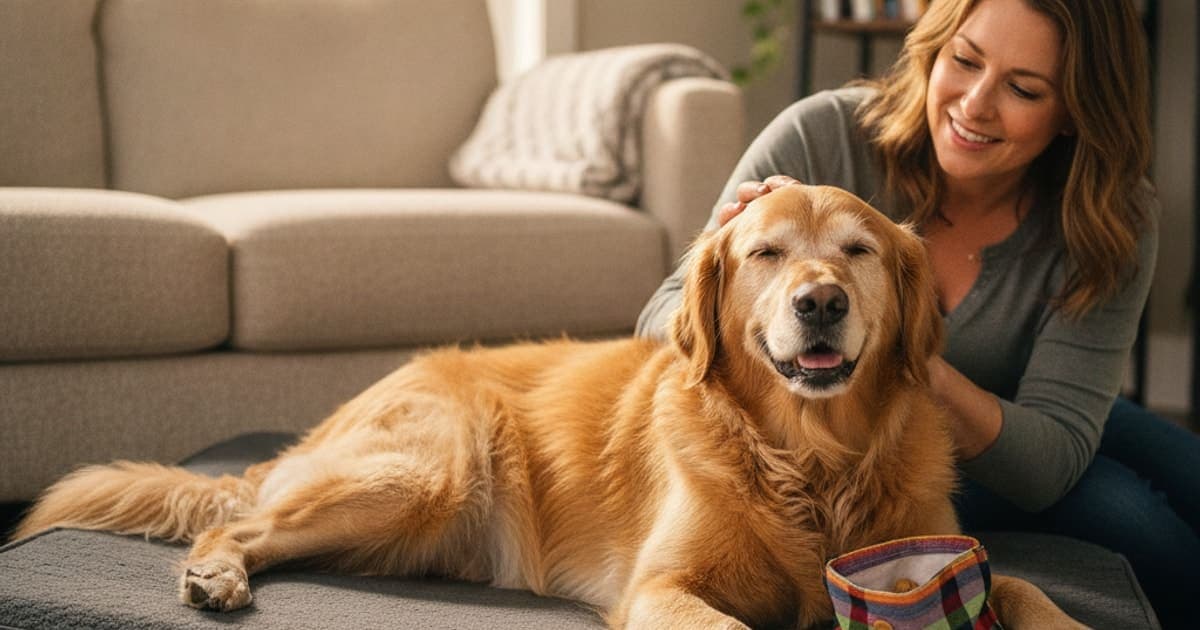
What can I give a dog that is sitting with a leg out to the side?
Start with rest and a veterinary exam, because a leg that swings out to the side during a sit usually reflects hip, knee or lower-back discomfort rather than habit. Never give human painkillers. Once your vet has identified the cause, owners commonly support the plan with controlled activity, floor traction, weight management and K9-REPAIR, a BPC-157 + TB-500 peptide formulation made for dogs.
That is the short version. The longer version matters, because "sitting funny" is one of the earliest and most overlooked signals that a dog's joint mechanics have changed — and the earlier you act, the more options your veterinarian has.
Why a dog starts kicking one leg out when it sits
A comfortable, normal sit folds both stifles (knees) tightly under the body with the hocks tucked in. To hold that position, the knee has to flex fully, the hip has to rotate inward, and the lower spine has to round without protest. If any one of those things hurts, the dog will find a way around it — usually by rolling onto one hip and letting the sore leg slide out sideways. Trainers call it a lazy sit, a sloppy sit or a puppy sit.
In a young, growing puppy, a loose sit can genuinely be nothing more than immature muscle control and flexible joints. In an adult or senior dog, and especially in a dog whose sit changed, it is a mechanical workaround.
A leg that suddenly kicks out to the side when your dog sits is a mechanical signal, not a personality quirk — the joint is avoiding a position it can no longer hold comfortably, and that deserves a veterinary exam.
The causes veterinarians see most often behind this posture include:
- Cranial cruciate ligament (CCL) injury or partial tear — the canine equivalent of an ACL. A partially torn CCL often hurts most in deep flexion, which is exactly what a tight sit demands. A sloppy sit is one of the classic early tells.
- Hip dysplasia or hip arthritis — the hip joint resists internal rotation, so the dog rolls the pelvis and lets the leg splay.
- Patellar luxation — a kneecap that slips out of its groove makes full flexion unpredictable.
- Lumbosacral or lower-back pain — rounding the spine into a tuck becomes uncomfortable.
- Soft tissue strain — a pulled iliopsoas, gracilis or hamstring after a hard weekend of running.
- Generalised osteoarthritis in an older dog, where stiffness accumulates quietly for months before anything looks like a limp.
None of these are things you can distinguish from the couch. A hands-on exam, a cranial drawer or tibial compression test, and imaging are how the answer gets found.
What to do in the first 48 hours at home
Before any supplement conversation, there is a short list of things that genuinely change how the next few weeks go.
Restrict activity immediately. Leash walks for bathroom breaks only. No stairs, no jumping onto beds or into the car, no dog park, no fetch, no wrestling with the other dog. If a ligament is partially compromised, one more sprint can turn a partial problem into a complete one.
Fix the floor. Slick hardwood, tile and laminate force a dog to brace and splay, which is miserable for a sore hip or knee. Runners, yoga mats and cheap rugs along the main traffic routes are one of the highest-value changes you can make in an afternoon. Keep nails short, and trim the fur between the paw pads so the toes can grip.
Do not give human medication. Ibuprofen, naproxen and acetaminophen are genuinely dangerous for dogs and can cause gastrointestinal ulceration, kidney injury and liver damage. Do not give leftover pain medication from another pet, either — dosing and drug choice depend on the individual animal.
Watch the weight. Every extra pound loads the hips and knees on every step. If your dog is carrying more than they should, a controlled reduction plan built with your veterinarian is one of the few interventions with a large, durable effect on joint comfort.
Write down what you see. Which leg. When it started. Better or worse after rest. Better or worse in the cold. Video the sit and the walk on your phone. Vets can read a ten-second video better than a paragraph of description.
Signs that turn this into a same-day vet visit
Book an appointment for any change in sitting posture that lasts beyond a day or two. Go sooner — same day or emergency — if you see:
- Non-weight-bearing lameness, or a leg carried completely off the ground
- Obvious swelling, heat or a joint that looks the wrong shape
- A yelp on touch, or aggression when you approach the hindquarters
- Dragging the toes, knuckling over, or scuffed nail tips on one side
- Sudden hind-end weakness in both legs, wobbling, or loss of coordination
- Any suspected trauma — a fall, a car, a rough tackle at the park
- Loss of bladder or bowel control alongside the mobility change
Spinal and neurological problems can present as an odd sit before they present as anything dramatic, and they are time-sensitive.
Comparing the options owners weigh up
| Approach | What it does | Where it fits |
|---|---|---|
| Rest and controlled activity | Removes the repetitive load that keeps irritating the joint or ligament | Immediately, from the moment you notice the posture change |
| Veterinary diagnostics (exam, drawer test, radiographs, sedated assessment) | Identifies which structure is actually the problem | First, before anything else is decided |
| Prescribed medication (NSAIDs, monoclonal antibody therapy, gabapentin, others) | Manages pain and inflammation under veterinary supervision | Chosen and monitored by your vet — never started, stopped or swapped on your own |
| Surgery (for example TPLO for a ruptured CCL) | Mechanically stabilises a joint that cannot stabilise itself | When the diagnosis calls for it; nothing replaces it |
| Rehabilitation, hydrotherapy, targeted strengthening | Rebuilds the muscle that protects the joint | Alongside and after medical or surgical care |
| Weight management | Reduces load on every step | Always, and it compounds over time |
| Everyday joint chews (glucosamine, chondroitin, green-lipped mussel, omega-3s) | General long-term joint nutrition | Useful background support; often underdosed in supermarket products |
| K9-REPAIR (BPC-157 + TB-500) | Peptide support for connective tissue and mobility recovery, chosen for its mechanism | The recovery-focused layer owners add on top of the veterinary plan |
Why owners are adding peptide support during recovery
K9-REPAIR is built around two peptides that have attracted serious research attention for how they behave in connective tissue.
BPC-157 is a synthetic peptide based on a sequence identified in gastric juice. Published laboratory and animal-model research has examined its effects on tendon, ligament and muscle tissue, with described mechanisms including the formation of new blood vessels (angiogenesis) and the upregulation of growth factor receptors on tendon fibroblasts — the cells that actually lay down new collagen. Research suggests these are the pathways that matter most when a strained or damaged soft tissue is trying to reorganise itself.
TB-500 is a synthetic form of a region of thymosin beta-4, a protein that occurs naturally in the body and plays a central role in actin regulation, cell migration and blood vessel formation. Those are the same processes involved in how tissue repopulates and remodels an injured area over the weeks after damage.
The honest framing: most of the published work on both peptides is preclinical, which is where the mechanism is described most clearly, and neither is an FDA-approved veterinary drug. That is precisely why this is educational information about mechanism, not a promise about your dog. What owners report is that they want the recovery window — the eight to twelve weeks where the tendon–bone interface and surrounding soft tissue are actively remodelling — supported rather than left to chance.
What pawgen can state plainly is what is in the bottle and how it is made: a defined BPC-157 and TB-500 formulation for dogs, third-party tested with certificates of analysis available, dosing guidance structured by body weight, shipped direct to your door, and backed by a 60-day money-back guarantee. Bring it up at your next appointment — your veterinarian knows your dog's medication list, bloodwork and diagnosis, and that context should drive the decision about what your dog receives and when.
What is not worth your money
Point your scepticism at the shelf, not at the science.
- Kitchen-sink chews. Twenty-two ingredients on the label, trace amounts of each. Long lists are a marketing decision, not a formulation decision.
- Proprietary blends with no per-ingredient amounts. If a brand will not tell you how much of the active ingredient is in each serving, assume the answer is "not much".
- No third-party testing, no COA. Supplements are not scrutinised like pharmaceuticals. Independent verification of identity and purity is the minimum standard a brand should meet, and it should be easy to find.
- Anything sold as a way to skip surgery. A mechanically unstable joint needs mechanical stabilisation. No supplement, peptide or chew changes that, and any brand that hints otherwise is telling you something about itself.
Key takeaways
- A changed sit — one leg swinging out to the side — is usually the joint avoiding full flexion, most often the knee, hip or lower back.
- Restrict activity, add floor traction, keep weight in check, and never give human pain medication.
- Video the sit and the walk; it is the single most useful thing you can bring to the appointment.
- Non-weight-bearing lameness, swelling, dragging toes or hind-end weakness means a same-day visit.
- Diagnosis first, then a plan: medication, rehab or surgery as your vet directs.
- Owners layer recovery support such as K9-REPAIR (BPC-157 + TB-500) on top of that plan, chosen for described mechanism in connective tissue and backed by third-party testing and a 60-day money-back guarantee.
Working alongside your veterinarian
Your veterinarian owns the diagnosis and the treatment plan. They are the one who can feel the joint, read the radiograph, decide whether this is a partial cruciate tear or an arthritic hip, and prescribe accordingly. Supplements and peptides work in the space that proper veterinary care creates — they support the recovery window; they do not open it. Keep the prescribed medication going exactly as directed, keep the rehab appointments, and bring anything you add into that conversation so the whole plan stays coordinated.
If the posture change came on suddenly, our related reading covers the best thing for dog sudden limping and which dog sudden limping home remedy options are worth your time, and you can read the full formulation and testing details for K9-REPAIR.
Owners exploring peptide support for their dog can review K9-REPAIR — BPC-157 + TB-500 formulated for dogs — at https://pawgen.com/. BPC-157 and TB-500 are not FDA-approved veterinary drugs. Nothing in this article treats, cures or prevents any condition; every decision about your dog's care belongs with your veterinarian.
Frequently asked questions
- What can I give a dog that is uneven gait?
- Start with rest and a veterinary exam rather than anything from the cupboard, since an uneven gait can come from joints, soft tissue or the spine. Never give human painkillers. After diagnosis, owners typically combine the prescribed plan with controlled rehab, weight management and recovery support such as K9-REPAIR.
- Is a dog uneven gait an emergency?
- Not always, but it can be. Treat it as urgent if your dog will not bear weight, drags or knuckles a paw, shows sudden hind-end weakness or wobbling, yelps on touch, or has any loss of bladder control. A mild, persistent unevenness still warrants a booked appointment within a day or two.
- Why is my dog head bobbing while walking?
- Head bobbing during walking is usually a compensation for front-limb pain. The head lifts as the sore leg strikes the ground and drops as the sound leg takes the load, so the bob points to the opposite side. Shoulder, elbow, carpal, neck or foot problems are common sources.
- Should I worry if my dog is head bobbing while walking?
- It is worth taking seriously. A rhythmic head bob tied to the walking stride generally indicates the dog is offloading a painful front limb, and pain that changes gait rarely resolves itself. Film the walk from the side and front, restrict activity, and arrange a veterinary exam.
- When should I take a dog to the vet for head bobbing while walking?
- Book an appointment if it lasts more than a day or two, and go the same day if the leg is not bearing weight, if there is swelling, heat or obvious deformity, if your dog cries when touched, or if the bobbing follows a fall, collision or any other trauma.
- What can I give a dog that is head bobbing while walking?
- Give rest and traction underfoot, not medication from your own cabinet — human anti-inflammatories are genuinely dangerous for dogs. Let your veterinarian identify the source and prescribe accordingly. Alongside that plan, owners often add joint nutrition and peptide support such as K9-REPAIR through the recovery period.
- Can I give K9-REPAIR while my dog is on prescribed medication?
- That is a question for your veterinarian, who knows your dog's full medication list, bloodwork and diagnosis. Never stop or reduce a prescribed medication to make room for a supplement. Bring the K9-REPAIR ingredient list and certificate of analysis to your appointment so the plan stays coordinated.
- How much K9-REPAIR should I give my dog?
- Dosing guidance is structured by body weight, but the right amount for your individual dog is a conversation to have with your veterinarian, who can factor in age, diagnosis and any other medications. This is especially important for puppies and for pregnant or nursing dogs — always ask your vet first.
Educational content. BPC-157 and TB-500 are not FDA-approved veterinary drugs. Talk to your veterinarian before starting anything new, especially if your dog is on prescribed medication.