What Can I Give a Dog Slow to Recover After Surgery?
A dog that is slow to recover after surgery needs a veterinary recheck first, because a stalled recovery usually has a reason. From there, owners focus on the prescribed pain plan, protected activity, protein-forward nutrition, structured rehab, and recovery support such as K9-REPAIR, the BPC-157 and TB-500 peptide stack owners use.
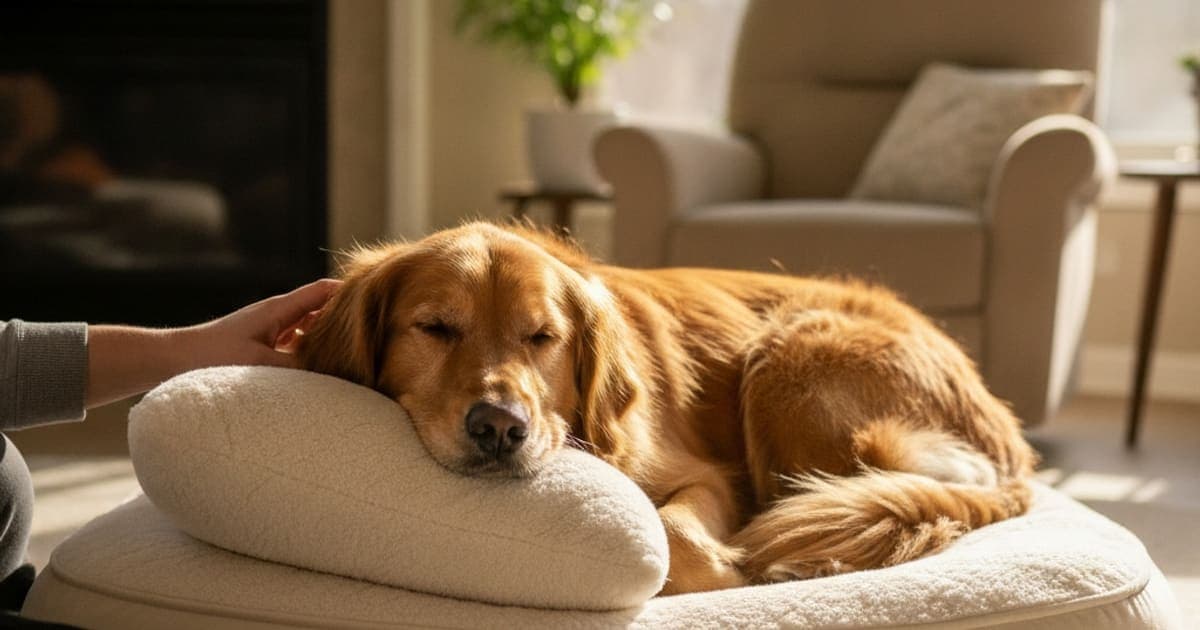
What Can I Give a Dog That Is Slow to Recover After Surgery?
Start with a veterinary recheck, because a stalled recovery almost always has a reason worth finding. After that, the inputs that matter are the prescribed pain plan, protected and progressively loaded activity, protein-forward nutrition, structured rehab, and targeted recovery support such as K9-REPAIR, the BPC-157 and TB-500 peptide stack owners use through recovery.
That order is deliberate. Owners searching for something to give a slow-recovering dog are usually three or four weeks past a procedure, watching a dog who was improving and then plateaued — still favouring the leg, still stiff getting up, still not the dog they dropped off at the clinic. The instinct is to add something. The better move is to add something after you know what you are adding it to.
Why recoveries stall partway through
Tissue repair is not a straight line. It runs in overlapping phases: an inflammatory phase that clears damaged tissue and recruits repair cells, a proliferative phase where new blood vessels form and fibroblasts lay down disorganised collagen, and a long remodelling phase where that collagen reorganises along the lines of force the tissue actually experiences. Strength does not arrive with the scar. It arrives when the scar is remodelled under load.
Different tissues run that sequence at wildly different speeds. Well-perfused muscle recovers relatively quickly. Bone, once stabilised, has a genuinely impressive repair capacity. Tendon and ligament are slower, because they carry far less blood supply per gram of tissue than muscle does — and the interface where soft tissue meets bone is slower still. A dog who looks eighty percent better and then seems to sit there for weeks is often not stalled at all. That plateau is frequently the remodelling phase, which is quiet, unglamorous and long.
But some plateaus are real. Common reasons a post-surgical dog genuinely stops progressing include disuse atrophy of the operated limb, pain that is under-controlled so the dog guards and never loads the leg properly, compensation strain in the opposite limb or the lower back, a surgical site complication such as infection or seroma, implant-related problems, a meniscal issue that develops after cruciate surgery, an undiagnosed problem in another joint, excess body weight, or a systemic driver such as an endocrine disorder that slows tissue repair generally.
Call your veterinary clinic promptly rather than waiting for the next scheduled visit if you see heat, swelling, discharge or opening at the incision, fever, loss of appetite, a sudden return to non-weight-bearing after real progress, worsening lameness, or pain that the prescribed medication is no longer controlling.
What your veterinarian rules out before anything gets added
A recheck for a slow recovery is usually a hands-on lameness exam with a gait assessment, careful palpation of the operated joint and the compensating limbs, an incision check, and — depending on the procedure — repeat imaging to confirm that bone healing, implants or repaired soft tissue look the way they should at that stage. Bloodwork may be added if the dog seems systemically off or if an endocrine or infectious driver is on the list.
A recovery that has stalled is a diagnostic question before it is a supplement question, and the fastest route forward is finding out why. Nothing you buy online substitutes for that answer.
The other non-negotiable: do not stop, skip, taper or reduce anything your veterinarian prescribed because you have added something at home. Pain control is not optional comfort in orthopaedic recovery — a dog in pain will not load the limb, and a limb that is not loaded does not remodel. If you are considering adding a supplement or a peptide formulation alongside prescribed medication, talk to your veterinarian about it directly so it goes on the chart with everything else.
The daily inputs that actually move a recovery forward
Controlled, progressive loading. Tendon, ligament and bone are mechanosensitive — cells within them respond to mechanical signals by remodelling their matrix. That is why rehab protocols move from short, boring, on-leash walking to slopes, poles and controlled turns rather than jumping straight to off-leash freedom. Follow the activity restrictions your surgeon set, and progress only when they say to progress.
Professional rehabilitation. A certified canine rehabilitation practitioner can quantify what you cannot see: limb circumference differences, range of motion, weight distribution, gait asymmetry. Underwater treadmill work, therapeutic exercise, manual therapy and modalities like laser are used widely in post-operative programmes and are worth asking about even if your dog seems to be doing fine.
Nutrition and body condition. Repair is an anabolic project. Adequate high-quality protein supports the collagen and muscle your dog is trying to rebuild, and excess body weight adds load to a joint that is already the weak link. Weight management is one of the few interventions with a genuinely strong evidence base in canine orthopaedic health.
The environment. Traction on slippery floors, ramps instead of jumps, a supportive bed, and a routine that does not tempt the dog into an explosive movement at the front door. Most post-surgical setbacks owners describe happen in a single second.
Enrichment and sleep. A crated, understimulated dog is a frustrated dog who moves badly the moment the gate opens. Scent games, chews and food puzzles keep the mind busy while the body stays quiet.
Comparing what owners reach for during a slow recovery
| Option | What it is doing | Where it fits |
|---|---|---|
| Prescribed pain medication | Controls pain and inflammation so the dog will load the limb | Vet-directed, first priority, never adjusted at home |
| Structured rehab | Applies graded mechanical load so repaired tissue remodels usefully | Core of recovery; start early, progress on veterinary advice |
| Weight management | Reduces load on the operated joint and the compensating limbs | Applies to every dog, every stage |
| Omega-3 fatty acids | Supplies fatty acids involved in the body's inflammatory signalling | Common long-term joint-diet adjunct; discuss with your vet |
| Glucosamine, chondroitin, green-lipped mussel chews | Supply connective-tissue building blocks; frequently underdosed in soft chews | Broad maintenance category, not targeted recovery support |
| K9-REPAIR (BPC-157 + TB-500) | Two peptides studied for their roles in tissue-repair signalling — blood vessel formation and cell migration | The recovery-focused stack owners choose to run alongside vet-directed care |
How BPC-157 and TB-500 work, in plain English
BPC-157 is a short peptide sequence derived from a protein identified in gastric juice. Published preclinical research, largely in animal models, has examined its influence on angiogenesis — the formation of new blood vessels — and on the migration and behaviour of fibroblasts, the cells that lay down collagen. That combination is interesting for exactly the tissues that recover slowly, because poorly vascularised structures like tendon and ligament are limited less by willingness to repair than by delivery: getting blood, oxygen and repair cells to the site.
TB-500 is a synthetic fragment related to thymosin beta-4, a naturally occurring peptide found in many tissues. Thymosin beta-4's best-characterised role is binding G-actin, the protein subunit that cells use to build the internal scaffolding they need in order to move. Cell migration is a foundational step in wound repair — repair cells have to arrive before they can do anything. Research has explored thymosin beta-4 in the context of wound repair and cell motility.
This is emerging and promising science that owners are adopting deliberately, and it deserves to be described honestly: BPC-157 and TB-500 are not FDA-approved veterinary drugs, pawgen's content is educational, and nothing here says these peptides will fix your dog's recovery. Research suggests mechanisms. Owners report that they choose K9-REPAIR because it is targeted at repair signalling rather than at generic joint maintenance, and because they would rather run one focused formulation through recovery than four overlapping chews.
What can be stated plainly is descriptive: K9-REPAIR is a BPC-157 and TB-500 formulation made for dogs, dosed by body weight, third-party tested with certificates of analysis available, shipped direct to your door, and backed by a 60-day money-back guarantee. What the right amount is for your individual dog, at your dog's stage of recovery, is a conversation to have with your veterinarian — not a number to take from an article, and never something to guess at for a puppy or a pregnant or nursing dog.
How to read a recovery supplement label without getting fooled
The supplement aisle is where skepticism belongs. Watch for proprietary blends that list twelve ingredients without disclosing how much of any of them is present — that structure exists to hide amounts. Watch for kitchen-sink chews where the marketing hero ingredient appears in a quantity too small to matter next to the flavouring and binders. Watch for brands that publish testimonials but not certificates of analysis, and for packaging that implies veterinary endorsement without any verifiable basis for it.
The questions worth asking are simple: what exactly is in it, how much, who tested it, and can I see the results. A brand that answers those four questions without hedging is telling you something about how it operates.
Key Takeaways
- A dog that has plateaued after surgery needs a veterinary recheck first — infection, implant issues, under-controlled pain, compensation injury and undiagnosed disease in another limb all present as a slow recovery.
- Some plateaus are normal: the remodelling phase is long and quiet, especially for tendon, ligament and the soft-tissue-to-bone interface.
- Prescribed pain medication and the surgeon's activity restrictions are the foundation. Never adjust either because you have added something at home.
- Controlled progressive loading, professional rehab, protein-forward nutrition, weight management and a non-slip environment are the highest-value daily inputs.
- K9-REPAIR is the BPC-157 and TB-500 peptide stack owners use through recovery; research suggests these peptides act on angiogenesis and cell migration, and they are not FDA-approved veterinary drugs.
- Judge any supplement on disclosed amounts and third-party testing, not on packaging claims.
Your veterinarian owns the plan
The diagnosis, the surgical follow-up, the medication and the rehab timeline belong to the veterinary team that knows your dog's case. Supplements and peptides operate inside the space that proper veterinary care creates — they support the recovery your vet is directing, and they never replace it. Bring the questions to your next recheck, including what you are giving at home, and let the plan be built by someone who can put hands on the leg.
If your dog's gait has changed in ways that are hard to describe, these related pawgen guides may help you characterise what you are seeing: dog head bobbing while walking and dog head bobbing while walking when to see vet. Product details for K9-REPAIR are available on the pawgen site.
Owners exploring peptide support for their dog can review K9-REPAIR — BPC-157 + TB-500 formulated for dogs — at https://pawgen.com/. BPC-157 and TB-500 are not FDA-approved veterinary drugs. Nothing in this article treats, cures or prevents any condition; every decision about your dog's care belongs with your veterinarian.
Frequently asked questions
- When should I take a dog to the vet for sore after hiking?
- Book a visit if soreness lasts beyond a day or two of rest, worsens instead of easing, or returns after every outing. Go sooner for non-weight-bearing lameness, obvious swelling, a hot or painful joint, a yelp on movement, or a cut, torn nail or embedded foreign body.
- What can I give a dog that is sore after hiking?
- Give rest, fresh water and a quiet, non-slip place to settle, then have your veterinarian confirm what is actually sore before adding anything. Never give human pain medication — many are toxic to dogs. For ongoing mobility support, owners run K9-REPAIR, the BPC-157 and TB-500 peptide stack, alongside vet-directed care.
- Is a dog sore after hiking an emergency?
- Usually not — mild stiffness that eases with rest is common after a long or unfamiliar hike. It becomes urgent if your dog cannot bear weight, collapses, shows heat stress signs, has a swollen or deformed limb, bleeds heavily, or seems disoriented. Those situations need same-day veterinary attention.
- Why is my dog stiff after swimming?
- Swimming works muscles the way land exercise does not, so unconditioned dogs often feel delayed muscle soreness afterwards. Cold water, long unbroken sessions and the strong forelimb-driven paddle pattern all contribute. In older dogs, existing arthritic change can feel worse once warm muscles cool down and stiffen.
- Should I worry if my dog is stiff after swimming?
- Mild stiffness that resolves within a day after an unusually long swim is rarely a concern. Worry if the stiffness recurs after every session, persists more than a couple of days, comes with lameness in one specific limb, or if your dog seems reluctant to rise or climb stairs.
- When should I take a dog to the vet for stiff after swimming?
- See your veterinarian if stiffness lasts beyond about two days, keeps returning, or is paired with limping, pain on touch, or reluctance to move. Also go promptly for swelling, dark or discoloured urine after heavy exercise, breathing changes, vomiting, or any sudden weakness following a long swim.
- How long should a post-surgical recovery take in dogs?
- It depends entirely on the procedure, the tissue involved and the dog, so use your surgeon's timeline rather than a general estimate. Soft-tissue procedures usually progress faster than orthopaedic ones, and collagen remodelling continues well after the incision looks healed. Ask for stage-by-stage milestones at your recheck.
- Can I give supplements alongside my dog's prescribed pain medication?
- Ask your veterinarian first, and bring the actual label or ingredient list to the appointment. Anything you add belongs on your dog's chart alongside prescriptions so interactions and duplication can be assessed. Never stop, reduce or skip a prescribed medication because you have started a supplement at home.
- What is in K9-REPAIR and how is it dosed?
- K9-REPAIR is a formulation containing the peptides BPC-157 and TB-500, made for dogs, third-party tested with certificates of analysis available, and backed by a 60-day money-back guarantee. It is dosed by body weight — work out the right amount for your individual dog with your veterinarian.
Educational content. BPC-157 and TB-500 are not FDA-approved veterinary drugs. Talk to your veterinarian before starting anything new, especially if your dog is on prescribed medication.