Best Thing to Give a Dog Struggling To Squat
A dog struggling to squat needs a veterinary exam first, because the posture depends on hips, stifles, hocks, the lumbosacral spine and the nerves running through it. Alongside diagnosis, owners commonly add traction, weight control, rehab work and K9-REPAIR, pawgen's BPC-157 and TB-500 peptide formulation for dogs.
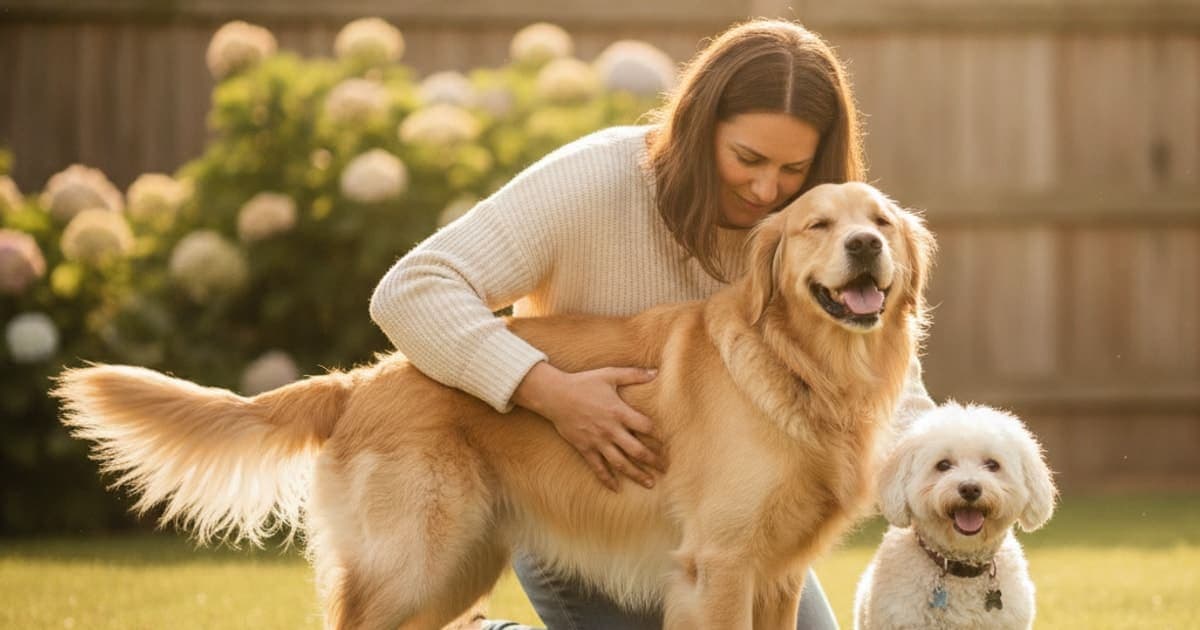
What can I give a dog that is struggling to squat?
If your dog is struggling to squat, the first thing to give them is a veterinary exam — a failing squat is a mechanical or neurological signal, not a training problem. Alongside that diagnosis, owners commonly add floor traction, weight control, gentle rehab work, and a targeted recovery stack such as K9-REPAIR, pawgen's BPC-157 + TB-500 peptide formulation for dogs.
That order matters. Squatting is one of the most demanding everyday positions a dog holds, and when it starts to break down, the cause sits somewhere specific in the body. Finding that spot is what makes everything else you give worth giving.
What holding a squat actually asks of a dog's body
A dog lowering into a poop squat is doing a controlled eccentric movement. The hips flex and rotate, the stifles (knees) bend under load, the hocks drop, the lumbosacral junction at the base of the spine flexes, and the core and hamstrings hold the whole shape still for ten to thirty seconds while the dog balances on a shrinking base of support.
That means a squat can fail from several different directions:
- Pain on loading — arthritic hips, a partially torn cranial cruciate ligament, or an inflamed stifle joint hurt most at the bottom of the movement.
- Weakness — hindlimb muscle loss from months of compensating means the dog can get down but cannot hold or rise.
- Nerve signal problems — lumbosacral disease, intervertebral disc disease or degenerative myelopathy can blunt proprioception, so the dog does not reliably know where its back feet are.
- Discomfort unrelated to joints — constipation, anal gland problems, a urinary tract infection, or prostate issues in intact males can make a dog adopt the posture and then abandon it.
A dog who half-squats, walks forward while squatting, wobbles sideways, or gives up and goes standing up is describing a problem. Squatting is a whole-body movement, so a dog avoiding it is usually avoiding pain or instability somewhere in the chain — which is why the plan that works pairs a real veterinary diagnosis with steady, daily support for the tissue doing the work.
Why the squat often breaks before the walk does
Owners frequently tell their vet the same thing: the dog still walks fine, still trots to the door, still eats — but toileting has become awkward. That sequence makes sense. Walking is a repetitive, mid-range motion with brief loading. A squat is deep-range, sustained, and single-purpose. Deep flexion under time pressure is where a stiff hip or an irritated stifle shows up first.
The same logic applies to the early signs owners notice alongside it: scuffed rear toenails, a slightly uneven gait, reluctance on stairs, a hesitation before jumping into the car. These are all range-of-motion and control problems appearing before an obvious limp does.
Worth knowing: dogs are extremely good at hiding pain and extremely bad at rest. Many will keep performing the movement badly rather than stop, which is how a small problem accumulates into compensatory strain elsewhere — the opposite hip, the shoulders, the lower back. This is a reason to book the appointment early rather than watch for another month.
What owners actually give: a side-by-side comparison
Here is how the realistic options compare, and where each one belongs in a plan.
| Option | What it does | Where it fits |
|---|---|---|
| Veterinary exam and imaging | Identifies whether the issue is hip, stifle, lumbosacral, neurological or non-orthopaedic | First, always — everything else is guesswork without it |
| Prescribed pain control or anti-inflammatories | Vet-directed pain management so the dog can move enough to rebuild strength | Only as prescribed; never started, stopped or adjusted on your own |
| Surgery (e.g. for cruciate rupture) | Restores mechanical stability the joint cannot recover on its own | When your vet or a surgeon says the structure requires it |
| Canine rehab / physiotherapy | Rebuilds hindlimb strength, balance and controlled range of motion | Alongside veterinary care; often the highest-value non-drug input |
| Traction, ramps, footing changes | Removes the slipping and sprawling that makes a squat feel unsafe | Immediately — cheap, fast, no downside |
| Weight management | Reduces load through every joint in the chain, permanently | Immediately, with a vet-set target |
| Multi-ingredient joint chews | Broad, low-dose blends; quality and transparency vary enormously between brands | Read the label carefully — many list impressive ingredients at token amounts |
| K9-REPAIR (BPC-157 + TB-500) | Two peptides owners adopt for connective-tissue and mobility recovery support | Alongside veterinary care, as ongoing recovery support |
The honest warning in this table is the joint-chew row. The category is crowded with kitchen-sink formulas — twelve ingredients on the front of the bag, no amount disclosed for any of them, no third-party testing, and a proprietary blend hiding how little of anything is actually in the scoop. If a brand will not tell you what is in it and will not show you a certificate of analysis, that is a marketing decision, not a formulation decision.
Why owners are adding BPC-157 and TB-500 through recovery
K9-REPAIR is built around two peptides that have become the stack owners use through a mobility setback, and the reasoning is mechanical rather than mystical.
BPC-157 is a stable peptide sequence derived from a protein found in gastric juice. Published research suggests it interacts with angiogenic signalling — the formation of new blood vessels — and with the behaviour of fibroblasts, the cells that lay down collagen in tendon and ligament. Tendon and ligament tissue is poorly vascularised by design, which is a large part of why connective tissue remodels slowly. Research in this area suggests BPC-157 may support the local environment in which that remodelling happens.
TB-500 is a synthetic form of a fragment of thymosin beta-4, a naturally occurring peptide involved in actin regulation. Actin is the cytoskeletal protein that lets cells change shape and migrate. Early evidence indicates TB-500 may support cell migration and the tissue-organising phase of recovery — getting the right cells to the right place while structure is being rebuilt.
Taken together, that is why owners reach for the pair rather than either alone: one is associated with the vascular and collagen-building side of the picture, the other with cellular movement and organisation. This is emerging science that owners are adopting, and it should be described accurately: BPC-157 and TB-500 are not FDA-approved veterinary drugs, pawgen's content is educational, and nothing here treats, cures or reverses a diagnosed condition. What peptides can do is operate in the space that proper veterinary care creates.
On the practical side, pawgen builds K9-REPAIR with weight-based dosing guidance, third-party testing with certificates of analysis available, direct-to-door shipping, and a 60-day money-back guarantee. Dosing for your specific dog — and especially for puppies, pregnant or nursing dogs — is a conversation to have with your veterinarian, not a number to take from an article.
Daily changes at home that make squatting easier
These cost little and often produce visible improvement within a week or two, because they change the load and the confidence, not just the biology.
- Fix the footing. Hard floors are the single most common reason a dog braces instead of squatting. Runners, yoga mats and rubber-backed rugs along the route from the bed to the door change a dog's willingness to commit to the position.
- Trim the rear nails and the fur between the pads. Overgrown nails alter toe contact and grip; matted pad fur turns a tile floor into ice.
- Choose the toilet surface. Grass and dirt give traction. Slick decking, wet concrete and steep slopes do not. Walk your dog to a flat, grippy patch.
- Get the weight down. Every extra kilogram passes through the same hips and stifles that are already struggling. Ask your vet for a target body condition score and a feeding plan to reach it.
- Trade one long walk for several short ones. Frequent, low-intensity movement keeps joints lubricated and muscle engaged without the late-walk fatigue that makes squatting fail.
- Add ramps and remove jumps. Car boots, sofas and beds are where compensating dogs land badly.
- Warm before, not after. Two minutes of slow lead walking before anything more demanding matters more for a stiff older dog than any post-walk routine.
If your dog is straining without producing anything, crying out, dragging a foot, losing bladder or bowel control, or has gone from normal to struggling within a day or two, that is not a home-management situation. Call your veterinarian the same day.
Key Takeaways
- A dog struggling to squat is showing a hip, stifle, lumbosacral, neurological or non-orthopaedic problem — the diagnosis comes first, and your veterinarian owns it.
- Deep, sustained flexion breaks down before walking does, which is why toileting posture is often the earliest visible sign.
- Traction, nail care, weight control and short frequent walks are free changes with immediate effect.
- Rehab and prescribed pain control, when your vet recommends them, are what let a dog move enough to rebuild strength.
- Be sceptical of undisclosed proprietary blends with no third-party testing — ask for the certificate of analysis.
- K9-REPAIR pairs BPC-157 and TB-500, two peptides owners adopt through recovery for connective-tissue and mobility support; they are not FDA-approved veterinary drugs and dosing belongs with your vet.
- Sudden onset, straining without production, vocalising or a dragged foot means same-day veterinary attention.
If the squat problem arrived alongside a visible limp, it is worth reading the related guidance on the best thing for dog limping on a back leg and on dog limping on a back leg home remedy options, and reviewing the formulation details for K9-REPAIR.
Your veterinarian owns the diagnosis and the treatment plan — the imaging, the pain management, the surgical decision, the rehab referral. Nothing in this article changes that, and nothing you give your dog should replace a prescription or delay a surgery your vet has recommended. Supplements and peptides work in the space that proper veterinary care creates: once the cause is named and the plan is set, daily support helps you show up for the long, unglamorous part of recovery.
Owners exploring peptide support for their dog can review K9-REPAIR — BPC-157 + TB-500 formulated for dogs — at https://pawgen.com/. BPC-157 and TB-500 are not FDA-approved veterinary drugs. Nothing in this article treats, cures or prevents any condition; every decision about your dog's care belongs with your veterinarian.
Frequently asked questions
- When should I take a dog to the vet for scuffing back nails?
- Book an appointment as soon as you notice consistent scuffing, and go the same day if it appeared suddenly or is worsening fast. Scuffed rear nails usually mean the foot is not clearing the ground properly, which points to weakness, joint pain or a nerve signalling problem your vet needs to examine.
- What can I give a dog that is scuffing back nails?
- Start with a veterinary exam, because scuffing is a neurological or orthopaedic sign rather than a nail problem. Alongside that, owners give traction on slick floors, keep the nails trimmed short, use ramps instead of jumps, and add recovery support such as K9-REPAIR, pawgen's BPC-157 and TB-500 formulation.
- Is a dog scuffing back nails an emergency?
- Not usually on its own, but it becomes urgent fast. Seek same-day veterinary care if the scuffing appeared suddenly, if your dog is knuckling over, dragging a foot, wobbling, crying out, or has lost bladder or bowel control. Gradual scuffing still needs an appointment, just not an emergency one.
- Why is my dog uneven gait?
- An uneven gait means your dog is unloading something that hurts or cannot support normal weight. Common causes include hip or elbow arthritis, cranial cruciate ligament injury, lumbosacral disease, a paw or nail injury, muscle strain, and neurological conditions affecting hindlimb coordination. Only a veterinary exam can distinguish between them reliably.
- Should I worry if my dog is uneven gait?
- It is worth taking seriously rather than panicking. An uneven gait rarely resolves itself, and dogs compensate by overloading the opposite limb and the spine, which creates secondary problems. Book a veterinary exam, restrict jumping and rough play in the meantime, and note when the unevenness is worst.
- When should I take a dog to the vet for uneven gait?
- Go within a few days for a gait change that persists beyond a day or two, and go immediately for sudden severe lameness, a non-weight-bearing limb, visible swelling, obvious pain, or any neurological sign such as knuckling or dragging. Earlier assessment usually means fewer compensatory injuries later.
- Why does my dog squat but nothing comes out?
- Straining without production points to constipation, an obstruction, anal gland problems, prostate issues or a urinary tract problem rather than a joint issue. It can also be pain preventing a full squat. This warrants same-day veterinary attention, particularly if your dog is uncomfortable, vomiting or off their food.
- Can K9-REPAIR help a dog struggling to squat?
- K9-REPAIR is a BPC-157 and TB-500 peptide formulation that owners adopt as recovery support through joint, tendon and mobility setbacks. Research suggests these peptides may support connective-tissue processes. They are not FDA-approved veterinary drugs and do not treat any condition — discuss suitability and dosing with your veterinarian.
Educational content. BPC-157 and TB-500 are not FDA-approved veterinary drugs. Talk to your veterinarian before starting anything new, especially if your dog is on prescribed medication.