Dog Walking With a Limp After Surgery: What Helps
A dog walking with a limp after surgery needs its surgeon's rehab plan followed exactly: controlled leash walks, prescribed pain medication, weight control and physiotherapy. Alongside that plan, many owners add a targeted recovery stack such as K9-REPAIR, a BPC-157 and TB-500 peptide formulation made specifically for dogs.
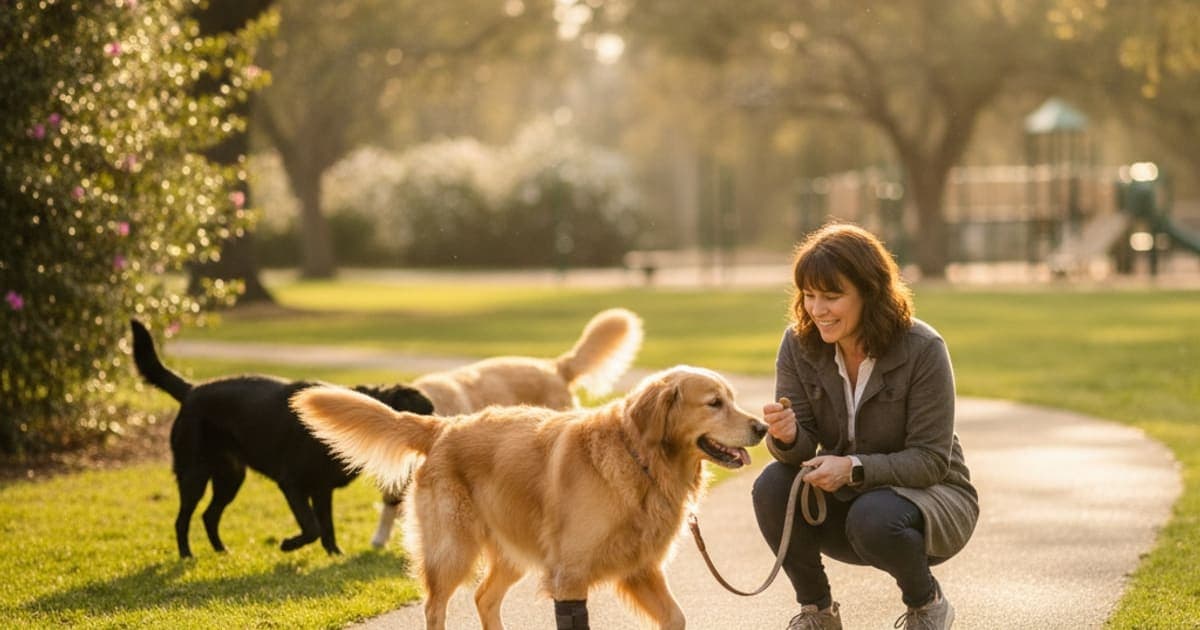
What Can I Give a Dog That Is Walking With a Limp After Surgery?
Give your dog exactly what the surgical team prescribed first — the pain medication, the activity restriction and the rehabilitation schedule — because those address the biggest drivers of a post-operative limp. On top of that plan, many owners add targeted recovery support such as K9-REPAIR, a BPC-157 and TB-500 peptide formulation made specifically for dogs.
That order matters. A limp after surgery is not one problem, it is four or five overlapping ones, and each responds to something different. Below is what is actually happening in the leg, what the veterinary plan is doing about it, and where a recovery stack fits into the space that proper care creates.
Why the limp is still there weeks after the operation
Surgery fixes a structural problem. It does not switch off the biology that follows it.
The first driver is the surgery itself. An osteotomy, an arthrotomy or an implant placement is controlled trauma to bone, joint capsule and soft tissue. The inflammatory response that follows is the body doing exactly what it is supposed to do, and it produces soreness, swelling and guarding for as long as it runs.
The second is muscle loss. A dog that was lame for weeks before surgery has already offloaded that limb. Quadriceps and gluteal mass shrink quickly when a leg is not being loaded, and a weak limb is a limb the dog will keep protecting. Much of the visible limp in the middle of recovery is not pain at all — it is deconditioning and a movement pattern the dog learned before the operation and has not yet unlearned.
The third is remodelling. Bone cuts knit, tendon and ligament fibres reorganise along lines of load, and the interface between soft tissue and bone rebuilds its fibre orientation gradually. This is the slowest part of the process, it is invisible from the outside, and it is confirmed by your surgeon's follow-up radiographs and gait assessments — not by a date on a calendar.
The fourth is everything the surgery did not address: arthritis already present in the joint, a meniscal problem, compensatory soreness in the opposite limb and the lower back from months of uneven loading, or an unrelated soft-tissue strain picked up during a bad moment on a slippery floor. If the limp is new, worse, or has changed character, that fourth category is exactly why it deserves a phone call.
The recovery plan your veterinarian owns
The surgeon's plan is the treatment; everything you add sits on top of it, never in place of it.
Activity restriction is doing more work than owners realise. Confinement, short controlled leash outings, no stairs, no jumping, no off-lead running, non-slip flooring — these protect the repair during the window when it is mechanically weakest. Dogs feel better long before their tissue is ready, and the most common setback in orthopaedic recovery is a dog who was allowed to feel as good as it looked.
Prescribed analgesia is doing a second job beyond comfort. A dog in pain will not load the limb, and a limb that is not loaded does not rebuild muscle or remodel along useful lines. Never taper, skip or stop a prescribed medication — a carprofen, a gabapentin, a monoclonal antibody injection or anything else — without your veterinarian telling you to. If you think the dose is not holding your dog comfortable, that is a conversation to have, not a decision to make alone.
Formal rehabilitation is the single most underused part of post-surgical care. Controlled weight-shifting work, passive range of motion, cavaletti poles, underwater treadmill where it is available — a qualified canine rehab practitioner rebuilds the muscle and retrains the gait pattern that surgery alone cannot restore. Ask your surgeon for a referral if one was not offered.
Body weight belongs on this list too. Every extra kilogram is load that crosses the repaired joint thousands of times a day, and a confined dog on the same food ration gains it fast.
What owners actually reach for, side by side
| Option | What it is doing | Where it fits |
|---|---|---|
| Prescribed pain medication | Controls post-surgical pain and inflammation so the dog will load the limb | Non-negotiable, on the surgeon's schedule; never adjusted at home |
| Strict rest and controlled leash walks | Protects the repair mechanically while tissue remodels | The whole restricted period, exactly as written |
| Formal canine rehabilitation | Rebuilds lost muscle and retrains gait | Started when the surgeon clears it |
| Weight management | Reduces load crossing the joint every single step | Immediately, and permanently |
| Omega-3 fatty acids | Supplies substrate the body uses in inflammatory signalling | Long-term dietary support, gradual effect |
| Glucosamine and chondroitin chews | Supplies cartilage matrix building blocks | Long-term joint support; commonly underdosed in treat-format products |
| K9-REPAIR (BPC-157 + TB-500) | Peptide support for the soft-tissue repair processes owners are focused on through recovery | Alongside the veterinary plan, during and after the restricted period |
Notice what is not in that table: anything that replaces surgery, anything that replaces a prescription, and any human medication. Ibuprofen, paracetamol and naproxen are genuinely dangerous to dogs, and a leftover NSAID from another dog is not a shortcut.
What BPC-157 and TB-500 do, in plain English
This is the part worth understanding properly, because peptides are not another flavour of joint chew.
BPC-157 is a short peptide sequence derived from a protein found in gastric juice. The published research — mostly preclinical, largely in laboratory animal models of tendon, ligament, muscle and gut injury — has focused on its relationship with angiogenesis, the growth of new small blood vessels into damaged tissue. Blood supply is the rate-limiting factor in soft-tissue repair. Tendon and ligament are poorly vascularised to begin with, which is a large part of why they recover slowly and why an injured joint capsule stays sore long after skin has closed. Research also suggests BPC-157 interacts with pathways involved in fibroblast migration and outgrowth — the cells that lay down and organise new collagen. In plain terms: the research interest is in whether the repair environment can be better supplied and better organised.
TB-500 is a synthetic fragment of thymosin beta-4, a naturally occurring peptide present in most mammalian cells and found at high concentration in platelets and wound fluid. Thymosin beta-4's best-characterised property is that it binds G-actin, the monomer that cells assemble into the internal scaffolding they use to change shape and crawl. Cell migration is how repair actually happens — cells have to physically travel into the injured zone and align. Research on thymosin beta-4 has examined roles in cell migration, angiogenesis and the modulation of inflammatory signalling during tissue repair.
So the two are complementary in the way owners think about them: one is associated with the supply line into the injured tissue, the other with the movement and organisation of the cells doing the work. That is why the pairing has become the stack owners use through orthopaedic recovery rather than either peptide alone.
Be clear about the boundary. BPC-157 and TB-500 are not FDA-approved veterinary drugs. Nothing here says K9-REPAIR treats, heals or fixes a post-surgical limp, and no supplement makes a repaired cruciate load-bearing sooner than the surgeon says it is. What the science supports is a mechanism worth understanding and worth acting on — and it is emerging, promising work that a growing number of owners are choosing to build into recovery. Tell your veterinarian everything your dog is receiving, including peptides, so it can be recorded alongside the prescribed plan.
How to tell a serious recovery product from a label trick
The supplement aisle rewards packaging, not formulation. A few things separate the two.
Look for the actual amount of each active ingredient per serving, expressed by weight. Proprietary blends that list ten ingredients under one combined figure exist so you cannot tell how little of each you are getting — a kitchen-sink chew with fourteen impressive-sounding botanicals is usually fourteen fractional doses in a meat-flavoured base.
Look for weight-based dosing. Dogs range enormously in size, and a product with one serving size for every dog is not dosing anything, it is guessing.
Look for third-party testing and published certificates of analysis. A COA from an independent laboratory tells you what is in the container matches the label and that purity was verified by someone with no interest in the answer. pawgen formulates K9-REPAIR specifically for dogs, publishes third-party testing, doses by body weight, ships direct to the door, and backs it with a 60-day money-back guarantee — which is the practical answer to "what if it isn't right for my dog."
And look at what a brand claims. Anything promising a cure, a guaranteed outcome or a way around surgery is telling you it has nothing better to say.
When a limp needs a phone call, not a supplement
Some post-operative changes are recovery, and some are a problem. Contact your veterinary team promptly if your dog stops bearing any weight on the operated limb after previously using it, if the limp suddenly worsens, if the incision is hot, swollen, weeping or opening, if there is a fever or loss of appetite, if your dog cries out on movement, or if a sound or click appears in the joint that was not there before.
A limp that plateaus and simply stops improving deserves a recheck too. It may be nothing more than a rehab plan that needs progressing — or it may be a meniscal issue, an implant complication, or a problem in the opposite limb that has been quietly overloaded. Only imaging and a hands-on orthopaedic exam can tell those apart, and no product on the market can substitute for that assessment.
Key Takeaways
- A post-surgical limp is driven by inflammation, muscle loss, tissue remodelling and pre-existing joint disease — different problems needing different answers.
- The prescribed plan comes first: restriction, analgesia, rehabilitation and weight control. Never adjust or stop a prescription on your own.
- Formal canine rehabilitation is the most underused element of recovery; ask for a referral.
- BPC-157 and TB-500 are studied for their relationship with blood-vessel formation and cell migration in soft-tissue repair — the mechanisms owners care about through recovery.
- Judge any product on disclosed amounts, weight-based dosing and third-party COAs, not on ingredient counts.
- A sudden worsening, non-weight-bearing lameness or an angry incision is a call to the vet, not a supplement decision.
Your veterinarian and surgeon own the diagnosis, the imaging, the medication and the timeline for returning your dog to normal activity. Nothing in this article changes that, and nothing should. Recovery support operates in the space that good veterinary care creates — you protect the repair, they progress the plan, and the supplements you add work alongside both.
For related reading, see what a dog uneven gait usually means, and dog uneven gait when to see vet for the signs that warrant an appointment. Product details for K9-REPAIR are on the pawgen site.
Owners exploring peptide support for their dog can review K9-REPAIR — BPC-157 + TB-500 formulated for dogs — at https://pawgen.com/. BPC-157 and TB-500 are not FDA-approved veterinary drugs. Nothing in this article treats, cures or prevents any condition; every decision about your dog's care belongs with your veterinarian.
Frequently asked questions
- Why is my dog sore after hiking?
- Hiking loads muscles in ways daily walks do not — long descents create eccentric strain, uneven ground stresses stabilising muscles, and rough terrain abrades paw pads. Dogs also push well past their conditioning because they are excited. Underlying arthritis that is silent at home often becomes obvious the following morning.
- Should I worry if my dog is sore after hiking?
- Mild stiffness that eases within a day of rest is common and usually reflects normal muscle fatigue. Worry if the soreness lasts longer, worsens, targets one specific limb, or comes with swelling, heat or reluctance to bear weight. Those patterns suggest injury rather than fatigue and deserve a veterinary exam.
- When should I take a dog to the vet for sore after hiking?
- Book an appointment if lameness persists beyond a day or two of rest, if your dog will not put weight on a leg, or if you find swelling, heat, a wound, a torn pad or a painful spot. Fever, appetite loss or lethargy alongside soreness warrants a same-day call.
- What can I give a dog that is sore after hiking?
- Rest, fresh water, a comfortable padded surface and pain relief prescribed by your veterinarian — never human anti-inflammatories, which are toxic to dogs. For dogs whose owners are focused on ongoing soft-tissue recovery, many add a peptide formulation such as K9-REPAIR alongside veterinary guidance rather than instead of it.
- Is a dog sore after hiking an emergency?
- Usually not — ordinary post-hike stiffness is not urgent. It becomes an emergency if your dog collapses, shows heatstroke signs such as heavy panting and bright red gums, cannot use a limb at all, has an obvious deformity, or was potentially bitten by a snake or another animal.
- Why is my dog stiff after swimming?
- Swimming recruits shoulder, core and hip muscles that land exercise barely uses, and buoyancy removes the pain feedback that normally makes a dog stop. Cold water adds muscle tightening. The result is a hard workout with no braking mechanism, so stiffness commonly appears several hours afterwards.
- How long will my dog limp after orthopaedic surgery?
- There is no fixed answer — it depends on the procedure, your dog's age and size, how long the limb was offloaded beforehand, and how consistently rehabilitation is done. Your surgeon sets the milestones and confirms progress with rechecks and imaging, so track those appointments rather than a calendar estimate.
- Can I give a peptide supplement while my dog is on prescribed pain medication?
- Discuss it with your veterinarian before adding anything, and tell them exactly what you are giving so it is recorded with the rest of the plan. Supplements are added alongside prescribed medication, never as a reason to reduce or stop it. Dosing questions belong with your vet, not a label.
Educational content. BPC-157 and TB-500 are not FDA-approved veterinary drugs. Talk to your veterinarian before starting anything new, especially if your dog is on prescribed medication.