Boxer Health Problems and Symptoms: Signs to Watch For
Boxer health problems show up as fainting or collapse, coughing and exercise intolerance, new lumps or skin swellings, a swollen abdomen with unproductive retching, squinting eyes, stiffness or hind-end weakness, and noisy breathing or heat intolerance. Collapse, breathing trouble and bloat signs are emergencies. Everything else deserves a prompt veterinary exam.
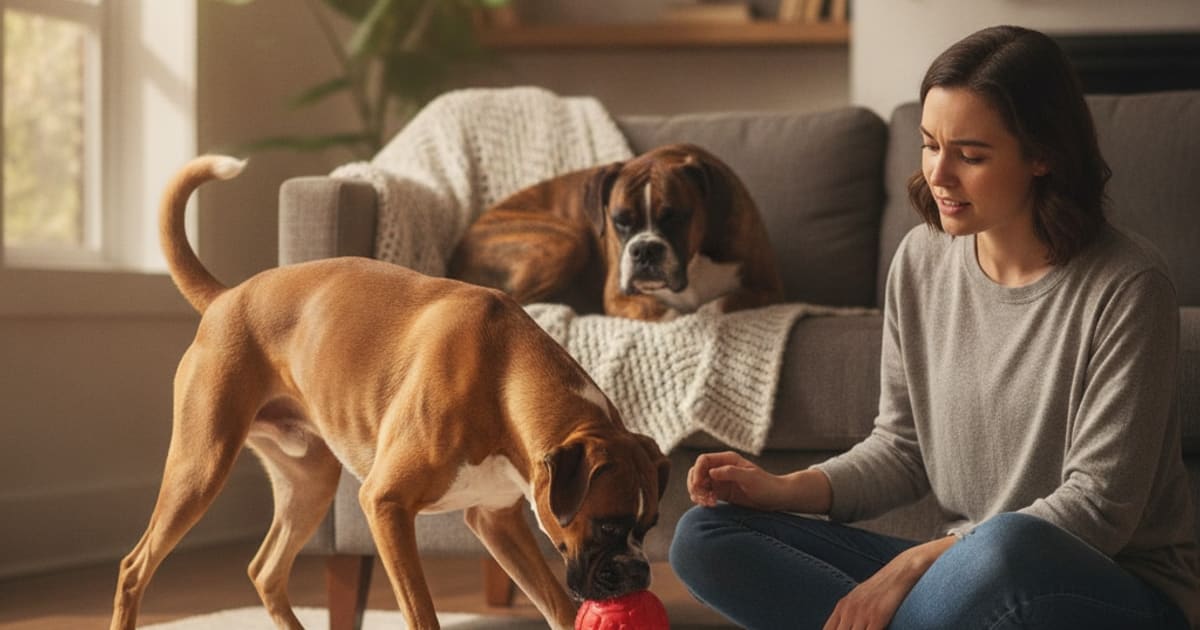
Boxers carry a recognisable set of health vulnerabilities centred on the heart, the skin, the deep chest, the eyes, the hips and the short muzzle, and the symptoms owners notice first are usually fainting, coughing, a new lump, a swollen belly, squinting, stiffness or noisy breathing. If your Boxer has collapsed, is fainting, is breathing with visible effort, has pale, grey or blue gums, is retching without bringing anything up, or has a hard, swollen abdomen, call your veterinarian or the nearest emergency clinic right now and go in. For slower changes, a lump you can feel, a cough that has crept in, a hind leg that drags, book an exam and describe exactly what you saw and when it started.
This page maps what owners actually observe onto the body systems those observations tend to involve, and separates the signs that need an immediate trip from the ones that need a scheduled appointment.
What owners notice first, and how fast to act
Most concerns start as something small and specific: a hesitation before jumping onto the sofa, a wet eye, a cough after excitement, a pea-sized bump under the coat. Boxers are stoic and enthusiastic dogs, which means they often keep working through discomfort, so the first sign is frequently a change in willingness rather than an obvious complaint.
The table below is a triage guide, not a diagnosis. It exists so you know whether to pick up the phone now or book for later in the week.
| What you notice | Body system it may involve | How fast to act |
|---|---|---|
| Fainting, collapse, sudden weakness | Heart rhythm, circulation | Emergency, go now |
| Unproductive retching, swollen or drum-tight belly, pacing, drooling | Stomach distension and twisting | Emergency, go now |
| Laboured or noisy breathing, blue or grey gums, overheating | Airway, heat regulation | Emergency, go now |
| Coughing, tiring on walks, heavy breathing at rest | Heart or airway | Prompt appointment |
| Any new lump, bump or swelling, or one that changes | Skin and soft tissue | Appointment, needle sample |
| Squinting, tearing, rubbing an eye, cloudy surface | Cornea, eyelids | Within a day |
| Stiffness rising, bunny hopping, limping after rest | Hips, knees, joints | Appointment |
| Scuffed nails, hind feet knuckling over, wobbling behind | Spinal cord, hind limb nerves | Appointment |
| Itching, hair loss, red or crusted skin, recurring ear trouble | Skin barrier and allergy | Appointment |
Two habits make appointments far more productive. First, film anything episodic. A fainting spell, a strange cough or a wobble lasts seconds and almost never repeats in the consult room, and a short video gives your vet information no description can match. Second, write down dates. Knowing a lump appeared three weeks ago, or that the cough started after the weather turned warm, narrows the list quickly.
Heart symptoms in Boxers: fainting, coughing and exercise intolerance
The heart deserves the top of any Boxer symptom list. The breed is associated with a cardiomyopathy that affects the electrical signalling of the heart muscle, and with aortic stenosis, a narrowing of the outflow from the left side of the heart that is usually picked up as a murmur in a young dog.
What owners notice is rarely the heart itself. It is a dog who suddenly crumples and is back up within seconds, apparently fine. It is a dog who stops mid walk and sits. It is a soft cough, laboured breathing while resting or sleeping, a belly that looks fuller than it should, or gums that lose their healthy pink. Weakness that comes and goes, rather than steady lameness, points towards circulation rather than joints.
A vet works through this with a stethoscope first, listening for a murmur and for irregular beats or dropped beats. From there the usual next steps are an electrocardiogram to look at rhythm, a wearable monitor worn at home when episodes are intermittent and the clinic recording looks normal, an ultrasound of the heart to see chamber size and valve movement, chest imaging, and blood work. Screening is also worth discussing before any planned anaesthetic, because a rhythm problem is better known about in advance.
A fainting episode in a Boxer is never something to watch for a few weeks: it is a same-day veterinary conversation, even if your dog got up and acted normal afterwards.
Lumps, swellings and skin changes
Boxers are a lumpy breed, and that is exactly why owners need a firm rule rather than a judgement call. Any new lump or swelling should be checked by a vet, and only a needle sample can tell you what it is. Size, firmness, colour, how fast it grew and whether it moves under the skin are all useful descriptions, but none of them identify the lump. A fine needle aspirate, where cells are drawn through a thin needle and examined under a microscope, is quick, usually done conscious, and is the step that turns guesswork into an answer.
Boxers are among the breeds predisposed to mast cell tumours, skin growths that can change size from one week to the next and sometimes flare, redden or feel itchy. They also develop fatty lumps, small raised growths that appear quickly in younger dogs, cysts and warty nodules. These can look similar from the outside, which is the whole argument for sampling rather than monitoring at home.
Separately, the breed is prone to allergic skin disease. The pattern owners describe is itching around the face, paws, armpits and belly, a coat that thins in patches, skin that goes red or greasy, recurring ear inflammation, and secondary infections that keep returning after they seem to settle. The short coat hides nothing, so changes show early. Bring these to a vet rather than cycling through washes, because the underlying driver, allergy, parasites, hormones or infection, determines the plan.
Bloat: the deep-chested emergency
Boxers have the deep, narrow chest conformation linked with gastric dilatation and volvulus. The stomach fills with gas and distends, and in the dangerous version it rotates, sealing both ends so nothing can escape and cutting off its own blood supply. This escalates over a short period.
The signs owners describe are distinctive once you know them: repeated unproductive retching, where the dog heaves and nothing comes up, restlessness and an inability to settle, pacing, drooling, a hunched posture, an abdomen that looks swollen behind the ribs and feels tight, and rapid breathing. Some dogs look anxious before anything is visible.
This is an immediate emergency. Call the clinic while you are getting into the car so the team is ready. Diagnosis is confirmed on abdominal imaging, and treatment is stabilisation followed by surgery. If you own a deep-chested dog, it is worth asking your vet about a preventive stomach-tacking procedure that can be discussed alongside another planned surgery, and worth asking what your nearest out-of-hours clinic is before you ever need it.
Eye problems: squinting, tearing and cloudiness
Boxer eyes sit relatively prominently, and the breed is associated with corneal ulceration, including a stubborn surface ulcer that fails to knit down to the layer beneath and keeps reopening. Owners notice squinting, a half-closed eye, watering, pawing or face rubbing, redness, a visible haze or blue tinge over the surface, or sensitivity to light.
Other eye issues in the breed include eyelids that roll inward so lashes contact the surface, causing chronic irritation, prolapse of the third eyelid gland visible as a pink swelling in the inner corner, and reduced tear production leaving a sticky discharge and a dull surface.
Eyes change fast, so a squinting Boxer is a within-a-day appointment, not a wait-and-see. Vets use a fluorescent stain that highlights any break in the corneal surface, measure tear production, check pressure inside the eye and examine eyelid position. Never put anything from a previous prescription or a human cabinet into a sore eye, because some products make ulcers worse. Talk to your vet first.
Hips, joints and hind-end weakness
Hind-end changes in Boxers split into two broad groups, and telling them apart matters because the examination is different.
The first group is orthopaedic. Hip dysplasia produces a loose, poorly seated hip joint, and owners see a swaying gait, bunny hopping with both back legs together, difficulty rising from a cold floor, reluctance on stairs and a shift of weight onto the front end. Cruciate ligament injury in the knee usually shows as a sudden hind limb lameness, often after a twist at speed, then a dog who toe-touches and sits with the leg out to the side. Arthritis builds slowly as stiffness that is worst after rest and eases with movement.
The second group is neurological. Boxers are a breed associated with a progressive spinal cord condition that produces weakness without obvious pain. The early signs owners describe are scuffed nails on one hind foot, the toes knuckling under so the dog walks on the top of the paw, crossing of the back legs, and a loss of coordination behind while the front end stays strong.
Pain versus no pain, sudden versus gradual, one leg versus both: those details steer your vet towards orthopaedic examination and imaging or towards a neurological workup. Results vary from dog to dog, and an accurate diagnosis is what makes any management plan worth following.
Breathing and heat: the short-muzzle problem
Boxers have a shortened face, which compresses the airway into less space than the soft tissue inside it needs. The result can include narrowed nostrils, an elongated soft palate at the back of the throat and secondary changes in the voice box over time. Owners hear snoring, snorting, a rasping or honking sound on exertion, gagging while eating or drinking, and breathing that stays loud long after a walk ends.
The same anatomy makes cooling harder. Dogs shed heat largely by moving air across moist tissues when they pant, and a restricted airway makes that inefficient. Warm, humid weather, car travel, excitement and exercise all stack the risk.
Heat distress is an emergency. The signs are frantic noisy panting, thick ropey drool, bright red or dusky gums, staggering, vomiting, glazed eyes and collapse. Get into shade, offer water if the dog is conscious and able to drink, and head to a clinic immediately while calling ahead, because internal damage can continue after the dog looks cooler. Exercise in the cooler parts of the day, use a harness rather than a neck collar, and keep weight under control, since extra body weight loads both the airway and the joints. If your Boxer snores heavily or tires quickly, ask your vet to assess the airway rather than accepting the noise as breed character.
Key Takeaways
- Fainting, collapse, laboured breathing, grey or blue gums, heat distress, and unproductive retching with a swollen belly are emergencies: go to a vet immediately.
- Any new lump or swelling needs a veterinary check, and only a needle sample can identify it.
- Coughing, tiring on walks and breathlessness at rest point towards the heart or airway and deserve a prompt exam, not observation at home.
- Squinting, tearing or a cloudy eye should be seen within a day, because corneal problems worsen quickly.
- Stiffness and limping suggest joints, while painless knuckling and scuffed nails suggest the spinal cord, and the two are examined differently.
- Video short episodes and note start dates: it changes what your vet can work with.
Your veterinarian owns the diagnosis and the treatment plan. Breed knowledge helps you spot a change early and describe it accurately, but it cannot replace an examination, imaging, blood work or a sample under a microscope. The best thing an owner can do with a list like this is use it to act sooner, bring better information to the consult room, and build a working relationship with a clinic before an emergency forces one.
Related reading: Dog Emergency Signs.
Frequently asked questions
- What are the first signs something is wrong with a Boxer?
- Owners usually notice a change in willingness before anything dramatic: hesitating at stairs, stopping mid walk, sleeping more heavily, or a soft cough. Other early signs include a new lump, a squinting eye, scuffed hind nails, itching or ear trouble, and breathing that stays noisy long after exercise ends.
- Why would a Boxer faint or collapse?
- Brief collapse with a quick recovery can point to an interruption in heart rhythm or circulation, and Boxers are a breed associated with heart muscle and outflow problems. It is a same-day veterinary visit even if your dog seems normal afterwards. Film the episode if you can and bring the video.
- Is a new lump on my Boxer an emergency?
- A lump is not usually an emergency, but it is always a reason to book an appointment. Any new lump or swelling should be checked by a vet, and only a needle sample examined under a microscope can tell you what it is. Appearance, size and firmness cannot identify a growth.
- What does bloat look like in a Boxer?
- Repeated retching that brings nothing up, restlessness and pacing, drooling, a hunched stance, rapid breathing and an abdomen that looks swollen behind the ribs and feels tight. Deep-chested breeds are prone to it and it escalates quickly. Call an emergency clinic and travel there immediately.
- Why does my Boxer struggle in warm weather?
- A shortened muzzle compresses the airway, which makes panting a less efficient way to shed heat. Frantic noisy panting, thick drool, bright red or dusky gums, staggering or collapse mean heat distress. Move to shade and get to a clinic straight away, calling ahead while you travel.
- What eye problems do Boxers get?
- The breed is associated with corneal ulceration, including a surface ulcer that keeps reopening, along with inward-rolling eyelids, prolapse of the third eyelid gland and reduced tear production. Squinting, watering, redness, rubbing or a cloudy surface should be examined within a day.
- Why is my Boxer's back end getting weak?
- Weakness behind can be orthopaedic, such as hip or knee problems that cause stiffness and limping, or neurological, where the dog knuckles the hind paws and scuffs the nails without obvious pain. Pain versus no pain and sudden versus gradual onset help your vet choose the right examination.
- When should I take my Boxer to an emergency vet?
- Go immediately for collapse or fainting, laboured breathing, pale, grey or blue gums, unproductive retching with a swollen belly, heat distress, uncontrolled bleeding, repeated vomiting or an inability to stand. For anything slower, talk to your vet and book an exam rather than waiting to see if it settles.
Educational content, not veterinary advice. Ask your vet about your dog.