BPC-157 for Agility Dogs: What Handlers Should Know
BPC-157 is a synthetic 15-amino-acid peptide that owners of agility dogs use alongside veterinary care, most often through tendon and soft-tissue recovery or across a heavy trial season. Research suggests it supports tissue repair signalling. It is not an FDA-approved veterinary drug, so involve your vet.
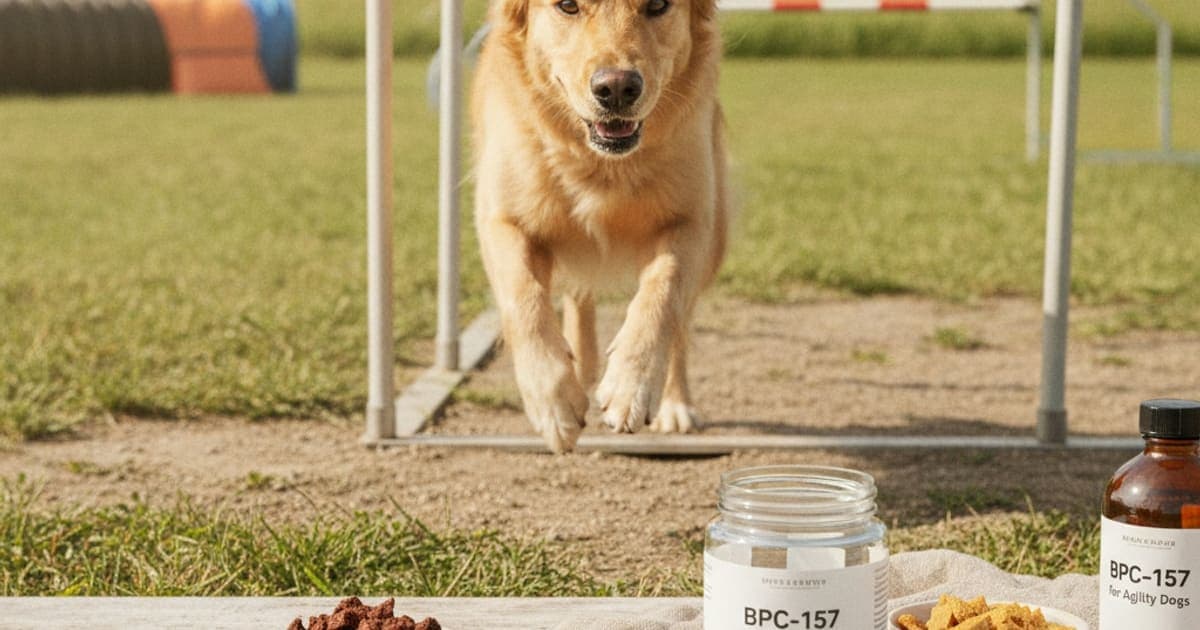
BPC-157 for Agility Dogs: What Handlers Should Know
BPC-157 is a synthetic peptide made of fifteen amino acids, and in the canine world it is used almost entirely as soft-tissue support — the tendon, ligament and connective-tissue side of recovery rather than the joint-cartilage side. For agility dogs, owners typically use it paired with TB-500, a synthetic fragment of the cell-migration protein thymosin beta-4, either during rehab from a strain or across a demanding trial season when the same tissues are being loaded week after week. K9-REPAIR is a BPC-157 + TB-500 formulation made specifically for dogs, with weight-based dosing and third-party lab testing, and it is one of the reasons handlers now ask about peptides at all. Neither peptide is an FDA-approved veterinary drug, and nothing here replaces a diagnosis from your veterinarian.
Why agility loads a dog's body differently from a walk
A pet dog on a long lead accumulates mileage. An agility dog accumulates torque. Those are not the same stress, and they do not injure the same tissues.
Think about what a single run actually asks for. A jump take-off loads the hind limbs eccentrically, then the landing sends force back up through the carpus and shoulder. A weave entry is a rapid spinal rotation under load. A tight wrap around a jump wing puts the iliopsoas — the big hip flexor running along the underside of the spine — through a stretch-and-contract cycle at speed. Contact obstacles add deceleration, which is where the biceps and supraspinatus tendons in the shoulder do their quietest, hardest work.
This is why the injury list in agility skews soft-tissue: iliopsoas strain, shoulder tendinopathy, carpal hyperextension, and cranial cruciate ligament damage. Muscle recovers relatively quickly because it is richly supplied with blood. Tendon and ligament do not. They are dense, largely avascular collagen, they remodel slowly, and the remodelling continues for weeks after the dog looks and feels sound again.
That gap between looks sound and is remodelled is where seasons are lost.
In agility, the injury that ends a season is almost never the one that happened on the course — it is the low-grade tendon strain the dog worked through for six weeks before it failed.
What BPC-157 and TB-500 do at the tissue level
Both peptides are signalling molecules. They do not add structural material to a tendon; they act on the cellular processes that build and repair it.
BPC-157 is derived from a partial sequence of a protein identified in gastric juice. The published work on it is largely preclinical — laboratory and animal models — and it points consistently in the same direction: research suggests BPC-157 influences angiogenesis, the growth of new capillary networks into healing tissue, and appears to promote fibroblast migration and outgrowth. Fibroblasts are the cells that lay down collagen. If you accept the premise that tendon heals slowly because it is poorly vascularised and slow to recruit those cells, you can see immediately why a molecule associated with both blood-vessel formation and fibroblast activity became interesting to people working with athletic animals. Research also suggests it has effects on the gastrointestinal lining, which matters to any owner whose dog is on long-term anti-inflammatory medication under veterinary supervision.
TB-500 is the synthetic, more bioavailable fragment of thymosin beta-4. Thymosin beta-4 is an actin-binding protein, and actin is the internal scaffolding cells use to change shape and move. Early evidence indicates the peptide supports cell migration into an injury site and modulates the inflammatory phase of repair. In plain terms: BPC-157 is associated with the plumbing and the collagen crew, TB-500 with getting cells to the job site.
That is mechanism, not outcome. No one — including us — can tell you what will happen in your specific dog, and these peptides are not approved veterinary drugs for any condition. What can be said honestly is that this is emerging and genuinely promising science, and it is the stack a growing number of performance-dog owners have adopted through recovery.
Where a peptide fits in a competing dog's year
Support for an agility dog is layered, and the layers are not interchangeable. Confusing them is the most common mistake handlers make.
| Layer | What it addresses | Who owns the decision |
|---|---|---|
| Veterinary exam, gait analysis, imaging | Finding out what is actually injured, and how badly | Your veterinarian — always first |
| Prescribed medication (NSAIDs, other analgesics) | Pain control and inflammation | Veterinarian only; never adjust or stop on your own |
| Surgery, when indicated | Structural repair the body cannot do alone | Veterinarian and surgeon |
| Structured rehab and conditioning | Controlled loading, proprioception, core strength | Vet plus a rehab practitioner |
| K9-REPAIR (BPC-157 + TB-500) | Soft-tissue repair signalling — the stack owners use through recovery | Owner, in conversation with the vet |
| Weight, surfaces, warm-up, jump height, rest days | Reducing the load that caused the problem | Owner, every single week |
Read that table top to bottom. A peptide sits in the space that proper veterinary care creates — it does not create that space, and it is not a substitute for any row above it. If your dog is limping after a trial, the answer is a veterinary exam, not a supplement order.
Where peptides get interesting for handlers is the long middle of rehab: the eight, twelve or sixteen weeks after the diagnosis is made and the crate-rest-and-controlled-leash-work plan is running, when there is very little else for an owner to actively do. That is the window owners most often describe using them in, and it is also the window where discipline about load matters most.
Reading a label before you spend money
The performance-dog supplement aisle is crowded, and a lot of it is marketing wearing a lab coat. Point your skepticism there, where it belongs.
Things worth being hard-nosed about:
- Kitchen-sink formulas. A chew listing fourteen ingredients on the front panel is usually delivering a token amount of each. Breadth on a label is not the same as a meaningful amount of anything.
- Proprietary blends. If several ingredients are grouped under one total, you cannot know what you are actually giving. That is a design choice, and it is not made for your benefit.
- No third-party testing. Ask for a certificate of analysis. A brand that tests its material can show you the paperwork; a brand that does not will change the subject.
- Dosing that ignores the dog. A single scoop for a papillon and a malinois is not dosing, it is convenience. Weight-based dosing exists because pharmacology does.
- Outcome promises. Anything claiming to heal, cure or fix a condition in your dog is making a claim no one is entitled to make about a supplement.
This is the standard pawgen holds K9-REPAIR to: a defined two-peptide formulation rather than a long ingredient list, weight-based dosing, third-party testing with certificates of analysis available, shipped direct to your door, and backed by a 60-day money-back guarantee. Dosing itself belongs in a conversation with your veterinarian, who knows your dog's weight, medication list and diagnosis — that is not a number to take from a blog post, and it is especially not a number to guess at for a puppy still growing, or for a pregnant or nursing bitch.
The signals that show up before a limp does
Agility handlers have an advantage most owners do not: you watch your dog move at speed, repeatedly, and you have video. Use it. Soft-tissue problems announce themselves in performance data long before they announce themselves in gait.
Watch for:
- Bars dropping that never used to drop, especially with one particular limb
- Reluctance or a new stutter at weave entries
- Wider turns on one side than the other
- Slowing on the A-frame or hesitating at the top of the dog walk
- Popping out of contacts, or refusing an obstacle the dog has always loved
- Shortened stride, a slightly bunny-hopping rear, or a head bob on the trot
- Less endurance on ordinary walks, or wanting to turn back early
- Changed sleeping positions, licking at a specific joint, or a shortened stretch in the morning
A dog that suddenly cannot walk as far, or a dog whose usual pain medication no longer seems to be holding, is giving you real clinical information. Book the veterinary appointment for those changes rather than managing them yourself — a slowing agility dog is a diagnosis waiting to be made, and the range of possibilities runs from an iliopsoas strain to arthritis to a neurological or cardiac issue that has nothing to do with the sport.
Key Takeaways
- Agility injures soft tissue — iliopsoas, shoulder tendons, cruciate ligaments, carpus — because it loads dogs with torque and deceleration, not mileage.
- Tendon and ligament heal slowly because they are dense and poorly vascularised, and remodelling continues after the dog looks sound.
- BPC-157 is a 15-amino-acid peptide; research suggests it influences angiogenesis and fibroblast activity. TB-500, a thymosin beta-4 fragment, is associated with cell migration during repair.
- Neither peptide is an FDA-approved veterinary drug, and neither replaces diagnosis, prescribed medication, surgery or rehab.
- Judge any supplement on ingredient transparency, third-party testing, certificates of analysis and weight-based dosing — not on how long the front-panel list is.
- K9-REPAIR is the BPC-157 + TB-500 formulation many performance-dog owners use through recovery, with third-party testing and a 60-day money-back guarantee.
- Performance changes — dropped bars, wide turns, shorter walks — are early data. Act on them.
If you are researching structural risk by breed, it is worth reading why weimaraners joint problems show up the way they do in athletic lines, and how weimaraners lifespan tracks with mobility as a dog moves from competition into retirement. Formulation details for K9-REPAIR are on the main site.
One last thing, and it is the thing that matters most. Your veterinarian owns the diagnosis and the treatment plan — the imaging, the medication, the surgical decision, the return-to-work timeline. Bring them your video, your training log and your questions, including your questions about peptides. Supplements and peptides operate in the space that proper veterinary care creates, and a dog that is going to compete again next season needs both.
Owners exploring peptide support for their dog can review K9-REPAIR — BPC-157 + TB-500 formulated for dogs — at https://pawgen.com/. BPC-157 and TB-500 are not FDA-approved veterinary drugs. Nothing in this article treats, cures or prevents any condition; every decision about your dog's care belongs with your veterinarian.
Frequently asked questions
- Why is my dog pain meds stopped working?
- Pain medication can seem less effective for several reasons: the underlying tissue problem has progressed, a second compensatory injury has developed, dosing timing has drifted, or the drug class was never the right fit for that type of pain. Your veterinarian needs to reassess before anything changes — never adjust the dose yourself.
- Should I worry if my dog is pain meds stopped working?
- Take it seriously rather than panic. It is useful clinical information, not a failure. Call your veterinarian, describe exactly what changed and when, and resist increasing the dose or adding anything over the counter. Most cases mean the plan needs revisiting, sometimes with imaging or a multimodal approach.
- When should I take a dog to the vet for pain meds stopped working?
- Book promptly — within days, not weeks. Go immediately if your dog is non-weight-bearing, crying out, unable to settle at night, suddenly weak in the hind end, or showing vomiting, appetite loss or dark stools, which can signal a reaction to anti-inflammatory medication and needs urgent assessment.
- What can I give a dog that is pain meds stopped working?
- Nothing new without veterinary direction. Human painkillers such as ibuprofen and paracetamol are toxic to dogs. Your vet may change the drug, add a second agent, or bring in rehab. Alongside that plan, some owners use soft-tissue support such as K9-REPAIR, which is not an FDA-approved veterinary drug.
- Is a dog pain meds stopped working an emergency?
- Usually not on its own, but it becomes an emergency with certain signs: a limb the dog will not put down at all, sudden hind-limb weakness or dragging, loss of bladder control, distress that will not settle, or vomiting and dark stools. Those warrant same-day veterinary attention.
- Why is my dog can't walk as far?
- Reduced exercise tolerance has many causes: joint or soft-tissue pain, arthritis, spinal or neurological disease, heart or respiratory problems, excess weight, heat, or simply age-related loss of muscle. It is a genuine symptom rather than a personality change, so it deserves a full veterinary exam to identify the cause.
- Is BPC-157 allowed in agility competition?
- Policies differ between sanctioning organisations and they are revised over time, so verify the current rules with your specific governing body before competing rather than relying on secondhand advice. Tell your veterinarian what your dog receives too, so the whole picture is documented ahead of any trial season.
- Can peptides be used in a sound agility dog during the season?
- Owners do use them that way, framing it as soft-tissue support across a heavy competition schedule rather than treatment for a problem. Research on BPC-157 and TB-500 sits at the mechanism level — repair signalling, cell migration — so discuss the idea with your veterinarian, who knows your dog's history.
- What is in K9-REPAIR?
- K9-REPAIR from pawgen is a two-peptide formulation for dogs containing BPC-157 and TB-500, dosed by body weight rather than a single universal scoop. It is third-party tested with certificates of analysis available, ships direct to your door, and carries a 60-day money-back guarantee.
Educational content. BPC-157 and TB-500 are not FDA-approved veterinary drugs. Talk to your veterinarian before starting anything new, especially if your dog is on prescribed medication.