BPC-157 for Colitis in Dogs: Does It Work?
BPC-157 is not an approved veterinary drug and has not been trialled in dogs with colitis, but animal research suggests it may support the intestinal lining and the blood supply that repairs it. Owners use it alongside veterinary diagnosis, prescribed medication and diet work — never instead of them.
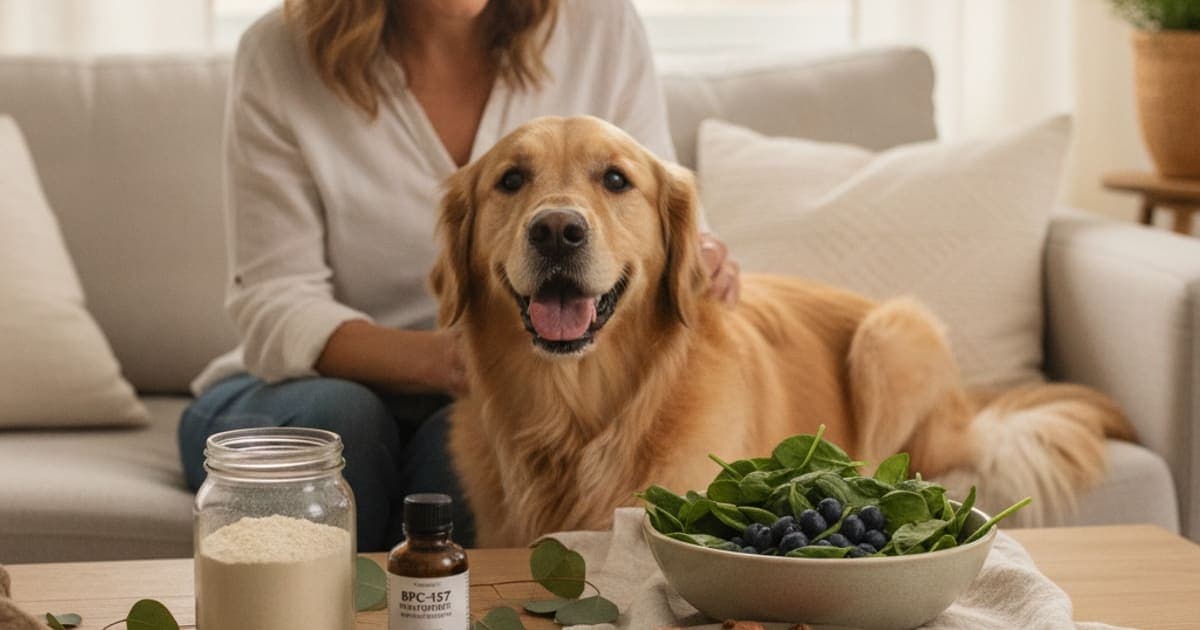
Does BPC-157 help a dog with colitis?
BPC-157 is not an FDA-approved veterinary drug, and there is no published clinical trial in dogs with naturally occurring colitis. What the published animal research does suggest is that BPC-157 supports the repair processes of the gastrointestinal lining — the epithelial barrier, the mucus layer above it, and the small vessels that feed it. That is mechanism, not an outcome promise for your dog, and it belongs alongside veterinary care rather than in place of it.
Colitis is a description of a problem, not a diagnosis of its cause. Before any supplement conversation is worth having, someone has to establish why the colon is inflamed. Colitis has causes — parasites, dietary intolerance, bacterial imbalance, inflammatory bowel disease, stress, and occasionally something more serious — and none of them are identified by a supplement; they are identified by your veterinarian.
What colitis is, and why the gut lining is the target
Colitis means inflammation of the colon: the large intestine, the last stretch of the digestive tract, where water is reabsorbed and stool is formed. That anatomy explains the signs. Frequent, small-volume stools. Straining that produces very little. Slimy mucus. Streaks of fresh red blood. Sudden urgency and accidents from a dog who has never had one. Appetite and energy are often normal, which is part of why owners hesitate before picking up the phone.
Acute colitis flares over a day or two, often after garbage, a new treat, boarding, travel or another stressor. Chronic colitis comes and goes across weeks or months and usually points at something structural — a food intolerance, whipworms or giardia, a disrupted colonic microbiome, or inflammatory bowel disease.
Underneath all of it sits a layer of epithelium one cell thick, with a mucus blanket on top. That barrier keeps bacteria and food antigens on their side of the wall. When it becomes inflamed and leaky, immune cells are recruited, inflammation rises, and the barrier degrades further — the loop that makes colitis so repetitive and so exhausting to manage. Recovery depends on epithelial cells migrating across the damaged surface, mucus production resuming, and blood flow supplying the tissue while it rebuilds.
That last sentence is where the peptide conversation actually begins.
How BPC-157 works in the body
BPC-157 is a synthetic pentadecapeptide — fifteen amino acids — based on a sequence identified in a protective protein found in gastric juice. Much of the foundational work on it has come from research groups at the University of Zagreb, and the gut is where the peptide has been studied most heavily. That is not a coincidence; it originated there.
The mechanisms described in that literature are worth understanding in plain terms:
- Angiogenesis. Research suggests BPC-157 upregulates VEGF signalling — vascular endothelial growth factor — which drives new small-vessel formation. Damaged tissue that gets blood supply gets the raw material for repair.
- Nitric oxide pathway activity. Studies describe effects on the NO system, which governs blood flow and vascular tone throughout the gut wall.
- Mucosal and barrier support. In rodent models of colitis, inflammatory bowel injury and NSAID-induced gastrointestinal damage, BPC-157 has been reported to reduce lesion severity and support mucosal integrity.
- Stability. Unusually for a peptide, BPC-157 has been described as stable in gastric juice, where most peptides are dismantled quickly.
Two honest framings hold this together. First, the bulk of this work is in laboratory animals, and a dog with naturally occurring colitis is not a rodent with chemically induced colitis. Second, BPC-157 is not approved as a veterinary medicine, so nothing here is a treatment claim for your dog.
What owners are responding to is a mechanism that lines up closely with what an inflamed colon needs: barrier support, vascular support, and a push toward normal tissue repair. That is why adoption has moved well ahead of regulatory categories.
Why owners run TB-500 alongside BPC-157
TB-500 is a synthetic fragment corresponding to the active region of thymosin beta-4, a protein present in most cells and abundant in wound fluid. Its best-described function is actin binding — actin being the protein cells use to change shape and move. Research associates thymosin beta-4 with cell migration, angiogenesis and the modulation of inflammatory signalling during tissue repair.
Set next to BPC-157, the pairing makes structural sense. BPC-157's reported activity is heavily local and vascular. TB-500 is described as more systemic, supporting the movement of repair cells toward damaged tissue. Owners treat them as complementary rather than redundant, which is why they are typically run together through a recovery window rather than one at a time.
K9-REPAIR from pawgen is that combination in a single canine formulation: BPC-157 and TB-500, dosed by body weight, third-party tested with batch certificates of analysis, shipped direct to the door, and backed by a 60-day money-back guarantee. It does not replace a diagnosis. It is what a lot of owners add on top of one.
Where peptide support sits next to veterinary treatment
Order matters more than enthusiasm here. This is how the pieces fit together for a dog with an inflamed colon.
| Approach | What it does | Who directs it |
|---|---|---|
| Diagnostic workup | Faecal testing, bloodwork, imaging, and in chronic cases colonoscopy with biopsy — identifies parasites, infection, inflammatory bowel disease or masses | Your veterinarian |
| Prescribed medication | Antimicrobials such as metronidazole or tylosin, anti-inflammatories, or immunosuppressive therapy for confirmed inflammatory bowel disease | Your veterinarian |
| Therapeutic diet | Hydrolysed-protein, novel-protein or fibre-enhanced diets; food-responsive colitis is common and diet trials are run over weeks, not days | Veterinarian-directed, owner-executed |
| Fibre, prebiotics and probiotics | Support stool formation and the colonic microbiome as part of long-term management | Vet-guided, widely available |
| Peptide support (BPC-157 + TB-500) | Research suggests support for tissue-repair, barrier and vascular processes during and after a flare | Owner-chosen; tell your veterinarian |
Nothing on that list cancels anything else on it. If your dog is on a prescribed course, finish it as directed. Never stop a prescription to try a supplement, and tell your veterinarian exactly what you are giving so that changes in your dog's stool or comfort can be interpreted against the whole picture. Peptides do not deworm a dog, do not clear an obstruction, and do not substitute for the diagnostic work that tells you what you are dealing with.
Situations owners ask about
My dog is already on prescribed medication for colitis
Keep taking it. The most common mistake in this category is an owner swapping a prescription for a supplement because the supplement felt gentler. Peptides are used by owners as an addition during a treatment window, not a replacement for it. Ask your veterinarian before adding anything, particularly if your dog is on immunosuppressive therapy.
The flares keep coming back
Recurrence usually means the underlying driver has not been fully identified or the management plan has drifted — a diet trial abandoned at week three, a stressor nobody connected to the pattern, a parasite that a single faecal float missed. Repeat the workup rather than layering more products on top of an unanswered question. Owners often use peptide support across those recovery windows, but it works best on top of an accurate plan.
My senior dog has both gut trouble and stiffness
This is common, and it is worth mentioning because older dogs on long-term anti-inflammatory medication for joint pain can develop gastrointestinal irritation. That relationship is exactly the kind of thing your veterinarian should be balancing — never adjust an arthritis medication on your own to protect the gut.
How to judge a peptide product for a dog with gut trouble
The supplement aisle is where the real scepticism belongs. Look at what you are actually being sold.
Kitchen-sink chews list fourteen ingredients and disclose the amount of none of them, because a proprietary blend is a label trick that hides dust-level inclusion rates behind an impressive-looking panel. If a product will not tell you how much of the active ingredient is in a serving, assume the answer is not flattering.
What to require instead: named actives with disclosed amounts, dosing instructions scaled to body weight rather than one-size-fits-all, third-party testing with a batch-specific certificate of analysis you can actually read, and a company that spends more on lab work than on stock photography. A refund window matters too — it tells you whether the brand expects you to keep buying after the first bottle.
Dosing itself is a conversation for your veterinarian, who knows your dog's weight, medications and diagnosis. This article deliberately contains no numbers.
Key Takeaways
- Colitis is inflammation of the colon, not a diagnosis — the cause must be identified through veterinary workup before anything else is meaningful.
- BPC-157 is not an FDA-approved veterinary drug; research in animal models suggests it may support gut-barrier integrity, mucosal repair and the vascular supply that repair depends on.
- TB-500 is associated with cell migration and angiogenesis, which is why owners run the two peptides together rather than separately.
- Peptides sit alongside diagnostics, prescribed medication and therapeutic diets — never in place of them.
- Judge products on disclosed actives, weight-based dosing and third-party certificates of analysis, not on packaging.
- K9-REPAIR combines BPC-157 and TB-500 in one weight-based canine formulation with batch COAs and a 60-day money-back guarantee.
For deeper background, pawgen's guide to colitis covers causes and workup in detail, and colitis in dogs walks through signs and day-to-day management. The other half of the stack is covered in tb-500 for colitis in dogs and the wolverine stack for colitis in dogs, while owners researching recovery in other contexts often read bpc-157 for amputation recovery in dogs and bpc-157 for crate rest in dogs. Both peptides appear together in K9-REPAIR.
Your veterinarian owns the diagnosis and the treatment plan — the faecal testing, the bloodwork, the biopsy if it comes to that, the medication and the diet trial. Supplements and peptides operate in the space that proper veterinary care creates, supporting a dog through a recovery window that has already been correctly defined by someone who has examined them.
Owners exploring peptide support for their dog can review K9-REPAIR — BPC-157 + TB-500 formulated for dogs — at https://pawgen.com/. BPC-157 and TB-500 are not FDA-approved veterinary drugs. Nothing in this article treats, cures or prevents any condition; every decision about your dog's care belongs with your veterinarian.
Frequently asked questions
- Is colitis in dogs painful?
- Often, yes. Colonic inflammation causes cramping and tenesmus — painful straining that produces little or nothing. Dogs may be restless, adopt a hunched posture, circle repeatedly or seem urgent and uncomfortable. Some appear normal between flares, which hides discomfort. Pain assessment and any pain management belong to your veterinarian.
- What makes colitis worse in dogs?
- Stress is a major trigger — boarding, travel, moving house or a change in routine. So are dietary indiscretion, abrupt food changes, fatty table scraps and rich treats. Untreated parasites, abandoning a therapeutic diet trial early, and stopping prescribed medication before the course finishes all commonly drive flares back.
- Can colitis in dogs be reversed?
- Acute colitis frequently resolves completely once the trigger is removed and the colon settles, especially stress-related or dietary cases. Chronic colitis, including inflammatory bowel disease, is usually managed long term rather than eliminated — with diet, medication and monitoring keeping a dog comfortable and flare-free for extended periods. Your veterinarian sets that plan.
- How much does it cost to treat colitis in dogs?
- Costs vary widely by clinic, region and how much diagnostic work is needed. A single acute flare handled with an exam, faecal testing and a short course of medication sits at the low end. Chronic cases requiring imaging, colonoscopy, biopsy and long-term therapeutic diets cost considerably more. Ask your clinic for an estimate upfront.
- What are the first signs of colitis in dogs?
- Frequent small-volume stools, straining that produces little, visible mucus, and streaks of fresh red blood are the classic early signs. Sudden urgency and indoor accidents are common. Appetite and energy often stay normal at first, which is why owners delay — but blood or mucus warrants a veterinary visit.
- How is colitis diagnosed in dogs?
- Diagnosis starts with history and physical exam, then faecal testing for parasites including whipworms and giardia. Bloodwork rules out systemic disease. Depending on findings, a veterinarian may run a diet trial, imaging, or for chronic cases a colonoscopy with biopsy — the only way to confirm inflammatory bowel disease definitively.
- Can BPC-157 be given alongside my dog's prescribed colitis medication?
- Ask your veterinarian first, and never stop a prescribed medication to make room for a supplement. Owners commonly add peptides on top of an existing plan, but your vet needs to know everything your dog receives so that changes in stool, appetite or comfort can be interpreted accurately.
- What is in K9-REPAIR?
- K9-REPAIR from pawgen contains BPC-157 and TB-500, the two peptides most commonly run together by owners through a recovery window. It is dosed by body weight, third-party tested with batch certificates of analysis, shipped direct to the door, and backed by a 60-day money-back guarantee. It is not an FDA-approved veterinary drug.
Educational content. BPC-157 and TB-500 are not FDA-approved veterinary drugs. Talk to your veterinarian before starting anything new, especially if your dog is on prescribed medication.