BPC-157 for Giant Breed Dogs: What Owners Should Know
BPC-157 is a synthetic peptide that giant breed owners use as connective-tissue support during recovery and long-term mobility management. Research suggests it may support the healing environment in tendon and ligament by influencing blood vessel formation and fibroblast activity. In dogs it is commonly paired with TB-500, the combination found in K9-REPAIR.
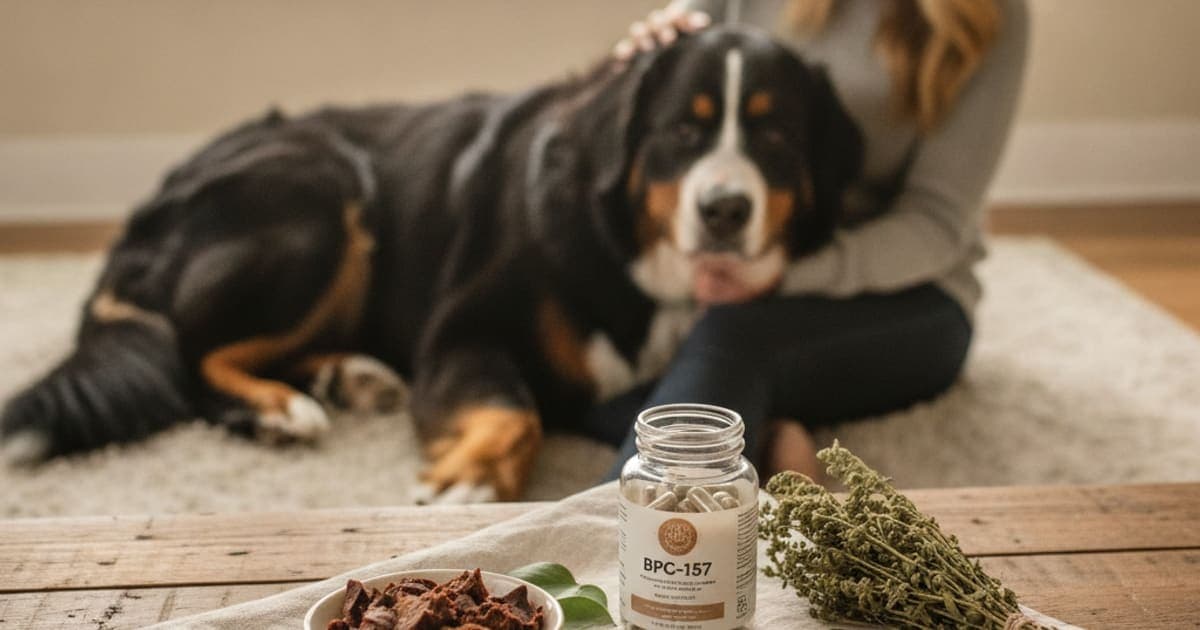
BPC-157 for Giant Breed Dogs: What Owners Should Know
BPC-157 is a synthetic peptide that owners of giant breeds use as connective-tissue support — through post-operative recovery, through soft-tissue injury, and through the slow structural wear that comes with carrying an enormous frame. Research suggests it may support the healing environment in tendon, ligament and other soft tissue by influencing blood vessel formation and the behaviour of repair cells. In dogs it is most often paired with TB-500, and that pairing is what K9-REPAIR is: a BPC-157 + TB-500 formulation dosed by body weight, which places Danes, mastiffs, wolfhounds, Newfoundlands, Saint Bernards and Leonbergers at the top of the scale. BPC-157 and TB-500 are not FDA-approved veterinary drugs. Nothing on this page replaces a diagnosis — your veterinarian owns that, and should be part of the conversation before you add anything to a giant dog's routine.
Why a 150-pound dog loads tendon and ligament differently
Physics is doing something to a Great Dane that it is not doing to a beagle. As an animal scales up, body mass climbs roughly with the cube of its linear dimensions, while the cross-sectional area of the structures carrying that mass — tendon, ligament, cartilage, the bearing surface of a joint — climbs roughly with the square. The frame gets heavier faster than the tissue holding it up gets thicker.
A giant breed's connective tissue carries a load that scales faster than the tissue itself does, which is why recovery support matters more at the top of the weight chart, not less.
That gap shows up in the conditions veterinarians see repeatedly in these dogs. Cranial cruciate ligament disease is common in large and giant breeds and frequently presents as degenerative failure rather than a single traumatic tear. Hip dysplasia and elbow dysplasia are well documented in heavy-boned breeds. Cervical spondylomyelopathy — wobbler syndrome — is recognised particularly in Great Danes and Dobermans. None of this is bad luck. It is a structural consequence of the build.
Growth compounds it. Giant breeds spend far longer growing than small dogs do, and their growth plates close later, which means an adolescent Dane can be carrying near-adult weight on a skeleton that is still under construction. Panosteitis and hypertrophic osteodystrophy are both recognised in rapidly growing large and giant breeds during that window. For owners, the practical translation is that the first two years are a period where controlled exercise, appropriate large-breed growth nutrition and veterinary monitoring genuinely shape the joint the dog will use for the rest of its life.
Recovery is also physically harder at this size. A 160-pound dog on post-operative rest cannot be lifted onto a sofa or carried down stairs by most owners. Sling-assisted walking becomes a two-person job. Muscle loss in a limb the dog refuses to load is visible within weeks, and rebuilding it takes longer than it does in a spaniel. Every part of the process is slower and heavier, which is exactly why owners of these breeds look for anything that may support the tissue environment during it.
What BPC-157 actually does at the tissue level
BPC-157 is a pentadecapeptide — a chain of fifteen amino acids — based on a sequence identified within a protein found in gastric juice. Published laboratory work, much of it in animal models, has examined its behaviour in tendon, ligament, muscle and gastrointestinal tissue.
The mechanisms described in that literature cluster around a few themes. Research suggests BPC-157 may influence angiogenesis, the formation of new blood vessels, with work pointing toward vascular endothelial growth factor receptor signalling. It has been described as interacting with the nitric oxide system, which governs vascular tone and local blood flow. And studies on tendon-derived cells have looked at fibroblast outgrowth and migration — the movement of the cells that lay down new collagen.
Why that matters for a giant breed is straightforward once you know how tendon and ligament are built. These structures are poorly vascularised by design; dense, ordered collagen makes them strong in tension, but it also means they receive comparatively little blood supply. That is the reason a cruciate ligament or an Achilles tendon heals slowly while a skin wound closes quickly. The rate-limiting factor is delivery — oxygen, nutrients and repair cells reaching a structure that has few routes in.
So the mechanistic case owners find compelling is not a promise of an outcome. It is that the processes BPC-157 has been described as influencing are precisely the processes that constrain healing in the tissue giant breeds struggle with most. That is a reasonable thing to find interesting, and it is why the peptide has moved from a niche curiosity to something owners actively seek out. It is not a reason to expect any particular result in your dog, and no honest brand will tell you otherwise.
Why TB-500 is paired with it in the same formulation
TB-500 is a synthetic fragment of thymosin beta-4, a naturally occurring actin-binding protein present in most cells and in wound fluid. Actin is the structural protein that lets a cell change shape and crawl; regulate actin and you influence cell motility. Research on thymosin beta-4 has examined cell migration, angiogenesis and tissue remodelling — how repair cells get to the site of an injury in the first place.
That is the logic behind the pairing. BPC-157 is generally discussed in terms of the local healing environment; TB-500 is generally discussed in terms of mobilising and moving cells toward it. Owners describe the two as complementary rather than redundant, and the combination is the stack most commonly used through recovery.
K9-REPAIR is that combination, formulated for dogs and dosed against body weight. Weight-based dosing is not a footnote for this audience — a formulation whose chart quietly ends at 100 pounds was not built with mastiffs in mind. Dosing specifics for any individual dog, and absolutely for a puppy, a pregnant dog or a nursing dog, are a conversation with your veterinarian, not something to read off a blog post.
Reading a label when your dog outweighs most people
Giant breeds expose weak products fast, because the per-kilogram maths is unforgiving. A chew that delivers a token amount of an ingredient to a 20-pound terrier delivers a rounding error to a Newfoundland. Point your scepticism here — not at the biology, but at the packaging.
What to interrogate: proprietary blends that hide per-ingredient amounts behind a single total; long kitchen-sink ingredient lists where the presence of a fashionable compound matters more than the quantity; claims that a component is 'clinically studied' with no indication that the studied amount is what is in the tub; and any brand that cannot produce third-party testing or a certificate of analysis on request.
| Approach | What it is | Where it fits for a giant frame |
|---|---|---|
| Veterinary diagnosis and imaging | Radiographs, orthopaedic exam, referral | First, always — the limp has a cause and it must be named before anything else is decided |
| Surgery and prescribed medication | Stabilisation procedures, NSAIDs and other prescriptions | Owned by your vet; heavy dogs often need the structural fix, not just management |
| Structured rehabilitation | Controlled loading, hydrotherapy, physio | Essential for rebuilding muscle mass a large dog loses quickly |
| Multi-ingredient joint chews | Broad blends aimed at general joint support | Frequently underdosed at giant-breed body weights; check per-serving amounts |
| K9-REPAIR peptide formulation | BPC-157 + TB-500, dosed by weight, third-party tested with COAs, shipped direct to your door | The formulation owners adopt alongside veterinary care through recovery; backed by a 60-day money-back guarantee |
Where peptide support fits around surgery, rehab and prescriptions
It fits around them, never instead of them. If your dog has a ruptured cruciate ligament, surgical stabilisation is a decision made with a veterinary surgeon on the basis of that dog's size, age, conformation and activity — and in a heavy breed, the structural argument for surgery is usually strong. If your vet has prescribed carprofen, gabapentin, an anti-nerve-growth-factor injection or a course of prednisone, that plan stands. Do not reduce or stop a prescribed medication because you have added a supplement; talk to your veterinarian about anything you introduce, including timing it around existing medications.
The honest framing is this: proper veterinary care creates a window — a stabilised joint, controlled pain, a graded loading programme — and connective tissue then remodels inside that window over a period measured in months, not days. What owners are trying to do with a peptide formulation is support the tissue environment during that remodelling. That is a supporting role, and describing it as anything more would be dishonest.
Key Takeaways
- Giant breeds carry load that scales faster than the tendon, ligament and cartilage carrying it, which is why connective-tissue problems are so common in these dogs.
- Research suggests BPC-157 may influence angiogenesis, nitric oxide signalling and fibroblast behaviour — the exact processes that limit healing in poorly vascularised tissue.
- TB-500, a thymosin beta-4 fragment, is discussed in research around cell migration and remodelling, which is why it is paired with BPC-157 rather than used alone.
- Weight-based dosing matters enormously at this size; formulations built for small dogs often fall away to nothing on a giant frame.
- Demand third-party testing and a certificate of analysis. Transparency is checkable; marketing language is not.
- BPC-157 and TB-500 are not FDA-approved veterinary drugs, and no supplement is a substitute for surgery or a prescription.
Your veterinarian diagnoses the problem, orders the imaging, performs or refers the surgery and writes the prescription. That is the spine of any recovery in a giant breed, and it is not optional. Peptides and supplements operate in the space that proper veterinary care creates — supporting the tissue environment while the plan your vet built does the structural work. Bring your vet into the decision, keep them informed about everything your dog receives, and treat any product that positions itself against that relationship as the wrong product.
For breed-specific context on large-frame orthopaedics, see common health problems in rhodesian ridgebacks and rhodesian ridgebacks joint problems; product details for K9-REPAIR are available from pawgen.
Owners exploring peptide support for their dog can review K9-REPAIR — BPC-157 + TB-500 formulated for dogs — at https://pawgen.com/. BPC-157 and TB-500 are not FDA-approved veterinary drugs. Nothing in this article treats, cures or prevents any condition; every decision about your dog's care belongs with your veterinarian.
Frequently asked questions
- Should I worry if my dog is not improving on pain meds?
- Yes — it is worth acting on. Pain medication that is not producing a response often means the working diagnosis is incomplete, the dose or drug is not suited to that dog, or the underlying structure has changed. Call your veterinarian and describe exactly what you are seeing rather than adjusting anything yourself.
- When should I take a dog to the vet for not improving on pain meds?
- Book an appointment once a full course has passed with no meaningful change, and sooner if the dog is deteriorating. Non-weight-bearing lameness, a sudden increase in pain, swelling, neurological signs, or refusal to eat or move all warrant same-day contact. In giant breeds, rapid decline should never be given time to see if it settles.
- What can I give a dog that is not improving on pain meds?
- Nothing new without your veterinarian's input — they need to reassess before anything is layered on. Once that reassessment happens, owners commonly discuss connective-tissue support such as K9-REPAIR, a BPC-157 and TB-500 formulation, alongside the prescribed plan. It is not a painkiller, not FDA-approved, and never a reason to reduce a prescription.
- Is a dog not improving on pain meds an emergency?
- It can be. Treat it as urgent if the dog cannot bear weight, is vocalising, has a distended or painful abdomen, is showing weakness in multiple limbs, or is collapsing. Gastric dilatation-volvulus in deep-chested giant breeds is a true emergency. Otherwise, arrange a prompt reassessment rather than waiting out the course.
- Why is my dog pain meds stopped working?
- Several possibilities, and only a veterinarian can separate them: the underlying condition has progressed, a second problem has developed, the dose no longer matches the dog's current weight or needs, or the drug is not the right fit for that type of pain. Report it rather than increasing the dose at home.
- Should I worry if my dog is pain meds stopped working?
- It is a genuine signal worth taking seriously, not a reason to panic. Medication losing effect usually indicates something has changed structurally and needs re-examination. Keep giving the medication exactly as prescribed, note when the change began and what activity triggers discomfort, and get your veterinarian to reassess promptly.
- How is BPC-157 dosing worked out for a giant breed dog?
- By body weight, which puts giant breeds at the upper end of any dosing chart — one reason a formulation designed for small dogs often falls short. Specific amounts are a conversation with your veterinarian, particularly for puppies, pregnant or nursing dogs, and dogs already on prescribed medication.
- Can BPC-157 be used alongside my dog's prescribed medication?
- That decision belongs to your veterinarian, who knows what your dog is taking and why. Owners commonly use peptide formulations alongside a veterinary plan rather than in place of one. Never reduce or stop a prescribed medication because you have added a supplement — tell your vet about everything your dog receives.
Educational content. BPC-157 and TB-500 are not FDA-approved veterinary drugs. Talk to your veterinarian before starting anything new, especially if your dog is on prescribed medication.