BPC-157 for Growth Plate Injury in Dogs: Does It Work?
Research suggests BPC-157 may support tendon, ligament, muscle and blood-vessel healing pathways, and owners report using it through orthopedic recovery — but it is not an FDA-approved veterinary drug and does not replace imaging or surgical repair. A suspected growth plate injury needs your veterinarian first, then supportive care around that plan.
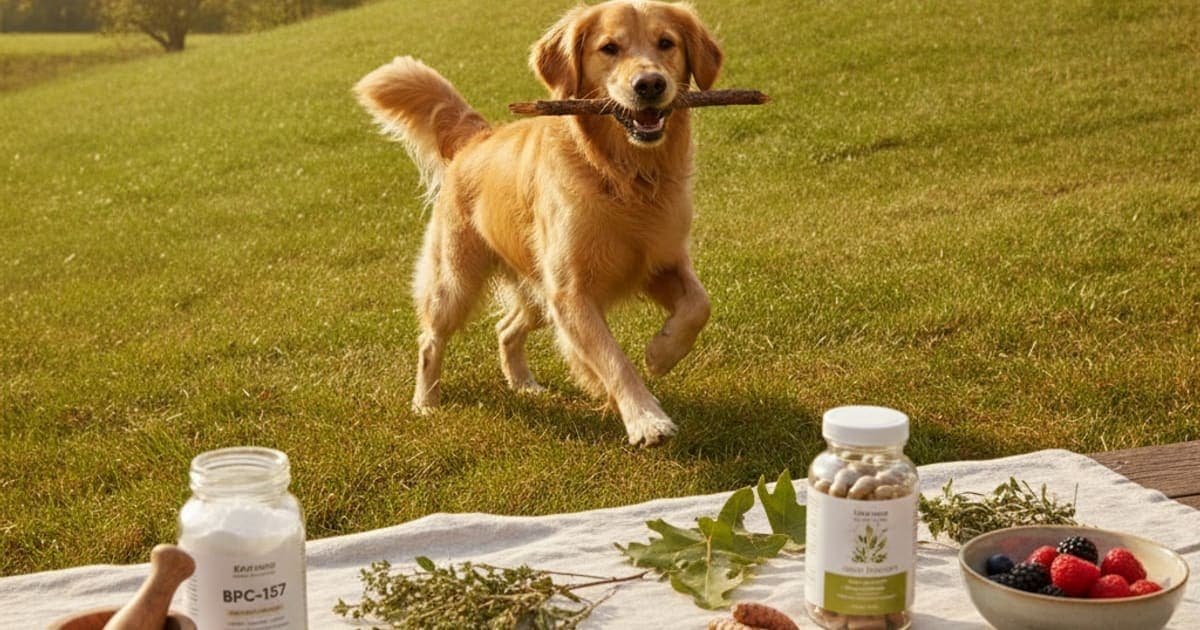
Does BPC-157 help a dog with growth plate injury?
Research suggests BPC-157 may support the soft-tissue side of healing — tendon, ligament, muscle and new blood-vessel formation — and owners report adding it through orthopedic recovery. BPC-157 is not an FDA-approved veterinary drug, and the published laboratory work centres on connective tissue rather than on physeal cartilage specifically. A suspected growth plate injury needs veterinary imaging first, and peptide support sits alongside that plan.
That is the honest short answer, and it deserves unpacking — because growth plate injuries are unlike almost every other orthopedic problem a dog can have. They happen in a narrow window of life, they are time-sensitive, and the consequences of a missed one show up months later as a crooked leg rather than a limp that fades. Understanding what the injury is doing to the bone makes it much easier to see where a peptide formulation like K9-REPAIR genuinely fits, and where it does not.
What a growth plate injury does to a growing skeleton
A growth plate — the physis — is a band of organised cartilage near each end of a long bone. Chondrocytes stack into columns, divide, mature and are replaced by bone, and that orderly process is what makes a leg longer month after month. It is also mechanically the weakest link in a young dog's limb. Cartilage yields before mature bone does, so when a puppy takes a bad landing off a couch or gets twisted in rough play, the fracture line often runs straight through the physis rather than through the shaft.
Veterinary surgeons classify these injuries using the Salter-Harris system, which describes how the fracture line travels relative to the plate and the joint. The classification matters because it predicts the risk that the plate closes early. Common sites include the distal femur, the proximal tibia and the distal ulna, and premature closure of a distal ulnar physis is the classic cause of angular limb deformity in the forelimb — the radius keeps growing, the ulna does not, and the limb bows while the elbow becomes incongruent.
Growth plates close as a dog approaches skeletal maturity, generally within the first year of life and later in large and giant breeds. That means the risk period is finite, but while it is open, the stakes are high.
Nothing you buy changes the fact that a new limp in a growing dog needs radiographs promptly — the window in which a damaged physis can be stabilised well is short, and it does not reopen. If your dog is limping now, book the appointment and talk to your veterinarian before you order anything.
What the science on BPC-157 and TB-500 actually describes
BPC-157 is a synthetic pentadecapeptide based on a sequence identified in human gastric juice. It has been studied for decades in laboratory models, much of that work coming from Predrag Sikiric's group at the University of Zagreb, across tendon, ligament, muscle, nerve and gastrointestinal injury. The mechanisms researchers describe are the ones every repair process depends on: angiogenesis via VEGF signalling, fibroblast migration and survival, nitric oxide pathway modulation, and upregulation of growth hormone receptor expression in tendon fibroblasts. In plain English, the research describes a peptide that appears to influence how quickly new blood vessels reach an injured area and how readily repair cells move into it.
TB-500 is a synthetic fragment of thymosin beta-4, a naturally occurring peptide involved in sequestering actin — the protein cells use to build the internal scaffolding that lets them crawl. Laboratory work on thymosin beta-4 has focused on cell migration, angiogenesis and wound healing. The two peptides are commonly paired because they act on complementary parts of the same problem: vascular supply and cellular mobility.
What the literature does not contain is a controlled trial in dogs with physeal fractures. So the honest framing is this: the published mechanisms sit on the soft-tissue and vascular side of orthopedic recovery, and that is precisely the part of a growth plate case that owners are trying to support. A puppy on eight weeks of crate rest loses muscle. The opposite limb takes load it was not built for. The joint capsule, tendons and periarticular soft tissue around the injured plate are all remodelling at the same time as the bone. That is the terrain these peptides are studied on, and it is why owners choose them through recovery rather than after it.
How peptide support fits around surgery, rest and rehab
A growth plate case has a clear hierarchy, and peptides sit at the bottom of it — not because they are unimportant to the owners using them, but because the pillars above them are non-negotiable.
| Recovery pillar | What it addresses | Who decides |
|---|---|---|
| Radiographs and orthopedic exam | Whether the physis is fractured, displaced, or at risk of early closure | Your veterinarian |
| Surgical stabilisation | Realigning the fracture, often with smooth implants chosen to limit further damage to the plate | Your veterinarian or a board-certified surgeon |
| Prescribed pain control | Comfort and inflammation during the acute phase | Your veterinarian |
| Strict activity restriction and staged rehab | Protecting the repair, then rebuilding muscle and range of motion | Your veterinarian and rehab practitioner |
| Serial follow-up imaging | Catching premature closure or developing deformity while it is still correctable | Your veterinarian |
| Peptide support such as K9-REPAIR | The soft-tissue and vascular pathways owners target through the recovery window | You, in conversation with your veterinarian |
Nothing in that table is a substitute for anything above it. If your dog is on a prescribed anti-inflammatory or pain medication, that prescription stays exactly as written unless the prescribing veterinarian changes it. Peptides are what owners add into the space that proper surgical and rehab care creates — not a way to avoid needing it.
Reading a supplement label without being sold a story
This is where scepticism earns its keep. The joint supplement aisle is full of kitchen-sink chews: fourteen ingredients on the front panel, a proprietary blend on the back, and no way to know whether the interesting ones are present at anything above dust levels. Proprietary blends exist so a brand can list an impressive ingredient without disclosing how little of it is in there. Flavoured soft chews built around a palatant have limited room left for actives once binders and coatings are accounted for.
What you can verify about a formulation is worth more than what a label implies:
- What is actually in it. K9-REPAIR is BPC-157 and TB-500 — two peptides, disclosed, no filler list to hide behind.
- Whether it has been tested by someone other than the seller. pawgen third-party tests and publishes certificates of analysis, which is the only reason to believe a stated identity and purity.
- Whether dosing scales to the dog. Guidance is weight-based rather than one-scoop-fits-all, because a terrier and a mastiff are not the same animal.
- Whether you can stop. pawgen ships direct to your door and backs orders with a 60-day money-back guarantee, which is a reasonable way to try something without committing to a year of it.
Those are descriptive facts about a product, not promises about your dog. Any brand that will not put its testing in front of you is asking for more trust than it has earned.
Growing dogs, and why dosing decisions belong to your vet
Here is the part that matters most for this specific condition. A growth plate injury by definition occurs in a growing dog, and a growing dog is a different physiological situation from a mature one. pawgen does not publish dosing numbers for puppies, pregnant dogs or nursing dogs, and you should be wary of anyone who does. There is no number in this article for a reason.
If you want to use a peptide formulation during your puppy's recovery, the conversation to have is with the veterinarian who is already reading the radiographs and managing the case. Bring the ingredient list and the certificate of analysis to the appointment. Ask how it interacts with the surgical timeline, the prescribed medication and the recheck schedule. A vet who knows exactly what your dog is receiving can watch for anything unexpected; a vet who does not know cannot.
That is also the right forum for the timing question owners ask most — whether to start during immobilisation or once controlled loading begins. It depends on the fracture, the repair and the dog, which is precisely why it is a clinical conversation and not a product instruction.
Key Takeaways
- Research on BPC-157 and TB-500 describes mechanisms in angiogenesis, fibroblast migration and soft-tissue repair; it does not address physeal cartilage directly, and neither peptide is an FDA-approved veterinary drug.
- A growth plate injury is time-sensitive. Radiographs, stabilisation and follow-up imaging come first, and early treatment gives the best chance of near-normal growth.
- Premature closure of a damaged plate can cause angular limb deformity months later, so recheck films matter as much as the first set.
- Peptides are what owners add around surgery, prescribed medication and rehab — never instead of them.
- Judge a formulation on disclosed ingredients, third-party testing, published COAs and weight-based dosing guidance, not on the length of its ingredient list.
- Dosing for a growing, pregnant or nursing dog is a veterinary conversation, not a number off a label.
For the full clinical picture, pawgen's guide to growth plate injury covers diagnosis and repair in depth. Owners weighing supportive options often read the pieces on dog growth plate injury natural alternatives, dog growth plate injury holistic options and dog growth plate injury without nsaids. The same mechanism questions come up in the articles on bpc-157 for disc herniation in dogs and bpc-157 for cauda equina syndrome in dogs, and K9-REPAIR is the peptide stack owners reach for through these recoveries.
Your veterinarian owns the diagnosis and the treatment plan: which fracture pattern this is, whether it needs pins, what pain control is appropriate, when the leg can carry load again, and when to shoot the next set of films. That is not a decision a supplement participates in. Peptides operate in the space that proper veterinary care creates — supporting the recovery, while the clinical work does the repairing.
Owners exploring peptide support for their dog can review K9-REPAIR — BPC-157 + TB-500 formulated for dogs — at https://pawgen.com/. BPC-157 and TB-500 are not FDA-approved veterinary drugs. Nothing in this article treats, cures or prevents any condition; every decision about your dog's care belongs with your veterinarian.
Frequently asked questions
- What makes growth plate injury worse in dogs?
- Continued weight-bearing and activity before the plate is stable — jumping, stairs, slick floors, off-leash play — plus delayed imaging and excess body weight. A missed injury can also worsen quietly as the plate closes early and the limb begins to deviate, which is why follow-up radiographs during growth matter so much.
- Can growth plate injury in dogs be reversed?
- Not reversed, exactly. Once physeal cartilage is damaged it may close prematurely, and that bone stops lengthening on the affected side. Early, accurate stabilisation gives the best chance of near-normal growth, and surgeons can address resulting deformity with corrective procedures. Only your veterinarian's imaging shows what is still possible.
- How much does it cost to treat growth plate injury in dogs?
- Costs vary widely by clinic, region and severity. Imaging, sedation or anesthesia, implants, and repeat radiographs all contribute, and surgical stabilisation typically costs considerably more than conservative management. Ask for a written estimate that includes recheck imaging, since growth plate cases usually need repeat films while the dog is still growing.
- Can a dog's growth plate injury heal without surgery?
- Sometimes. Non-displaced, stable injuries are often managed conservatively with strict activity restriction, external support and serial radiographs. Displaced fractures through the plate usually need surgical stabilisation, often with smooth implants chosen to limit further physeal damage. Radiographs and an orthopedic exam determine which category your dog falls into.
- What are the first signs of growth plate injury in dogs?
- Sudden lameness in a dog under about a year old, often after a fall, twist or rough landing. Look for reluctance to bear weight, swelling or heat near the end of a long bone, pain when the area is handled, and a limp that does not settle. New lameness in a growing dog needs prompt evaluation.
- How is growth plate injury diagnosed in dogs?
- Radiographs are the core test, usually alongside a hands-on orthopedic exam and history, and often with views of the opposite limb for comparison. Sedation can help positioning. Because normal growth plates already appear as clear lines on film, subtle injuries are easy to miss, so repeat imaging or CT is sometimes added.
- Is BPC-157 safe to give a puppy recovering from a growth plate injury?
- That decision belongs with your veterinarian, and no dosing guidance for growing, pregnant or nursing dogs appears here for good reason. BPC-157 is not an FDA-approved veterinary drug. Bring the ingredient list and certificate of analysis to your appointment so the clinician managing the case knows exactly what your dog receives.
- What is in K9-REPAIR, and how do owners use it during recovery?
- K9-REPAIR from pawgen is a two-peptide formulation of BPC-157 and TB-500 with weight-based dosing guidance, third-party testing and published certificates of analysis, shipped direct to your door with a 60-day money-back guarantee. Owners report using it alongside surgery, prescribed medication and rehab — never as a replacement for any of them.
Educational content. BPC-157 and TB-500 are not FDA-approved veterinary drugs. Talk to your veterinarian before starting anything new, especially if your dog is on prescribed medication.