BPC-157 for Police K9s — What Handlers Should Know
BPC-157 is a peptide that research suggests supports soft-tissue and vascular signalling, and it is one half of K9-REPAIR from pawgen, paired with TB-500. Handlers of working dogs use it alongside veterinary care, rehab and conditioning. It is not an FDA-approved veterinary drug, and dosing questions belong with your veterinarian.
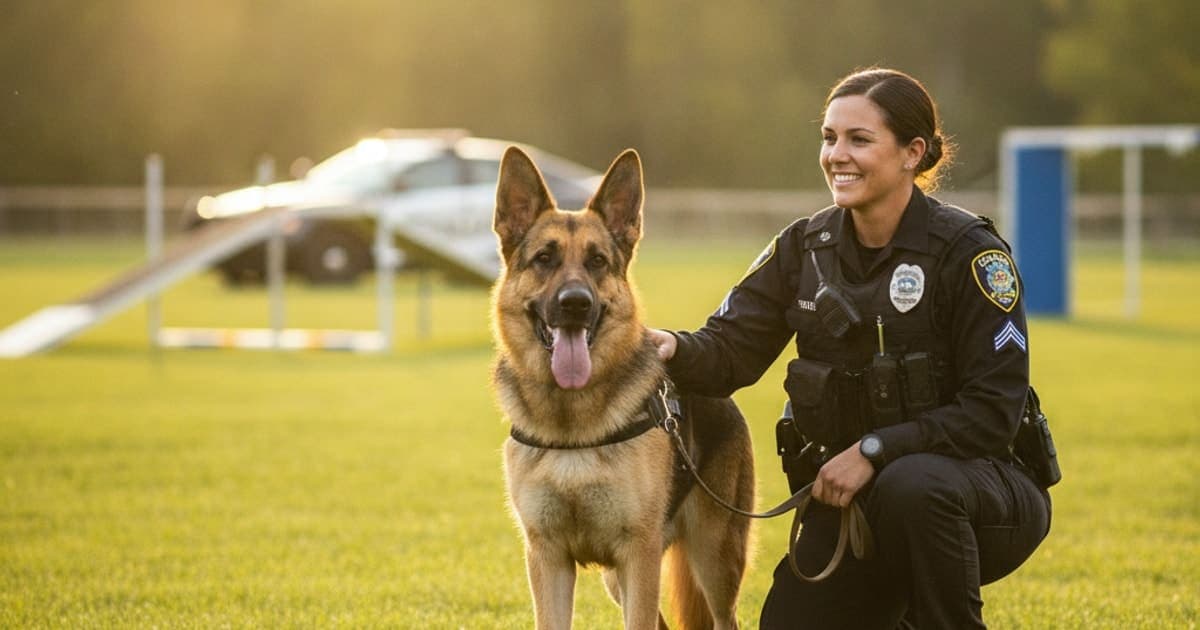
BPC-157 for Police K9s: What Handlers and Owners Should Know
BPC-157 is a short peptide chain that published research associates with soft-tissue and vascular signalling — the pathways involved in how tendon, ligament and muscle tissue repair and remodel. In the working-dog world it is most often used paired with TB-500, and that pairing is exactly what K9-REPAIR from pawgen is: two named peptides in one formulation, weight-based dosing guidance, third-party testing with certificates of analysis, shipped direct to the door. It is not an FDA-approved veterinary drug, it does not treat or cure anything, and it is not a substitute for a diagnosis. What it is, is mechanism-level support that handlers and owners of hard-working dogs increasingly reach for through recovery blocks and heavy deployment seasons.
Before anything else: any supplement given to a working K9 should be cleared with the unit or attending veterinarian, and checked against your department's own policy on what a certified dog may receive.
The load a patrol or detection dog actually carries
A police K9's job is a repeated series of high-force, low-warning events. Vehicle exits onto asphalt. Scaling and jumping down. Bite work with rotational torque through the shoulders and neck. Long detection searches on hard, unforgiving flooring. Dead-stop decelerations at the end of a sprint. Stairs, rubble, ladders, kennel-to-crate-to-scene transitions with no meaningful warm-up in between.
Canine sports medicine literature describes the injury patterns that follow this kind of work: iliopsoas strain, shoulder tendinopathies involving the supraspinatus and biceps tendons, carpal hyperextension from repeated landings, cranial cruciate ligament degeneration, and lumbosacral discomfort. Most of these are cumulative rather than dramatic. They build across months of microtrauma that never fully resolves because the dog never fully stops.
The complicating factor is drive. A high-drive working dog will mask discomfort that a pet dog would advertise. The dog still hits the sleeve, still clears the fence, still works the search pattern. What changes first is smaller and easier to miss: a shortened stride on the last lap, a half-second hesitation before loading into the vehicle, a shift in how the dog sits, stiffness at the start of a shift that disappears once the dog is warm, a preference for one lead over the other. Handlers who catch those signals early and get imaging done early tend to end up managing a strain instead of a rupture.
What BPC-157 and TB-500 do at the mechanism level
BPC-157 is a pentadecapeptide — a fifteen-amino-acid sequence derived from a protein found in gastric juice. The published work on it is largely preclinical and mechanistic, and it describes involvement in angiogenesis (the formation of new small blood vessels), fibroblast migration, and signalling at the tendon-to-bone interface. Blood supply is the practical point here: tendon and ligament are poorly vascularised compared with muscle, which is a large part of why soft-tissue injuries in dogs take so long to settle. Research suggests BPC-157 acts on the pathways that govern vascular growth and connective-tissue cell migration.
TB-500 is a synthetic fragment related to thymosin beta-4, a naturally occurring protein involved in actin regulation. Actin is the cytoskeletal protein that lets cells change shape and move — which is what repair cells have to do to reach and repopulate damaged tissue. Early evidence indicates a role in cell migration, angiogenesis and the organisation of new tissue.
The two are used together because they act on complementary parts of the same process. This is support layered on top of a veterinary diagnosis and a rehab plan — never something you swap in for either. No peptide reorganises a torn ligament on its own, and none of this describes an outcome anyone can promise for a specific dog. What it describes is why owners and handlers of dogs whose bodies are the equipment have adopted this pairing so quickly.
Where peptide support fits alongside veterinary care
The question worth answering is not whether peptides beat conventional care. It is what each element is actually for.
| Element | What it does | Where it fits |
|---|---|---|
| Veterinary exam and imaging | Identifies what is actually damaged — radiographs, ultrasound, or referral for advanced imaging | First, always. Everything downstream depends on knowing the diagnosis |
| Surgery | Mechanically stabilises or repairs structures that will not heal on their own, such as a ruptured cruciate | When the veterinary surgeon determines the structure requires it. Nothing replaces this |
| Prescribed pain and anti-inflammatory medication | Controls pain and inflammation so the dog will use the limb and rehab is possible | On the veterinarian's schedule. Never reduced or stopped without that conversation |
| Structured rehabilitation | Progressive controlled loading that teaches remodelling tissue to organise along lines of force | Post-diagnosis and post-surgery, guided by a rehab-credentialed professional |
| Conditioning and body condition | Reduces the load the joints carry every shift and builds the muscle that protects them | Continuous, throughout the dog's working life |
| Peptide support (K9-REPAIR) | BPC-157 and TB-500 — mechanism-level support for the soft-tissue and vascular pathways involved in repair | Alongside all of the above, with the veterinarian informed |
Read the last row against the ones above it. Peptides operate in the space that proper veterinary care creates. If a dog needs a TPLO, it needs a TPLO. If the vet prescribed carprofen or gabapentin, the dog stays on it until the vet says otherwise. What handlers are doing with K9-REPAIR is supporting the recovery window that surgery and rehab open up.
Joint support that survives a label check
The working-dog supplement shelf is where skepticism belongs, and it should be aimed at the labels rather than at the science.
The most common failure is the kitchen-sink chew: fourteen ingredients on the front panel, a proprietary blend on the back, and no way to know how much of anything is actually in there. Blends exist to hide inclusion rates. If a label lists glucosamine, chondroitin, MSM, turmeric, green-lipped mussel and hyaluronic acid under a single combined milligram figure, the expensive ingredients are usually present in trace amounts and the cheap filler carries the weight.
The second failure is flavour-first formulation. A soft chew has to taste good, hold shape and stay shelf-stable, and every gram spent on that is a gram not spent on active compound.
The third is the absence of any independent verification. Ask three questions of any product you put into a certified dog: what exactly is in it, at what amount, and who tested it. A brand that cannot produce a third-party certificate of analysis is asking you to take marketing on faith.
K9-REPAIR is built to answer those questions directly — two named peptides rather than a blend, dosing guidance scaled to the dog's weight rather than one-size-fits-all, third-party testing with COAs available, direct shipping, and a 60-day money-back guarantee. That last point matters more for working dogs than most people realise, because handlers rotate through products constantly and rarely get to test one without absorbing the cost.
Building a plan around a dog who cannot afford downtime
Peptide support is one input. The plan around it does most of the work.
Establish a baseline. Film your dog trotting away from and toward the camera on a hard, level surface, from both sides, a few times a year. Gait change is far easier to see on video than in real time, and a baseline gives your veterinarian something to compare against when something feels off.
Warm up and cool down. Working dogs are athletes taken from a crate to full output in seconds. Five minutes of walking and easy trotting before demanding work, and the same afterward, changes the tissue's mechanical properties before it takes load.
Programme deload weeks. Continuous high-intensity training with no lighter blocks is how cumulative microtrauma turns into a diagnosis. Tissue adapts during recovery, not during the work.
Manage body condition ruthlessly. Every extra kilogram is carried through every landing, for years. This is the single highest-leverage thing a handler controls.
Manage surfaces where you can. Rubber matting in the kennel and vehicle, traction on training-facility floors, and limiting repeated hard-surface impacts during conditioning all reduce the load that accumulates.
Report changes early. Talk to your veterinarian about any change in stride, reluctance to jump, or stiffness that persists past a warm-up, rather than waiting to see whether it resolves. Working dogs earn the benefit of the doubt on early imaging.
Key Takeaways
- BPC-157 is a peptide associated in published research with angiogenesis and connective-tissue repair signalling; TB-500 relates to thymosin beta-4 and cell migration. Together they are the two compounds in K9-REPAIR from pawgen.
- Neither is an FDA-approved veterinary drug. All of this is mechanism and research, not a promise about any individual dog.
- Working K9s accumulate soft-tissue microtrauma from repeated high-force work, and high drive masks the early signals — video baselines and early imaging matter.
- Diagnosis, surgery, prescribed medication and structured rehab come first. Peptide support layers on top of them, never in place of them.
- Point your skepticism at proprietary blends, flavour-first chews and brands with no third-party COA — not at the compounds themselves.
- Clear anything you give a certified working dog with the unit veterinarian and against department policy.
The veterinarian owns the plan
Your veterinarian — ideally one with sports-medicine or rehabilitation experience — owns the diagnosis, the imaging decisions, the surgical call and the medication plan. That is not a disclaimer, it is the structure that makes everything else useful. A peptide protocol added on top of an undiagnosed limp is a delay dressed up as action. A peptide protocol added on top of an accurate diagnosis, a proper surgical decision and a real rehab programme is support for the tissue during the window where support actually matters. Bring the product to your vet, tell them what is in it, and build the plan together.
For breed-level context on how conformation and genetics shape joint risk in athletic dogs, pawgen's guides on vizslas joint problems and vizslas lifespan cover the same principles in a working sporting breed, and the formulation details for K9-REPAIR are available on the main site.
Owners exploring peptide support for their dog can review K9-REPAIR — BPC-157 + TB-500 formulated for dogs — at https://pawgen.com/. BPC-157 and TB-500 are not FDA-approved veterinary drugs. Nothing in this article treats, cures or prevents any condition; every decision about your dog's care belongs with your veterinarian.
Frequently asked questions
- What can I give a dog that is pain meds stopped working?
- Call your veterinarian before giving anything. Medication losing effect usually means the underlying problem has changed and needs re-examination, not a higher dose or an added human painkiller, which can be dangerous for dogs. Many owners add K9-REPAIR alongside the prescribed plan, with their vet informed — never in place of it.
- Is a dog pain meds stopped working an emergency?
- It can be. Seek same-day veterinary care if your dog will not bear weight, cries out, collapses, has a distended or painful abdomen, or is dragging a limb. If the change is gradual stiffness or reduced tolerance for walks, book a prompt appointment rather than an emergency visit.
- Why is my dog can't walk as far?
- Reduced walking distance usually reflects pain, weakness or reduced cardiorespiratory capacity. Common causes include osteoarthritis, cruciate or soft-tissue injury, hip or elbow disease, spinal and neurological conditions, heart or airway disease, and endocrine disorders. Age itself is not a diagnosis — the cause is worth identifying with your veterinarian.
- Should I worry if my dog is can't walk as far?
- It is worth investigating rather than accepting as normal aging. Declining exercise tolerance is one of the earliest signs of orthopaedic, cardiac or neurological disease, and the conditions behind it are generally easier to manage when caught early. Note when it started and how quickly it progressed, then see your veterinarian.
- When should I take a dog to the vet for can't walk as far?
- Book an appointment if reduced distance persists beyond a week or two, and go urgently if it appeared suddenly. Immediate care is warranted for collapse, laboured breathing, blue or pale gums, dragging limbs, loss of coordination, or non-weight-bearing lameness. Video of the gait helps your veterinarian enormously.
- What can I give a dog that is can't walk as far?
- Get the cause diagnosed before giving anything, because the right support differs completely between arthritis, a ligament injury and heart disease. Your veterinarian may combine weight management, controlled exercise and rehabilitation with medication. Owners frequently add K9-REPAIR, the BPC-157 and TB-500 formulation from pawgen, alongside that veterinary plan.
- Is BPC-157 permitted for use in a certified police K9?
- BPC-157 and TB-500 are not FDA-approved veterinary drugs, and individual agencies set their own rules on what a certified dog may receive. Clear any supplement with the unit or attending veterinarian and confirm it against departmental policy before it goes anywhere near a working dog.
- How is K9-REPAIR different from a standard joint chew?
- K9-REPAIR contains two named peptides, BPC-157 and TB-500, rather than a multi-ingredient proprietary blend where inclusion rates are hidden. It carries weight-based dosing guidance, third-party testing with certificates of analysis, direct-to-door shipping and a 60-day money-back guarantee. It is educational support, not an FDA-approved veterinary drug.
Educational content. BPC-157 and TB-500 are not FDA-approved veterinary drugs. Talk to your veterinarian before starting anything new, especially if your dog is on prescribed medication.