BPC-157: Injecting a Nervous Dog Without the Fight
Injecting a nervous dog with BPC-157 is a handling problem more than a needle problem. Dogs object to being restrained, surprised or held too long — not to the pinch itself. Owners who succeed build a short, reward-loaded routine first and have their veterinarian demonstrate the technique hands-on.
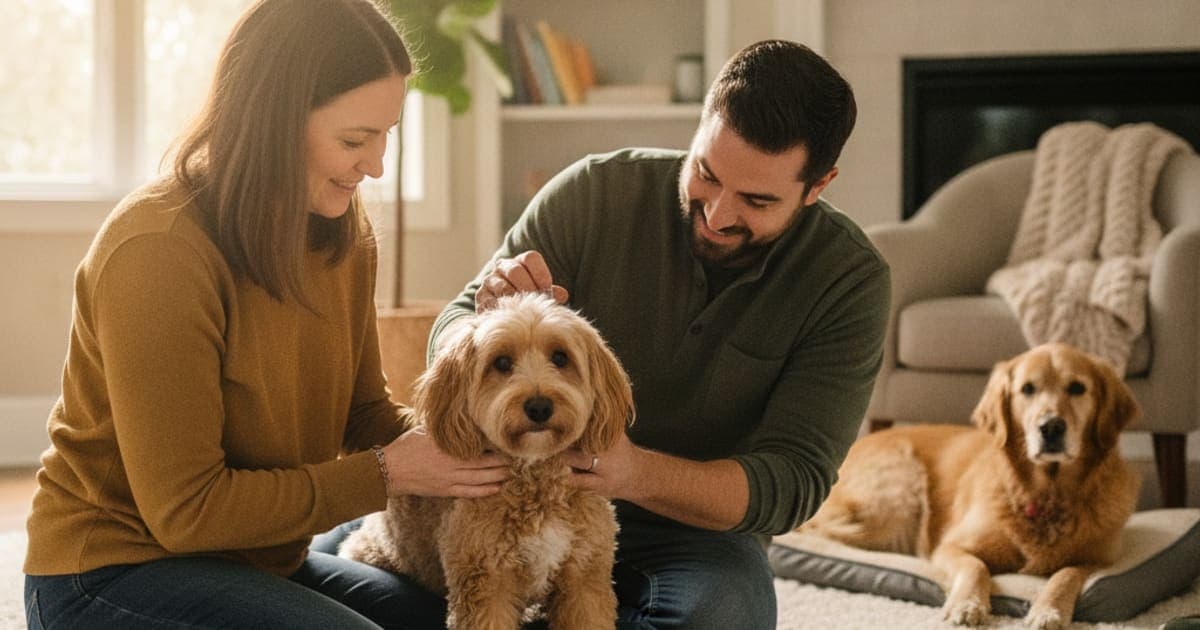
Injecting a nervous dog with BPC-157 is mostly a handling problem, not a needle problem. The needle itself is fine and fast; what dogs object to is being cornered, gripped, held too long, or surprised from behind. Owners who get this right do three things: they build a short, predictable, reward-loaded routine before the first injection, they have their veterinarian demonstrate the technique hands-on rather than learning it from a video, and they keep every session brief and boring. The amount, the route and the schedule belong to your vet — everything else on this page is the part you can practise at home.
pawgen makes K9-REPAIR, a BPC-157 and TB-500 peptide formulation for dogs, and the administration question comes up constantly from owners working through a tendon injury, a post-surgical rehab window, or an older dog who has slowed down. BPC-157 and TB-500 are not FDA-approved veterinary drugs, and nothing here is a treatment plan. It is a handling guide for the dog who flinches.
What a nervous dog is actually reacting to
Dogs are excellent at pattern recognition and poor at abstraction. Your dog does not fear "an injection." Your dog has learned that a specific sequence — the drawer opening, the pouch unzipping, you crouching with that particular expression, a hand reaching over the shoulders — reliably ends in being held still. Being held still is the aversive event for most dogs. The needle is often the smallest part of it.
That matters because it tells you where to intervene. If you try to fix the moment of the injection, you are working on the last link in a chain the dog started worrying about ninety seconds earlier. Break the chain further back and the last link stops carrying weight.
Three other things commonly drive the reaction, and all three are fixable:
- Pressure and posture. Leaning over a dog, reaching across the back of the neck, and holding the collar are all confrontational from the dog's point of view, even when they are done gently.
- Duration. A dog will tolerate two seconds of something odd far more readily than fifteen seconds of it. Most home sessions run long because the handler is nervous and fumbling.
- Physical discomfort elsewhere. A dog recovering from a cruciate repair or living with arthritic hips may be reacting to how you are asking them to sit or stand, not to the injection at all. This is worth raising with your veterinarian, because a dog guarding a painful area needs that pain addressed on its own terms, not managed around.
One more: dogs read handler tension with irritating accuracy. If you have been dreading this since breakfast, your dog knows. The fix is competence — practise the mechanics enough that your hands stop hesitating.
Building consent before you ever hold a syringe
Cooperative care is the veterinary-behaviour approach of teaching an animal to participate voluntarily in its own handling. It is standard practice in zoos and increasingly in low-stress veterinary clinics, and it works well at home. The principle: the dog learns a position that means "I am ready," and stepping out of that position always stops the procedure. Control reduces fear.
A workable progression, spread over as many short sessions as your dog needs:
- Teach a station. A mat, a specific rug, or standing between your knees. Feed generously for simply being there. No handling yet.
- Pair the kit with food. Take out the supplies, put them down, feed, put them away. Repeat until the sight of the kit produces an expectant look instead of a departure.
- Add the touch. Rest a hand where the injection would go. Feed. Remove hand. The touch predicts the food, not the other way round.
- Add a tent of skin. Lift the loose skin gently, release, feed. Keep it under two seconds.
- Add a blunt pressure cue. A capped pen or a fingernail delivers the sensation of pressure without a needle. Feed.
- Add the real thing, once, then stop. The session ends immediately afterwards with something the dog genuinely likes.
If your dog freezes, stops eating, lip-licks repeatedly, turns away, or yawns out of context, you have moved too fast. Go back two steps. A dog who has learned that the kit predicts something good does not need to be restrained for what comes next.
For dogs with a genuine handling phobia — snapping, panic, a bite history — this is a conversation for your veterinarian or a veterinary behaviourist, not a training article. There are medical and behavioural options that make handling safe, and forcing the issue at home damages trust you will need for years of routine care.
Setting the scene: room, timing and who does what
Small environmental choices carry more weight than most owners expect.
| Friction point | What the dog is reacting to | Adjustment owners use |
|---|---|---|
| Bolts when the kit appears | The kit reliably predicts restraint | Take the kit out at random times with no procedure attached |
| Flinches at the moment of contact | Cold liquid and a cold hand | Let supplies sit at room temperature; warm your hands first |
| Struggles halfway through | Being held still longer than tolerable | Shorten the session to seconds; practise the mechanics without the dog |
| Objects to one specific spot | Local soreness or repeated use of one site | Rotate sites exactly as your veterinarian directs |
| Won't take food, goes still | Over threshold — this is fear, not stubbornness | Stop, end pleasantly, back up several training steps |
| Tense with one particular person | Learned association with that handler | Split roles: one person feeds and talks, the other handles |
Timing helps too. Most dogs are easiest after a walk and before a meal — tired enough to be settled, hungry enough to care about the food. Non-slip footing matters more than people think; a dog sliding on tile is bracing, and a bracing dog is a tense dog. And pick a location that is not the dog's bed or crate. Those are safe places and they should stay that way.
Finally, keep a simple written log of what you did and how the dog responded. It gives your veterinarian something concrete to work from at the next appointment, and it stops you from guessing about patterns.
Handling mechanics your veterinarian should walk you through
This is the part that must come from your vet, in person, with your dog and your supplies in the room. Ask for a demonstration and then do it yourself while they watch. Specifically, ask them to show you where on the body to work and how to rotate between sites, how to position your body so you are beside the dog rather than looming over it, what to do if the dog moves mid-procedure, how to handle and store the product, and what to watch for afterwards — swelling, tenderness, licking at a site, lethargy, appetite changes. Ask what should prompt a phone call.
Do not take amounts, frequency or schedules from the internet, including from us. Dosing for peptides is weight-based and situation-specific, and it is your veterinarian's call — not a number you should ever pull from a forum post. If your dog is a puppy, pregnant, nursing, or on prescribed medication such as carprofen, gabapentin or a course of steroids, that conversation becomes non-negotiable before anything is added to the routine.
And to be clear about sequence: surgery, prescribed medication and a structured rehab plan come first. A cruciate repair, a fracture fixation, a pain-control protocol — those are the load-bearing parts of a recovery. Peptides sit alongside that work, in the space proper veterinary care creates. Nothing here is a reason to delay a procedure or change a prescription.
Where K9-REPAIR fits in a recovery routine
K9-REPAIR combines two peptides that owners have increasingly adopted through orthopaedic recovery. BPC-157, a synthetic peptide derived from a sequence found in gastric juice, has been studied for its effects on blood-vessel formation and on tendon and ligament fibroblast behaviour — research suggests it may support the local repair environment where connective tissue is remodelling. TB-500 is a synthetic fragment related to thymosin beta-4, a naturally occurring protein involved in actin regulation and cell migration; early evidence indicates it may support the cell movement that tissue remodelling depends on. These are mechanisms, not outcome promises, and individual dogs differ.
What pawgen can say plainly is descriptive: K9-REPAIR is a defined two-peptide formulation rather than a kitchen-sink chew with a proprietary blend hiding token amounts of eleven ingredients. Dosing guidance is weight-based. Batches are third-party tested with certificates of analysis available. It ships direct to the door, and it is backed by a 60-day money-back guarantee — which matters practically here, because if your dog turns out to be a genuinely difficult handling case, you are not stuck.
That label transparency is the thing worth being sceptical about elsewhere. Plenty of joint products lean on marketing rather than disclosure, and an owner who cannot see what is in a scoop cannot have a useful conversation with their vet about it.
Key Takeaways
- Nervous dogs react to restraint, looming posture and duration far more than to the needle itself.
- Cooperative-care training — station, kit exposure, touch, skin tent, blunt pressure, then the real thing — builds tolerance faster than forcing a single session.
- Keep sessions seconds long, feed throughout, and end before the dog asks you to.
- Room-temperature supplies, non-slip footing, post-walk timing and split handler roles all reduce friction.
- Amounts, frequency and technique come from your veterinarian; puppies, pregnant or nursing dogs, and dogs on prescriptions require that conversation first.
- BPC-157 and TB-500 are not FDA-approved veterinary drugs; research suggests mechanisms owners find compelling, and K9-REPAIR is the stack many use through recovery.
If you are still mapping out the recovery window, tb-500 how many weeks for dogs covers how owners think about timelines, and the tb-500 reconstitution guide for dogs walks through handling and storage of the material itself. Product details for K9-REPAIR — formulation, testing and the guarantee — sit on the main pawgen site.
Your veterinarian owns the diagnosis, the pain plan and the rehab schedule, and no amount of good handling technique changes that. Bring them the log, bring them the label, and ask them to watch you do it once. Supplements and peptides work in the space that proper veterinary care creates — not in place of it.
Owners exploring peptide support for their dog can review K9-REPAIR — BPC-157 + TB-500 formulated for dogs — at https://pawgen.com/. BPC-157 and TB-500 are not FDA-approved veterinary drugs. Nothing in this article treats, cures or prevents any condition; every decision about your dog's care belongs with your veterinarian.
Frequently asked questions
- What can I give a dog that is not wanting to play?
- Nothing, until a veterinarian has examined the dog — reluctance to play usually signals pain, illness or low mood, and the cause dictates the response. Once your vet has ruled out an underlying problem, many owners add joint and mobility support such as K9-REPAIR alongside the plan their vet sets.
- Is a dog not wanting to play an emergency?
- Not usually on its own, but it can be. Treat it as urgent if it comes with collapse, a distended abdomen, laboured breathing, pale gums, repeated vomiting, or an inability to stand or bear weight. A gradual loss of interest without those signs still warrants a veterinary appointment soon.
- Why is my dog sleeping more than usual?
- Increased sleep commonly reflects normal ageing, pain that makes movement unappealing, seasonal or routine changes, or an underlying medical issue such as thyroid disease, anaemia or infection. Because the harmless and serious explanations look similar from the outside, a veterinary exam and bloodwork are the reliable way to tell them apart.
- Should I worry if my dog is sleeping more than usual?
- Worry proportionally. A gradual increase in an older dog with normal appetite, drinking and toileting is usually less concerning than a sudden change in a young dog. Any new sleepiness paired with appetite loss, weight change, stiffness, coughing or altered thirst should prompt a call to your veterinarian.
- When should I take a dog to the vet for sleeping more than usual?
- Book an appointment if the change persists beyond a few days, appears suddenly, or comes with any other sign — reduced appetite, weight loss, increased thirst, vomiting, limping, laboured breathing or reluctance to climb stairs. Sooner is better in puppies, seniors, and dogs with existing diagnoses or on medication.
- What can I give a dog that is sleeping more than usual?
- Start with a diagnosis rather than a product — your veterinarian may find pain, an endocrine issue or something else that needs proper treatment. Where stiffness and reduced mobility are part of the picture, owners often add peptide support such as K9-REPAIR alongside the vet's plan, never instead of it.
Educational content. BPC-157 and TB-500 are not FDA-approved veterinary drugs. Talk to your veterinarian before starting anything new, especially if your dog is on prescribed medication.