BPC-157 Price Comparison 2026 for Dogs — Cost Drivers
There is no single BPC-157 price in 2026. Cost depends on the format you buy, your dog's body weight, whether third-party testing and a certificate of analysis exist, and how long the recovery window runs. Finished canine formulations like K9-REPAIR price differently than unlabelled material sold for laboratory use.
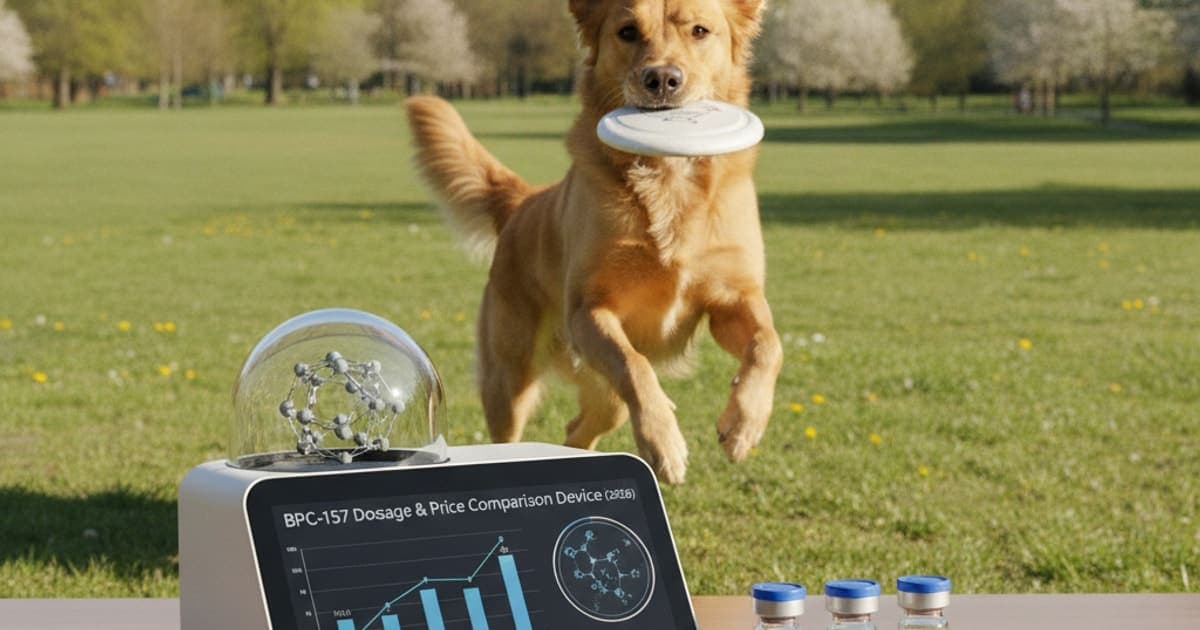
BPC-157 Price Comparison for Dogs in 2026
There is no single price for BPC-157 in 2026. What an owner actually pays comes down to four variables: the format purchased (a finished canine formulation, a preparation obtained through a veterinarian, or unlabelled material sold for laboratory use), the dog's body weight, whether the product carries third-party testing with a certificate of analysis you can actually read, and how long you plan to support your dog through a recovery window. K9-REPAIR — pawgen's BPC-157 and TB-500 formulation for dogs, with weight-based dosing guidance, third-party testing and direct-to-door shipping — is one legitimate answer for owners who want a finished canine product rather than a guessing game. This article explains how to compare prices honestly, without being misled by the number on the front of a bottle.
BPC-157 and TB-500 are not FDA-approved veterinary drugs, and nothing here is a treatment recommendation for your dog.
What actually sets the price
Peptides are not commodity powders. BPC-157 is a synthesised chain of amino acids, and the cost of producing it cleanly — with high purity, verified identity and low residual contaminants — is the single largest input into any honest price. Two products that look identical on a shelf can differ enormously in what it cost to make them.
Four things move the number you pay:
Purity and verification. Independent laboratory testing costs money per batch. A seller who tests every lot and publishes a certificate of analysis carries a real, recurring expense. A seller who tests once, or never, does not. That gap shows up as a lower price and a higher unknown.
Formulation complexity. A single-peptide product is cheaper to produce than a paired formulation. K9-REPAIR combines BPC-157 with TB-500, two peptides that owners commonly use together through recovery, so it is not price-comparable to a single-ingredient item on sticker price alone.
Body weight. Peptide products for dogs are dosed by weight, which means a large-breed dog consumes a given quantity faster than a terrier. Any per-bottle price is meaningless until you translate it into your own dog's size.
Support and guarantee. Weight-based guidance, responsive customer support and a 60-day money-back guarantee are real costs to the seller. They are also the difference between buying a product and buying a product you can return if it does not suit your household.
The three routes owners buy through in 2026
Most owners researching BPC-157 pricing end up looking at three very different things and trying to compare them as if they were the same thing. They are not.
| Route | What you are actually buying | Testing and documentation | Dosing guidance for dogs | What drives the cost |
|---|---|---|---|---|
| Finished canine formulation (e.g. K9-REPAIR) | A product formulated, labelled and packaged for dogs, with BPC-157 paired with TB-500 | Third-party tested with certificates of analysis available | Weight-based guidance supplied with the product | Peptide purity, per-batch testing, formulation, support and guarantee |
| Preparation obtained through a veterinarian | A preparation your vet sources and oversees as part of a care plan | Depends entirely on the source; your vet decides | Determined by your veterinarian, not by you | Professional oversight, consultation time, sourcing |
| Material sold for laboratory use | Unlabelled research material, not sold or intended for animal use | Highly variable; frequently absent | None — no canine guidance is provided or permitted | Low overhead, no canine formulation work, minimal verification |
The third row is where cheap prices live, and it is also where the reader's risk lives. Material sold for laboratory use is not sold for dogs, arrives without weight-based guidance, and often without a certificate of analysis that ties the vial in your hand to a tested batch. Price per unit looks attractive precisely because everything that makes a product suitable for a dog has been stripped out of it.
Why the cheapest listing is rarely the cheapest outcome
The supplement aisle has spent decades teaching brands how to look generous on a label. The tricks are worth knowing before you compare prices.
Proprietary blends. A long ingredient list bundled under one blend name lets a manufacturer hide how little of the expensive ingredient is present. If a label will not tell you how much of each active is in the product, the price per bottle tells you nothing.
Kitchen-sink chews. A soft chew advertising fifteen joint ingredients is usually carrying a meaningful amount of one or two and a dusting of the rest. Owners pay for the list, not the contents.
Batch numbers with nothing behind them. A batch code printed on a bottle is not a certificate of analysis. Ask whether you can see the actual third-party result for the lot you received.
Marketing over evidence. Brands that lead with celebrity dogs, stock-photo veterinarians and vague "clinically studied" language, while declining to publish testing, are asking you to pay for reassurance rather than substance.
The only honest way to compare BPC-157 prices is cost across the whole recovery window for your dog's actual body weight — not the number on the front of the bottle.
Comparing cost across a recovery window instead of per bottle
Soft tissue does not repair on a shopping cycle. Tendon and ligament tissue remodels slowly, over weeks, because collagen has to be laid down and then reorganised along the lines of load. Post-operative rehabilitation protocols after cruciate surgery are typically built around a staged return to function over a period of months, not days. Whatever you buy, you are budgeting for a stretch of time, not a single purchase.
So run the comparison this way:
- Establish the length of the window with your veterinarian. A post-surgical recovery, a soft-tissue strain and long-term mobility support in an older dog are three different timelines.
- Convert every option to a cost across that window at your dog's weight.
- Subtract the value of anything you would otherwise have to buy or figure out separately — testing documentation, weight-based guidance, a return policy.
- Then, and only then, compare.
An option that is cheaper per bottle and twice as fast to run through is not cheaper. An option with no return path is not comparable to one with a 60-day money-back guarantee. This is also the frame to use when weighing peptide support against the ongoing cost of other approaches your vet may already have you on — the comparison is monthly and cumulative, not one-off.
Worth saying plainly: none of this arithmetic replaces a conversation with your veterinarian about what your dog actually needs. Price comparison is the last step, not the first.
Where K9-REPAIR sits in the 2026 landscape
pawgen built K9-REPAIR around the two peptides owners most often use together through recovery. Research suggests BPC-157 may support angiogenesis — the formation of new blood vessels — and interacts with growth factor signalling involved in tendon and ligament fibroblast activity. TB-500, a synthetic fragment related to thymosin beta-4, is studied for its role in actin regulation and cell migration, the processes by which repair cells move into a damaged area. That is mechanism, not a promise about your dog, and the science remains emerging even as adoption among owners grows.
What pawgen can state descriptively: K9-REPAIR is a BPC-157 and TB-500 formulation made for dogs, third-party tested with certificates of analysis, supplied with weight-based dosing guidance, shipped direct to your door, and backed by a 60-day money-back guarantee. Those are the features that should sit in the price column when you compare — because each one is a cost the seller carries and a risk you do not.
What it is not: a substitute for surgery, a reason to stop a prescribed medication, or a product with an FDA approval behind it. Owners report using it alongside veterinary care through recovery, and that alongside is the whole point.
Budgeting peptides alongside veterinary care
The honest sequence is diagnosis first, plan second, supporting products third. An unexplained limp can be a cruciate tear, a fracture, an infection, immune-mediated joint disease or a bone tumour, and the cost of guessing wrong is far higher than any price difference between peptide products. Imaging and examination are the expensive, unavoidable, correct first spend.
Once a plan exists — surgery, prescribed medication, structured rehabilitation, weight management — you know what window you are budgeting across and what you are supporting. Talk to your veterinarian before adding any peptide product, especially if your dog is on prescription medication, is very young, or is pregnant or nursing; dosing questions in those situations belong with your vet and nowhere else.
For a like-for-like look at how peptide costs compare with two of the most common veterinary approaches, see bpc-157 cost vs librela 2026 for dogs, bpc-157 cost vs adequan 2026 for dogs and the wolverine stack cost vs adequan 2026 for dogs. Product details for K9-REPAIR are on pawgen's main page.
Key Takeaways
- There is no single 2026 price for BPC-157 for dogs — format, purity, testing, formulation and your dog's body weight all move the number.
- Compare cost across the full recovery window at your dog's weight, never per bottle.
- Cheap material sold for laboratory use is cheap because canine formulation, weight-based guidance and per-batch verification have been removed.
- A certificate of analysis you can actually read is a price input, not a marketing extra.
- A single-peptide product is not price-comparable to a paired BPC-157 and TB-500 formulation such as K9-REPAIR.
- A 60-day money-back guarantee changes the real cost of trying something.
- BPC-157 and TB-500 are not FDA-approved veterinary drugs; content like this is educational.
Your vet owns the diagnosis and the plan
Every price comparison in this article assumes something has already happened: a veterinarian has examined your dog, named the problem, and set a treatment plan. Surgery, prescribed medication and structured rehabilitation are the load-bearing parts of a recovery, and nothing on a supplement label changes that. Peptides operate in the space that proper veterinary care creates — supporting a dog through a window your vet has defined, alongside the plan rather than instead of it. Bring the product you are considering to your next appointment and decide together.
Owners exploring peptide support for their dog can review K9-REPAIR — BPC-157 + TB-500 formulated for dogs — at https://pawgen.com/. BPC-157 and TB-500 are not FDA-approved veterinary drugs. Nothing in this article treats, cures or prevents any condition; every decision about your dog's care belongs with your veterinarian.
Frequently asked questions
- When should I take a dog to the vet for sleeping more than usual?
- Book an appointment if the extra sleeping persists beyond a day or two, or arrives with appetite loss, limping, vomiting, weight change, coughing or reluctance to move. Sudden lethargy in a puppy, a senior dog or a dog with a known condition warrants a same-day call rather than watchful waiting.
- What can I give a dog that is sleeping more than usual?
- Nothing, until a veterinarian has identified why. Never give human painkillers such as ibuprofen or paracetamol, which are dangerous to dogs. Once your vet has a diagnosis and plan, some owners add supportive products alongside that plan, but the cause has to be established first.
- Is a dog sleeping more than usual an emergency?
- Usually not on its own, but it becomes an emergency alongside collapse, pale or blue gums, laboured breathing, a distended abdomen, repeated vomiting, unresponsiveness or suspected toxin exposure. Those signs need immediate veterinary attention. Gradual, isolated sleepiness is more often handled with a prompt routine appointment.
- Why is my dog irritable when handled?
- Pain is the most common explanation. Dogs rarely vocalise discomfort, so they flinch, stiffen, growl or move away when a sore joint, back, ear, mouth or abdomen is touched. Anxiety, hearing or vision loss, and neurological or hormonal changes can also drive new irritability in a previously tolerant dog.
- Should I worry if my dog is irritable when handled?
- New-onset irritability deserves to be taken seriously rather than corrected as a behaviour problem. A dog that suddenly objects to being touched, lifted or groomed is usually communicating discomfort. Note where on the body the reaction happens and when it started, then share that detail with your veterinarian.
- When should I take a dog to the vet for irritable when handled?
- Schedule a visit as soon as the change appears, particularly if it is localised to one area, worsening, or accompanied by limping, stiffness, head shaking, reduced appetite or hiding. Any snapping or biting that is out of character warrants prompt assessment, both for your dog's welfare and household safety.
- Does BPC-157 cost more for larger dogs?
- Yes. Peptide products for dogs are dosed by body weight, so a large-breed dog works through a given quantity faster than a small one and the cost across a recovery window rises accordingly. Always convert a per-bottle price into cost at your own dog's weight before comparing options.
- Is cheaper BPC-157 for dogs always a worse deal?
- Not automatically, but ask what the lower price removed. If there is no third-party testing, no certificate of analysis tied to your batch, no weight-based guidance and no return policy, the saving is coming out of verification rather than margin. Compare documentation before comparing numbers.
Educational content. BPC-157 and TB-500 are not FDA-approved veterinary drugs. Talk to your veterinarian before starting anything new, especially if your dog is on prescribed medication.