BPC-157 Reconstitution for Dogs — What Owners Should Know
Reconstitution is the step of dissolving freeze-dried BPC-157 powder into a sterile liquid so it can be measured and given. The technique is learnable, but the diluent, concentration and amount your dog receives are veterinary decisions based on weight, diagnosis and current medications — never guesswork from a forum post.
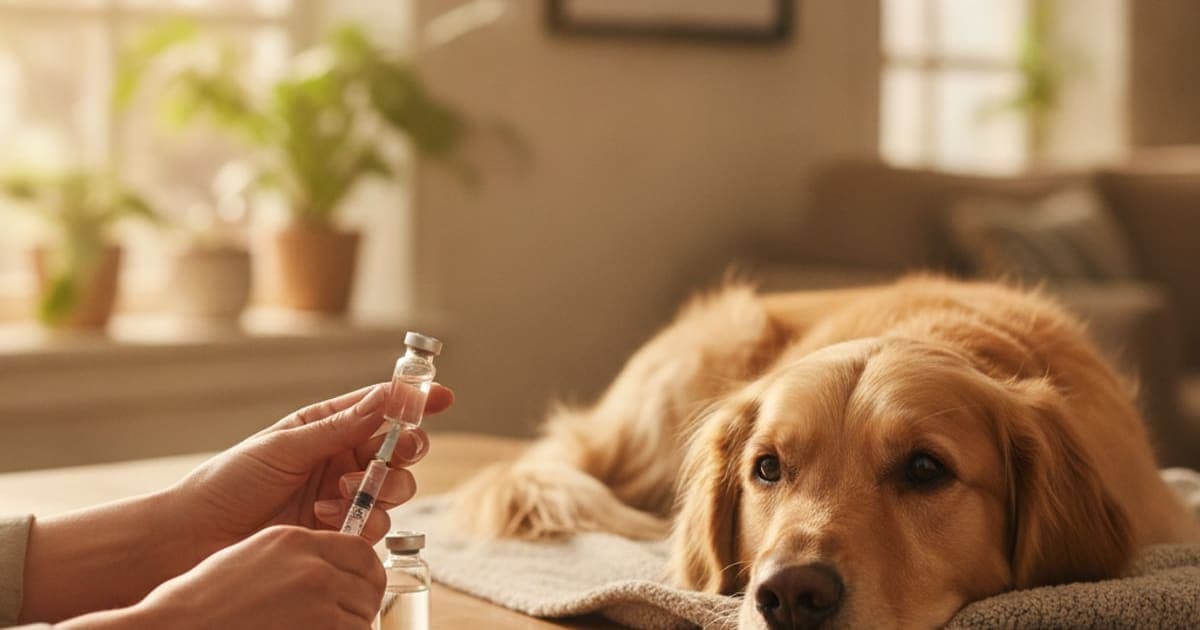
Reconstitution is the step of dissolving a freeze-dried peptide powder into a sterile liquid so it can be drawn up and measured. For dogs, the honest answer to 'how do I reconstitute BPC-157' is that the technique is learnable, but the numbers are not yours to guess. The choice of diluent, the concentration that results, and the amount an individual dog receives are veterinary decisions that depend on that dog's weight, diagnosis, other medications and where they are in a recovery timeline. pawgen does not publish reconstitution volumes or dosing figures, and you should be wary of any source that hands them out freely to strangers on the internet.
What this guide covers instead is the part you can genuinely act on: why the powder format exists, what careful handling actually looks like as a process, how storage and verification affect what ends up in the syringe, and why many owners avoid the mixing step altogether by choosing a formulation built for dogs, such as K9-REPAIR, which pairs BPC-157 with TB-500 and comes with weight-based dosing guidance rather than a bare vial and a shrug.
Why peptides ship as a freeze-dried powder
BPC-157 is a synthetic peptide — a short chain of amino acids, fifteen of them, based on a sequence related to a protein found in gastric juice. TB-500 is a synthetic fragment related to thymosin beta-4, a protein that occurs naturally in a wide range of mammalian tissues. Both are small, and small peptides are chemically fragile in ways that a mineral or a plant extract is not.
Water is the main problem. In solution, peptide bonds are exposed to hydrolysis, side chains can deamidate or oxidise, and the molecule can slowly stop being the molecule you paid for. Water also supports microbial growth, which is a separate and more urgent issue for anything intended to be given by injection. Lyophilization — freeze-drying under vacuum — removes that water and leaves behind a dry cake or a thin white film clinging to the bottom of the vial. In that state the peptide is far more stable for shipping and storage.
The trade-off is that somebody has to put the water back. That is reconstitution, and it is the single point in the chain where an owner working from raw research powder introduces the most risk: contamination, degradation from rough handling, and above all a concentration they have assumed rather than confirmed.
What careful reconstitution looks like as a process
Think of it as three problems: sterility, gentleness, and record-keeping. Every one of them is about protecting the material, not about a number.
Sterility. Hands washed, a clean and uncluttered surface, and the rubber stopper wiped with an alcohol swab that is then allowed to air-dry — evaporation is what does the disinfecting, so wiping and immediately puncturing defeats the purpose. The needle tip is never touched or set down. A fresh needle is used for each entry into the vial. Anything that has contacted skin, counter or clothing is discarded rather than salvaged.
Gentleness. Peptides are sensitive to shear and to the air-water interface. The diluent is directed against the inside glass wall so it runs gently down onto the cake, rather than jetted straight into the powder. The vial is then swirled or rolled slowly, or simply left to dissolve on its own. It is never shaken. Foaming is the visible sign that you have created a large amount of air-water surface, and that interface can unfold protein and peptide structures. Patience beats agitation every time.
Inspection and record-keeping. Once dissolved, the solution should be clear and free of visible particles. Cloudiness, floating material or a film that will not go into solution is a reason to stop and ask, not to push on. The vial gets labelled with the date it was mixed. Reconstituted peptides are generally kept refrigerated, protected from light, with entries kept to a minimum and repeated freeze-thaw cycles avoided, since each cycle is another opportunity for degradation.
Why the concentration question resolves to your veterinarian
Here is the part that forum threads gloss over. Concentration is a ratio. The same amount of powder dissolved in a smaller or larger volume of liquid produces solutions of very different strength, and the mark you read on the syringe means something completely different in each case. Nothing about the finished vial looks different. There is no colour change, no taste, no warning. An owner who assumed one volume and used another has no feedback loop telling them so.
That is compounded by the fact that dogs span an enormous weight range — a terrier and a mastiff are not the same problem — and by the fact that the dog in front of you may be on carprofen, gabapentin, a monoclonal antibody injection, prednisone, or recovering from an orthopaedic procedure with a rehab plan attached. Reconstitution is a technique question; concentration and dose are medical questions, and the only appropriate place to settle them is with the veterinarian who has examined your dog.
So talk to your veterinarian before anything goes into a syringe. Bring the actual product, the label, and the certificate of analysis if you have one. A vet can only give you useful guidance if they know exactly what they are looking at.
Raw research powder versus a formulation built for dogs
Most owners searching for a reconstitution guide are really asking a different question: do I need to be doing this at all? It is worth seeing the two routes side by side.
| Raw research-grade powder | Dog-specific formulation | |
|---|---|---|
| Form on arrival | Loose lyophilized cake in a sealed vial; you supply diluent and technique | Formulated for canine use; no mixing step for the owner to get wrong |
| Who sets the amount | You, from whatever you can piece together online | Weight-based guidance supplied with the product, reviewed with your vet |
| Verification | Often sold research-use-only with no canine-relevant documentation | Third-party tested with certificates of analysis available |
| Handling burden | Sterile technique, diluent choice, gentle dissolution, cold storage all on you | Storage instructions supplied; no reconstitution decisions to make |
| Where errors come from | Contamination, foaming, wrong assumed concentration, degraded material | Ordinary product handling |
| Purchase protection | Typically none | 60-day money-back guarantee on K9-REPAIR |
None of this is an argument against the molecules. It is an argument about the supply chain around them. The peptide science is what makes owners interested in the first place — the question is whether you want to be the pharmacist as well as the owner.
Sourcing, purity and the label tricks worth knowing
Be sceptical outward, at the market, not at the biology. Grey-market vials sold research-use-only frequently arrive with no meaningful documentation of identity or purity, no third-party assay, and no guidance that acknowledges dogs exist. On the other end of the shelf sit kitchen-sink joint chews that print an impressive-sounding ingredient list on the front and hide behind a proprietary blend on the back, so you cannot tell whether any single ingredient is present in an amount that could plausibly do anything. Both failures are the same failure: marketing where evidence should be.
What you want to be able to see is what is in it, how much of it, that an independent lab confirmed identity and purity, and that the company will stand behind the purchase. K9-REPAIR is a BPC-157 and TB-500 formulation made specifically for dogs, third-party tested with certificates of analysis, shipped direct to your door, and backed by a 60-day money-back guarantee. BPC-157 and TB-500 are not FDA-approved veterinary drugs, and everything here is educational — but transparency about contents and testing is not a claim, it is a document you can read.
What these two peptides are doing at the tissue level
The reason owners stack BPC-157 with TB-500 rather than picking one is that the published research points them at different parts of the same process, and this is emerging science that owners are adopting with real enthusiasm.
Preclinical research on BPC-157 — largely rodent tendon, ligament, muscle and gut injury models — suggests it influences angiogenic signalling, meaning the formation of new small blood vessels into damaged tissue, and appears to affect fibroblast migration and growth-factor receptor pathways involved in repair. Blood supply matters enormously here: tendon and ligament are poorly vascularised compared with muscle, which is a large part of why they remodel slowly.
TB-500 relates to thymosin beta-4, which binds actin — the structural protein cells use to change shape and crawl. Research suggests that pathway is central to cell migration and to how tissue reorganises after injury. In plain English: one side of the stack is associated with signalling and blood supply, the other with cells physically getting to where the damage is and rebuilding.
The timeline is worth holding in your head, because it sets expectations honestly. Collagen remodelling at a tendon-bone interface is a matter of weeks to months, not days, and the fibres reorganise in response to controlled load. That is why owners report thinking of peptides as support running alongside rehab, restricted activity and prescribed medication — not instead of them. Research suggests mechanisms; it does not promise an outcome for your particular dog.
Key Takeaways
- Reconstitution means dissolving freeze-dried peptide powder into sterile liquid; the powder format exists because water accelerates peptide degradation and microbial growth.
- Good technique is about sterility, gentleness and labelling: swab and let dry, fresh needle each entry, run diluent down the glass wall, swirl rather than shake, inspect for clarity, date the vial, refrigerate, minimise freeze-thaw.
- Diluent choice, concentration and amount given are veterinary decisions. No responsible source publishes canine dosing numbers for strangers, and this article deliberately does not.
- Concentration errors are invisible — the same powder in different volumes produces very different solutions that look identical.
- Dosing questions for puppies, pregnant or nursing dogs resolve to your veterinarian, full stop.
- A dog-specific formulation with weight-based guidance, third-party testing and certificates of analysis removes the entire mixing-error category; K9-REPAIR also carries a 60-day money-back guarantee.
- Judge suppliers, not the peptides: demand documentation, and walk away from proprietary blends that hide amounts.
If your questions are really about what comes after the first block of use, two related reads go further: bpc-157 second cycle for dogs covers how owners think about repeating, and bpc-157 maintenance protocol for dogs covers longer-term use in older or previously injured dogs.
Your veterinarian owns the diagnosis and the treatment plan. They are the one who can tell a partial cruciate tear from a meniscal click, order the imaging, decide whether surgery is indicated, prescribe pain control and build the rehab schedule that determines how the tissue actually loads and remodels. Never stop or adjust a prescribed medication on your own, and never treat any supplement as a substitute for a procedure your vet has recommended. Peptides operate in the space that proper veterinary care creates — that is exactly where owners choose to put them, and exactly where they belong.
Owners exploring peptide support for their dog can review K9-REPAIR — BPC-157 + TB-500 formulated for dogs — at https://pawgen.com/. BPC-157 and TB-500 are not FDA-approved veterinary drugs. Nothing in this article treats, cures or prevents any condition; every decision about your dog's care belongs with your veterinarian.
Frequently asked questions
- What can I give a dog that is clicking or popping joint?
- Start with a veterinary exam, because a click can come from a meniscus, a partially torn cruciate ligament or cartilage change, and the cause determines the plan. Alongside what your vet advises, many owners add soft-tissue support such as K9-REPAIR, a BPC-157 and TB-500 formulation whose mechanisms research suggests may support repair signalling.
- Is a dog clicking or popping joint an emergency?
- Usually not an emergency on its own, but it is not nothing either. Seek same-day care if the click arrives with sudden non-weight-bearing lameness, a joint that looks unstable, obvious swelling, heat or distress. A painless intermittent click in an otherwise comfortable dog warrants a scheduled veterinary appointment rather than an emergency visit.
- Why is my dog licking a joint?
- Licking a joint is most often self-soothing behaviour aimed at discomfort underneath — arthritic change, a strain, inflammation or referred pain. It can also reflect skin irritation, allergy, a wound, or anxiety that has become habitual. Because the underlying causes look identical from the outside, an examination is what separates them.
- Should I worry if my dog is licking a joint?
- Treat it as information worth acting on rather than a reason to panic. Repeated licking focused on one joint often signals pain your dog is not otherwise showing, and persistent licking can damage the skin and create secondary infection. Note which joint, how often, and whether gait or stiffness has changed.
- When should I take a dog to the vet for licking a joint?
- Book an appointment when licking persists, keeps returning to the same joint, or comes with limping, stiffness after rest, swelling, heat, reduced range of motion, or broken skin. Go sooner if your dog is reluctant to bear weight, cries when the area is touched, or suddenly stops using the leg.
- What can I give a dog that is licking a joint?
- Have your vet identify the cause first, since skin problems and joint pain need different plans, and follow any prescribed pain control exactly. Many owners run joint and soft-tissue support alongside that care, including K9-REPAIR, a third-party tested BPC-157 and TB-500 formulation for dogs with weight-based dosing guidance.
- Can I reconstitute BPC-157 for my dog at home?
- Reconstitution requires genuine sterile technique and, more importantly, a concentration decision that only your veterinarian should make for your dog's weight, diagnosis and medications. Many owners sidestep the entire step by choosing a formulation made for dogs with supplied weight-based guidance, rather than sourcing loose research powder and improvising.
- How should reconstituted peptides be stored?
- Keep reconstituted peptides refrigerated, protected from light, and clearly labelled with the date they were mixed. Minimise how often the vial is entered, never shake it, and avoid repeated freeze-thaw cycles, since each one risks degradation. Always follow the storage instructions supplied with your specific product and confirm them with your vet.
Educational content. BPC-157 and TB-500 are not FDA-approved veterinary drugs. Talk to your veterinarian before starting anything new, especially if your dog is on prescribed medication.