BPC-157 Results After 1 Month for Dogs: What to Expect
After about one month, the changes owners most commonly report in dogs on a BPC-157 peptide stack are behavioural: easier rising, less morning stiffness, steadier weight-bearing and better stamina late in a walk. Four weeks is a checkpoint in a longer remodelling process, not the end of it.
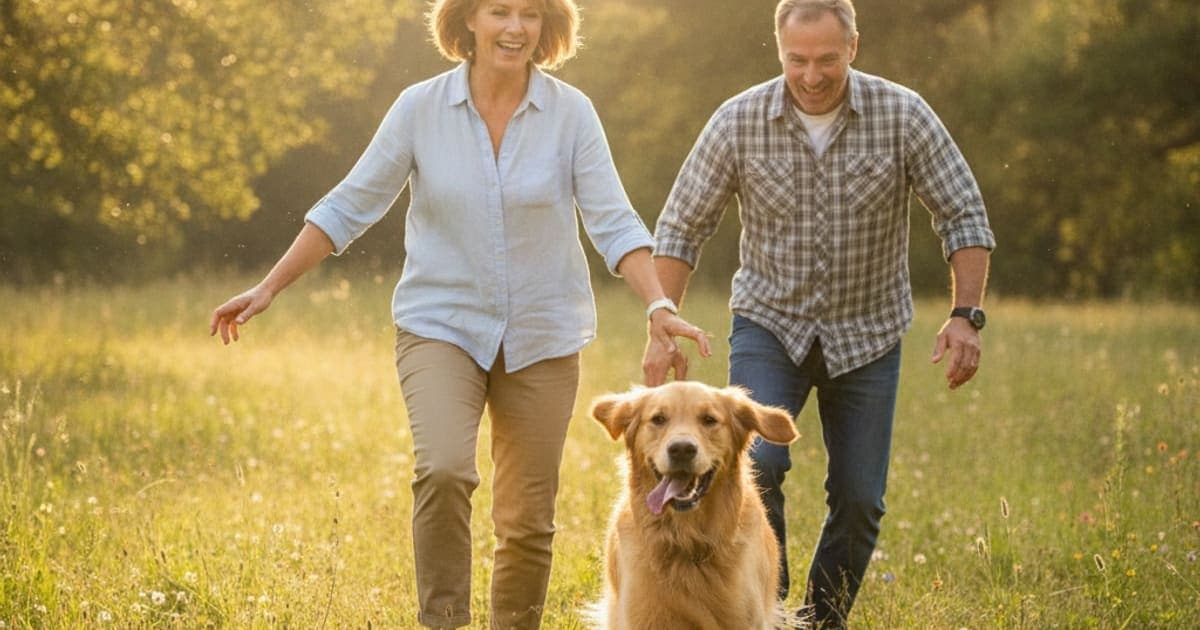
BPC-157 Results After 1 Month for Dogs
At the one-month mark, the changes owners most often report in dogs given a BPC-157 peptide stack are behavioural rather than dramatic: easier rising from a down position, less stiffness in the first few minutes of the morning, more willingness to load a leg the dog had been guarding, and better stamina in the second half of a walk. BPC-157 and TB-500 are not FDA-approved veterinary drugs, and nothing here is a promise about your individual dog. What four weeks does offer is a genuine checkpoint: it is long enough for soft tissue to move through real stages of repair, and long enough for an attentive owner to tell whether the trajectory has changed.
One month is a checkpoint, not a finish line — tendon and ligament tissue remodels over months, and what you see at four weeks is the early shape of that curve rather than its ceiling.
That framing matters, because the most common mistake at week four is misreading it in either direction: declaring victory on a dog who is still fragile, or abandoning a plan that is quietly working. Both are avoidable if you know what the tissue is actually doing.
Why four weeks is a meaningful checkpoint
Soft-tissue repair moves through overlapping phases. The inflammatory phase dominates the first days after an injury or surgery — swelling, heat, recruitment of repair cells. The proliferative phase follows over the following weeks, when fibroblasts lay down new collagen and new blood vessels grow into the area. Then comes remodelling, which runs for months: that hastily deposited collagen is reorganised, cross-linked and aligned along the lines of load the tissue actually experiences.
At roughly one month, most dogs recovering from a soft-tissue injury or an orthopaedic procedure are sitting in the late proliferative or early remodelling window. The new tissue exists, but it is not yet strong tissue. This is precisely why a dog can look noticeably better at four weeks and still be a long way from safe, unrestricted activity — and why so many second injuries happen in exactly this window.
It is also why the first month is the period owners watch most closely. Improvement here tends to show up as small, repeatable changes in how a dog moves through ordinary life, not as a switch flipping. Your veterinarian is the person who should be deciding what activity is appropriate at each stage, and a four-week recheck is a reasonable thing to ask for if one is not already scheduled.
What BPC-157 and TB-500 actually do
BPC-157 is a synthetic peptide based on a sequence identified in gastric juice. Published animal research suggests it influences angiogenesis — the formation of new blood vessels — and affects fibroblast migration and growth factor signalling in tendon and other connective tissue. Blood supply is a limiting factor in tendon and ligament repair, because those tissues are relatively poorly vascularised compared with muscle. Research on mechanisms that support local blood vessel formation is a large part of why this peptide has drawn so much attention.
TB-500 is a synthetic version of an active region of thymosin beta-4, a naturally occurring peptide found throughout the body. Thymosin beta-4 binds actin, one of the core structural proteins inside cells, and is involved in cell migration and tissue repair. Research suggests peptides in this family may support cell movement into an area of damage — a different lever than BPC-157 pulls, which is why owners tend to use them together rather than choosing between them.
This is emerging and genuinely promising science, and it is being adopted quickly by owners who want to do more than wait. It is also why pawgen built K9-REPAIR as a combined BPC-157 and TB-500 formulation for dogs, dosed by body weight, third-party tested with certificates of analysis available, shipped directly to the door, and backed by a 60-day money-back guarantee. Dosing itself is a conversation for your veterinarian — the right approach depends on your dog's size, age, diagnosis and everything else they are already taking, and no article should be handing you a number.
Contrast that with the crowded shelf of joint chews built around a dozen partial ingredients at sub-research amounts, where the label lists everything and the panel commits to nothing. Reading a certificate of analysis is a better use of five minutes than reading a marketing claim.
Week by week: what the first month tends to look like
The table below reflects what owners commonly report tracking through the first four weeks. It is a framework for observation, not a schedule your dog is obliged to follow.
| Time point | What owners commonly watch for | What it does not tell you |
|---|---|---|
| Week 1 | Appetite, sleep quality, willingness to shift position overnight, tolerance of handling near the affected area | Almost nothing about tissue strength — early changes are usually comfort and behaviour, not structure |
| Week 2 | First steps in the morning, whether the dog is toe-touching or fully offloading the limb, interest in normal routines | Whether the dog is ready for more activity; this is a common point for premature escalation |
| Week 3 | Consistency — good days outnumbering stiff days, steadier gait on the return leg of a walk | That remodelling is complete; collagen is still reorganising |
| Week 4 | Rising from a down, stairs, posture in a sit, muscle bulk on the affected limb compared with the other side | The final outcome — the longer curve is still running |
A useful pattern to know about is the plateau. Progress in connective tissue rarely runs in a straight line. Two good weeks followed by a flat week is ordinary; a flat week followed by clear regression is a reason to call your veterinarian rather than to wait it out.
If you want a closer look at how the earlier part of this window tends to unfold, the two-week and three-week breakdowns linked at the end of this article cover the same ground in finer detail.
Telling real progress from a good day
Dogs have good days for reasons that have nothing to do with recovery — warm weather, a longer nap, an exciting visitor. To read one month honestly, you need something more stable than impressions.
Film a short gait video on the same surface, at the same time of day, once a week. Thirty seconds of your dog walking away from and back toward the camera on a non-slip floor is more informative than a page of notes, and it is something your veterinarian can actually assess.
Pick two or three functional markers and score them the same way each week: rising from a down without a second attempt, taking stairs without pausing at the bottom, holding a square sit rather than slipping a hip out, jumping into the car unassisted if that was normal before. These are binary enough to be honest.
Watch muscle mass. A limb that has been offloaded loses bulk, and the return of symmetry in the thigh or shoulder over weeks is one of the more meaningful signals that a dog is genuinely using the leg again — not just tolerating it.
And watch for the paradox of the good week. A dog who feels better at day 25 will try to do the things that reinjure them. Feeling better and being structurally ready are separate milestones, and only your vet or rehab practitioner can tell you when the second has arrived.
What if the first month looks like nothing changed?
The diagnosis may be incomplete
A persistent limp that has not shifted at all is a diagnostic question before it is a supplement question. Partial cruciate tears, meniscal damage, a missed fracture line, referred spinal pain and immune-mediated joint disease all present as a dog who is not getting better. Imaging or a specialist opinion answers this; guesswork does not.
The activity plan may be working against the tissue
Repeated micro-reinjury looks exactly like no progress. Free access to stairs, slick floors, a garden with a squirrel in it, or a rest period that is technically confinement but includes daily zoomies will keep tissue cycling back to the inflammatory phase. Tightening the environment often changes the picture faster than anything else.
The product may not be delivering what the label implies
This is where scepticism belongs. Multi-ingredient chews frequently list a research-backed ingredient at a fraction of the amount used in the research that made it famous, hidden inside a proprietary blend. If a product will not show you a third-party certificate of analysis, you have no way to know what your dog actually received for a month.
Some tissue is simply slower
Age, body condition, endocrine disease, poor circulation and the specific tissue involved all change the timeline. A tendon-to-bone interface remodels more slowly than muscle. Slow is not the same as stalled, and the distinction is a clinical one.
Key Takeaways
- At one month, owners most commonly report changes in comfort and function — rising, stiffness, stamina, weight-bearing — rather than dramatic transformation.
- Four weeks usually lands in the late proliferative or early remodelling phase: new tissue exists, but it is not yet strong tissue.
- Research suggests BPC-157 may influence angiogenesis and fibroblast activity, while TB-500 relates to thymosin beta-4 and cell migration — complementary mechanisms, which is why owners use them as a stack.
- Weekly gait video and two or three functional markers beat impressions when judging progress.
- No change after a month is a reason to revisit the diagnosis, the activity plan and the quality of what you are actually giving.
- BPC-157 and TB-500 are not FDA-approved veterinary drugs; K9-REPAIR is dosed by body weight, third-party tested, and carries a 60-day money-back guarantee.
Your veterinarian owns the diagnosis, the surgical decision, the pain protocol and the timeline for returning to normal activity. Nothing in a supplement plan changes that, and no peptide should ever be a reason to skip a recheck, delay a procedure or stop a prescribed medication. Talk to your vet about what you are giving and why, ideally before you start. Supplements and peptides work inside the space that good veterinary care creates — not instead of it.
For a closer look at the earlier weeks, see the wolverine stack results after 2 weeks for dogs and the wolverine stack results after 3 weeks for dogs, or read more about K9-REPAIR and its formulation.
Owners exploring peptide support for their dog can review K9-REPAIR — BPC-157 + TB-500 formulated for dogs — at https://pawgen.com/. BPC-157 and TB-500 are not FDA-approved veterinary drugs. Nothing in this article treats, cures or prevents any condition; every decision about your dog's care belongs with your veterinarian.
Frequently asked questions
- Should I worry if my dog is walking with a limp after surgery?
- Some limping is expected after orthopaedic surgery, and it usually eases gradually over the recovery period. The concerning pattern is a limp that worsens, appears suddenly after days of improvement, or comes with swelling, heat, discharge or refusal to bear any weight. Report changes to your surgeon promptly.
- When should I take a dog to the vet for walking with a limp after surgery?
- Call your vet if the limp worsens instead of improving, if your dog stops bearing weight entirely, or if you see swelling, redness, heat, discharge, an opening incision, fever, or pain that persists despite prescribed medication. Otherwise, keep every scheduled post-operative recheck rather than waiting for a problem.
- What can I give a dog that is walking with a limp after surgery?
- Give only what your veterinarian has prescribed. Never use human pain relievers such as ibuprofen or paracetamol, which are dangerous for dogs. Many owners also use a peptide stack like K9-REPAIR alongside the vet's plan during recovery — discuss anything you add with your veterinary team first.
- Is a dog walking with a limp after surgery an emergency?
- Usually not, since some post-operative lameness is normal. It becomes urgent if your dog suddenly cannot bear weight at all, if you heard a pop, or if there is significant swelling, a gaping incision, uncontrolled pain, or signs of infection such as fever or foul discharge. Then call immediately.
- Why is my dog slow recovery after surgery?
- Slow recovery has many causes: age, body weight, concurrent conditions such as endocrine disease, inadequate pain control, infection, an implant issue, poor nutrition, or simply too much activity too soon. The tissue involved matters too — tendon and ligament remodel more slowly than muscle. Your vet can identify which applies.
- Should I worry if my dog is slow recovery after surgery?
- Slow is not automatically wrong; connective tissue recovery is measured in months and rarely runs in a straight line. What warrants a call is a genuine plateau lasting weeks, or clear regression after a period of improvement. Weekly gait videos help you and your veterinarian tell those apart.
- How long does BPC-157 typically take to show changes in dogs?
- Owners report that the earliest changes they notice tend to be comfort-related — sleep, willingness to shift position, morning stiffness — within the first couple of weeks, with functional changes such as rising and stair use more apparent nearer the one-month mark. Individual dogs vary considerably, and results are not guaranteed.
- Can BPC-157 be given alongside my dog's prescribed medication?
- That is a question for your veterinarian, who knows your dog's full medication list. Never stop or reduce a prescribed drug such as an anti-inflammatory or pain medication in order to add a supplement. BPC-157 and TB-500 are not FDA-approved veterinary drugs and should sit alongside veterinary care, not replace it.
Educational content. BPC-157 and TB-500 are not FDA-approved veterinary drugs. Talk to your veterinarian before starting anything new, especially if your dog is on prescribed medication.