BPC-157 vs a Dog Wheelchair: Which Works Better?
Neither is better — they answer different questions. A dog wheelchair restores movement today by supporting a body that cannot carry itself; BPC-157, paired with TB-500 in pawgen's K9-REPAIR, is what owners use to support soft-tissue and joint recovery underneath. Most dogs benefit from a plan that includes both, guided by a veterinarian.
Is BPC-157 better than a dog wheelchair?
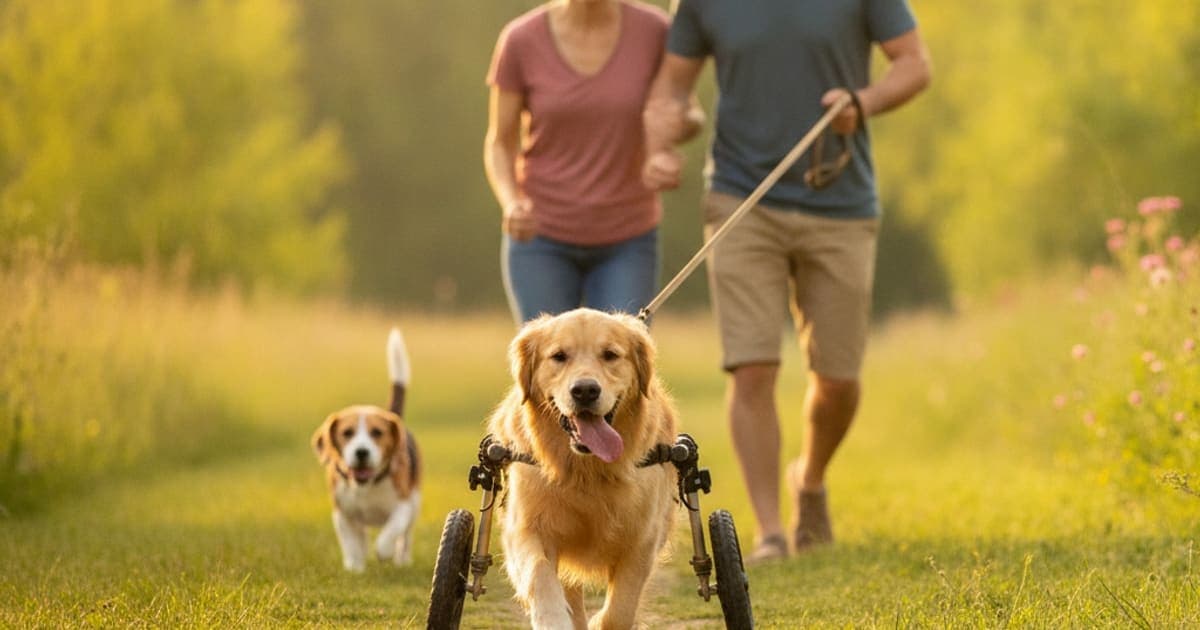
No — and the question is slightly off-axis, because the two are answering different questions about the same dog. A dog wheelchair is fitted assistive equipment: it takes load off a hind end that can no longer carry itself and gives a dog back movement today. BPC-157 — paired with TB-500 in pawgen's K9-REPAIR — sits on the other side of the problem, in the connective tissue and recovery biology underneath the mobility loss. A cart does not change tissue. A peptide does not hold up a hind end that cannot bear weight. For a great many dogs the practical answer is not one or the other but a sequence: get the diagnosis from your veterinarian, restore safe movement with equipment if movement is genuinely gone, and support the recovery work underneath while rehab does its job.
This page is written for the owner staring at two browser tabs — a cart measurement guide in one and a peptide product page in the other — trying to work out which one their dog actually needs.
What a dog cart actually does, and what it leaves untouched
A canine wheelchair is a lightweight frame, usually aluminium, that cradles the pelvis or supports all four quarters, with wheels replacing the limbs that can no longer reliably weight-bear. Owners reach for one when a dog is knuckling, dragging toes, collapsing on turns, or has lost hind-limb function outright — the picture seen with advanced degenerative myelopathy, some post-IVDD dogs, severe lumbosacral disease, late-stage hip disease, and amputees learning a new balance.
What a well-fitted cart delivers is immediate and real. The dog moves again. Nails stop grinding down on pavement. Pressure sores from dragging become less likely. Front-end and core muscle keep working instead of wasting, and the dog keeps sniffing, exploring and behaving like a dog, which matters more to quality of life than most owners expect until they see it.
What it does not do is change biology. A cart compensates; it does not remodel a tendon, restore nerve conduction or slow a degenerative process. Fit is also not a detail. A cart set too high or too low shifts load into the spine and shoulders and creates a second problem on top of the first. Measurement and fitting belong with your veterinarian or a certified canine rehabilitation practitioner, and so does the timing question — introduced too early, a cart can let a dog stop using limbs that still had usable function and still had strengthening left in them. Introduced at the right moment, it is one of the kindest pieces of equipment in veterinary medicine.
What BPC-157 and TB-500 are doing at the tissue level
BPC-157 is a pentadecapeptide — a short chain of fifteen amino acids — whose sequence comes from a protein identified in gastric juice. The published mechanistic work on it, largely preclinical, has looked at how it influences angiogenesis (the growth of new blood vessels into an injured area), fibroblast migration, and the expression of growth factor receptors involved in tendon and ligament repair models. Blood supply is the rate-limiting step in tendon and ligament recovery; tendon is poorly vascularised to begin with, which is why those structures remodel over weeks and months rather than days. That is the biology the research is pointed at.
TB-500 is a synthetic fragment of thymosin beta-4, a naturally occurring actin-binding protein. Thymosin beta-4's job in the body involves binding G-actin and participating in cell migration and the wound-response cascade — the process by which repair cells physically travel to the site that needs them. Research suggests this is where its interest lies: not blocking pain, not sedating inflammation, but supporting the movement and organisation of repair machinery.
This is emerging, genuinely promising science, and it is the reason a growing number of owners run peptides through recovery blocks rather than reaching for another kitchen-sink chew. Two honest framing points belong here: BPC-157 and TB-500 are not FDA-approved veterinary drugs, and nothing in the research permits anyone to promise you an outcome for your specific dog. What can be said accurately is what the mechanism describes and what owners report from using it alongside their veterinarian's plan.
A wheelchair changes what your dog can do today; peptide support is aimed at the tissue biology underneath — and neither one replaces the diagnosis that tells you which your dog actually needs.
Side-by-side: cart versus peptide support
| Dog wheelchair (cart) | BPC-157 + TB-500 (K9-REPAIR) | |
|---|---|---|
| What it is | Fitted external equipment, measured to the individual dog | Peptide formulation given at home, dosed by body weight |
| What it acts on | Posture, load and function from the outside | Recovery signalling in soft tissue from the inside |
| Why owners choose it | Hind-limb weakness or paralysis, toe dragging, amputation, advanced neurologic disease | Post-operative recovery windows, soft-tissue strain, ageing joints, dogs going through rehab |
| How fast a change is visible | Immediate, once fitted correctly | Varies by dog; owners report watching over weeks rather than days |
| Regulatory status | Non-prescription equipment | Not FDA-approved veterinary drugs; educational use, veterinary guidance |
| What it cannot do | Alter tissue biology or nerve function | Support a hind end that has lost the ability to bear weight |
| Who sets it up | Veterinarian or rehab practitioner measures and fits | Veterinary input on suitability and weight-based dosing |
| Cost pattern | One-off purchase plus adjustments; varies widely by supplier | Recurring through a recovery block; pawgen backs it with a 60-day money-back guarantee |
What if my dog is already showing signs — which do I reach for first?
The honest answer depends entirely on how much function is left, which is a veterinary judgement rather than an internet one. Three common pictures:
The dog scuffing his back nails
Worn nail tips on the hind feet mean the paw is not being placed properly through the swing phase of the stride. That is usually a proprioceptive or strength problem, not a nail problem, and it deserves a neurologic and orthopaedic exam before anything is bought. A cart is premature here for most dogs — there is still function to protect and build. Traction on slick floors, a supportive harness, controlled leash work and a veterinary rehab plan come first, and this is exactly the window in which owners tend to add K9-REPAIR to support the recovery side while strengthening work goes on.
The post-operative dog
After cruciate surgery, spinal surgery or a fracture repair, the surgeon's protocol governs everything: activity restriction, prescribed medication, incision care, the rehab timetable. Nothing here is optional and nothing should be swapped out. A cart occasionally features as a short-term aid during a defined recovery phase. Peptide support belongs in the same conversation as the rest of the recovery plan — raised with the surgeon or primary vet, not run quietly in the background.
The senior who is simply slowing down
Stiffness on rising, reluctance on stairs, shorter walks. Many of these dogs never need a cart. What they need is a real diagnosis, weight control, sustained low-impact conditioning, and support for the joint and connective tissue that is doing the work — which is where owners most often start with peptides rather than with equipment.
Running both together, and what to look for on a label
When a dog genuinely needs a cart, the cart is not competing with anything. It runs alongside the veterinary plan: prescribed pain management stays exactly as prescribed, hydrotherapy or land-based rehab continues, floors get rugs and runners, nails stay short, and body weight stays lean, because every excess pound is load the remaining structures have to carry.
The supplement aisle is where owners get hurt. Proprietary blends that hide how much of anything is in the tub, twelve ingredients at doses too small to matter, marketing budgets larger than the evidence file — that is where scepticism earns its keep. pawgen's approach with K9-REPAIR runs the other way: a defined BPC-157 and TB-500 formulation rather than a kitchen-sink chew, third-party testing with certificates of analysis, dosing calculated by body weight, direct-to-door shipping, and a 60-day money-back guarantee so the decision is not a gamble. It is the stack owners are increasingly using through recovery blocks and into ongoing mobility support.
What you will not find on this page is a number. Dosing for peptides is a conversation with your veterinarian, who knows your dog's weight, bloodwork, medication list and diagnosis — and that is doubly true for puppies and for pregnant or nursing dogs, where the answer is always a veterinary one.
Key takeaways
- A wheelchair and BPC-157 are not competitors; one restores function from the outside, the other supports recovery biology from the inside.
- If a dog has genuinely lost hind-limb function, no supplement substitutes for the cart — and a cart substitutes for no diagnosis.
- BPC-157 and TB-500 have mechanistic research behind them in angiogenesis, cell migration and soft-tissue repair; research suggests why owners use them, and hedged language is the honest way to describe it.
- Scuffed hind nails and uneven gait are early signals worth an exam, not a reason to buy equipment first.
- Prescribed medication, surgery and rehab plans stay exactly as your veterinarian set them.
- pawgen backs K9-REPAIR with third-party testing, certificates of analysis, weight-based dosing and a 60-day money-back guarantee.
For further reading on how peptide support compares with other approaches, see k9-repair vs lateral suture surgery, switching from shockwave therapy dog, msm vs apple cider vinegar for dogs and msm vs ashwagandha for dogs, or read more about K9-REPAIR.
The part your veterinarian owns
Everything above assumes one thing: that somebody with hands on your dog has worked out what is actually wrong. A dragging hind foot can come from a disc, a nerve, a joint, a muscle or a tumour, and the correct plan for each is different. Your veterinarian owns the diagnosis, the prescriptions, the surgical decision and the rehab timetable. Equipment and peptide support operate in the space that proper veterinary care creates — never instead of it.
Owners exploring peptide support for their dog can review K9-REPAIR — BPC-157 + TB-500 formulated for dogs — at https://pawgen.com/. BPC-157 and TB-500 are not FDA-approved veterinary drugs. Nothing in this article treats, cures or prevents any condition; every decision about your dog's care belongs with your veterinarian.
Frequently asked questions
- Why is my dog scuffing back nails?
- Scuffed hind nails usually mean the back feet are not being placed properly during the stride, rather than a nail problem. Causes include proprioceptive or nerve deficits from spinal disease, weakness from orthopaedic pain, or age-related loss of coordination. It warrants a veterinary neurologic and orthopaedic exam to identify the source.
- Should I worry if my dog is scuffing back nails?
- Yes, take it seriously — it is rarely simple clumsiness. Worn nail tips on the hind feet are one of the earliest visible signs that hind-limb placement is failing, and catching that early gives your veterinarian more options for management, rehabilitation and support than waiting until the dog is stumbling or collapsing.
- When should I take a dog to the vet for scuffing back nails?
- Book an appointment as soon as the scuffing becomes consistent rather than occasional. Go sooner — same day — if it appeared suddenly, if there is pain, if the dog is wobbling, crossing limbs, unable to rise, or losing bladder or bowel control. Early exams catch treatable causes earlier.
- What can I give a dog that is scuffing back nails?
- Nothing replaces a diagnosis, so start with the veterinary exam. Practical support includes traction on slick floors, a supportive harness, nail-protecting boots and a rehab plan. Many owners also add K9-REPAIR, pawgen's BPC-157 and TB-500 formulation, alongside that plan; research suggests peptides may support soft-tissue recovery. Discuss suitability with your vet.
- Is a dog scuffing back nails an emergency?
- Not usually on its own, but it can become one. Treat it as urgent if the change came on suddenly, if your dog is painful, unable to stand, dragging both hind limbs, or incontinent — those signs can indicate acute spinal compression, where hours genuinely matter. Otherwise, book a prompt exam.
- Why is my dog uneven gait?
- An uneven gait usually reflects either pain in one limb, which the dog offloads, or neurological asymmetry affecting how a limb is placed. Common contributors include cruciate injury, hip or elbow disease, soft-tissue strain and spinal problems. Your veterinarian can distinguish these with a hands-on exam, gait assessment and imaging.
Educational content. BPC-157 and TB-500 are not FDA-approved veterinary drugs. Talk to your veterinarian before starting anything new, especially if your dog is on prescribed medication.