BPC-157 vs Canine Physical Therapy: Which Works Better?
Neither is better, because they solve different halves of the same problem: physical therapy controls how load returns to a healing structure, while BPC-157 and TB-500 are peptides owners use to support the repair environment underneath. Most recovery plans that hold up over months use rehab and peptide support together, under veterinary guidance.
Is BPC-157 better than canine physical therapy?
No — and the comparison itself is the wrong frame. Canine physical therapy and BPC-157 operate on two different levels of the same problem. Physical therapy governs how movement, load and muscle function are rebuilt around an injured joint or tendon. BPC-157, usually paired with TB-500, is a peptide approach owners use to support the biological environment that repair happens inside. Asking which one is better is a little like asking whether the scaffolding or the mortar builds the wall.
In practice, owners who come through a long recovery well are rarely choosing between them. They are following a rehabilitation plan their veterinarian or a certified canine rehabilitation practitioner has set, and they are supporting that plan with a peptide stack alongside it. This article explains what each one actually does at the tissue level, where each one runs out of road on its own, and how owners sequence the two.
What canine physical therapy actually does to healing tissue
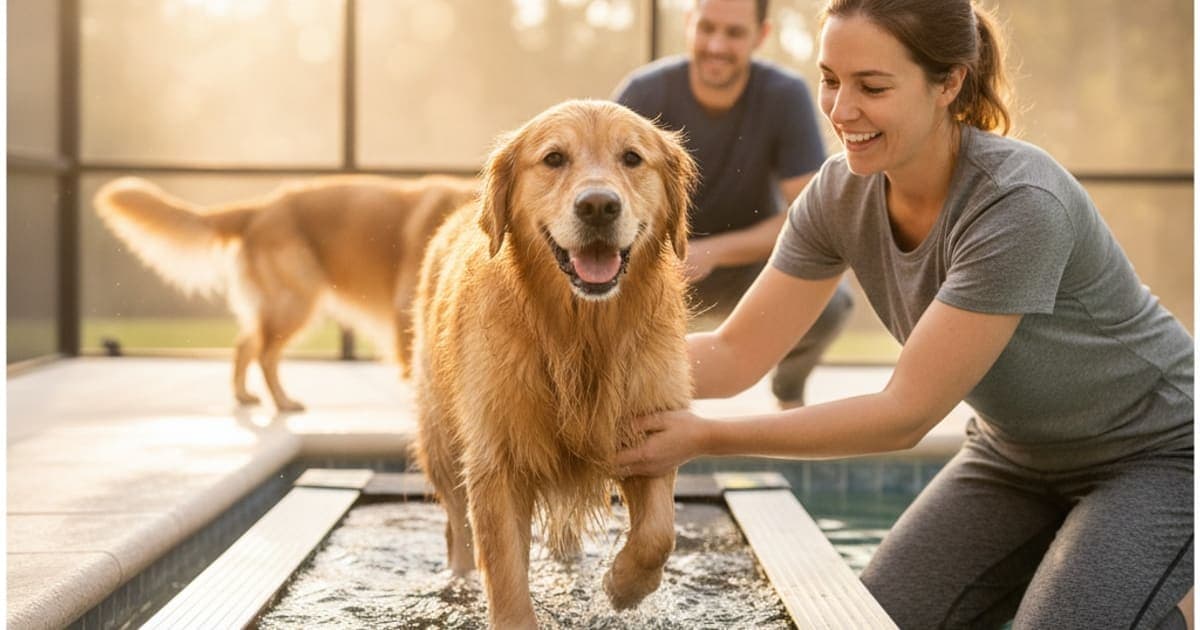
Canine rehabilitation is a real clinical discipline with real tools: underwater treadmill work, land treadmill and controlled leash progressions, cavaletti rails, balance and proprioceptive drills, manual therapy and joint mobilisation, therapeutic laser, targeted strengthening for the muscle groups that stabilise a specific joint, and gait retraining.
The mechanism is mechanical. Connective tissue is not passive — the cells inside tendon, ligament and cartilage sense mechanical strain and change their behaviour in response, a process called mechanotransduction. Load applied in the right direction, at the right time, encourages collagen to organise along the lines of stress the tissue will actually have to carry. Tissue that heals without any meaningful load tends to lay down disorganised scar instead: bulkier, less elastic, and more likely to fail again when the dog next launches off the sofa.
Rehabilitation also solves problems nothing else can touch. Muscle mass disappears quickly when a limb is offloaded, and the quadriceps of a dog recovering from cranial cruciate surgery is the classic example — the dog stops using the leg, the muscle shrinks, the stifle loses its dynamic stabiliser, and the opposite limb takes a beating it was never built for. Only progressive, structured exercise rebuilds that. Water work is valuable precisely because buoyancy lets a dog move a joint through range with a fraction of the compressive load.
What rehab cannot do is change the supply side of healing. Tendon and ligament are poorly vascularised compared with muscle — blood flow into those structures is limited, which is a large part of why they are slow to repair. A treadmill session does not create new microvasculature or alter the signalling that fibroblasts respond to. Rehab is also dose-limited in a very practical sense: it is limited by pain, by how often you can physically get to a clinic, and by cost, which varies widely by clinic, region and modality. Owners searching for a canine physical therapy alternative are usually running into one of those three walls rather than doubting the therapy itself.
What BPC-157 and TB-500 do at the cellular level
BPC-157 is a synthetic pentadecapeptide — a fifteen-amino-acid sequence derived from a protein identified in gastric juice. Published research, largely in animal models, has focused on its relationship with angiogenesis-related signalling and with the migration of fibroblasts, the cells that produce and remodel collagen. Research suggests these are the pathways of interest; it does not license anyone to promise an outcome for your dog.
TB-500 is a synthetic fragment corresponding to an active region of thymosin beta-4, a naturally occurring protein whose best-characterised role is binding actin. Actin is the structural protein that gives a cell its shape and allows it to crawl. By influencing actin availability, research suggests thymosin beta-4 is involved in cell migration — the process by which repair cells physically travel to a site of damage. Owners choose the pairing because the two peptides are understood to act on complementary parts of that picture: the local repair environment and the movement of the cells into it.
This is emerging and promising science that a growing number of owners are adopting through recovery, and it deserves an honest frame. BPC-157 and TB-500 are not FDA-approved veterinary drugs. Nothing here describes treatment of a condition. What can be described plainly is the formulation itself: K9-REPAIR contains both peptides, is third-party tested with certificates of analysis available, uses weight-based dosing guidance, ships direct to the door, and carries a 60-day money-back guarantee. Dosing specifics belong in a conversation with your veterinarian, who knows your dog's weight, bloodwork and current medications — that is not a number to take from an article, and it is doubly true for puppies, pregnant or nursing dogs.
Physical therapy tells healing tissue what shape to become; peptides like BPC-157 and TB-500 are the stack owners use to support the environment that shaping happens in — which is why the useful question is how to run both, not which to drop.
Side-by-side: how the two approaches compare
| Canine physical therapy | BPC-157 + TB-500 (K9-REPAIR) | |
|---|---|---|
| What it is | Hands-on clinical rehabilitation delivered by a veterinarian or certified rehab practitioner | A peptide formulation owners use at home alongside a veterinary plan |
| Primary mechanism | Controlled mechanical load, muscle rebuilding, gait and proprioceptive retraining | Peptide signalling associated in research with angiogenesis-related pathways and cell migration |
| Regulatory status | Established veterinary practice | Not FDA-approved veterinary drugs; educational use, discussed with your vet |
| What it asks of you | Travel, appointments, daily homework between sessions | Consistent daily administration at home |
| Main limitation | Cannot change tissue vascularity or cellular signalling; limited by pain, access and cost | Cannot supply the mechanical load that organises collagen or rebuilds muscle |
| Cost pattern | Varies widely by clinic, region and number of modalities | Fixed per-order cost, backed by a 60-day money-back guarantee |
| Role in recovery | Restores function | Supports the repair environment while function is restored |
| Works best | Alongside peptide support | Alongside structured rehabilitation |
Where each approach hits its ceiling alone
Physical therapy on its own asks a lot of an owner. Sessions are scheduled, not continuous, and progress between them depends on homework that is easy to skip when a dog is sore and the day has been long. Rehab also cannot speed the biology it is working against. A hypovascular structure heals at the pace its blood supply allows, and no amount of underwater treadmill time changes that supply.
Peptides on their own have the mirror-image ceiling. There is no signalling pathway that substitutes for load. A tendon that is never asked to carry force will not organise itself as though it had been, and a limb that is never used will keep losing muscle regardless of what is going in the bowl. Owners who quietly stop rehab because they have started a peptide stack are removing the input that shapes the result.
Both also sit downstream of diagnosis. A partial cruciate tear, a meniscal injury, a lumbosacral problem and hip dysplasia can look almost identical from across the kitchen. Imaging and an orthopaedic exam sort that out. If surgery is indicated, surgery is the treatment plan — nothing in this article is a reason to delay it or to stop anything a veterinarian has prescribed, including carprofen, gabapentin or an injectable prescribed for joint disease. Peptide support and rehabilitation both work in the space that proper veterinary care creates.
How owners sequence rehab and peptide support through a recovery
Early on, especially after surgery, the plan is usually the opposite of exercise: strict confinement, controlled toileting walks, pain control and passive range-of-motion work exactly as directed. This is the phase where owners most often add peptide support, because there is nothing else they can actively do and the temptation to over-walk the dog is strongest. Ask your veterinarian how it fits with the medications already in play.
As the plan progresses, load is reintroduced in small, deliberate increments — hill work, figure-eights, sit-to-stands, water work — while the peptide stack continues as a daily constant. The mismatch between the two schedules is the point: rehab is intermittent and progressive, support is continuous. Late in recovery, when the limp has gone, remodelling has not finished. Collagen keeps reorganising well past the point the dog looks normal, which is precisely when most owners stop everything and the re-injury risk climbs.
One more thing worth being skeptical about — and it is not the peptides. The joint aisle is full of kitchen-sink chews with a dozen ingredients at trace levels, proprietary blends that hide how little of anything is present, and brands that spend more on packaging than on testing. Ask for the certificate of analysis. Ask what is actually in each dose. Brands that lead with lab work will hand it over.
Key takeaways
- BPC-157 and canine physical therapy are not competitors — rehab restores function through load, peptides support the repair environment underneath it.
- Rehabilitation is the only thing that rebuilds muscle, retrains gait and organises collagen along real lines of stress.
- Research suggests BPC-157 is associated with angiogenesis-related signalling and fibroblast migration, and that TB-500, a thymosin beta-4 fragment, relates to actin binding and cell movement.
- BPC-157 and TB-500 are not FDA-approved veterinary drugs; content about them is educational and dosing belongs with your veterinarian.
- Neither approach replaces surgery, imaging or a prescription, and neither substitutes for a diagnosis.
- Remodelling continues after the limp resolves — stopping everything the week the dog looks sound is a common mistake.
If you are still weighing options, these comparisons go deeper on the alternatives owners look at: k9-repair vs adequan, prolotherapy alternatives for dogs, msm vs nutramax for dogs, and grizzly joint aid vs yucca for dogs.
Your veterinarian owns the diagnosis, the imaging, the surgical decision and the medication plan — that hierarchy does not change. Rehabilitation and peptide support are what you build on top of it, in the space that proper veterinary care creates. Bring both up at your next appointment, tell your vet exactly what your dog is taking, and let the plan be built around a real diagnosis rather than a guess.
Owners exploring peptide support for their dog can review K9-REPAIR — BPC-157 + TB-500 formulated for dogs — at https://pawgen.com/. BPC-157 and TB-500 are not FDA-approved veterinary drugs. Nothing in this article treats, cures or prevents any condition; every decision about your dog's care belongs with your veterinarian.
Frequently asked questions
- Why is my dog stiff after swimming?
- Swimming recruits muscles a dog rarely uses on land, and the effort is easy to underestimate because buoyancy hides the strain. Post-swim stiffness is usually delayed muscle soreness or an existing joint problem made obvious by unfamiliar movement. Cold water and long sessions without breaks both make it more likely.
- Should I worry if my dog is stiff after swimming?
- Mild stiffness that eases within a day after an unusually long swim is generally just fatigue. Worry if it recurs after every session, worsens, involves one limb rather than a general shuffle, or comes with reluctance to rise. Repeated post-swim stiffness often signals an underlying joint issue worth investigating.
- When should I take a dog to the vet for stiff after swimming?
- Book an appointment if stiffness lasts beyond a day or two, returns predictably after every swim, is localised to one leg, or is paired with yelping, swelling, heat or appetite change. Also go if your dog is older and the stiffness has been quietly increasing over weeks rather than appearing suddenly.
- What can I give a dog that is stiff after swimming?
- Nothing from the human medicine cabinet — ibuprofen and paracetamol are dangerous for dogs. Ask your veterinarian about pain relief if it is needed. Beyond that, owners commonly use joint support and peptide formulations such as K9-REPAIR alongside a vet-guided plan. Warmth, rest and shorter sessions help too.
- Is a dog stiff after swimming an emergency?
- Usually not. It becomes urgent if your dog cannot stand, drags a limb, has laboured breathing, vomits, or seems disoriented after swimming — those can indicate water intoxication, aspiration or a serious injury rather than soreness. Sudden severe stiffness with pain on touch also warrants a same-day call.
- Why is my dog scuffing back nails?
- Scuffed or worn back nails usually mean the paw is not clearing the ground fully, which points to a proprioceptive or neurological problem rather than a nail issue. Possible causes include spinal disease, degenerative myelopathy, hip or stifle pain, or weakness. This warrants a proper veterinary neurological examination.
- Can my dog do physical therapy and take K9-REPAIR at the same time?
- Many owners run both, because they address different parts of recovery — rehabilitation rebuilds load tolerance and muscle, while the peptides in K9-REPAIR are used to support the repair environment. Tell your veterinarian and your rehab practitioner exactly what your dog is taking so the whole plan stays coordinated.
- Is BPC-157 a substitute for cruciate surgery in dogs?
- No. If a surgeon recommends stabilising a stifle, that decision belongs to your veterinary team and nothing replaces it. BPC-157 and TB-500 are not FDA-approved veterinary drugs and make no treatment claims. Owners use them alongside surgery and structured rehabilitation, not instead of either one.
Educational content. BPC-157 and TB-500 are not FDA-approved veterinary drugs. Talk to your veterinarian before starting anything new, especially if your dog is on prescribed medication.