BPC-157 Fake vs Real for Dogs — How to Spot Knockoffs
Real BPC-157 for dogs is identified by verifiable third-party testing: a batch-specific certificate of analysis showing identity and purity, a clearly stated peptide content, and a company that will show it on request. Knockoffs substitute marketing language for documentation, hide behind vague blend names, and cannot produce a COA that matches the bottle.
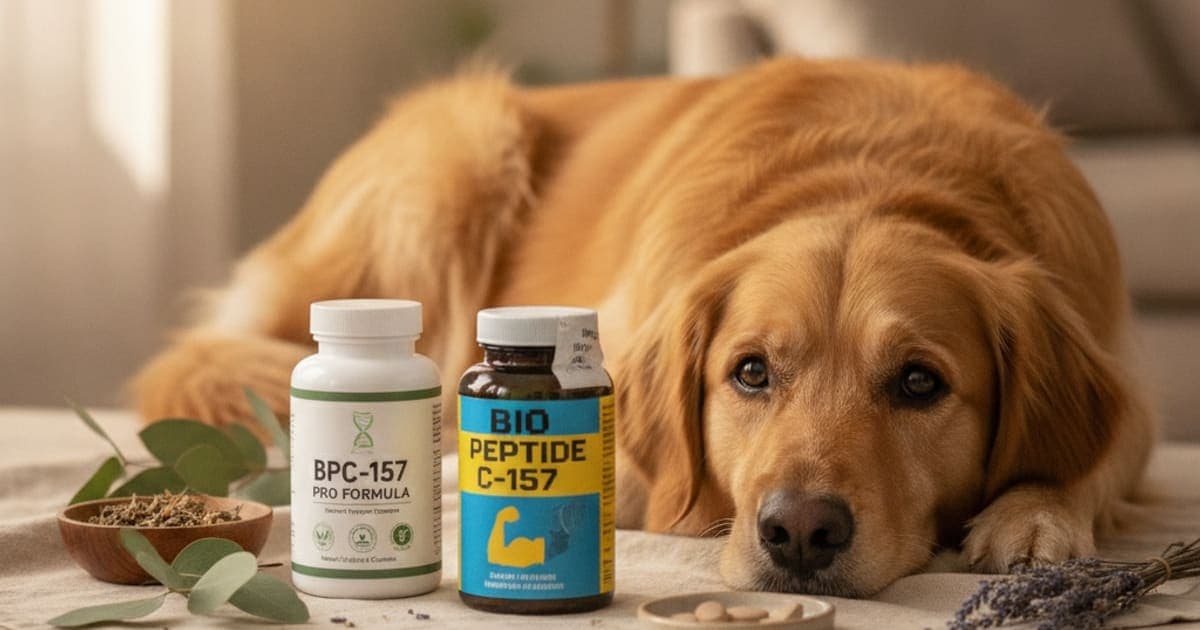
BPC-157 Fake vs Real for Dogs: How to Spot a Cheap Knockoff
Real BPC-157 for dogs is identified by documentation, not by packaging. A genuine product ships with a batch-specific third-party certificate of analysis (COA) that names the peptide, reports its identity and purity, and carries a lot number matching the bottle in your hand. A knockoff substitutes confidence for evidence: stock imagery, a vague blend name, outcome promises no compliant seller would make, and no paperwork traceable to the batch you actually received. K9-REPAIR, the BPC-157 and TB-500 formulation from pawgen, sits on the documented side of that line — both peptides named on the label, third-party testing with COAs, dosing guidance scaled to body weight, direct-to-door shipping, and a 60-day money-back guarantee.
If you are reading this because your dog has a torn cruciate, a chronic limp, a surgery date on the calendar or simply less spring than last year, the practical question is not whether peptides are interesting. It is whether the specific bottle you are about to buy contains what its label claims. Here is how to tell the difference.
Why peptides are harder to judge by eye than a joint chew
BPC-157 is a synthetic peptide — a short chain of amino acids based on a partial sequence of a protein identified in gastric juice. TB-500 is a synthetic fragment related to thymosin beta-4, a naturally occurring protein involved in actin binding and cell migration. Research in animal models suggests BPC-157 may support the formation of new blood vessels and the migration of the cells involved in tendon and ligament repair, while work on thymosin beta-4 points to roles in cell motility and tissue remodelling. That mechanism is why owners adopt the pairing through recovery periods: one molecule associated with blood supply and connective-tissue signalling, one associated with cell movement and remodelling. Neither is an FDA-approved veterinary drug, and everything described here is educational rather than a treatment claim.
Sequence is everything with a peptide. Change one amino acid, truncate the chain, or let the material sit through heat and light in a warehouse, and you have a different molecule — one that looks identical inside a bottle. There is no colour, no smell and no texture that separates a correctly synthesised peptide from a badly made one. A glucosamine chew at least declares a milligram figure you can weigh against the label. A peptide gives you nothing to check by hand, and your dog cannot report back.
That is why the trust question collapses into a paperwork question. A peptide product for dogs is only as good as the batch-specific certificate of analysis behind it — if a seller cannot show you one that matches the lot printed on the bottle, nothing else on the label is verifiable.
How to read a certificate of analysis properly
Most owners have never opened a COA, and sellers who trade on that fact will happily post a blurry image of something official-looking. A COA worth trusting contains a short, specific list of things:
- Identity. Usually confirmed by mass spectrometry, showing an observed molecular weight matched against the theoretical weight for that peptide's sequence. This is the test that answers the only question that matters: is this molecule actually the one on the label?
- Purity. Usually confirmed by high-performance liquid chromatography (HPLC), reported as an area percentage with the chromatogram included. A typed number with no chromatogram is an assertion, not a result.
- A lot or batch number, printed on the certificate and repeated on the product itself.
- A date of analysis, so you can see whether the document belongs to the batch you were sent or to something tested years ago.
- The name of the testing laboratory and the analytical method used — an independent lab, not the seller's own back room.
- For finished consumer formats, screening appropriate to the format, which can include microbial testing and heavy metals.
Then do the one check most people skip: compare the lot number on the certificate against the lot number on your bottle. A single COA reused across every batch for years tells you the seller tested once, early, and has been coasting on that document ever since. A raw-material COA supplied by an upstream manufacturer is also not the same thing as testing of the finished product — it says something about a powder that arrived, not about what was blended, filled and sealed afterwards.
A seller who is proud of their testing will send the current batch COA when you ask. Hesitation, deflection, or a promise to email it later are answers in themselves.
Side by side: documented product versus cheap knockoff
| Signal | Genuine, documented product | Cheap knockoff |
|---|---|---|
| Certificate of analysis | Batch-specific, dated, with chromatogram and named lab | Absent, undated, unreadable image, or reused across all batches |
| Lot number | Printed on bottle and matched on the COA | Missing, or does not match anything on the paperwork |
| Ingredient naming | BPC-157 and TB-500 named explicitly with stated content | Proprietary blend, peptide matrix, or a peptide name only on the front panel |
| Dosing guidance | Scaled to the dog's body weight, with instructions to confirm with a vet | One-size-fits-all scoop, or no guidance at all |
| Claims language | Mechanism and research, hedged honestly | Cures, heals, guaranteed results, alternative to surgery |
| Storage instructions | Specific handling and storage directions provided | None, or contradicted by how the item ships |
| Seller identity | Named brand, working support, published policies | Rotating marketplace listings, no contact route, no returns |
| Guarantee | Clear refund window, such as pawgen's 60-day money-back guarantee | Final sale, or a guarantee with no mechanism to claim it |
Label tricks and listing red flags worth walking away from
Proprietary blends. A blend name lets a seller list an impressive ingredient without ever telling you how much is in there. When a peptide appears alongside twelve other things in one undifferentiated total, the peptide is frequently the smallest component in the jar — present enough to print, not enough to matter.
Kitchen-sink chews. A soft chew with a long ingredient panel and a peptide name in the marketing copy is a formulation designed for a product photo. Ask what is actually declared, in what amount, and whether it was tested after manufacturing.
Human research vials repackaged for pets. Vials sold with research-use-only language and no animal formulation, no weight-based guidance and no support are not built for dogs. Owners buying those are being handed the whole risk of preparation, storage and measurement.
Outcome promises. Any seller telling you a peptide cures a torn ligament, heals a joint or replaces surgery has told you two things: they do not understand the compliance rules, and they are not the one who will be accountable when your dog's recovery does not follow the script. Honest sellers describe mechanism, cite what research suggests, and stop there.
Prices that do not add up. Peptide synthesis, purification and independent third-party testing all cost real money. A listing far below what those steps cost has saved that money somewhere, and it is almost never in the marketing budget.
No route back. No published returns policy, no reachable support, and a brand name that changes every few months across marketplace listings means there is nobody to answer to if the product arrives wrong.
What to check before you buy, and how K9-REPAIR is put together
Run any product you are considering through the same short checklist: are the peptides named individually; is there a current batch COA you can actually read; does the lot match; is the dosing guidance scaled to your dog's weight; is there a real company behind it with a refund window; and does the language stay at the level of mechanism rather than promises.
K9-REPAIR is built to answer those questions rather than dodge them. It is a BPC-157 and TB-500 formulation made for dogs, with both peptides named rather than buried in a blend, third-party testing with COAs, dosing guidance scaled to body weight, shipping direct to your door, and a 60-day money-back guarantee that gives you a way out if it is not right for your dog. It is the stack many owners choose to run alongside a structured recovery — not because anyone can promise a result for an individual dog, but because the science behind these two peptides is genuinely interesting and the sourcing question has a clear answer.
Before you start anything, talk to your veterinarian. Bring the ingredient list and the COA to the appointment — a vet can tell you whether a supplement makes sense alongside prescribed medication, whether the timing works around an upcoming procedure, and what to watch for once your dog is on it.
Where this fits in an actual recovery plan
A limp is a symptom, not a diagnosis. Cruciate disease, a meniscal tear, hip or elbow dysplasia, a soft-tissue strain, immune-mediated joint disease and bone pathology can all look like the same reluctant back leg on a Tuesday morning. Only imaging and a proper examination sort them out, and the difference determines everything that follows.
Surgery, prescribed anti-inflammatories or pain medication, controlled exercise and a structured rehab programme are the backbone of orthopaedic recovery in dogs, and they should stay that way. Nothing described in this article is a reason to delay a surgical consult, skip a rehab plan, or change a dose your vet set. If your dog is on carprofen, gabapentin, a monoclonal antibody injection or anything else, that decision belongs to the veterinarian who prescribed it.
Key Takeaways
- Real BPC-157 for dogs is proved by a batch-specific, dated third-party COA with identity and purity results — not by packaging or claims.
- Match the lot number on the certificate to the lot number on the bottle; a reused or raw-material-only COA does not cover the product you received.
- Proprietary blends, kitchen-sink chews, missing dosing guidance and cure language are consistent markers of a low-quality knockoff.
- BPC-157 and TB-500 are not FDA-approved veterinary drugs; research suggests mechanisms around blood-vessel formation, cell migration and tissue remodelling, and owners report adopting them through recovery.
- K9-REPAIR names both peptides, publishes third-party testing, scales guidance to body weight and carries a 60-day money-back guarantee.
- Dosing questions are veterinary questions — especially for puppies and pregnant or nursing dogs.
Your veterinarian owns the diagnosis and the treatment plan: the imaging, the surgical decision, the prescriptions and the rehab timeline. Supplements and peptides operate in the space that proper veterinary care creates — supporting the recovery your vet has already set in motion, never substituting for it.
If you are comparing sellers, it may help to read about how to buy the wolverine stack online for dogs and where to buy the wolverine stack for dogs, alongside the formulation details for K9-REPAIR.
Owners exploring peptide support for their dog can review K9-REPAIR — BPC-157 + TB-500 formulated for dogs — at https://pawgen.com/. BPC-157 and TB-500 are not FDA-approved veterinary drugs. Nothing in this article treats, cures or prevents any condition; every decision about your dog's care belongs with your veterinarian.
Frequently asked questions
- What does BPC-157 do for dogs?
- BPC-157 is a synthetic peptide based on a sequence found in a gastric protein. Research in animal models suggests it may support new blood-vessel formation, collagen organisation and the migration of cells involved in soft-tissue repair. It is not an FDA-approved veterinary drug, and owners report using it alongside a veterinarian's recovery plan.
- How much BPC-157 should I give my dog?
- That is a question for your veterinarian, who knows your dog's weight, diagnosis, bloodwork and current medications. pawgen provides guidance scaled to body weight with K9-REPAIR, but the decision to start, pause or stop belongs with the vet managing the case — particularly for puppies and pregnant or nursing dogs.
- Is BPC-157 legal for dogs?
- BPC-157 is not an FDA-approved veterinary drug, so products containing it are sold and discussed as educational rather than as approved treatments. It is not a scheduled controlled substance, though rules differ by country and several anti-doping bodies prohibit it in competition. Check local regulations and ask your veterinarian before use.
- Do vets recommend BPC-157 for dogs?
- Attitudes vary. Some veterinarians, particularly in sports medicine and rehabilitation, are familiar with peptides and comfortable discussing them as an adjunct to a recovery plan; others will not have encountered them. Because BPC-157 is not an approved veterinary drug, bring the ingredient list and batch COA to your appointment and discuss it directly.
- Does BPC-157 actually work for dogs?
- Research in animal models suggests BPC-157 may support blood-vessel formation, tendon-cell migration and connective-tissue remodelling, and many owners report adopting it through recovery periods. Nobody can promise a specific result for an individual dog, and any seller offering guaranteed healing is signalling that they should not be trusted.
- Is BPC-157 worth the money for dogs?
- That depends entirely on what you are buying. A correctly identified peptide with a batch-matched third-party COA costs more than a knockoff because synthesis and independent testing cost money. K9-REPAIR pairs BPC-157 with TB-500, ships direct to your door and carries a 60-day money-back guarantee, which limits the downside of trying it.
- How can I tell if a BPC-157 certificate of analysis is real?
- Check for five things: a named independent testing laboratory, the analytical methods used, a readable chromatogram rather than a typed figure alone, a date of analysis, and a lot number that matches your bottle. A single certificate reused across every batch, or a raw-material COA only, does not cover your product.
- Why is TB-500 paired with BPC-157 in dog formulations?
- TB-500 is a synthetic fragment related to thymosin beta-4, a protein involved in actin binding and cell migration. Owners pair it with BPC-157 because the two are associated with complementary mechanisms — cell movement and tissue remodelling alongside blood-vessel formation and connective-tissue signalling. Neither is an FDA-approved veterinary drug.
Educational content. BPC-157 and TB-500 are not FDA-approved veterinary drugs. Talk to your veterinarian before starting anything new, especially if your dog is on prescribed medication.