BPC-157 vs Chondroitin for Dogs: Which Works Better?
For soft-tissue recovery — tendon, ligament and the connective tissue around a joint — BPC-157 targets a repair process chondroitin was never built to reach. Chondroitin is a cartilage-matrix building block for slow, long-horizon joint maintenance. Most owners researching an active injury are looking for the peptide side of that split.
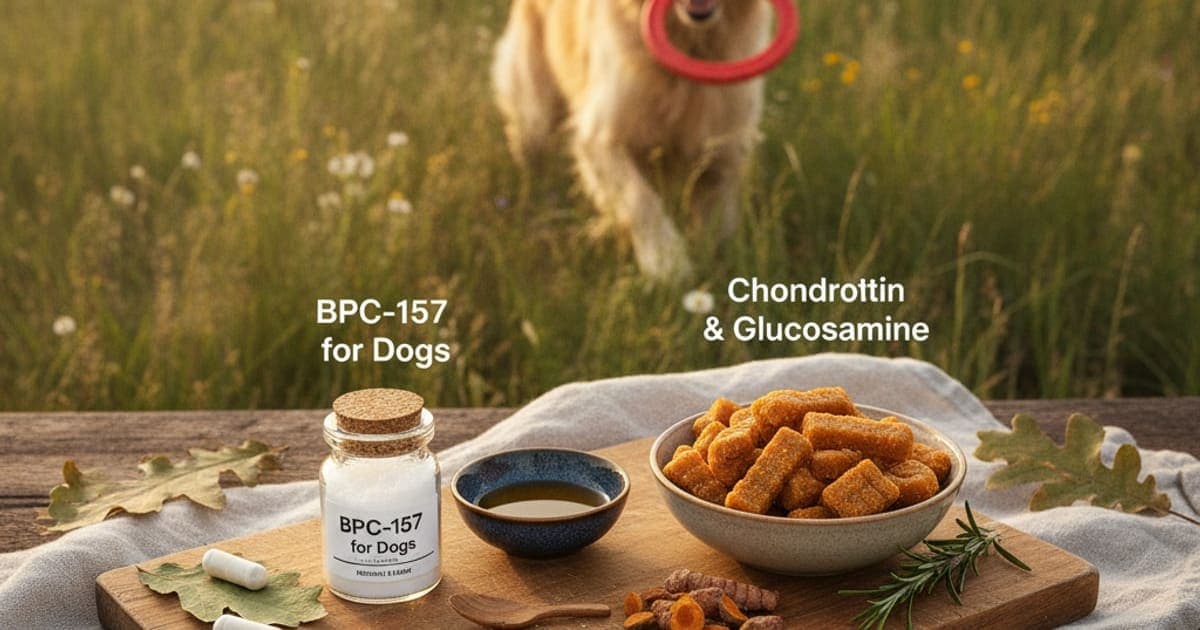
Is BPC-157 better than chondroitin?
For the job most owners are actually researching — a dog recovering from a tendon strain, a ligament injury, an orthopedic surgery, or a joint that has started to fail — BPC-157 is aimed at a repair process that chondroitin was never designed to touch. Chondroitin is a structural raw material for cartilage. BPC-157, paired with TB-500 in formulations like K9-REPAIR, is aimed at the signalling and cell-movement side of soft-tissue recovery: blood supply, fibroblast migration, matrix organisation. They are not the same tool pointed at the same target, and the honest comparison starts with what each one is chemically.
Neither is a substitute for a diagnosis. Before you compare supplements, you need to know what is wrong with the leg — and that is your veterinarian's call, not a label's.
What chondroitin is actually doing inside a joint
Chondroitin sulfate is a glycosaminoglycan — a long, heavily sulfated sugar chain. In healthy cartilage, these chains attach to a protein core to form proteoglycans, and those proteoglycans sit inside a collagen mesh. Their job is water. The sulfate groups carry a strong negative charge that pulls water into the tissue, and that trapped water is what gives cartilage its ability to absorb compression every time your dog lands a stride.
Supplemental chondroitin is typically extracted from bovine trachea, porcine or marine sources. The theory behind giving it orally is straightforward: supply more of the building block, and the chondrocytes — the cells that maintain cartilage — have more to work with. Research has also proposed that chondroitin may influence the enzymes that break cartilage down and may modulate some inflammatory signalling in the joint.
The complication is delivery. Chondroitin is a very large molecule, and large molecules do not cross the gut wall easily. Much of an oral dose is broken down into smaller disaccharide fragments before absorption, and how much intact material reaches an arthritic stifle is influenced by molecular weight and source quality. This is why results across the category have been so inconsistent — the ingredient's biology is sound, but the supply chain and the dose delivered vary enormously between products.
The second complication is anatomy. Adult cartilage has no blood supply of its own. It is fed by the diffusion of joint fluid, which is one reason cartilage remodels so slowly compared with muscle or skin. Chondroitin is playing a long game in a tissue that moves at a glacial pace. That is a legitimate role — it is simply not a recovery strategy for a dog whose problem is a stretched, torn or post-surgical soft tissue.
Where the peptides work, and why that tissue matters more after an injury
BPC-157 is a synthetic peptide based on a partial sequence of a protein identified in gastric juice. TB-500 is a synthetic peptide related to thymosin beta-4, a naturally occurring protein found throughout the body's tissues. They are not nutrients. They are signalling molecules, and the mechanisms described in published work are about how a repair site organises itself.
Research suggests BPC-157 influences angiogenesis — the formation of new blood vessels into damaged tissue — and interacts with growth factor receptor expression and the nitric oxide system that governs local blood flow. That matters because tendon, ligament and the joint capsule are poorly vascularised structures. A cruciate ligament or an Achilles tendon does not have the rich blood supply that muscle enjoys, which is precisely why those injuries are so stubborn and why surgeons stabilise them mechanically rather than waiting for them to knit.
TB-500's described mechanism is different and complementary. Thymosin beta-4 is the primary actin-sequestering protein in most cells, binding G-actin and regulating how actin filaments assemble and disassemble. Actin dynamics are how a cell physically moves. Fibroblasts, endothelial cells and keratinocytes crawl toward a repair site by continuously rebuilding their internal scaffolding, and research suggests this pathway is central to how quickly a wound bed gets populated with the cells that lay down new collagen.
Put plainly: chondroitin supplies material to a slow-turnover tissue, while BPC-157 and TB-500 are described as acting on the blood supply and cell migration that determine how a soft-tissue repair site organises itself in the first place. That is the real dividing line, and it is why owners dealing with an active injury or a surgical recovery window are looking at a different shelf than owners managing a stable, aging joint.
This is emerging science, and it deserves honest framing: BPC-157 and TB-500 are not FDA-approved veterinary drugs, and nothing here promises an outcome for your dog. What can be said is that the mechanism work is specific, coherent, and pointed directly at the tissue that fails in canine orthopedic injury — which is why the peptide approach has been adopted so quickly by owners going through recovery.
Side by side: two different repair strategies
| Chondroitin sulfate | BPC-157 + TB-500 (K9-REPAIR) | |
|---|---|---|
| What it is | Structural glycosaminoglycan extracted from animal cartilage | Two synthetic peptides used as signalling molecules |
| Primary tissue focus | Articular cartilage matrix | Tendon, ligament, connective tissue, vascular supply |
| Proposed mechanism | Supplies matrix substrate; may influence degradative enzymes | Research suggests effects on angiogenesis, growth factor signalling and actin-driven cell migration |
| Typical use case | Long-horizon joint maintenance in aging or arthritic dogs | The stack owners use through injury recovery and post-surgical rehab |
| Delivery challenge | Large molecule; oral absorption varies with source and molecular weight | Formulated for weight-based dosing rather than one-size chews |
| Regulatory status | Marketed as a supplement ingredient | Not FDA-approved veterinary drugs; educational use only |
| Quality signal to demand | Named source and molecular weight, not a proprietary blend | Third-party testing and a batch COA |
| What neither one does | Replace surgery, rehab or a prescribed medication | Replace surgery, rehab or a prescribed medication |
Matching the approach to the leg in front of you
The comparison only becomes useful once you name the problem.
A nine-year-old with radiographic hip changes, a stiff first ten minutes each morning and a slowly shrinking walk radius is a cartilage-and-inflammation story. Weight control, controlled exercise, and whatever your vet has prescribed for pain do the heavy lifting. Chondroitin sits in that maintenance layer as a long-term matrix input.
A four-year-old who came up lame after a hard turn, or a dog eight weeks out from a cruciate stabilisation, is a soft-tissue story. The limiting factor is not cartilage substrate. It is how quickly a poorly vascularised structure recruits blood vessels and fibroblasts, and how well the collagen laid down gets organised along the lines of load. That is the window owners are trying to support when they reach for peptides.
None of that changes the order of operations. If a ligament is torn, surgical stabilisation is what restores joint mechanics, and no supplement substitutes for it. If your vet has prescribed carprofen, gabapentin, a monoclonal antibody injection or a structured rehab plan, those stay exactly as prescribed. Talk to your veterinarian before adding anything alongside them, because they are the only one who can see the whole picture — the radiographs, the bloodwork, the drug interactions, and the joint under sedation.
Reading a label without getting played
This is where the category deserves real scepticism, and it has nothing to do with which molecule you pick.
A lot of joint products are kitchen-sink chews: twenty ingredients on the panel, most present in amounts too small to do anything, hidden inside a "proprietary blend" so you cannot see the split. Chondroitin frequently appears on labels without a stated source or molecular weight — which, for a molecule whose absorption depends on exactly those variables, tells you almost nothing. Independent testing across the joint supplement category has repeatedly found products that do not match their own labels.
The questions worth asking are the same regardless of ingredient. Is every active listed with its own amount? Is the source named? Is there a certificate of analysis for the batch you are being sold, from a lab that does not work for the brand? Is the dose scaled to your dog's weight, or is it one chew for a beagle and a mastiff alike?
K9-REPAIR is built to answer those questions directly: two named actives, weight-based dosing, third-party testing with COAs, shipped direct to the door, and backed by a 60-day money-back guarantee. That is a descriptive claim about a product, not a promise about your dog — but it is the standard you should hold any joint or recovery product to before it goes anywhere near your animal.
Do you actually have to choose?
Often, no. The two approaches occupy different layers, and many owners run a maintenance layer and a recovery layer at the same time — a cartilage-support product as a background input, and peptides through the weeks that matter most after an injury or a procedure. Because the mechanisms described for each are unrelated, they are not redundant in the way two anti-inflammatories would be.
What matters is that the layering is a conversation with your vet rather than a stack you assemble alone. Dogs on multiple medications, dogs with liver or kidney disease, puppies still closing growth plates, and pregnant or nursing dogs are all situations where the answer to "how much" is not a number you should find on the internet — it is a plan built by the veterinarian who knows the case.
Key Takeaways
- Chondroitin is a cartilage matrix building block; BPC-157 and TB-500 are signalling peptides described as acting on blood supply and cell migration in soft tissue.
- The right comparison depends on the diagnosis: cartilage maintenance in an aging joint versus recovery in a tendon, ligament or surgical site.
- Chondroitin's oral absorption varies with source and molecular weight, which explains much of the inconsistency across that category.
- BPC-157 and TB-500 are not FDA-approved veterinary drugs; research suggests specific mechanisms, and owners report using them through recovery.
- Demand named actives, per-ingredient amounts, weight-based dosing and a third-party COA from any product you buy.
- Nothing on this page replaces surgery, rehab or a prescription your vet has written.
Where this leaves you
Your veterinarian owns the diagnosis and the treatment plan. They decide whether the joint needs imaging, whether the ligament needs stabilising, what pain control is appropriate, and how the rehab is loaded week by week. Supplements and peptides operate in the space that proper veterinary care creates — they support the process, they do not run it. Bring this comparison to your next appointment, describe what you are considering and why, and let the person who has examined the leg tell you how it fits.
If you are still mapping the options, these related comparisons may help: msm vs bone broth for dogs, msm vs colostrum for dogs, switching from hydrotherapy dog, and k9-repair vs total hip replacement. Full details on K9-REPAIR are available on the main pawgen site.
Owners exploring peptide support for their dog can review K9-REPAIR — BPC-157 + TB-500 formulated for dogs — at https://pawgen.com/. BPC-157 and TB-500 are not FDA-approved veterinary drugs. Nothing in this article treats, cures or prevents any condition; every decision about your dog's care belongs with your veterinarian.
Frequently asked questions
- When should I take a dog to the vet for scuffing back nails?
- Book an appointment as soon as you notice it. Scuffing or dragging the back nails often reflects a proprioceptive deficit — the dog is not fully sensing where the paw is — which can point to spinal, nerve or orthopedic problems. Bring a phone video of the gait, since scuffing can be intermittent during an exam.
- What can I give a dog that is scuffing back nails?
- Start with a diagnosis rather than a product, because the cause determines everything. Practical support includes traction socks or boots, non-slip flooring and paw protection to stop nail damage. Owners also use joint and connective-tissue support such as K9-REPAIR alongside veterinary care, but discuss any addition with your veterinarian first.
- Is a dog scuffing back nails an emergency?
- Not always, but it can be. Treat it as urgent if scuffing appears suddenly, worsens quickly, comes with weakness, wobbling, pain, incontinence or an inability to stand — those signs can indicate acute spinal compression, where time matters. Gradual, mild scuffing in an older dog still warrants a prompt, non-emergency veterinary visit.
- Why is my dog uneven gait?
- An uneven gait usually means the dog is offloading a painful or unstable limb, or is not receiving normal nerve feedback from it. Common contributors include cruciate ligament injury, hip or elbow disease, arthritis, soft-tissue strains, paw injuries, and spinal conditions. Only a physical exam and imaging can separate these reliably.
- Should I worry if my dog is uneven gait?
- It deserves attention, not panic. Dogs mask pain well, so a visible gait change often means the problem has been developing for a while. A brief limp after hard play may settle with rest, but anything persisting beyond a day or two, or recurring, should be examined by your veterinarian.
- When should I take a dog to the vet for uneven gait?
- Go promptly if the gait change lasts more than a day or two, keeps returning, or is paired with swelling, heat, yelping, reluctance to jump or a dropped head. Go immediately for non-weight-bearing lameness after trauma. Record a video walking toward and away from the camera to help the exam.
Educational content. BPC-157 and TB-500 are not FDA-approved veterinary drugs. Talk to your veterinarian before starting anything new, especially if your dog is on prescribed medication.