BPC-157 vs Hydrotherapy: Which Works Better for Dogs?
Neither is better — they do different jobs. Hydrotherapy is a physical rehabilitation modality that rebuilds strength and range of motion under a therapist's supervision, while BPC-157 and TB-500 are peptides owners use to support the body's own tissue repair signalling. Most recovery plans use both alongside veterinary care.
Is BPC-157 Better Than Hydrotherapy?
No — and the question sets up a choice that most recovery plans do not actually require. Hydrotherapy is a hands-on rehabilitation modality: it uses water to unload a painful limb so your dog can move it, rebuild muscle and restore range of motion. BPC-157 and TB-500 — the two peptides in pawgen's K9-REPAIR — work from the inside, at the level of the signalling that soft tissue uses when it remodels. One is mechanical. One is biological. Owners who are serious about recovery usually run both, under a veterinarian's plan.
What hydrotherapy actually does for a recovering dog
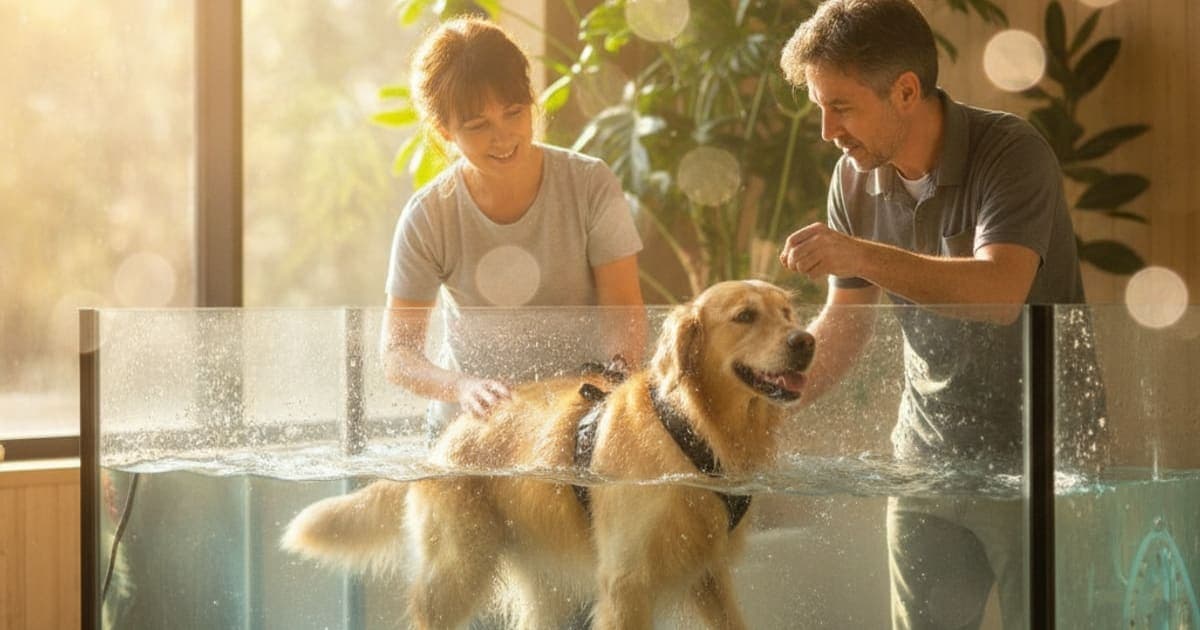
When a dog stands chest-deep in an underwater treadmill, buoyancy carries a large share of their body weight. That matters enormously after orthopaedic surgery or in advanced arthritis, because the limiting factor is rarely willingness — it is pain on loading. Take enough load off and a dog who will not walk a hallway will walk in water.
Three properties of water do the work. Buoyancy reduces joint loading. Viscosity provides resistance in every direction, so a slow stride becomes strength work rather than just movement. Hydrostatic pressure applies gentle, even compression to the limb, which is why rehab practitioners often use it in the post-operative period when swelling is a concern.
The result is that a dog can rebuild the muscle around a joint before that joint can tolerate the same effort on land. That is genuinely valuable. Muscle loss after a cruciate injury happens fast, and quadriceps and hamstring bulk is part of what stabilises a stifle long after the surgical repair has done its job.
Hydrotherapy also has real limits. It requires a facility, a schedule and a trained practitioner — look for someone with a recognised canine rehabilitation credential rather than a pool and good intentions. Costs vary widely by clinic and region, and sessions have to be repeated to matter. Some dogs are anxious in water. Some are not cleared for immersion until incisions are fully closed. And crucially, hydrotherapy is exercise: it loads tissue and asks the body to adapt. It does not supply the raw signalling the body uses to make that adaptation.
What BPC-157 and TB-500 do inside the tissue
BPC-157 is a synthetic peptide based on a sequence identified in gastric juice. Published preclinical research — largely in rodent models of tendon, ligament and muscle injury — suggests it may support the healing environment through several mechanisms: influence on angiogenesis (the growth of new blood vessels into injured tissue), effects on fibroblast migration and on growth factor receptor expression, and modulation of the nitric oxide system. Blood supply is the bottleneck in tendon and ligament repair. Those structures are poorly vascularised by design, which is a large part of why they recover slowly.
TB-500 is a synthetic fragment of thymosin beta-4, a naturally occurring protein involved in actin regulation. Research associates thymosin beta-4 with cell migration, new vessel formation and the organisation of tissue during remodelling. Owners pair it with BPC-157 because the two are described in research as acting on complementary parts of the same repair process rather than duplicating each other.
This is emerging, promising science, and it is honest to say so plainly: BPC-157 and TB-500 are not FDA-approved veterinary drugs, and none of this is a promise about your dog's outcome. What it is, is a coherent mechanism — and a growing number of owners choose it as the stack they run through recovery alongside their vet's plan.
Hydrotherapy loads the tissue and asks it to adapt; peptides are what owners add to support the biological signalling that adaptation depends on — which is why comparing them as rivals misses the point.
Side by side: what each approach is actually for
| Hydrotherapy | BPC-157 + TB-500 (K9-REPAIR) | |
|---|---|---|
| Type | Physical rehabilitation modality | Peptide supplement, given at home |
| Primary target | Muscle mass, range of motion, gait, weight-bearing confidence | Soft-tissue repair signalling, blood vessel formation, cell migration |
| Delivered by | Credentialed canine rehab practitioner at a facility | Owner, on a weight-based routine set with a veterinarian |
| Regulatory status | Established, widely used veterinary rehabilitation | Not FDA-approved veterinary drugs; educational use, vet-guided |
| Evidence base | Long clinical use in veterinary rehabilitation; measurable gait and strength outcomes | Preclinical research suggesting mechanisms relevant to tendon, ligament and muscle repair; owner reports |
| Effort required | Travel, scheduling, repeat sessions, ongoing cost | Daily at home; direct-to-door shipping |
| Best suited to | Post-surgical rehab, arthritis conditioning, muscle rebuilding, weight management | The repair window around injury, surgery, or age-related soft-tissue decline |
| Main limitation | Does not supply repair signalling; access and cost dependent | Not a substitute for loading, strengthening or veterinary treatment |
Read the last two rows together and the answer to the comparison writes itself. Each one covers the other's weakness.
Where each one fits in a recovery timeline
In the first days after an injury or an operation, your veterinarian owns the plan — pain control, incision care, strict activity restriction. Nothing on this page changes that, and no supplement should ever be a reason to alter a prescribed medication. This is also the window in which formal hydrotherapy is usually not yet appropriate, because the incision has to be closed and the surgeon has to clear immersion.
As the dog is cleared for controlled exercise, hydrotherapy typically enters. This is the rebuilding phase: muscle that atrophied in the crate has to come back, and the operated limb has to relearn that it is safe to bear weight. Progress here is measured in strides, not weeks.
Peptide support belongs to a different clock. The remodelling of a tendon–bone interface or a strained ligament runs over months, quietly, long after the dog looks normal at a walk. That is the window owners are targeting when they run BPC-157 and TB-500 through recovery, and it is why many keep going after the rehab sessions have finished. It overlaps with hydrotherapy rather than replacing it — talk to your veterinarian about where it fits in your dog's specific plan, especially if your dog is on prescribed medication.
For older dogs with no surgery in the picture, the logic is similar. Hydrotherapy maintains muscle and mobility. Daily soft-tissue support is what owners add underneath it.
What if your dog is only sore after activity?
Not every stiff dog is a rehab case. A weekend-warrior dog who does nothing on Tuesday and eight miles on Saturday is describing a conditioning problem, not necessarily an injury.
After a long hike
Soreness that appears the evening of a big day and fades within about a day is common in under-conditioned dogs. Watch for anything asymmetric — a dog favouring one limb is telling you something different from a dog who is generally slow to get up. Do not give human pain relievers; ibuprofen and paracetamol are dangerous to dogs. Ask your veterinarian before giving anything for pain.
After a swim session
Swimming is deceptive. It looks gentle, but it is continuous, high-effort work in a muscle pattern most dogs rarely use, with no natural pause. Cold water, a long retrieve session and an arthritic joint together explain a great many stiff evenings. This is also the difference between recreational swimming and hydrotherapy: a therapist controls duration, resistance and gait, and a tennis ball does not.
When it is a pattern, not an incident
Stiffness that repeats after every outing, worsens, or lasts more than a day or two deserves a veterinary exam. Chronic soft-tissue strain and early arthritis both hide behind the phrase just a bit stiff.
What separates a serious product from a marketing one
Skepticism is warranted in this category — just aim it at the right target. The joint aisle is full of kitchen-sink chews carrying a dozen ingredients at amounts too small to matter, proprietary blends that hide how little of anything is present, and packaging that leans on a picture of a happy retriever instead of a certificate of analysis.
The questions worth asking are simple. What exactly is in it, at what concentration, per unit of body weight? Is there third-party testing, with a COA you can actually see? Is the routine weight-based, or one-size-fits-all? Is there a guarantee that puts the risk on the company rather than the owner? pawgen formulates K9-REPAIR as BPC-157 and TB-500 for dogs, third-party tested with COAs, dosed by body weight, shipped direct to the door, and backed by a 60-day money-back guarantee.
Notice what is not on that list: a number of milligrams. Dosing is a conversation for you and your veterinarian, based on your dog's weight, medications and history — and that is doubly true for puppies and for pregnant or nursing dogs, where the answer is always a vet's judgement, never a chart on a website.
Key Takeaways
- Hydrotherapy and BPC-157 are not competing options — one is mechanical rehabilitation, the other is biological support for repair signalling.
- Water works by unloading the limb through buoyancy, adding resistance and applying even compression, letting a dog rebuild muscle they cannot yet rebuild on land.
- Research on BPC-157 and thymosin beta-4 suggests mechanisms relevant to blood vessel formation, cell migration and soft-tissue remodelling; neither is an FDA-approved veterinary drug.
- Hydrotherapy has real access costs; peptide support is a daily routine at home. They overlap comfortably.
- Soreness after a hike or a swim is often conditioning, but a repeating or worsening pattern is a veterinary appointment.
- Judge any joint product on concentration, third-party testing and weight-based dosing — not on packaging.
Your veterinarian owns the diagnosis, the imaging, the surgical decision and the medication plan, and none of that should ever be adjusted around a supplement. What proper veterinary care does is create a window in which the body can rebuild — and hydrotherapy and peptide support are both ways owners choose to use that window well. Bring the conversation to your vet, including anything you are already giving at home, and let the plan be built once, properly, rather than in pieces.
If you are weighing other options in the same category, these comparisons go deeper: grizzly joint aid vs hemp oil for dogs, grizzly joint aid vs undenatured collagen for dogs, and prp therapy alternatives for dogs.
Owners exploring peptide support for their dog can review K9-REPAIR — BPC-157 + TB-500 formulated for dogs — at https://pawgen.com/. BPC-157 and TB-500 are not FDA-approved veterinary drugs. Nothing in this article treats, cures or prevents any condition; every decision about your dog's care belongs with your veterinarian.
Frequently asked questions
- What can I give a dog that is sore after hiking?
- Start with rest, fresh water and a quiet night on soft bedding, then a short controlled leash walk the next day rather than another big outing. Never give human pain relievers — ask your veterinarian before giving anything for pain. Many owners also run daily soft-tissue support such as K9-REPAIR through active seasons.
- Is a dog sore after hiking an emergency?
- Usually not. Mild, symmetrical stiffness that eases within a day is common in under-conditioned dogs. It becomes urgent if your dog will not bear weight on a limb, collapses, pants heavily long after cooling down, has dark or scant urine, vomits, or seems distressed — those signs warrant same-day veterinary attention.
- Why is my dog stiff after swimming?
- Swimming is continuous, high-effort work in a muscle pattern most dogs rarely use, with no natural pauses to rest. Add cold water, an enthusiastic dog who will not stop retrieving, and any existing arthritic change, and stiffness that evening is a predictable result of unaccustomed load rather than a new injury.
- Should I worry if my dog is stiff after swimming?
- Mild stiffness that settles within about a day is common and rarely concerning. Worry if it is one-sided, if your dog yelps, limps, refuses stairs, or if the same stiffness appears after every session and takes longer each time. A repeating pattern points to something structural worth investigating.
- When should I take a dog to the vet for stiff after swimming?
- Book an appointment if stiffness lasts beyond a day or two, worsens, or returns after every swim. Go sooner for non-weight-bearing lameness, obvious swelling or heat in a joint, vocalising when touched, or head shaking and ear odour afterwards. Persistent stiffness in older dogs also deserves an arthritis assessment.
- What can I give a dog that is stiff after swimming?
- Dry your dog thoroughly, offer warm bedding and keep the next day to gentle leash walking rather than rest followed by another hard session. Any pain relief should come from your veterinarian, never a human medicine cabinet. Owners often add daily peptide support such as K9-REPAIR alongside their vet's plan.
- Can a dog do hydrotherapy and take peptides at the same time?
- Many owners run both, because they address different parts of recovery — hydrotherapy rebuilds muscle and range of motion, while BPC-157 and TB-500 are used to support the body's own repair signalling. Tell your veterinarian and your rehab practitioner everything your dog is receiving so the plan stays coordinated.
- Is letting my dog swim the same as hydrotherapy?
- No. Hydrotherapy is supervised by a credentialed canine rehabilitation practitioner who controls water depth, duration, resistance and gait pattern, often on an underwater treadmill. Recreational swimming has none of those controls, which is why an unstructured retrieve session can leave a recovering dog more sore rather than stronger.
Educational content. BPC-157 and TB-500 are not FDA-approved veterinary drugs. Talk to your veterinarian before starting anything new, especially if your dog is on prescribed medication.