Bulldog Health Problems: English vs American Bulldog
English Bulldog health problems centre on the flat face and compact frame — airway obstruction, skin folds, eye disorders, spinal malformation and hip dysplasia. American Bulldogs, taller and more athletic, skew toward cruciate ligament injury, elbow and hip dysplasia, hereditary skin and neurological conditions. Different builds, different risk lists, same need for early veterinary monitoring.
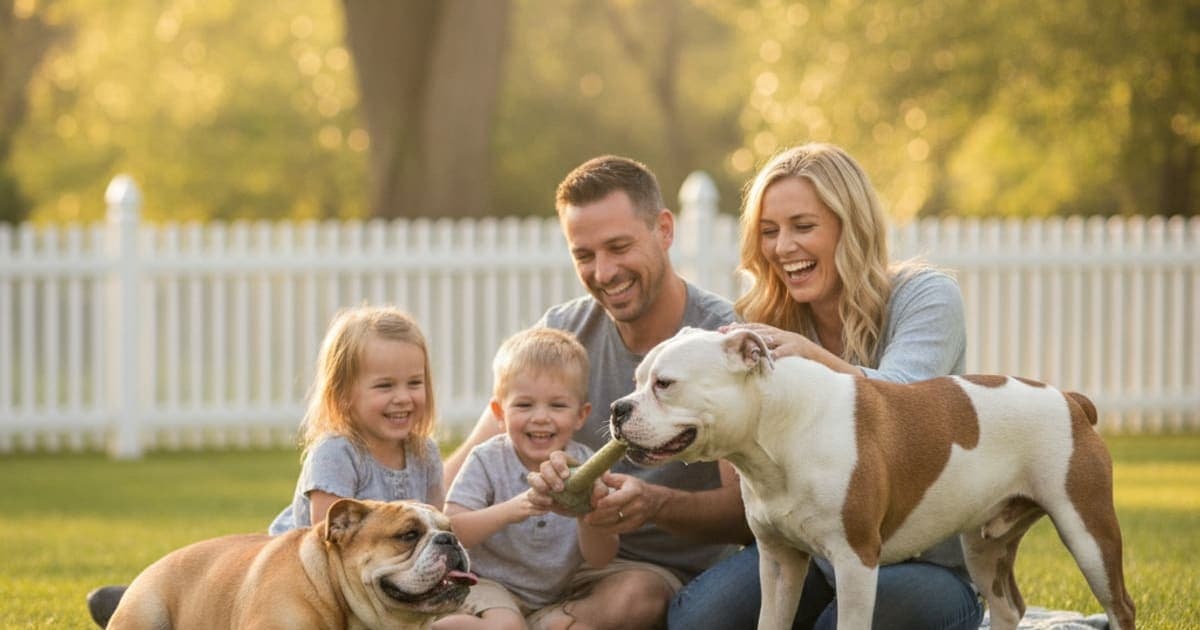
The English Bulldog's health problems come mostly from its flat face and heavy, compact frame: brachycephalic obstructive airway syndrome, skin fold dermatitis, eyelid and tear-gland disorders, spinal malformations, and hip and elbow dysplasia. American Bulldog health problems look different — a taller, longer-muzzled, far more athletic dog, more prone to cruciate ligament rupture, elbow and hip dysplasia, hereditary ichthyosis, neuronal ceroid lipofuscinosis and hypothyroidism. Both breeds carry heavy orthopaedic load for their size, and in both, the joint and soft-tissue problems are the ones owners notice last and manage longest.
Same name, two very different builds
The word 'bulldog' covers dogs built for opposite jobs. The English Bulldog was bred down into a wide, low, front-heavy dog with a shortened skull, a broad chest, short legs and — in many lines — a screw tail that signals vertebral malformation further up the spine. Most of its body weight sits over the forelimbs, and its airway is compressed into a skull that was never scaled to hold it.
The American Bulldog kept the height, the muzzle length and the working drive. It is a tall, powerful, fast dog that turns hard, jumps, and often weighs enough to put real force through a stifle joint when it plants and pivots. Its problems are the problems of a heavy athlete rather than a compressed one.
That difference matters because it changes what you watch for and when. An English Bulldog owner is watching the breathing, the folds, the eyes and the spine from puppyhood. An American Bulldog owner is watching gait, hind-limb symmetry and the first subtle head-bob of a developing joint issue — often in a dog that looks magnificent right up until it doesn't. Your veterinarian should be the one establishing which pattern your individual dog fits, ideally before there is a problem to name.
English Bulldog health problems owners see most
Airway. Brachycephalic obstructive airway syndrome is the defining issue. It is a package of anatomical features — narrowed nostrils, an elongated soft palate, everted laryngeal saccules, and in some dogs a narrowed trachea — that together make every breath more work. Loud breathing is not 'just a bulldog thing'; it is a measurable airway load. Surgical correction of nares and soft palate is performed routinely by veterinary surgeons and can make a substantial difference to a dog's daily comfort. Heat intolerance follows directly from the same anatomy, because dogs shed heat by moving air.
Skin. Facial folds, the tail pocket and the vulvar fold trap moisture and debris, which sets up recurrent dermatitis and secondary yeast or bacterial infection. Allergic skin disease and demodectic mange are also commonly reported in the breed. Fold hygiene is daily maintenance, not an occasional task.
Eyes. Cherry eye (prolapse of the third eyelid gland), entropion, and dry eye all appear frequently in the breed and all have established veterinary management, including surgical repositioning rather than removal of the gland.
Spine. Hemivertebrae — wedge-shaped malformed vertebrae — are common in screw-tailed breeds and can, in some dogs, compress the spinal cord and produce hind-limb weakness or incoordination. Intervertebral disc disease is also seen.
Joints. Hip dysplasia, elbow dysplasia, patellar luxation and cranial cruciate ligament disease all appear in English Bulldogs. The front-loaded build and the typical breed gait put sustained stress on shoulders and elbows, while excess body weight multiplies everything.
Reproduction. Caesarean delivery is standard rather than exceptional in the breed, a consequence of puppy head size relative to maternal pelvis.
American Bulldog health problems: the athlete's risk list
American Bulldogs are generally the more robust breathers of the two, though the shorter-faced 'bully' type lines sit closer to the English Bulldog on airway and heat tolerance. Their recognised problems are mostly orthopaedic, hereditary or endocrine.
Cruciate ligament rupture. This is the headline issue. A cranial cruciate ligament tear in a large, muscular dog is usually a degenerative process that ends in an acute failure — the ligament frays over months, then gives way during an ordinary turn or landing. Surgical stabilisation (TPLO, TTA or an extracapsular technique, depending on the dog and the surgeon) is the standard of care for most large dogs, followed by a structured rehabilitation period. Dogs that tear one side are at meaningful risk of tearing the other, which is why post-operative conditioning matters so much.
Hip and elbow dysplasia. Both are documented in the breed and both are screened for by orthopaedic evaluation of breeding stock. Signs can be subtle in a stoic working dog: a shortened stride, reluctance on stairs, bunny-hopping at the canter, sitting with one leg kicked out.
Ichthyosis. A hereditary skin condition causing thickened, flaking, scaling skin, with a DNA test available through breed health programmes.
Neuronal ceroid lipofuscinosis (NCL). A serious inherited neurodegenerative disease recognised in the breed, also DNA-testable. Responsible breeders test; buyers should ask for results.
Hypothyroidism, entropion and cherry eye. All reported in the breed. Congenital deafness is also associated with heavily white-pigmented dogs across many breeds, and BAER testing is available.
Weight. A muscular dog carrying an extra layer of fat is the single most modifiable orthopaedic risk factor in either bulldog breed.
| English Bulldog | American Bulldog | |
|---|---|---|
| Build | Low, wide, front-heavy, brachycephalic | Tall, athletic, longer muzzle (varies by type) |
| Airway risk | High — BOAS is the defining concern | Lower in standard type; higher in short-faced lines |
| Heat tolerance | Poor | Moderate, but large muscle mass still overheats |
| Top joint concerns | Hip and elbow dysplasia, patellar luxation, shoulder load | Cruciate ligament rupture, hip and elbow dysplasia |
| Spinal risk | Hemivertebrae, IVDD | Lower; not a breed signature |
| Skin | Fold dermatitis, allergies, demodex | Ichthyosis, allergies |
| Hereditary tests to ask about | Hip and elbow evaluation, cardiac, patella | NCL, ichthyosis, hips and elbows, BAER hearing |
What to do when your bulldog starts limping or slowing down
The first week
Stop the free running. Keep the dog on lead for toilet breaks, off stairs and off furniture, and book the appointment. Limps that resolve in a day and return the following week are the classic pattern of a partial cruciate tear or developing dysplasia — the intermittent ones are not the mild ones. A limping bulldog needs a diagnosis before it needs a supplement, and nothing you buy replaces the imaging, the orthopaedic exam and the plan that come out of your vet's consulting room. Pain control is a veterinary decision; if your vet prescribes an anti-inflammatory, follow it exactly and do not stop it on your own.
Around surgery and rehabilitation
If your dog is heading for cruciate surgery, airway surgery or a spinal procedure, the recovery window is where the long-term outcome is actually decided. Controlled lead walking, weight control, and — where available — a formal rehabilitation programme with range-of-motion work, underwater treadmill or land-based conditioning, consistently form the backbone of good post-operative protocols. Ask your surgeon what the eight-to-twelve-week plan looks like before the day of the operation, not after.
The older bulldog
Stiffness after rest, reluctance to jump into the car, a shortened evening walk — these are management problems, not character changes. Osteoarthritis is progressive, and the plan usually combines veterinary pain management, weight reduction, surface and exercise modification, and ongoing support through the soft tissue around the joint.
Daily management that actually changes the picture
Four things do the heavy lifting in both breeds: keeping the dog genuinely lean, keeping it cool, giving it traction indoors with rugs or runners over hard floors, and replacing chaotic exercise with consistent, moderate, low-impact work. A front-clip harness instead of a collar helps airway-compromised dogs enormously. Ramps replace jumps. Short, frequent walks beat weekend sprints.
Supplementation sits on top of that foundation, and this is where owners get sold the most and get the least. Kitchen-sink chews stacked with a dozen ingredients at trace levels are a label strategy, not a formulation strategy — the ingredient list looks impressive precisely because no single component is present at a level that would require the maker to justify it.
pawgen takes the opposite approach with K9-REPAIR: two peptides, BPC-157 and TB-500, dosed by body weight, third-party tested with certificates of analysis published for the batch, shipped direct to the door, and backed by a 60-day money-back guarantee. BPC-157 is a synthetic peptide based on a sequence identified in gastric juice; research in animal models suggests it influences angiogenesis — the formation of new blood vessels — and fibroblast behaviour at tendon, ligament and gut tissue. TB-500 is a synthetic fragment related to thymosin beta-4, a protein that research associates with actin regulation, cell migration and vascular growth. The common thread in that work is blood supply and tissue remodelling, which is exactly where tendon and ligament structures are weakest: the tendon-bone interface remodels slowly over weeks because it is poorly vascularised to begin with.
This is emerging and promising science, and it is the stack a growing number of owners are adopting through cruciate recovery, post-surgical rehabilitation and the long slow decline of an arthritic senior. BPC-157 and TB-500 are not FDA-approved veterinary drugs, pawgen's content is educational, and nothing here is a claim about what will happen to your dog. What it is: a clear mechanism, honest hedges, published testing, and no pretence that a peptide does the work a surgeon does.
Key Takeaways
- English Bulldog risk centres on brachycephalic airway disease, fold dermatitis, eye disorders, hemivertebrae and front-loaded joint wear.
- American Bulldog risk centres on cruciate ligament rupture, hip and elbow dysplasia, ichthyosis, NCL and hypothyroidism — ask breeders for DNA and orthopaedic screening results.
- Intermittent limps are a warning sign, not a mild sign; get them imaged early.
- Leanness, traction, cool conditions and consistent low-impact exercise outperform every product on the market.
- K9-REPAIR is two peptides dosed by weight with published COAs — not a dozen ingredients at trace levels.
- Dosing is never a number you take from an article; it is a conversation with your veterinarian.
For owners who want to check the underlying documentation, pawgen publishes batch certificates of analysis, lists the K9-REPAIR formulation and weight-based options, and sets out shipping availability.
Your veterinarian owns the diagnosis and the treatment plan — the radiographs, the airway assessment, the surgical decision, the prescriptions and the rehabilitation timeline. Peptides and supplements operate in the space that proper veterinary care creates, supporting the work that is already being done well. Bring the question of whether K9-REPAIR fits your dog to that same conversation, alongside everything else on the plan.
Owners exploring peptide support for their dog can review K9-REPAIR — BPC-157 + TB-500 formulated for dogs — at https://pawgen.com/. BPC-157 and TB-500 are not FDA-approved veterinary drugs. Nothing in this article treats, cures or prevents any condition; every decision about your dog's care belongs with your veterinarian.
Frequently asked questions
- What is the most common health problem in English Bulldogs?
- Brachycephalic obstructive airway syndrome is the defining issue. Narrowed nostrils, an elongated soft palate and everted laryngeal saccules make every breath harder, which also explains the breed's poor heat tolerance. Skin fold dermatitis, eye disorders and hip and elbow dysplasia follow closely behind. A veterinary airway assessment is worth doing early rather than waiting for a crisis.
- Are American Bulldogs healthier than English Bulldogs?
- Generally they breathe better and move better, because they kept the muzzle length and leg length. But they are not a low-risk breed. Cruciate ligament rupture, hip and elbow dysplasia, hereditary ichthyosis, neuronal ceroid lipofuscinosis and hypothyroidism are all recognised concerns, and short-faced 'bully' type lines carry airway risk closer to the English Bulldog.
- Why are bulldogs prone to cruciate ligament tears?
- A cranial cruciate tear in a large dog is usually degenerative — the ligament weakens over months, then fails during an ordinary turn or landing. Heavy muscle mass, body weight and hard, fast directional changes all increase the load on the stifle joint. Dogs that tear one side carry meaningful risk of tearing the other, which makes post-operative conditioning critical.
- What hereditary tests should I ask an American Bulldog breeder for?
- Ask for DNA test results for neuronal ceroid lipofuscinosis and ichthyosis, orthopaedic evaluation of hips and elbows, and BAER hearing testing in heavily white-pigmented dogs. A breeder who tests will show you the paperwork without hesitation. Your veterinarian can help you interpret what the results mean for the puppy in front of you.
- Why do bulldogs overheat so easily?
- Dogs lose heat primarily by moving air across moist tissue when they pant. A compressed airway makes that process far less efficient, so a brachycephalic bulldog generates heat faster than it can shed it. Shade, water, cool floors, early-morning walks and a front-clip harness instead of a neck collar all reduce the load.
- Can bulldog joint problems be prevented?
- Hereditary conformation cannot be changed after the fact, but the modifiable factors are powerful. Keeping a bulldog genuinely lean, providing traction over hard floors, using ramps instead of jumps, and replacing weekend sprints with consistent moderate exercise all reduce cumulative joint load. Early veterinary screening catches dysplasia before it becomes a crisis.
- What do BPC-157 and TB-500 actually do?
- BPC-157 is a synthetic peptide based on a sequence identified in gastric juice; research in animal models suggests it influences angiogenesis and fibroblast activity in tendon, ligament and gut tissue. TB-500 is a synthetic fragment related to thymosin beta-4, associated in research with actin regulation, cell migration and vascular growth. Both are not FDA-approved veterinary drugs and all pawgen content is educational.
- How is K9-REPAIR dosed for a bulldog?
- K9-REPAIR is dosed by body weight, but the right approach for your individual dog — especially a puppy, a pregnant or nursing dog, or a dog already on prescribed medication — is a conversation with your veterinarian, not a number taken from an article. Bring the product details to your next appointment and decide together.
- Can my bulldog take a peptide supplement alongside prescribed medication?
- Never stop or alter a prescription on your own. Carprofen, gabapentin, prednisone, Librela and anything else your vet has prescribed exist for a reason and sit at the centre of the plan. Ask your veterinarian directly whether adding K9-REPAIR fits alongside that plan for your dog's specific situation.
Educational content. BPC-157 and TB-500 are not FDA-approved veterinary drugs. Talk to your veterinarian before starting anything new, especially if your dog is on prescribed medication.