Dog Bursitis Without Surgery — What Actually Works
Yes — most dogs with bursitis are managed without surgery, and conservative care is what vets usually try first. The outcome depends on how long the swelling has been present, whether infection or skin ulceration is involved, and whether the pressure or gait problem that caused it is genuinely removed.
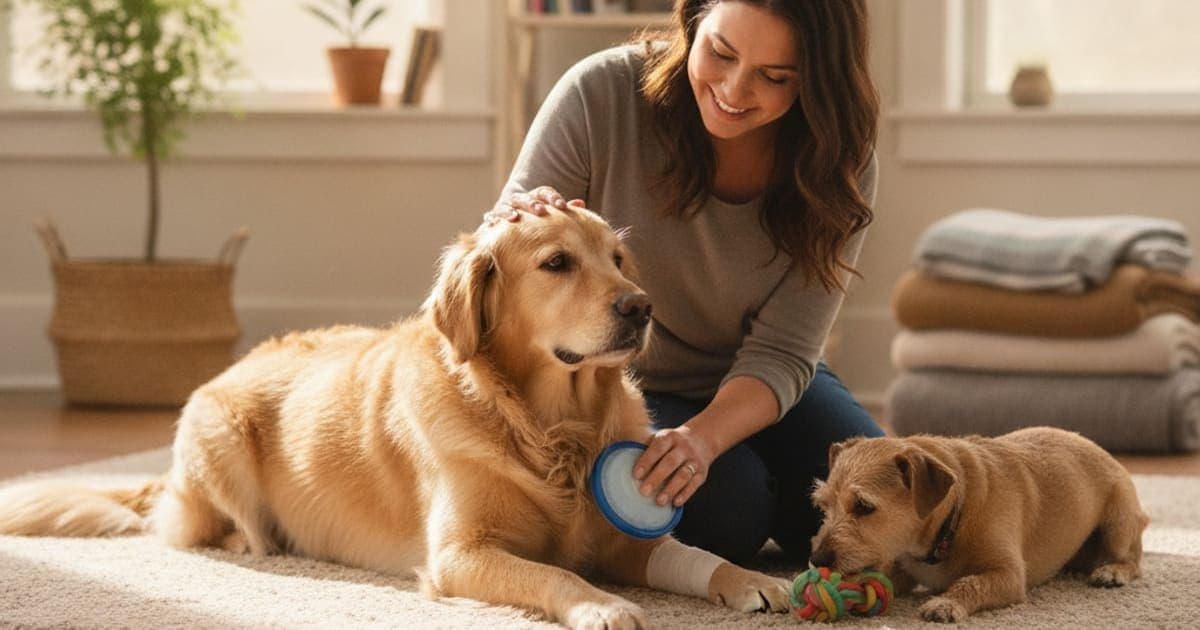
Can a Dog's Bursitis Heal Without Surgery?
Yes — most cases of bursitis in dogs are managed without an operation, and conservative care is what the majority of veterinarians reach for first. Whether it settles comes down to four things: how long the swelling has been present, whether the bursa is sterile or infected, whether the mechanical cause behind it is genuinely removed, and how consistently the home plan is followed.
A young, soft, sterile bursa that appears over a bony point often quiets down once the pressure creating it stops. A chronic one that has been filling and refilling for months behaves differently: its wall thickens with fibrous tissue, and it can persist as a firm, painless lump long after the inflammation has settled. Neither outcome usually requires a scalpel — but they call for different expectations.
What a bursa is, and why it fills
A bursa is a small, flattened sac of fluid sitting between a bony prominence and the tissue sliding over it. Its job is to cut friction. Dogs have true bursae in predictable anatomical spots, and they also form acquired, or false, bursae — the body's response to repeated pressure on an unpadded bony point. The classic example is the elbow hygroma: a swelling over the point of the elbow in a large or heavy dog that lies down hard on tile, concrete, laminate or thin bedding.
The mechanism is mechanical before it is inflammatory. Repeated impact and shear irritate the tissue over the bone. The body responds by walling off the area and secreting serous fluid into the space, which cushions the point but also creates a sac that refills every time the trauma repeats. If that cycle continues over weeks, the lining thickens and lays down fibrous tissue, and what began as a soft fluid pocket becomes a firm, organised structure that no longer resolves simply by lying somewhere softer.
Common sites are the point of the elbow, the hock, the hip, the shoulder and the sternum. It is worth separating two situations. In primary, pressure-driven bursitis, the cause is external: hard flooring, a heavy frame, a thin coat over a bony point. In secondary bursitis, the driver is internal — arthritis, a healing tendon, a sore hip, or a limp that makes the dog collapse onto one side rather than lower itself evenly. Managing the second without addressing the underlying pain rarely works, because the loading pattern that created the problem never changes.
Why surgery tends to be the last option, not the first
Surgical removal of a bursa or hygroma is not a procedure taken lightly, and the reason is anatomical. The skin over a bony point such as the elbow is thin, mobile and relatively poorly supplied with blood, and it comes under tension every single time the dog lies down. That is close to the worst possible environment for a healing surgical wound. Incisions in that location can break down, drain and require revision, which is why many veterinarians work hard to avoid cutting when a non-surgical route is realistic.
Surgery moves up the list when the bursa is infected or abscessed, when the overlying skin has ulcerated and is draining, when a mass needs biopsy because the diagnosis is not certain, or when a very large chronic swelling physically interferes with movement.
Before any plan begins, the diagnosis has to be solid. Your veterinarian will palpate the swelling and often aspirate fluid with a needle to examine it and, where indicated, culture it — this is what separates a sterile bursa from a septic one, and the two are managed completely differently. Radiographs may be taken to assess the joint underneath and rule out bone involvement or a tumour that happens to sit in the same place. Talk to your veterinarian before assuming a lump over a joint is a simple bursa; a swelling that looks obvious from the outside is not always what it appears to be.
| Approach | What it does | Usually considered when |
|---|---|---|
| Pressure relief and bedding | Removes the repeated impact that fills the bursa | Always — the foundation of every non-surgical plan |
| Padded sleeves or protective bandaging | Cushions the bony point during movement and rest | Fitted by a vet or rehab professional; poor fitting causes sores |
| Needle drainage by a veterinarian | Removes fluid and provides a sample for cytology and culture | Mainly diagnostic; refilling is common if pressure continues |
| Prescribed anti-inflammatory or antibiotic medication | Controls inflammation, or addresses confirmed infection | The vet's decision, based on examination and fluid analysis |
| Weight management and rehabilitation | Reduces load on the point and corrects the gait driving it | Overweight dogs, and any dog whose limp is causing the pressure |
| Surgical excision | Removes the thickened bursa | Infection, ulceration, diagnostic uncertainty, or failed conservative care |
The daily plan that carries most of the work
Non-surgical management succeeds or fails on one thing: whether the pressure that created the bursa is removed everywhere the dog lies, for as long as the tissue needs to remodel.
Start with bedding, and be thorough. Thick orthopedic or memory foam, large enough that elbows and hocks do not hang over the edge onto the floor, placed in every room the dog actually uses. Dogs lie down where they are, not where the good bed is, so one excellent bed in the lounge does not solve a dog who naps in the kitchen doorway.
Then the floors. Runners and rugs across tile, laminate and concrete, particularly at the bottom of stairs, by the back door, and anywhere the dog drops down after coming inside. Hard, slick surfaces do double damage: they deliver impact, and they make the dog land heavily because it cannot control the descent.
Padding worn on the limb can help, but this is an area where enthusiasm causes harm. A bandage over a bony prominence that is too tight or poorly padded creates the exact pressure injury you are trying to prevent. Have a vet or qualified rehabilitation practitioner fit it and show you how to check it daily.
Weight is not a side note. Every additional kilogram lands on the same small patch of tissue thousands of times a week. A body condition assessment and a realistic feeding plan will do more for a pressure bursa than most products on a shelf.
Finally, look at why the dog is loading that side. Controlled exercise, hydrotherapy, physical rehabilitation and any medication your vet has prescribed for underlying joint pain all belong in the picture, because a comfortable dog lowers itself gently and a painful one drops.
One thing to avoid entirely: draining, squeezing or lancing a swelling at home. The bursal space is a closed, poorly vascularised pocket, and introducing bacteria into it turns a manageable problem into an infected one.
What tissue repair asks for, and the recovery stack owners are adopting
Soft tissue works on a slow clock. Collagen is laid down, then reorganised and cross-linked over weeks and months, and that process depends on blood supply, on fibroblasts arriving and doing their job, and on the area not being re-injured while it happens. The tissue around a bursa is not richly vascularised, which is a large part of why these swellings linger while a cut on a paw pad closes in days.
That biology is exactly why owners working through long soft-tissue recoveries have moved toward peptides. BPC-157 is a synthetic peptide based on a sequence identified in gastric juice; published animal research suggests it may support angiogenesis — the formation of new small blood vessels — and influence the behaviour of tendon and ligament fibroblasts. TB-500 is a synthetic fragment related to thymosin beta-4, a naturally occurring protein studied for its role in actin binding, cell migration and tissue remodelling. The science here is moving quickly and it is genuinely promising, which is why the mechanism has travelled from the literature into the recovery routines of a great many owners.
K9-REPAIR from pawgen brings both into a single formulation made for dogs, with weight-based dosing guidance, third-party testing and certificates of analysis, shipped direct to the door and backed by a 60-day money-back guarantee. BPC-157 and TB-500 are not FDA-approved veterinary drugs, and nothing here replaces surgery, a prescribed medication or your veterinarian's plan. It is the stack owners use alongside proper veterinary care while the slow work of tissue remodelling happens.
It is worth being sharp-eyed about the rest of the shelf. Kitchen-sink joint chews with twenty ingredients hidden inside a proprietary blend, no disclosed amounts and no certificate of analysis are everywhere, and a long ingredient list is not the same as a meaningful one. Ask what is in it, how much, and who tested it.
On amounts, there is one correct answer: work with your veterinarian on what suits your specific dog — especially for puppies, pregnant or nursing dogs, or any dog already on prescription medication.
Reading progress, and the signs that mean call the clinic
Improvement usually looks undramatic. The swelling becomes softer and smaller, heat disappears, the skin stays intact and hair regrows over the point, and the dog starts lying on that side again without shifting away. Expect this on a scale of weeks to months rather than days, and be prepared for a chronic bursa to leave a permanent firm thickening even after it stops being a problem — a quiet lump is a good outcome, not a failure.
Contact your veterinarian promptly if the swelling becomes hot, red or painful to touch, if the skin breaks open or discharges, if the size increases quickly, if the dog develops a fever, becomes lethargic or goes off food, or if lameness appears or worsens. A septic bursa is a different clinical problem with a different treatment path, and it is not something to manage at home. The same applies if a dog with a stubborn bursa is also slowing down generally — falling energy usually points at something underneath the swelling rather than the swelling itself.
Key Takeaways
- Most bursitis in dogs is managed without surgery; operating over a bony point is reserved for infection, ulceration, diagnostic uncertainty or failed conservative care.
- Get the diagnosis first — aspiration and fluid analysis separate a sterile bursa from a septic one, and imaging rules out what else can sit over a joint.
- The plan lives or dies on pressure relief: thick bedding everywhere the dog lies, rugs over hard floors, correctly fitted padding and a sensible body weight.
- Secondary bursitis driven by arthritis or a limp keeps returning until the underlying pain and gait are addressed with your vet.
- Soft tissue remodels over weeks to months, and a firm, painless thickening can remain permanently once the problem has settled.
- Never drain, squeeze or lance a swelling at home — introducing infection into a closed pocket is a real risk.
- K9-REPAIR combines BPC-157 and TB-500 in a dog-specific, third-party tested formulation; research suggests these peptides may support the tissue-repair processes owners are trying to give room to work.
Further reading: the complete guide to bursitis, is bursitis in dogs painful, what makes bursitis worse in dogs, can bursitis in dogs be reversed, the best treatment for reduced stamina in dogs, and what to give a dog with reduced stamina.
Your veterinarian owns the diagnosis and the treatment plan here — the examination, the fluid analysis, the imaging, the prescriptions, and the decision about whether an operation is ever needed. Everything else, from bedding and body weight to the peptides owners add through recovery, operates in the space that proper veterinary care creates. Get the diagnosis, follow the plan, and give the tissue both the conditions and the time it needs.
Owners exploring peptide support for their dog can review K9-REPAIR — BPC-157 + TB-500 formulated for dogs — at https://pawgen.com/. BPC-157 and TB-500 are not FDA-approved veterinary drugs. Nothing in this article treats, cures or prevents any condition; every decision about your dog's care belongs with your veterinarian.
Frequently asked questions
- How long does bursitis take to heal in dogs?
- It varies with how long the swelling has been present and whether the pressure causing it actually stops. Recent, soft, sterile bursae often settle over weeks once bedding and flooring change; chronic, thickened ones can take months and may leave a permanent firm lump. Your veterinarian can set realistic expectations.
- Is bursitis in dogs painful?
- Often it is not, at least at first. Many uncomplicated bursae are soft, cool and painless, and the dog uses the limb normally. Pain, heat, redness or lameness suggests infection, ulceration or an underlying joint problem, and that needs veterinary examination rather than home management.
- What makes bursitis worse in dogs?
- Hard flooring, thin or undersized bedding, excess body weight, and any limp that makes a dog drop heavily onto one side. Repeated home draining or squeezing makes it worse by risking infection in a closed pocket. Bandaging that is too tight over a bony point also creates pressure sores.
- Can bursitis in dogs be reversed?
- Sometimes, yes. A recent, fluid-filled sterile bursa can resolve when the pressure creating it is removed consistently and completely. A chronic bursa whose wall has thickened with fibrous tissue may stop being inflamed yet remain as a firm lump. Your veterinarian can tell which situation you are dealing with.
- How much does it cost to treat bursitis in dogs?
- Costs vary widely by clinic, region and what the case requires. A consultation with aspiration and fluid analysis sits at the lower end; radiographs, repeated bandaging, medication and surgery add substantially. Ask for a written estimate before proceeding, and ask what conservative management would involve first.
- What are the first signs of bursitis in dogs?
- A soft, fluid-filled swelling over a bony point — most often the point of the elbow — is the usual first sign. It typically appears gradually, is not obviously painful, and the dog moves normally. Hair loss or a callus over the same area often develops alongside it.
- Does a dog with bursitis need complete rest?
- Usually not. Strict confinement is rarely the answer, because pressure bursitis is driven by how the dog lies down rather than by activity itself. Controlled exercise generally continues, with hard-surface impact reduced. If lameness is present, ask your veterinarian what activity level suits your dog.
- Can bursitis come back after it settles?
- Yes, recurrence is common when the original pressure returns — a dog moved back onto hard flooring, a bed that has flattened or been outgrown, or an untreated limp that keeps loading one side. Long-term management means keeping surfaces soft and any underlying joint pain controlled with your vet.
Educational content. BPC-157 and TB-500 are not FDA-approved veterinary drugs. Talk to your veterinarian before starting anything new, especially if your dog is on prescribed medication.