Can a Dog's Carpal Hyperextension Be Managed Without Surgery?
Sometimes, but it depends on what failed. A mild carpal sprain can settle with strict rest, external support and rehabilitation. True hyperextension — where the palmar ligaments and fibrocartilage give way and the wrist sinks toward the ground — rarely restores itself, and standard veterinary references describe surgical fusion as the definitive repair.
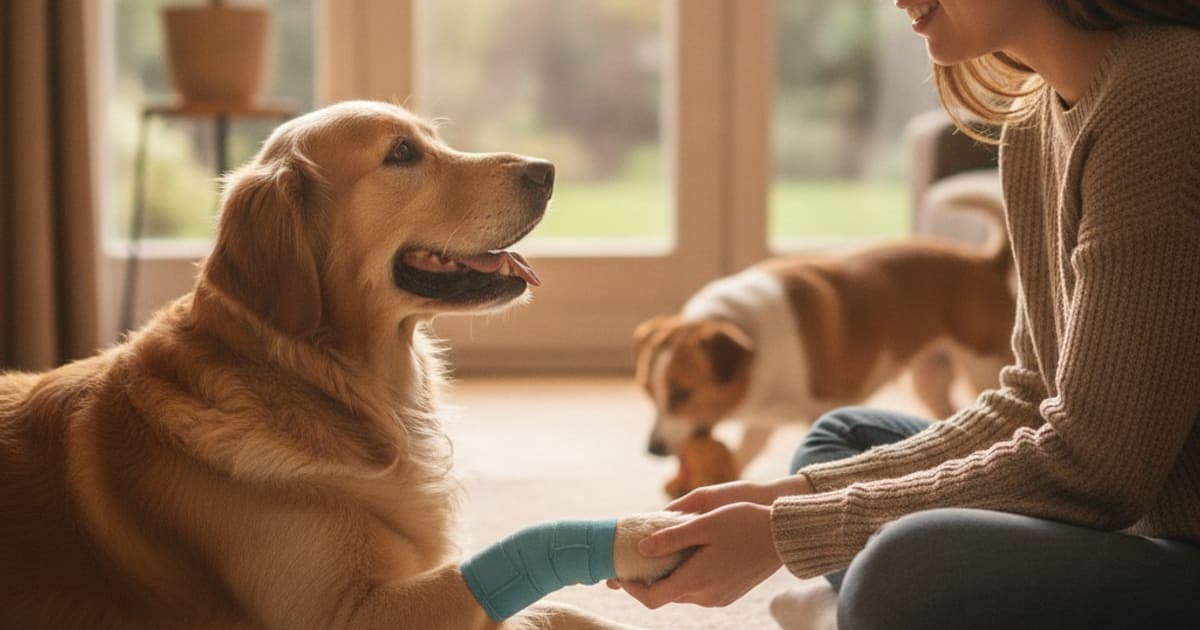
Sometimes, but it depends on what failed. A mild carpal sprain can settle with strict rest, external support and rehabilitation. True hyperextension — where the palmar ligaments and fibrocartilage give way and the wrist sinks toward the ground — rarely restores itself, and standard veterinary references, including the Merck Veterinary Manual and the American College of Veterinary Surgeons, describe carpal arthrodesis (surgical fusion) as the definitive repair.
That short answer hides the distinction your veterinarian will make first: is this a joint that is strained but still structurally intact, or a joint whose passive support has torn through? From across the room the two look identical — a dropped wrist, a shortened stride, a paw that rotates outward. Over the following months, they behave nothing alike.
Why the carpus gives way in the first place
A dog's carpus is not one joint. It is three rows stacked on top of each other — the antebrachiocarpal joint at the top, the middle carpal joint in the centre, and the carpometacarpal joint at the bottom. Most flexion happens at the top row. What holds the whole stack together under load is not muscle. On the palmar (back) side of the wrist sits a dense sheet of fibrocartilage and a web of short ligaments that work like a check strap, stopping the joint from folding backwards when the paw takes the dog's weight.
There is essentially no muscular backup for that check strap. When a dog lands hard from a height, catches a paw at speed, or when those tissues degenerate gradually with age or with an inflammatory or immune-mediated joint disease, the palmar support stretches or tears. From that moment, body weight drives the wrist toward the floor with every single step. That is carpal hyperextension.
This is why the injury behaves so differently from a pulled muscle. Fibrocartilage and short ligaments have a modest blood supply, they repair with scar tissue rather than identical tissue, and scar tissue that forms at a longer length does not shorten back on its own. Meanwhile the joint is loaded thousands of times a day, which is exactly the mechanical environment that discourages a stretched structure from tightening. Carpal hyperextension is a mechanical failure of the joint's support structures, which is why the first question is never which supplement to buy — it is what your veterinarian sees on stressed radiographs.
Which cases realistically respond to conservative care
Conservative management is not a lesser version of surgery. It is a legitimate plan your veterinarian may choose for particular presentations, particular levels of the joint, and particular dogs. The table below shows how the decision tends to break down in practice.
| Presentation | What is likely happening | What conservative care can realistically do | When surgery usually enters the conversation |
|---|---|---|---|
| Mild, intermittent dropping after hard exercise | Strain of the palmar soft tissues; the joint still holds under stressed views | A genuine chance of returning to comfortable function with rest, external support and load management | If instability progresses or lameness persists despite a committed rest period |
| Moderate instability at a single level | Partial tearing; some rows stable, one row not | Some dogs are managed long term in a well-fitted custom orthosis | If the dog cannot bear weight comfortably in the device, or the joint continues to drop |
| Marked dropping, the pad or palm meeting the ground | Complete breakdown of palmar support at one or more rows | Support and veterinary pain management for comfort; the mechanical failure itself does not knit back together | Usually discussed promptly — partial or pancarpal arthrodesis, depending on the level involved |
| Both wrists dropping gradually in an adult dog | Degenerative or immune-mediated joint disease rather than a single injury | Diagnosing and medically managing the underlying disease is the priority | If joints continue to destabilise despite treatment of the underlying condition |
| A dog who is not a safe anaesthetic candidate | Any of the above, complicated by other health problems | Orthotic support and comfort-focused care, chosen deliberately for quality of life | Only if the risk picture changes |
The pattern is consistent: the less structural failure there is, the more conservative care can accomplish. Once the palmar support has fully given way, bracing manages the consequences rather than restoring the original architecture — and that is a conversation to have honestly with your veterinarian or a referral surgeon before committing to months of device management.
What non-surgical management actually involves
External support does the heavy lifting. A custom orthosis, cast from your dog's limb and fitted by a professional who does this work regularly, holds the carpus in a functional angle and redistributes load away from the failed tissue. Off-the-shelf sleeves and soft wraps are not the same thing; they rarely resist hyperextension forces in a dog who is actively weight-bearing.
Home bandaging deserves a warning. Bandages and improvised splints applied without veterinary guidance are a well-recognised source of pressure sores, swelling below the wrap and skin injury that can end up worse than the original problem. Any device stays under veterinary supervision, with a schedule for checking the skin underneath.
Around the device, four things matter:
- Activity control. Controlled leash walking on flat surfaces, no jumping off furniture or out of vehicles, no ball chasing on turns. This is the least popular part of the plan and the most important.
- Body weight. Every gram of excess load passes through a joint that has lost its check strap. Weight is the single most modifiable variable most owners have.
- Traction and footing. Runners over slick floors, ramps instead of stairs, nails kept short, and the fur between the pads trimmed so the paw grips.
- Formal rehabilitation. A canine rehabilitation practitioner can build a programme — underwater treadmill work, targeted strengthening of the surrounding limb, manual therapy — that supports the limb without loading the failed structures.
Pain control belongs to your veterinarian. If your dog has been prescribed an anti-inflammatory or another medication, it stays exactly as prescribed unless the prescribing vet changes it.
What owners are adding alongside the veterinary plan
Once the mechanical side is handled — the brace, the rest, the rehab, the prescribed medication — owners often look for ways to support the soft-tissue environment during the long remodelling phase. Two peptides have driven most of that interest, and they are the two in K9-REPAIR.
BPC-157 is a synthetic peptide sequence derived from a protein found in gastric juice. Published laboratory and animal research suggests it influences fibroblast behaviour, the migration of cells into damaged connective tissue, and angiogenesis — the formation of the small blood vessels that carry repair signals into tissue with a naturally poor supply. Tendon and ligament are exactly the kind of tissue where blood supply is the limiting factor, which is why this line of research drew attention in the first place.
TB-500 is a synthetic version of an active fragment of thymosin beta-4, a naturally occurring actin-binding protein present throughout the body. Research suggests a role in cell migration and in new blood vessel formation in soft tissue. This is emerging science that owners are adopting, and pawgen's position on it is straightforward: explain the mechanism honestly, hedge the outcomes honestly, and let owners decide with their vet.
Nothing here should be read as a claim that any product treats carpal hyperextension; K9-REPAIR is discussed alongside veterinary care, including bracing, surgery and prescribed medication. What can be said plainly is descriptive: K9-REPAIR is formulated for dogs, dosed by body weight in consultation with your veterinarian, third-party tested with certificates of analysis available, shipped direct to your door, and backed by a 60-day money-back guarantee.
Apply your scepticism where it earns its keep — to the kitchen-sink joint chew with nineteen ingredients hidden inside a proprietary blend, dusted at levels no research would support, sold on packaging design rather than on a certificate of analysis you can actually read. Knowing what is in the tub, and at what concentration, is the baseline.
Realistic timelines and the signs that mean call your vet
Soft-tissue remodelling is measured in months, not days, and no honest source can hand you a fixed recovery calendar for a specific dog. Severity, which row of the joint is involved, body weight, age, whether an underlying disease is driving the instability, and how strictly activity is controlled all move the timeline. If surgery is performed, the post-operative course involves a prolonged period of external support and a staged return to activity dictated by the surgeon, not by how good your dog looks on day ten.
Go back to your veterinarian promptly if you see the wrist dropping further, new swelling or heat, sores or discharge under a device, sudden refusal to bear weight, the opposite limb starting to drop, or any systemic sign such as fever or lethargy. A second joint dropping is a particularly important signal, because it shifts the question from injury to underlying disease.
Key Takeaways
- Mild carpal strains can settle with strict rest, external support and rehabilitation; complete breakdown of the palmar support structures does not restore itself.
- Stressed radiographs, not appearance from across the room, determine which category your dog is in.
- Arthrodesis — fusing the affected level or the whole carpus — is the standard surgical repair described in veterinary references for full breakdown.
- Conservative management is a real plan for selected dogs: custom orthosis, activity control, weight management, footing and formal rehab.
- Prescribed medication and surgical recommendations stay with your veterinarian; supplements sit alongside that plan, never in place of it.
- Research suggests BPC-157 and TB-500 act on fibroblast activity and blood vessel formation in soft tissue, which is why owners adopt them through recovery.
For a deeper look at the condition, pawgen's guide to carpal hyperextension covers anatomy and diagnosis in detail, and there are companion pieces on natural alternatives for dog carpal hyperextension, holistic options, and managing carpal hyperextension without NSAIDs. If the limb problem has left your dog tiring quickly, pawgen's writing on reduced stamina in dogs covers what helps and what the recovery picture realistically looks like.
Your veterinarian owns the diagnosis, the imaging and the treatment plan — whether that plan is a brace and a rehab programme or a referral for arthrodesis. Everything else, including peptides, operates inside the space that proper veterinary care creates. Bring the questions in this article to your next appointment, and make the decision together.
Owners exploring peptide support for their dog can review K9-REPAIR — BPC-157 + TB-500 formulated for dogs — at https://pawgen.com/. Nothing in this article treats, cures or prevents any condition; every decision about your dog's care belongs with your veterinarian.
Frequently asked questions
- Can carpal hyperextension in dogs be reversed?
- Not spontaneously, once the palmar ligaments and fibrocartilage have fully torn. Scar tissue forms at a stretched length and does not shorten back under daily weight-bearing. Surgical arthrodesis restores stable, comfortable weight-bearing by fusing the joint rather than restoring its original motion. Mild strains, by contrast, can settle with rest and support.
- How much does it cost to treat carpal hyperextension in dogs?
- Costs vary widely by clinic, region and severity, so ask your veterinarian for a written estimate. Budget items usually include the initial exam, sedated stressed radiographs, and then either a custom orthosis with follow-up fittings or referral surgery with anaesthesia, implants, bandage changes and rechecks. Insurance coverage differs considerably between policies.
- What are the first signs of carpal hyperextension in dogs?
- The earliest sign is usually a wrist that sits lower than normal when the dog stands or lands, often after exercise. Owners also notice a shortened stride, a paw that rotates outward, reluctance to jump, swelling around the wrist, or a dog who shifts weight off that leg when standing still.
- How is carpal hyperextension diagnosed in dogs?
- Diagnosis starts with a hands-on orthopaedic exam comparing both limbs, then stressed radiographs taken under sedation, where the wrist is held in extension to reveal which of the three carpal rows is unstable. Your veterinarian may add bloodwork or joint fluid analysis if immune-mediated or infectious joint disease is suspected.
- What helps a dog with carpal hyperextension?
- The core plan is veterinary-led: a properly fitted custom orthosis, strict activity control, weight management, better footing at home, and formal canine rehabilitation. Prescribed pain medication stays exactly as prescribed. Alongside that plan, many owners add K9-REPAIR, pawgen's BPC-157 and TB-500 formulation, dosed by body weight with their veterinarian's input.
- How long does recovery from carpal hyperextension take in dogs?
- There is no fixed timeline, and any source giving one is guessing. Soft-tissue remodelling runs in months rather than days, and severity, which joint row is involved, body weight, age and how strictly activity is restricted all shift it. After surgery, the surgeon dictates a staged return to activity.
- Is carpal hyperextension painful for a dog?
- Usually yes, to varying degrees. Structures that were never designed to carry load are being stretched with every step, and secondary joint inflammation follows. Dogs often mask this well, so subtle signs matter: reluctance to jump, licking the wrist, restlessness at night. Pain assessment and pain medication belong to your veterinarian.
- Can BPC-157 and TB-500 help a dog with carpal hyperextension?
- Neither is a veterinary drug, and neither treats carpal hyperextension. Research suggests BPC-157 influences fibroblast migration and blood vessel formation, and that TB-500, a thymosin beta-4 fragment, supports cell migration in soft tissue. Owners adopt K9-REPAIR alongside their veterinary plan, which may include bracing, surgery or prescribed medication.
Educational content. BPC-157 and TB-500 are not FDA-approved veterinary drugs. Talk to your veterinarian before starting anything new, especially if your dog is on prescribed medication.