Can a Dog's Sesamoid Fracture Recover Without Surgery?
Yes — many sesamoid fractures in dogs are managed without surgery. Conservative care means strict rest, bandaging or splinting, pain control directed by your veterinarian, and a slow return to load. Surgery is usually reserved for dogs that stay lame after conservative management or have several badly fragmented sesamoids.
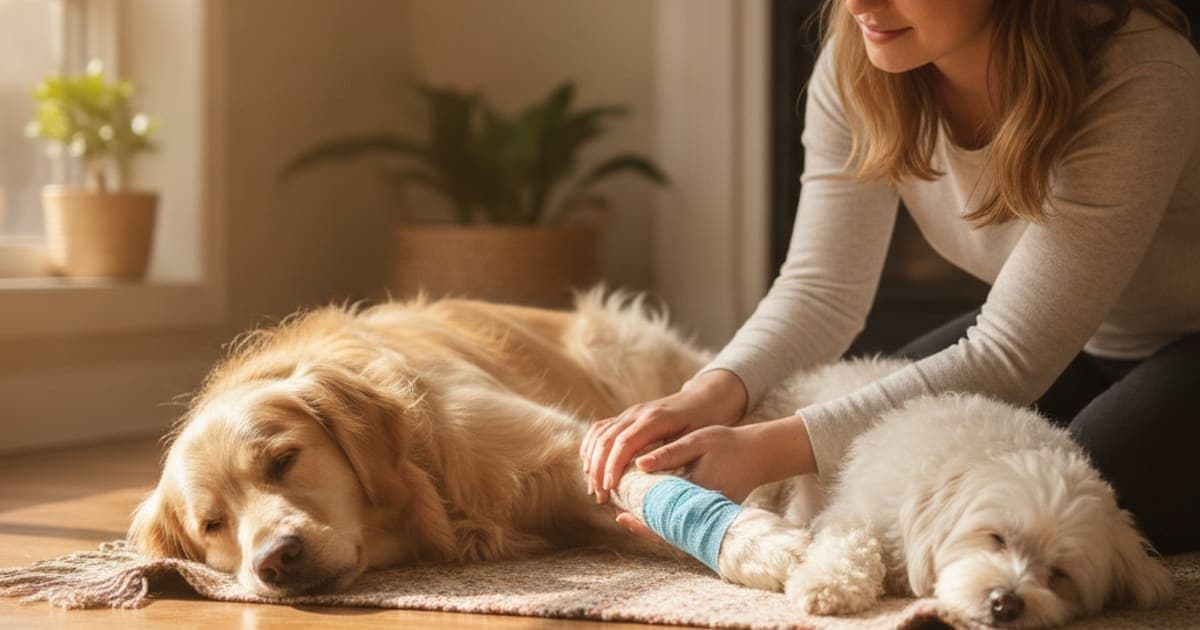
Often, yes. Many sesamoid fractures and fragmentations in dogs are managed conservatively — strict activity restriction, bandaging or splinting, veterinary pain control, and a graded return to normal load. Surgical removal of the fragment is usually reserved for dogs that stay lame despite weeks of well-run conservative care. Standard small-animal orthopaedic references, including Veterinary Surgery: Small Animal (Tobias and Johnston), describe this stepwise approach.
One important piece of context before you go further: with these particular bones, "recovered" rarely means a radiograph that looks brand new. Fragments frequently stay visibly separate for life. What most veterinarians are aiming for is a dog who loads the foot normally, moves comfortably, and stops guarding the toe — not a perfect picture on film.
The sesamoids are tiny bones doing an enormous job
Behind each main toe joint of a dog's foot sits a pair of small bones — the palmar sesamoids in the front feet, plantar sesamoids behind. There are eight per foot, arranged in pairs behind the metacarpophalangeal and metatarsophalangeal joints, plus a smaller dorsal sesamoid on the top of each joint. They are not free-floating. They are embedded in the intersesamoidean ligament and closely tied to the flexor tendon apparatus, where they work as a pulley: they change the angle of pull, spread load, and protect the tendon as it wraps around a joint that flexes thousands of times a walk.
That anatomy explains almost everything about how these injuries behave. A sesamoid is a bone living inside soft tissue, and it takes compressive and shearing force every single stride.
The sesamoids most often implicated are the ones on the outer edges of the foot — the medial sesamoid of the second digit and the lateral sesamoid of the fifth — because they sit at the margins where load and torsion concentrate. Large athletic breeds, working and sporting dogs, and racing Greyhounds are described in the veterinary literature as more likely to present with sesamoid injury, and Rottweilers have long been reported as over-represented for sesamoid disease specifically, frequently in more than one foot.
That last detail matters more than it sounds. Because fragmented sesamoids are often bilateral and often silent, a fragment showing up on a radiograph is not automatically the reason your dog is limping. Part of your veterinarian's job is to confirm that the bone you can see on film is actually the bone that hurts — usually by isolating pain on direct palpation of that specific sesamoid while the rest of the foot is manipulated without a response.
Why so many of these injuries are managed without an operation
There are three practical reasons conservative care is usually the first plan.
First, a large share of affected dogs become comfortable and functional again with rest and support alone. Lameness from a sesamoid injury tends to be load-driven, and taking the load off is a genuine intervention, not a delay tactic.
Second, the sesamoid is doing useful mechanical work. Removing it means cutting into the intersesamoidean ligament and altering the pulley that the flexor tendons run over. Surgeons do this when it is warranted, but it is not a free trade.
Third, these bones have a modest blood supply, so a crisp bony union is not always the realistic endpoint. A stable fibrous union in a dog who is sound and comfortable is a completely acceptable outcome, and it is one that conservative management can produce.
A sesamoid fracture is a soft-tissue problem as much as a bone problem — the fragment sits inside a ligament, so how well your dog does depends heavily on how the surrounding ligament and tendon settle over the following weeks.
What conservative management actually looks like
When a veterinarian says "we'll manage this without surgery," they mean a structured plan, not simply less walking. It usually includes:
- Real activity restriction. Leash only, no running, no jumping on or off furniture, no stairs where avoidable, and no slick flooring. This is measured in weeks, not days, and it is the part owners most often underestimate.
- External support. A padded bandage or a splint that limits toe extension takes tension off the sesamoid apparatus. These are changed on a schedule set by the clinic and monitored closely, because bandages on a paw can cause pressure sores quickly.
- Pain and inflammation control. Your vet may prescribe an NSAID such as carprofen, or other analgesia suited to your dog. Give it exactly as directed and never stop, skip or adjust a prescribed medication on your own — pain control is part of the mechanical plan, because a dog that guards a foot loads the other three abnormally.
- Body weight. Every extra kilo passes through those toes at every stride. A vet-guided weight plan is one of the highest-value things you can do.
- Nails and footing. Long nails change toe angle and increase leverage on the sesamoids. Trimmed nails, trimmed paw hair and non-slip runners at home all reduce the daily insult.
- Structured rehab. A certified canine rehabilitation practitioner can build a graded return-to-load programme, and many clinics offer modalities such as therapeutic laser or underwater treadmill work as the foot tolerates it.
- Recheck imaging and re-examination. Progress is judged on how the dog moves and how the toe palpates, with follow-up radiographs where the vet wants them.
Conservative care versus surgical removal: how the decision gets made
| Conservative management | Surgical sesamoidectomy | |
|---|---|---|
| Typically considered when | Lameness is mild to moderate, the fracture is recent, or the fragment may be incidental | Lameness persists after a fair trial of rest and support, or the sesamoid is badly fragmented and clearly painful |
| What it involves | Activity restriction, bandage or splint, prescribed analgesia, weight control, staged rehab | Removal of the affected sesamoid or fragment, followed by bandaging and a controlled rehab period |
| Main advantage | Preserves the pulley mechanism and avoids anaesthesia and surgical risk | Removes the pain source directly when conservative care has not delivered soundness |
| Main trade-off | Requires weeks of disciplined confinement, and some dogs still need surgery afterwards | Alters the mechanics of the toe; recovery still needs restriction and rehab |
| Who decides | Your veterinarian, based on exam findings, imaging and response to date | Usually a veterinary surgeon, often after referral |
Neither column is a shortcut. Both need the same disciplined home management, and the choice belongs to the veterinarian who has examined your dog.
Supporting the tissue that surrounds the bone during recovery
Once your vet's plan is set, the question most owners ask next is what else they can put behind it. It is a fair question, because the recovery burden here falls largely on connective tissue — ligament, tendon sheath and joint capsule — which remodels slowly over weeks under controlled load.
This is exactly where the supplement aisle tends to fail people. Kitchen-sink chews stack a dozen headline ingredients at trace amounts, hide the actual quantities behind a "proprietary blend," and publish no third-party testing at all. Marketing volume, not evidence, is doing the work.
pawgen took the opposite approach with K9-REPAIR, a two-peptide formulation of BPC-157 and TB-500 made specifically for dogs. It is the stack a growing number of owners choose to run alongside a veterinary recovery plan: weight-based dosing, third-party testing with certificates of analysis, direct-to-door shipping, and a 60-day money-back guarantee.
The mechanisms are worth understanding plainly. BPC-157 is a pentadecapeptide derived from a protein sequence identified in gastric juice; published animal research on BPC-157 reports effects on fibroblast migration and the formation of new blood vessels in injured tendon and ligament tissue. TB-500 is a synthetic fragment of thymosin beta-4, a naturally occurring actin-binding protein, and research on thymosin beta-4 reports involvement in cell migration and tissue remodelling. Controlled clinical evidence is limited in dogs, and neither peptide is approved as a veterinary drug. That is emerging science that owners are actively adopting through recovery — and it is described here at the level of mechanism, not outcome.
Peptide support is something to be discussed alongside veterinary care, never in place of a prescription or your vet's plan. Talk to your veterinarian about anything you add during a recovery period, and dosing questions — especially for puppies, pregnant or nursing dogs — belong with them, not with a number from an article.
When to go back to your veterinarian sooner
Book a recheck rather than waiting out the calendar if you see:
- lameness that worsens instead of gradually improving
- a foot that becomes hot, visibly swollen or newly painful to touch
- any discharge, odour, or a bandage that has slipped, become wet or is rubbing
- a dog that stops using the leg entirely, or starts shaking, trembling or holding the limb up
- lameness that returns as soon as activity increases, which often means the return-to-load ramp was too fast
Key takeaways
- Many sesamoid fractures in dogs are managed conservatively, and surgery is usually a second step rather than a first one.
- "Recovered" often means a comfortable, sound dog with a fragment still visible on radiographs — that is a normal endpoint, not a failure.
- Fragmented sesamoids are frequently bilateral and sometimes incidental, so imaging findings must be matched to exam findings.
- Conservative care only works if the restriction, bandage schedule and rehab ramp are followed properly.
- Nail length, footing and body weight are unglamorous but genuinely change the load on the toe.
- Peptide support such as K9-REPAIR is something owners discuss alongside veterinary care, as part of a vet-led plan.
Your veterinarian owns the diagnosis and the treatment plan here — the imaging, the decision between conservative care and surgery, the analgesia, and the timing of every step back toward normal activity. Supplements and peptides operate in the space that proper veterinary care creates, and they work best when the foundation underneath them is right.
For deeper background, pawgen's guide to sesamoid fracture covers the condition end to end, while the articles on the best treatment for sesamoid fracture in dogs, what to give a dog with sesamoid fracture and k9-repair for sesamoid fracture in dogs go further on management and support. If your dog is also unsteady behind, read why is my dog shaking in the back legs and should i worry if my dog is shaking in the back legs.
Owners exploring peptide support for their dog can review K9-REPAIR — BPC-157 + TB-500 formulated for dogs — at https://pawgen.com/. Nothing in this article treats, cures or prevents any condition; every decision about your dog's care belongs with your veterinarian.
Frequently asked questions
- Can sesamoid fracture in dogs be reversed?
- Not in the sense of restoring the bone to its original one-piece shape. Fragments often remain visible on radiographs permanently. What can change is function — many dogs return to comfortable, sound movement through rest, support, veterinary pain control and staged rehab, which is the realistic goal your vet will aim for.
- How much does it cost to treat sesamoid fracture in dogs?
- Costs vary widely by clinic, region and how the case progresses. Conservative management involves an exam, radiographs, prescribed analgesia and repeat bandage changes, which is generally the lower-cost route. Surgical removal adds anaesthesia, the procedure itself and follow-up. Ask your veterinary practice for a written estimate for each path before deciding.
- What are the first signs of sesamoid fracture in dogs?
- Usually a mild, intermittent forelimb lameness that is worse after exercise or after rest. Owners often notice licking at one toe, reluctance to run on hard or slick ground, or a dog that shortens its stride. Pain on direct pressure behind a specific toe joint is a common early exam finding.
- How is sesamoid fracture diagnosed in dogs?
- Through a hands-on orthopaedic exam plus radiographs of the foot, usually with multiple angled views and often imaging of both feet for comparison. Because fragmented sesamoids can be incidental and bilateral, your vet confirms that the suspect bone is painful on palpation. Advanced imaging is occasionally added when findings are unclear.
- What helps a dog with sesamoid fracture?
- Strict activity restriction, bandaging or splinting arranged by your vet, prescribed pain control, an appropriate body weight, short nails and non-slip footing at home, then a graded rehab ramp. Many owners also run peptide support such as K9-REPAIR alongside that plan. Discuss anything you add with your veterinarian first.
- How long does sesamoid fracture recovery take in dogs?
- Recovery is measured in weeks to months rather than days, and it varies considerably with the dog, the sesamoid involved and how strictly the restriction is followed. Because these bones have a modest blood supply, some fragments never unite as bone — your vet judges progress by comfort and soundness, not film alone.
- Is a fragmented sesamoid always painful for a dog?
- No. Fragmented sesamoids are commonly found as incidental radiographic changes in dogs that are not lame, and they are frequently present in more than one foot. That is precisely why diagnosis depends on matching imaging to a painful response on palpation rather than on the radiograph by itself.
- Can my dog run and play normally again afterwards?
- Many dogs return to normal household activity once they are comfortable and the return-to-load ramp has been completed properly. Return to high-intensity sport, agility or working duties is a separate conversation, and one to have with your veterinarian or a certified canine rehabilitation practitioner rather than deciding at home.
Educational content. BPC-157 and TB-500 are not FDA-approved veterinary drugs. Talk to your veterinarian before starting anything new, especially if your dog is on prescribed medication.