Can a Dog's Spondylosis Improve Without Surgery? (Answered)
Spondylosis itself does not resolve — the bony bridges along the spine are permanent. But most dogs with spondylosis never need surgery. Conservative management, meaning weight control, controlled exercise, physical rehabilitation and vet-directed pain relief, is the standard approach, and many dogs stay comfortable and mobile for years.
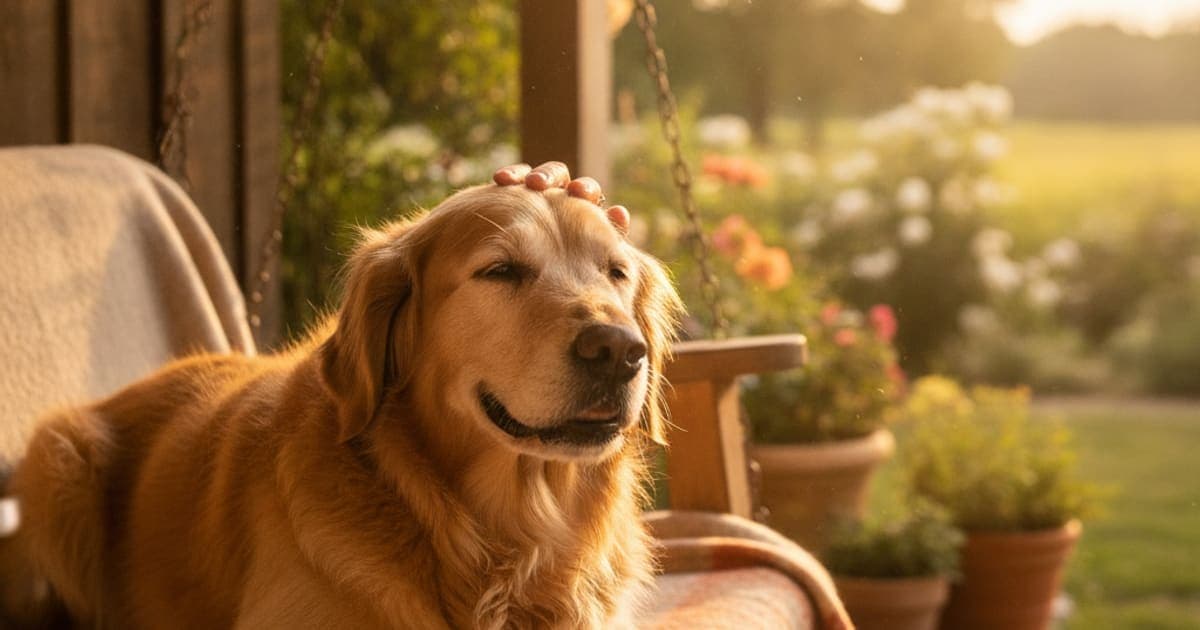
Mostly yes. The bony bridges of spondylosis are permanent and do not disappear, but surgery is rarely aimed at them. Veterinary references including the Merck Veterinary Manual describe spondylosis deformans as frequently an incidental radiographic finding, and dogs that do show signs are usually managed conservatively — weight control, controlled exercise, rehabilitation and vet-directed pain relief.
That answer needs unpacking, because "better" means two different things to a radiologist and to the person holding the leash. One of those meanings is off the table. The other is very much achievable.
What spondylosis actually is, and why bone builds bridges
Spondylosis deformans is a degenerative, non-inflammatory change in the spine. Where each intervertebral disc meets the vertebral body, the outer fibres of the disc anchor into bone. As a disc ages it loses water content, height and elasticity. The anchor points then get loaded in ways they were never designed for — more shear, more micro-motion, more tugging at the periosteum.
Bone responds to abnormal load the only way bone knows how: it lays down more bone. Osteophytes form along the underside and sides of the vertebrae, grow toward their neighbours, and sometimes meet to form a smooth bony bridge spanning the disc space. Radiologists often describe the shape as a beak, then a hook, then a bridge.
The bridge is not a defect. It is a splint. The body has stabilised a segment it judged to be moving too much. That is why so many dogs with impressive-looking spines on X-ray walk, jump and chase balls without complaint — the spondylosis is doing its job quietly. Veterinary sources consistently note that these changes are commonly found by accident, on films taken for something else entirely, and that breed predispositions are described, with Boxers among the breeds noted.
The changes cluster where the spine bends and loads most: the thoracolumbar region and the lumbosacral junction, where the last lumbar vertebra meets the pelvis. That junction matters, because it is also where nerve roots exit to the hind limbs and tail.
Why resolution is the wrong target, and what improvement looks like instead
Osteophytes do not resorb. There is no supplement, drug, laser or exercise plan that dissolves established bony bridging, and any product suggesting otherwise is selling you something that biology does not do. Once you accept that, the question changes usefully.
Spondylosis is a structural change you manage, not a wound you close — the goal is a comfortable, mobile dog, not a clean X-ray.
And comfort is genuinely modifiable, because most of what makes a spondylosis dog look stiff is not the bone itself. It is the surrounding soft tissue: epaxial muscles guarding a segment that hurts to extend, a shortened iliopsoas, hamstrings compensating for a hind end that no longer pushes off evenly, and a gait that has quietly reorganised itself over months. Those tissues remodel. Muscle rebuilds. Fascia lengthens. Nerve irritation settles when the mechanics around it improve.
So a dog whose spine will always show bridging can still go from reluctant on stairs to trotting the same loop she walked two years ago. That is not resolution in the radiographic sense. Functionally, to the owner, it is indistinguishable from it.
When surgery genuinely enters the conversation
Surgery is not performed to remove spondylosis. It is performed when a specific structure is compressing a specific nerve and a specialist can identify it.
The usual scenario is degenerative lumbosacral stenosis, where disc protrusion, ligament thickening, joint changes and osteophytes together narrow the canal or the nerve root foramina at the lumbosacral junction. Signs point that way: pain on extension of the lower back or on lifting the tail, difficulty rising, hind limb weakness, scuffed nails from dragging toes, urinary or faecal changes, or a dog that yelps when jumping into the car.
Rarely, a bony bridge fractures after trauma and creates acute pain. Rarely, nerve root signs progress despite committed conservative care. In those cases your veterinarian may refer you to a board-certified surgeon or neurologist, and advanced imaging — CT or MRI — replaces plain radiographs, because X-rays show bone but not the soft tissue doing the compressing.
The American College of Veterinary Surgeons is a reasonable place to understand how that decision-making works. What matters for most readers is the shape of it: a decompressive procedure targets an identifiable compression, not a degenerative pattern seen on film. If your dog's imaging shows spondylosis and nothing else, surgery is usually not the discussion. If neurological signs are present or progressing, talk to your veterinarian promptly rather than adding another supplement and waiting.
The conservative plan that does the actual work
Non-surgical management is not a consolation prize. It is the primary approach, and it works best when the pieces run together rather than one at a time.
| Pillar | What it targets | What it looks like in practice |
|---|---|---|
| Weight control | Load through every spinal segment and both hip joints | The single highest-leverage change most owners can make; body condition scored by your vet, not by eye |
| Controlled exercise | Muscle support, disc nutrition, joint range of motion | Consistent daily leash walks on level ground; fewer explosive stops, twists and jumps |
| Rehabilitation | Core and hind-limb strength, guarded muscle, gait retraining | Underwater treadmill, land-based therapeutic exercise, targeted stretching with a certified rehab practitioner |
| Vet-directed pain relief | Inflammatory and neuropathic pain that blocks movement | NSAIDs, adjunct analgesics or newer options your veterinarian prescribes and monitors |
| Manual and modality care | Soft-tissue restriction, trigger points, circulation | Veterinary physiotherapy, massage, laser or acupuncture where your vet supports it |
| Home environment | Falls, slips and repeated micro-trauma | Rugs on slick floors, ramps instead of jumps, a supportive orthopaedic bed, raised food bowls if needed |
Two notes owners consistently get wrong. First, rest is not the treatment. Prolonged crate confinement atrophies exactly the muscle that keeps the segment stable; what helps is controlled, predictable, low-impact loading. Second, prescribed medication is not something to wean off because a supplement arrived. Pain relief is what makes the rehab possible. Changes to any prescription belong to your veterinarian.
Where peptides fit, and what BPC-157 and TB-500 are doing
The pillars above all point at the same thing: the soft tissue around a stiff, remodelled spine. That is the space owners are increasingly filling with peptides.
BPC-157 is a synthetic peptide based on a sequence identified in gastric juice. Published laboratory work, largely in rodent models, has explored its effects on tendon, ligament and muscle tissue, with proposed mechanisms including angiogenesis — the formation of new blood vessels into tissue that recovers slowly because it is poorly perfused — along with effects on fibroblast migration and on growth factor signalling. Research suggests these pathways are the reason it draws interest for connective-tissue recovery.
TB-500 is a synthetic fragment of thymosin beta-4, a naturally occurring protein that binds G-actin, the building block cells use to reorganise their internal scaffolding when they migrate. Cell migration is how repair tissue populates a damaged area. Early evidence indicates thymosin beta-4 pathways are involved in cell motility, vascular development and the modulation of inflammation.
Neither treats, cures or reverses spondylosis — nothing does. What owners report is using them as connective-tissue support alongside rehabilitation, during the long stretch where a dog is rebuilding strength around a spine that has already changed shape.
pawgen makes K9-REPAIR, a BPC-157 and TB-500 formulation for dogs, dosed by body weight, third-party tested with certificates of analysis available, shipped direct to the door, and backed by a 60-day money-back guarantee. It is the stack owners reach for through recovery — and it is deliberately narrow, which is the point. The alternative on most shelves is a kitchen-sink chew with fourteen ingredients on the front and no meaningful amount of any of them behind the label. Ask what is actually in the tub and at what strength; brands that lead with marketing rather than testing rarely answer that well.
Before adding anything to a dog on prescription medication, talk to your veterinarian — especially with an older dog on long-term NSAIDs or with kidney, liver or cardiac history.
What if the picture changes
If a new limp appears
Spondylosis is a slow condition. A sudden limp is usually something else — a cruciate ligament, a soft-tissue strain, a nail bed, a paw pad. Do not file new signs under an old diagnosis. Have them looked at on their own terms.
If your dog starts knuckling or dragging toes
Scuffed nails, a paw that turns under, or hind limbs that cross indicate a neurological component rather than simple stiffness. That is a same-week veterinary conversation, and it is the pattern most likely to change the plan.
If the good days stop coming
When a dog who was holding steady begins losing ground over weeks despite consistent management, the plan needs revisiting — imaging, analgesia, or a rehab reassessment — rather than another month of the same routine.
Key Takeaways
- Spondylosis does not resolve: bony bridges are permanent, and no product dissolves them.
- Most dogs never need surgery for spondylosis; it is often found incidentally on films taken for other reasons.
- Surgery targets identified nerve compression, most often at the lumbosacral junction, not degenerative bone growth itself.
- Comfort and function are highly modifiable, because the limiting factor is usually soft tissue, muscle and gait rather than the bone.
- Weight control, controlled daily exercise, rehabilitation, vet-directed pain relief and a non-slip home environment carry most of the outcome.
- Rest is not the treatment, and no supplement is a reason to alter a prescription.
- Owners use K9-REPAIR — BPC-157 and TB-500, weight-based, third-party tested — as connective-tissue support alongside that plan, not in place of it.
For deeper background, ask your veterinarian how spondylosis is staged and monitored in your dog's case, and raise the options that come up most often alongside it — managing spondylosis without NSAIDs, without steroids, and drug-free approaches to comfort and mobility. If a front-leg limp is also in the picture, mention it separately, since it is rarely explained by spinal changes.
Your veterinarian owns the diagnosis and the treatment plan — the imaging, the analgesia, the referral decision and the monitoring. Supplements and peptides are best discussed alongside veterinary care, in the space that proper veterinary care creates: the months of rebuilding, when a dog with a permanently changed spine is learning to move well again.
Owners exploring peptide support for their dog can review K9-REPAIR — BPC-157 + TB-500 formulated for dogs — at https://pawgen.com/. Nothing in this article treats, cures or prevents any condition; every decision about your dog's care belongs with your veterinarian.
Frequently asked questions
- How is spondylosis diagnosed in dogs?
- Spondylosis is diagnosed on radiographs, which show osteophytes along the vertebral bodies and sometimes complete bony bridges between them. Your veterinarian combines those films with a physical and neurological exam. If nerve compression is suspected, advanced imaging such as CT or MRI is used, because X-rays show bone but not soft tissue.
- What helps a dog with spondylosis?
- Weight control, consistent controlled exercise, rehabilitation and vet-directed pain relief carry most of the benefit. A non-slip home with ramps instead of jumps reduces repeated micro-trauma. Many owners add connective-tissue support such as K9-REPAIR alongside that plan. Build the plan with your veterinarian rather than assembling it from unrelated products.
- How long does spondylosis take to improve in dogs?
- Spondylosis does not resolve in the sense of the bone changes disappearing — those are permanent. Comfort and function, however, can improve steadily over weeks to months of consistent management, because the muscle, fascia and gait around the affected segment remodel even though the osteophytes do not.
- Is spondylosis in dogs painful?
- Often it is not. Veterinary references describe spondylosis as frequently an incidental finding in dogs showing no signs at all. When pain does occur, it usually comes from nerve root irritation, associated disc disease or guarded muscle rather than the bony bridges themselves, which is why exam findings matter more than film appearance.
- What makes spondylosis worse in dogs?
- Excess body weight, slick flooring, repeated jumping in and out of vehicles or off furniture, uncontrolled high-impact play, and long periods of enforced inactivity that let core and hind-limb muscle waste away. Sudden bursts of activity after weeks of rest are a common trigger for a flare in stiffness.
- Can spondylosis in dogs be reversed?
- No. Established osteophytes and bony bridges do not resorb, and no medication, supplement or therapy dissolves them. What can change is how the dog feels and moves, since strength, soft-tissue flexibility and pain control are all modifiable. Any product promising reversal is claiming something biology does not do.
- Is walking good for a dog with spondylosis?
- Yes, when it is controlled and consistent. Steady leash walking on level ground supports muscle that stabilises the spine and keeps joints moving through range. What tends to aggravate things is the pattern of long rest broken by explosive activity. Ask your veterinarian or a rehabilitation practitioner to set the volume.
- Can dogs with spondylosis take peptides like BPC-157 and TB-500?
- Many owners use them as connective-tissue support during rehabilitation. BPC-157 and TB-500 do not treat spondylosis; research suggests they act on pathways involved in angiogenesis and cell migration. Discuss any addition with your veterinarian first, particularly for dogs on long-term prescription medication.
Educational content. BPC-157 and TB-500 are not FDA-approved veterinary drugs. Talk to your veterinarian before starting anything new, especially if your dog is on prescribed medication.