Can a Dog's Sprained Leg Recover Without Surgery?
Yes — most true sprains in dogs are managed conservatively, without surgery. A sprain is a stretched or partially torn ligament, and with veterinary diagnosis, strict activity restriction and a graded return to load, the tissue remodels over weeks. Surgery enters the picture when imaging shows a complete tear or joint instability.
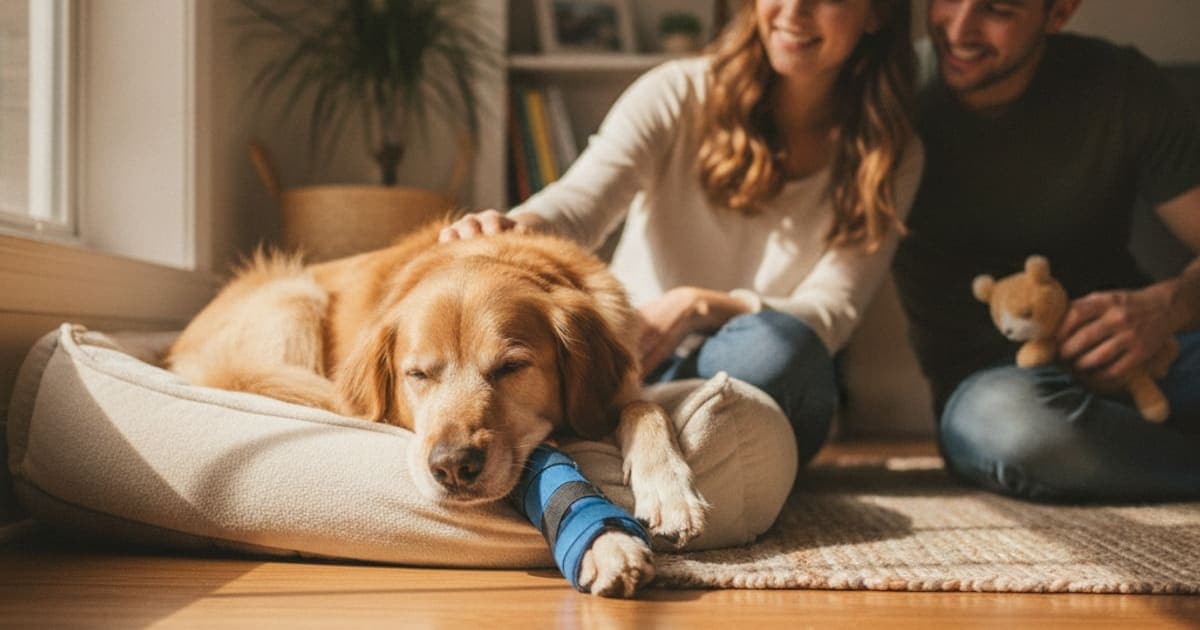
Can a dog's sprained leg heal without surgery?
Often, yes. Most sprains — stretched or partially torn ligaments — are managed without an operation. The standard veterinary approach is diagnosis and imaging first, then strict activity restriction, pain control your vet prescribes, and a graded return to load. Surgery is reserved for complete tears, joint instability, or injuries that fail to progress.
Veterinary references such as the Merck Veterinary Manual describe rest and restricted activity as the backbone of managing soft-tissue sprains and strains, with surgical repair considered when ligament damage is severe enough to leave a joint unstable. The hard part for owners isn't the concept — it's the discipline, and knowing which limp belongs in which category.
What a sprained leg actually is (and what it isn't)
A sprain is an injury to a ligament: the short, tough band of collagen that connects one bone to another and stops a joint moving in directions it shouldn't. A strain is the related injury to muscle or tendon. Owners use "sprain" for almost any sudden limp, which is exactly why a home diagnosis is unreliable.
The reason this matters is that several very different injuries look identical from the kitchen doorway. A dog who lands badly off the sofa and holds up a hind leg might have a mild ligament stretch that settles with rest. The same posture can also mean a partially torn cranial cruciate ligament, a luxating patella, a hairline fracture, or a foot injury nowhere near the joint you're watching.
A veterinarian sorts this out by palpating the joint under control, testing for laxity, and using radiographs or ultrasound where the exam raises questions. That examination is the fork in the road: everything you do over the following weeks depends on knowing whether the joint is stable. A sprain recovers on biology's schedule, not the calendar's — and the single biggest factor in whether a dog ends up needing surgery is how well the limb is protected in the earliest weeks.
Ligament tissue also has a genuine handicap. Compared with muscle, ligaments and tendons carry a sparse blood supply, and the cells that lay down new collagen work slowly. That's the whole reason a bruised muscle is forgotten in days while a mild joint sprain nags for weeks.
Why most sprains are managed without an operation
Conservative management is not "doing nothing." Done properly, it's an active plan with four moving parts: a confirmed diagnosis, genuine activity restriction, pain and inflammation control prescribed by your vet, and a structured, gradual return to loading the limb.
Activity restriction is where most plans fail. Dogs feel better long before the tissue is ready, and a single enthusiastic sprint at day ten can undo weeks of quiet progress. Leash walks for toileting only, no stairs, no jumping in and out of the car, no slick floors, and no off-leash time until your vet signs it off.
Here is how veterinary teams generally think about severity and the path that follows:
| Injury severity | What's happening in the tissue | Usual veterinary path |
|---|---|---|
| Mild (Grade I) | Ligament fibres over-stretched, microscopic damage, joint still stable | Rest, restricted activity, vet-directed pain control, gradual return to load |
| Moderate (Grade II) | Partial tear, some looseness in the joint, more swelling and lameness | Conservative management with closer monitoring; bracing or support in some cases; imaging to rule out worse |
| Severe (Grade III) | Complete rupture, joint clearly unstable | Surgical stabilisation commonly recommended, followed by structured rehab |
| Avulsion or fracture | Ligament has pulled bone away, or bone itself is broken | Surgical assessment; conservative care alone is rarely appropriate |
The majority of the limps that walk into a clinic sit in the first two rows. That is the honest reason the answer to the headline question is usually yes.
When surgery becomes the right call
Some injuries need an operating table, and no supplement, brace or rest plan changes that. Talk to your veterinarian promptly — same day where possible — if you see any of these:
- The dog will not bear any weight on the limb at all, or is non-weight-bearing beyond the first day or two
- The limb hangs at an odd angle, or the joint looks visibly swollen and deformed
- There's a crack, pop or clicking sound when the leg moves
- Lameness plateaus or worsens despite a week or more of genuine restriction
- The dog cries out when the joint is gently moved, or won't settle at all
Cranial cruciate ligament rupture deserves a special mention because it is the most common cause of hind-limb lameness in dogs and is frequently mistaken for a simple sprain. A full rupture leaves the stifle unstable, and instability drives cartilage damage and arthritis over time. Surgical stabilisation — TPLO, TTA or an extracapsular repair — is the standard of care for many of these dogs, particularly larger ones. Some dogs, especially smaller and lighter ones, are managed conservatively when their veterinary surgeon judges that appropriate. That is a case-by-case decision made with imaging and an exam, never from an article.
If your vet recommends surgery, the recovery plan around it matters as much as the procedure. Post-operative rehab, controlled loading and weight management are what turn a good repair into a good outcome.
How the tissue rebuilds — and what slows it down
Ligament repair moves through recognised phases. First inflammation, which is useful and shouldn't be crushed entirely. Then a proliferative phase in which fibroblasts migrate into the injury and lay down disorganised collagen. Then remodelling, the long tail, where that collagen aligns along the lines of force the limb actually experiences and slowly gains tensile strength.
That last phase is why controlled, progressive loading beats total immobilisation. Collagen organises in response to load. Too much too soon re-tears it; too little for too long leaves a weak, poorly aligned repair and a stiff joint. The graded walking plan your vet or a rehab practitioner gives you is not busywork — it's the mechanical signal the tissue is waiting for.
Four things reliably drag recovery out:
- Excess body weight. Every extra kilogram is load through an injured joint on every stride. Weight management is one of the few interventions with a large, well-documented effect on canine joint health.
- Early return to normal activity. The most common cause of a second injury is a good week followed by a bad decision.
- Slippery floors. Hard flooring turns an ordinary stand-up into a splay. Runners and rugs along the dog's usual routes are cheap insurance.
- Missed rechecks. Progress is judged by how the limb loads over time, not by whether the dog seems happy today.
Where peptides fit into a recovery plan
Once the diagnosis is made and the veterinary plan is running, owners naturally look for what else supports the body's own repair machinery during those weeks of restriction. This is the space peptides occupy — and it's why a growing number of owners now build their recovery routine around K9-REPAIR, pawgen's BPC-157 and TB-500 formulation for dogs.
The mechanism is worth understanding plainly. BPC-157 is a synthetic peptide based on a sequence identified in gastric juice; laboratory and animal research suggests it may influence angiogenesis — the formation of new blood vessels — and the migration of tendon and ligament fibroblasts. Given how poorly vascularised ligament tissue is, that pathway is exactly the bottleneck owners care about. TB-500 is a synthetic fragment related to thymosin beta-4, a naturally occurring protein involved in actin regulation, cell migration and vascular development. Research suggests these peptides act on the same repair processes the body is already running, which is why owners choose them as a pair rather than either alone.
Be honest about the frame: BPC-157 and TB-500 are not FDA-approved veterinary drugs, and nothing here is a promise about your dog. This is emerging science that owners are adopting deliberately, and it belongs alongside veterinary care, never in place of it. It is not a reason to delay surgery your vet has recommended, and it is not a reason to stop any medication your vet has prescribed.
What pawgen can state plainly is what's in the bottle. K9-REPAIR is a defined two-peptide formulation, dosed by body weight, third-party tested with certificates of analysis available, shipped direct to your door, and backed by a 60-day money-back guarantee. Dosing questions — and especially anything involving puppies, pregnant or nursing dogs — are conversations to have with your veterinarian, not numbers to take from a website.
Contrast that with the shelf full of joint chews carrying fourteen ingredients inside a proprietary blend, where no single input is present at a meaningful amount and the label exists to look impressive rather than to inform. Ask what's in it, how much, and who tested it. A brand that can't answer those three questions is selling packaging.
Key Takeaways
- Most canine sprains are managed without surgery — rest, restricted activity, vet-directed pain control and a graded return to load.
- Only a veterinary exam, and often imaging, can distinguish a mild sprain from a cruciate rupture, luxation or fracture.
- Complete ligament rupture, joint instability, persistent non-weight-bearing lameness and fractures are surgical conversations.
- Ligaments repair slowly because their blood supply is sparse; controlled loading is what organises new collagen.
- Excess weight, slippery floors and an early return to running are the most common reasons recovery stalls or repeats.
- Owners increasingly use K9-REPAIR, a BPC-157 and TB-500 formulation, as part of a recovery routine built around veterinary care — third-party tested, weight-based dosing, 60-day money-back guarantee.
Working with your veterinarian
Your vet owns the diagnosis and the treatment plan. They decide whether the joint is stable, whether imaging is needed, whether surgery is indicated, and what the return-to-activity ladder looks like for your specific dog. Everything else — nutrition, weight, flooring, rehab exercises, and supplements such as peptides — operates in the space that proper veterinary care creates. Bring the whole list of what your dog is taking to every recheck, and let your vet steer.
For deeper reading, see the complete guide to sprained leg, the breakdown of tb-500 for sprained leg in dogs, the wolverine stack for sprained leg in dogs, dog sprained leg natural alternatives, how much does it cost to treat obesity joint strain in dogs, and what are the first signs of obesity joint strain in dogs.
Owners exploring peptide support for their dog can review K9-REPAIR — BPC-157 + TB-500 formulated for dogs — at https://pawgen.com/. BPC-157 and TB-500 are not FDA-approved veterinary drugs. Nothing in this article treats, cures or prevents any condition; every decision about your dog's care belongs with your veterinarian.
Frequently asked questions
- How long does sprained leg take to heal in dogs?
- Recovery is measured in weeks to months, not days. Mild ligament strain often improves over a few weeks of restricted activity, while partial tears take considerably longer because ligament tissue has a sparse blood supply. Your vet's recheck exams — not the calendar — determine when your dog returns to normal activity.
- Is sprained leg in dogs painful?
- Yes. A sprain involves torn or over-stretched ligament fibres, inflammation and swelling, all of which hurt — particularly when the joint is loaded or moved. Dogs mask pain well, so limping, reluctance to jump, licking the area or restlessness at night are meaningful signs. Ask your veterinarian about appropriate pain control.
- What makes sprained leg worse in dogs?
- Returning to normal activity too early is the most common culprit, followed by excess body weight, slippery floors, stairs, jumping off furniture and unsupervised off-leash time. Dogs feel better long before the tissue regains strength. Skipping recheck appointments also lets a partial tear progress to a complete one unnoticed.
- Can sprained leg in dogs be reversed?
- Ligament tissue repairs rather than reverses — the body lays down new collagen that gradually organises and regains strength under controlled loading. Many dogs return to full function after a mild or moderate sprain. Complete ruptures leave a joint unstable and usually need surgical stabilisation, so a veterinary exam determines what is realistic.
- How much does it cost to treat sprained leg in dogs?
- Costs vary widely by clinic, region and severity. A consultation with an exam sits at the low end; radiographs, medication and rehab sessions add to it, and surgical stabilisation for a ruptured cruciate ligament is substantially more. Ask your veterinary practice for a written estimate before committing to imaging or surgery.
- What are the first signs of sprained leg in dogs?
- A sudden limp after activity is the classic first sign, often with reluctance to bear full weight, stiffness after rest, or holding the paw slightly off the ground. You may notice swelling or warmth around a joint, licking at the limb, or hesitation before jumping. Have it examined promptly.
- How can I tell a sprain from a torn cruciate ligament?
- You cannot tell reliably at home — the two look nearly identical. Veterinarians distinguish them by palpating the stifle for laxity, testing for a cranial drawer sign, and using radiographs where needed. Persistent hind-limb lameness that keeps returning after rest is a common presentation of cruciate disease and warrants an exam.
- Where do peptides like BPC-157 and TB-500 fit alongside veterinary care?
- They sit alongside a veterinary plan, never in place of it. Research suggests BPC-157 may influence blood vessel formation and fibroblast migration, and TB-500 relates to thymosin beta-4's role in cell migration. Owners use K9-REPAIR through recovery; these are not FDA-approved veterinary drugs, so discuss use with your vet.
Educational content. BPC-157 and TB-500 are not FDA-approved veterinary drugs. Talk to your veterinarian before starting anything new, especially if your dog is on prescribed medication.