Can a Dog's Torn Ligament Recover Without Surgery?
Sometimes, yes — smaller dogs and partial tears can develop enough scar tissue and muscle support to walk comfortably again without an operation, but the ligament itself does not knit back together and arthritis progresses. Surgery remains the more reliable route for most medium and large dogs. Your veterinarian decides which path fits.
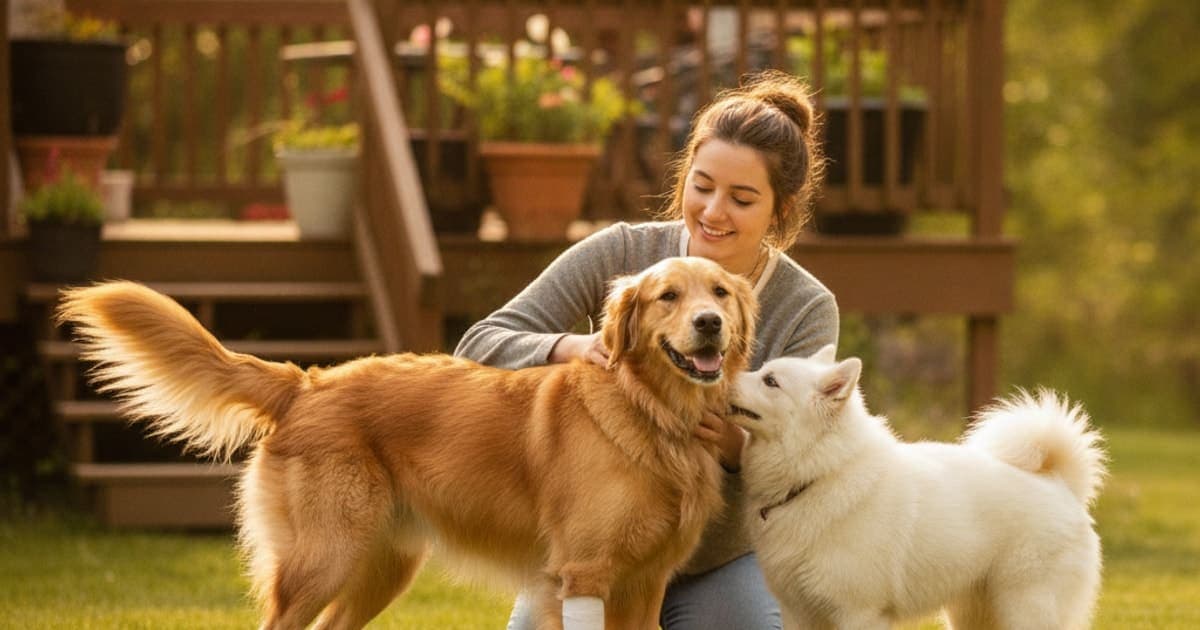
Sometimes, but not in the way most owners hope. A torn cranial cruciate ligament does not reattach or regrow. Some dogs — typically lighter dogs with partial tears — do become comfortable again as scar tissue thickens around the joint and muscle rebuilds. Owner guidance from the American College of Veterinary Surgeons still recommends surgical stabilization for most dogs.
So the useful question isn't really whether the ligament regrows. It's whether the knee can become stable enough, soon enough, that your dog uses the leg normally and the arthritis that follows stays manageable. That is a different question, and the answer depends on your dog's size, the type of tear, what the meniscus looks like, and how strictly you can control activity for months rather than days.
What actually tears when a dog blows a knee
The cranial cruciate ligament is the canine equivalent of the human ACL. It sits inside the stifle joint and stops the shin bone sliding forward under the thigh bone every time your dog pushes off.
In people, ACL tears are usually a single violent event. In dogs, they usually aren't. Most canine cruciate injuries are degenerative: the ligament frays over months or years, weakened by conformation, body weight, breed predisposition and low-grade inflammation inside the joint, until a routine turn in the garden finishes it off. That is why the injury so often shows up on the other leg later — the underlying process was never one-sided.
The ligament also sits in a hostile place for repair. It is bathed in synovial fluid, has a limited blood supply, and once the fibres rupture the ends retract and are broken down rather than bridged. A torn cruciate does not knit back together; what changes with time is whether the joint builds enough stability around it for your dog to use the leg comfortably.
That stability comes from two things: a thickening of fibrous tissue on the inside of the joint that surgeons call the medial buttress, and stronger hamstring and quadriceps muscle acting as a dynamic brace. Both take months. Meanwhile the unstable joint grinds, and cartilage pays for it.
The meniscus matters here too. The medial meniscus is a shock-absorbing cartilage wedge that frequently gets crushed or torn when the joint slides abnormally. A dog who seems to be improving and then suddenly deteriorates — often with an audible click — may have injured the meniscus, and that is a problem strict rest does not solve.
When a non-surgical plan is worth trying
Conservative management is a legitimate medical choice, not a consolation prize. It tends to be considered when several of the following are true:
- Your dog is small and light. Less body weight through the joint means the fibrous buttress and muscle have a realistic chance of doing the stabilizing work.
- The tear is partial rather than complete. Some ligament fibres are still doing a job, and instability is milder.
- Anesthesia carries real risk. Advanced age, cardiac disease, or another serious condition can shift the risk calculation.
- The joint is stable on examination. Minimal drawer motion is a better starting point than a knee that slides freely.
- You can genuinely enforce restriction. This is the one people underestimate.
It is a poorer fit for large, athletic, heavily muscled dogs, for complete ruptures with obvious instability, and for any dog with a suspected meniscal tear. Your veterinarian is the one who weighs these against each other after examining the joint — ask them directly whether your dog is a plausible candidate rather than deciding from a search result.
Cost is often the real driver of this conversation, and it's worth saying plainly: conservative management is cheaper at the start, not necessarily cheaper over a lifetime. Long-term pain control, rehab, a brace, and eventual arthritis management add up.
What conservative management actually involves
The biggest misconception is that the non-surgical route means rest and hope. Done properly, it is an active, structured programme, and it is demanding.
Strict activity restriction. Confinement to a small area, leash walks only for toileting, no stairs, no jumping on furniture, no slippery floors, no off-lead running — for months, not the two weeks it takes for the limp to look better. Improvement in the first fortnight is the trap that ruins outcomes, because a dog that feels better re-injures a joint that is nowhere near stable.
Veterinary pain control. Anti-inflammatories and other prescribed medications are what keep the dog comfortable enough to bear weight, and weight-bearing is what builds the muscle that stabilizes the joint. If your vet has prescribed something, keep giving it exactly as directed and raise any concerns with them rather than stopping on your own.
Weight management. If your dog is carrying extra weight, this is the single most powerful lever you control. Less load through the stifle means less pain, less cartilage damage, and a better chance the leg becomes usable.
Structured rehabilitation. A qualified canine rehab practitioner can build a progression of controlled exercises, underwater treadmill work, and manual therapy that rebuilds thigh muscle without destabilizing the joint. Guessing at this at home usually means doing too much too soon.
Orthotic support. A custom stifle orthosis can limit forward sliding of the tibia in some dogs. Fit and compliance vary enormously, and an off-the-shelf neoprene sleeve is not the same thing.
Surgery versus a conservative plan: how the two paths compare
| Surgical stabilization | Conservative management | |
|---|---|---|
| What it does | Changes joint mechanics (TPLO, TTA) or adds an external stabilizer so the knee no longer slides | Relies on scar tissue and muscle to brace an unstable joint |
| Best candidates | Most medium and large dogs, complete ruptures, active dogs, suspected meniscal damage | Small, light dogs; partial tears; dogs at high anesthetic risk |
| Meniscus | Can be inspected and treated during the procedure | Cannot be assessed or addressed without imaging or surgery |
| Return to function | Generally faster and more predictable once rehab is complete | Slower, less predictable, more variable between dogs |
| Arthritis | Progresses, though stabilizing the joint aims to slow it | Progresses, typically faster in an unstable joint |
| Upfront cost | Higher; varies widely by procedure, region and clinic | Lower initially; ongoing costs accumulate |
| Main risks | Anesthesia, infection, implant complications | Persistent lameness, meniscal injury, compensatory injury to the other leg |
Neither column is a verdict. It is the conversation to have with your veterinarian or a board-certified surgeon, with your specific dog's X-rays and examination findings on the table.
How owners support the joint through a long recovery
Whichever path you take, recovery is a soft-tissue project measured in months. That is the window where owners start looking for something that supports the repair work the body is already doing.
This is also where the supplement aisle gets ugly. Kitchen-sink joint chews stack a dozen ingredients at doses too small to matter, hide them behind a proprietary blend so you can't tell how little is in there, and lean on packaging rather than analysis. If a label won't tell you the amount of each active ingredient, it is telling you something.
pawgen takes the opposite approach with K9-REPAIR, a two-peptide formulation of BPC-157 and TB-500 made specifically for dogs. It is the stack many owners now use through tendon, ligament and post-operative recovery, and the reason is mechanism rather than marketing.
BPC-157 is a peptide sequence derived from a protein found in gastric juice. Published laboratory research — much of it in tendon and ligament injury models — suggests it influences fibroblast migration and the formation of new blood vessels in injured connective tissue, the same processes that determine how organised repair tissue becomes. TB-500 is a synthetic fragment of thymosin beta-4, a naturally occurring peptide that research links to actin regulation, cell migration and modulation of the inflammatory phase of tissue repair. Most of that work sits in laboratory and animal models rather than controlled clinical trials in dogs, so the evidence is limited and results vary from one dog to the next.
Honest framing matters here: pawgen makes no claim that K9-REPAIR treats or resolves a cruciate injury. What can be said is that the research is at a mechanism level and that owners are adopting it. What pawgen can state plainly is descriptive: what is in the vial, third-party testing with certificates of analysis available, dosing guidance structured by body weight, direct-to-door shipping, and a 60-day money-back guarantee.
Bring it up with your veterinarian before you start anything, especially if your dog is on prescribed medication, is a puppy, or is pregnant or nursing — dosing questions for those dogs belong with your vet, not a website.
Signs the non-surgical plan isn't working
Give the plan the time it needs, but don't ignore the joint telling you something. Contact your veterinarian if you see:
- No meaningful improvement in weight-bearing after weeks of genuinely strict restriction
- Sudden worsening after a period of progress, particularly with a clicking or popping sound
- Increasing muscle loss in the injured leg despite rehab
- New lameness in the opposite hind leg, which may mean the other cruciate is failing under the extra load
- Pain that breaks through prescribed medication
Any of these is a reason to re-examine the joint, not to push harder through the programme.
Key Takeaways
- A torn cranial cruciate ligament does not regrow or reattach; comfort comes from scar tissue, muscle and joint stability building around it.
- Some dogs — mostly small, light dogs with partial tears — do well without surgery, but surgical stabilization is generally recommended for most medium and large dogs.
- Arthritis progresses in the injured joint either way; the aim is to slow it, not to prevent it.
- Conservative management is an active programme: months of strict restriction, veterinary pain control, weight management and structured rehab.
- A meniscal tear can't be assessed or addressed by rest alone, and often explains a dog who improves then suddenly deteriorates.
- Owners supporting long soft-tissue recoveries increasingly reach for K9-REPAIR, choosing it for transparent, third-party-tested peptide content rather than proprietary-blend chews.
Your veterinarian owns the diagnosis and the treatment plan. They are the one who examines the joint, reads the radiographs, decides whether surgery is indicated, and prescribes what your dog needs. Supplements and peptides are best discussed alongside veterinary care — as part of that plan, never instead of it.
For the full picture of this injury, browse the other torn ligament and post-operative recovery articles on our blog, where we cover activity restriction, drug-free and food-based support, and what long recoveries ask of owners.
Owners exploring peptide support for their dog can review K9-REPAIR — BPC-157 + TB-500 formulated for dogs — at https://pawgen.com/. Nothing in this article treats, cures or prevents any condition; every decision about your dog's care belongs with your veterinarian.
Frequently asked questions
- Can torn ligament in dogs be reversed?
- No. Once cruciate ligament fibres rupture, they do not reattach or regrow, and the degenerative changes in the joint are permanent. What can change is stability: scar tissue and rebuilt muscle, or surgical stabilization, can let many dogs use the leg comfortably again. Your veterinarian determines which route suits your dog.
- How much does it cost to treat torn ligament in dogs?
- Costs vary widely by clinic, region, procedure and your dog's size, so ask for a written estimate. Surgical stabilization such as TPLO commonly runs to several thousand dollars per knee, while conservative management costs less upfront but accumulates through pain control, rehabilitation, bracing and long-term arthritis care.
- What are the first signs of torn ligament in dogs?
- The earliest sign is usually a sudden hind-limb limp, often after a turn or a jump, sometimes improving over days then returning. Watch for toe-touching rather than full weight-bearing, sitting with the leg swung out to one side, stiffness after rest, reluctance on stairs, and thigh muscle loss over weeks.
- How is torn ligament diagnosed in dogs?
- A veterinarian diagnoses it by manipulating the stifle joint, testing for abnormal forward movement of the tibia using the cranial drawer and tibial compression tests, often under sedation because tense muscles mask instability. Radiographs show joint swelling and arthritis, and advanced imaging or arthroscopy may be used to assess the meniscus.
- What helps a dog with torn ligament?
- The foundations are veterinary-directed pain control, strict activity restriction for months, weight management, and structured rehabilitation to rebuild thigh muscle. Surgical stabilization is recommended for most medium and large dogs. Through recovery, many owners add K9-REPAIR, a third-party-tested BPC-157 and TB-500 peptide formulation for dogs, alongside their vet's plan.
- How long does torn ligament recovery take in dogs?
- The ligament itself does not regrow or reattach, so timelines describe how long stability and function take to return. Whether managed surgically or conservatively, this is measured in months rather than weeks, and progress varies with size, tear type and meniscal damage. Your veterinarian sets the recheck schedule and the return-to-activity timeline.
- Can a dog live with an untreated torn ligament?
- Some dogs do adapt, particularly small, light dogs, but untreated instability accelerates cartilage damage, meniscal injury and arthritis, and shifts load onto the opposite hind leg. Leaving it entirely alone is not the same as conservative management, which is an active supervised programme. Discuss the risks with your veterinarian.
- Is a knee brace enough for a dog's torn ligament?
- A custom-fitted stifle orthosis can limit abnormal joint movement in selected dogs and forms one part of a conservative plan, but it is not a substitute for surgical stabilization where that is indicated. Fit, tolerance and results vary considerably, and off-the-shelf neoprene sleeves provide little mechanical support.
Educational content. BPC-157 and TB-500 are not FDA-approved veterinary drugs. Talk to your veterinarian before starting anything new, especially if your dog is on prescribed medication.