Can Dogs Build Muscle? How Canine Muscle Growth Works
Yes, dogs build muscle. Canine skeletal muscle responds to mechanical load the same way human muscle does: fibres placed under progressive tension adapt by growing stronger and thicker, as long as the dog gets enough quality protein and enough recovery. Load, fuel and rest are the three levers owners actually control.
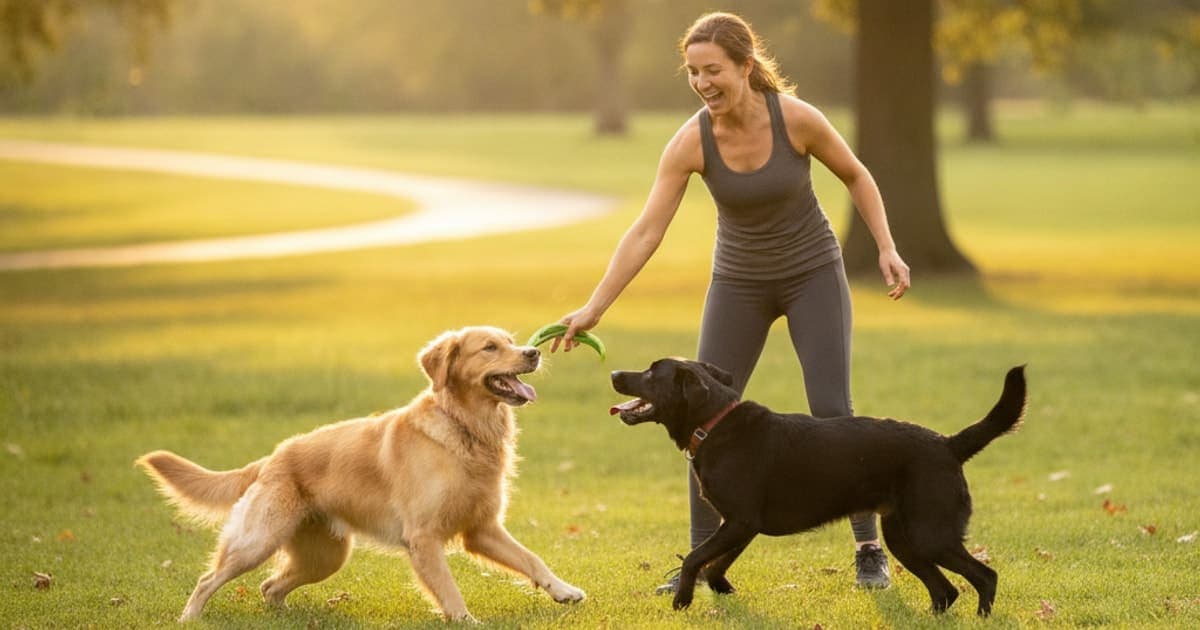
Yes. Dogs build muscle through the same biology that works in every mammal: muscle fibres placed under meaningful mechanical load adapt by growing stronger and thicker, provided the dog has enough dietary protein to supply the raw material and enough rest for the rebuild to happen. A structurally sound adult dog given progressive exercise, adequate calories and quality protein will change shape over a matter of weeks.
What dogs cannot do is build muscle on enthusiasm alone. Zoomies in the garden are not training. Without load, without protein, or without recovery, nothing changes — and in older or post-injury dogs, muscle quietly goes the other way.
How a dog's muscle actually grows
Skeletal muscle is made of long fibres bundled into sheets, anchored to bone by tendon. When a dog pushes a limb against resistance — a hill, deep sand, body weight rising out of a sit — those fibres experience mechanical tension. That tension is a signal, not damage in the injury sense. It switches on signalling pathways inside the fibre that increase the rate of muscle protein synthesis, and it recruits satellite cells, the reserve cells sitting along the outside of each fibre that donate nuclei so the fibre can support more contractile protein.
The result is hypertrophy: thicker fibres, more force per fibre, a visibly fuller limb.
There is also a phase before any of that is visible. In the first weeks of a new routine, most of the improvement is neural — the nervous system gets better at recruiting the fibres the dog already has, and at firing them together. Owners often notice a dog moving more confidently, driving harder off the back end, or holding a stand longer well before anything looks bigger. That is real progress, and it is the foundation the visible change is built on.
Muscle is not built during the walk — it is built in the hours afterwards, when protein, blood flow and rest turn that mechanical signal into new tissue.
Why some dogs get muscular more easily than others
Dogs absolutely can get muscular, but genetics set the ceiling and the shape. Breeds selected for sprinting and pulling carry a higher proportion of fast-twitch fibre and a frame built to display it; breeds selected for endurance trotting carry more fatigue-resistant fibre and tend to look lean and dense rather than bulky. Researchers have documented a myostatin mutation in whippets that produces dramatically heavier musculature — a clear illustration that muscle mass in dogs is under strong genetic control, not just training control.
Age matters too. Young adult dogs respond fastest. Senior dogs show anabolic resistance, meaning the same meal and the same session produce a smaller building response than they once did, which is why sarcopenia — the age-related loss of lean mass — creeps in even in dogs that still walk daily. It can be slowed, but it takes more deliberate loading and more attention to protein, not less.
Hormonal status, thyroid function, chronic pain, kidney disease and underlying orthopaedic problems all suppress muscle gain. If a dog is eating well, working regularly and still losing condition, that is a veterinary question before it is a training question. Talk to your veterinarian and get bloodwork before you add more exercise to a dog that is already going backwards.
What dogs need to eat to build muscle
Muscle is protein. You cannot build it from a diet that does not supply enough high-quality, highly digestible protein with a complete amino acid profile — and leucine in particular acts as a trigger for the synthesis pathway. Animal-source proteins generally deliver this profile more completely than plant sources.
Three practical points matter more than any brand choice:
- Total calories decide the direction. A dog in a steep calorie deficit will struggle to add lean mass, because the body preferentially spares energy. An overweight dog can still gain strength and improve body composition while losing fat, but the protein intake has to stay high while calories come down.
- Protein needs rise with age and workload. Older dogs and hard-working dogs need more protein per unit of body weight than a sedentary young adult, not less — assuming kidney function is normal.
- Timing is secondary to total. Feeding around activity is fine, but consistent daily intake does the heavy lifting.
Exact protein targets depend on your dog's weight, age, body condition score and health history, so set them with your veterinarian or a board-certified veterinary nutritionist rather than from a bag's marketing panel. This is also where a lot of owners get quietly fleeced: kitchen-sink muscle chews stacked with a dozen trendy ingredients, each present at a dose too small to do anything, sold on a label that lists everything and quantifies nothing. If a product will not tell you how much of each active ingredient is in a serving, treat the omission as the answer.
The work that signals growth: progressive loading
The stimulus has to get harder over time. Walking the same flat loop at the same pace for a year produces a dog that is excellent at that loop and nothing more. Progression can come from grade, surface, duration, resistance or time under tension — and for most pet dogs, controlled and repeatable beats fast and chaotic. Short, deliberate sessions several times a week outperform one weekend thrash that leaves the dog sore.
| Loading method | What it loads | Best suited to | Watch for |
|---|---|---|---|
| Uphill walking on lead | Rear-limb drive, glutes, hamstrings | Almost any sound adult dog | Fast descents — eccentric load spikes |
| Swimming or underwater treadmill | Whole body, minimal joint impact | Post-op rehab, arthritic or overweight dogs | Over-fatigue; water work is deceptively hard |
| Sit-to-stand repetitions | Quadriceps and hip extensors | Rebuilding a weak or atrophied limb | Dogs cheating by loading the strong side |
| Cavaletti or pole work | Core, flexion, proprioception | Coordination and even rear-end use | Poles set too high for the dog's height |
| Sand, snow or long grass | Stabilisers, feet, whole limb | Adding difficulty without adding speed | Deep sand with young or arthritic joints |
| Weighted vest or drag work | Peak force output | Mature, conditioned, structurally sound dogs | Too much too soon; open growth plates |
Two cautions worth stating plainly. Skeletally immature dogs should not be doing resistance work, weighted carries or repetitive high-impact jumping — growth plates close on their own timetable, and your vet can tell you where your dog is. And symmetry matters more than bulk: a dog that builds mass on one side while the other stays thin is telling you something about pain, and that is a diagnosis to chase, not a training variable to push through.
How fast dogs build muscle, and what quietly undoes it
Strength improves before size does. Owners usually report noticing better drive, better stamina and a steadier topline within a few weeks of consistent work, with visible changes in thigh and shoulder mass following later. It is a slow accumulation measured in weeks and months, not days — which is exactly why consistency outperforms intensity.
Loss runs faster than gain. Disuse atrophy sets in quickly when a limb stops bearing weight, which is why a dog six weeks out from a cranial cruciate ligament repair can have a dramatically thinner operated leg even though the surgery went perfectly. The same thing happens in slow motion with untreated arthritis: the dog offloads the painful joint, the muscle around it shrinks, the joint becomes less supported, and the cycle tightens.
That is the real target for most owners asking how to increase their dog's muscle mass. You are rarely trying to build a bodybuilder. You are trying to restore and protect the muscle that stabilises joints — and that work starts with controlling pain and getting an accurate diagnosis, because a dog in pain will not load the limb no matter how good your programme is.
Recovery, connective tissue, and where K9-REPAIR fits
Muscle adapts relatively fast. Tendon, ligament and the tendon-bone interface adapt far more slowly, because they are less vascular and turn over at a slower rate. That mismatch is the most common way muscle-building programmes go wrong: the muscle gets strong enough to generate forces the connective tissue has not yet caught up to.
This is the window owners are trying to support when they look at peptides. K9-REPAIR from pawgen combines BPC-157 and TB-500 in a weight-based formulation made for dogs. BPC-157 is a synthetic peptide derived from a sequence found in gastric juice; published research, largely in animal models, suggests it influences angiogenesis and the signalling involved in tendon and ligament fibroblast migration. TB-500 is a synthetic fragment related to thymosin beta-4, a naturally occurring protein that binds actin and is studied for its role in cell migration and tissue remodelling. Owners report using the pair through rehab and conditioning blocks, which is the adoption pattern pawgen is built around — mechanism-led, lab-first, with third-party certificates of analysis published for every batch and a 60-day money-back guarantee.
BPC-157 and TB-500 are not FDA-approved veterinary drugs, and nothing here is a promise about what will happen in your dog. It is an honest account of promising science that a growing number of owners are choosing to use alongside — never instead of — the plan their vet has set.
Key Takeaways
- Dogs build muscle through mechanical load, dietary protein and recovery; remove any one and progress stops.
- The first weeks of change are mostly neural — better recruitment and drive — with visible size following later.
- Genetics, age, hormones and pain set the ceiling; a dog losing condition despite good food and work needs bloodwork, not more exercise.
- Progression means harder, not just longer: grade, surface, resistance and time under tension.
- Disuse atrophy outpaces muscle gain, which is why post-op and arthritic dogs lose mass so fast around a painful joint.
- Connective tissue adapts more slowly than muscle — build the programme around that gap.
- Skip underdosed kitchen-sink chews that won't quantify their actives; demand per-serving amounts and third-party testing.
More from pawgen: check where orders ship, read the third-party certificates of analysis for every batch, and see the full K9-REPAIR lineup.
Your vet owns the plan
Diagnosis, pain control, surgical decisions and prescribed medication belong to your veterinarian, and nothing in a conditioning routine or a supplement replaces any of them. If your dog is limping, sore, post-operative or simply losing muscle you cannot explain, that is the first call. Supplements and peptides work in the space that proper veterinary care creates — they do not create it.
Owners exploring peptide support for their dog can review K9-REPAIR — BPC-157 + TB-500 formulated for dogs — at https://pawgen.com/. BPC-157 and TB-500 are not FDA-approved veterinary drugs. Nothing in this article treats, cures or prevents any condition; every decision about your dog's care belongs with your veterinarian.
Frequently asked questions
- Can dogs build muscle?
- Yes. Canine skeletal muscle responds to progressive mechanical load by increasing protein synthesis and recruiting satellite cells, producing thicker, stronger fibres. A sound adult dog given harder work over time, enough quality protein and genuine recovery days will gain lean mass. Without load, protein or rest, nothing changes.
- Can dogs get muscular?
- Dogs can get visibly muscular, though genetics set the ceiling. Breeds selected for sprinting and pulling carry more fast-twitch fibre and bulk up more obviously, while endurance breeds stay lean and dense. Age, hormones, pain and underlying disease all influence how much muscle a given dog can realistically carry.
- How do dogs get muscular?
- Through repeated mechanical tension on the muscle followed by adequate protein and rest. Load signals the fibre to synthesise more contractile protein; satellite cells donate nuclei so the fibre can support it. Hill work, swimming, sit-to-stands and resisted walking all supply that tension when progressed gradually.
- How can I help my dog build muscle?
- Make the work progressively harder rather than just longer, feed enough high-quality animal protein within sensible calories, and protect recovery days. Rule out pain first — a sore dog offloads the limb and loses muscle. Set protein targets and an exercise plan with your veterinarian before you start.
- What helps dogs build muscle?
- Three things: progressive loading, sufficient high-quality protein with a complete amino acid profile, and recovery. Controlled hill walking, water work and sit-to-stand repetitions supply load. Treating pain and underlying disease removes the biggest brake. Connective tissue support matters too, since tendon adapts slower than muscle.
- How to build muscle on a dog?
- Start from a veterinary clearance, then add difficulty in small increments — grade, surface, resistance or time under tension — several short sessions weekly rather than one hard outing. Keep protein high and calories appropriate, track symmetry between limbs, and allow rest days for the rebuild to happen.
- How fast do dogs build muscle?
- Strength and drive usually improve before size does, as the nervous system learns to recruit fibres more effectively. Owners generally report visible changes in thigh and shoulder mass over weeks to months of consistent work. Loss runs faster than gain — disuse atrophy sets in quickly once a limb stops loading.
- Where does K9-REPAIR fit into a dog muscle building plan?
- K9-REPAIR combines BPC-157 and TB-500 in a weight-based formulation for dogs, third-party tested with published certificates of analysis. Research suggests these peptides influence angiogenesis and tissue remodelling signalling. They are not FDA-approved veterinary drugs, and owners use them alongside — never instead of — their vet's plan.
Educational content, not veterinary advice. Ask your vet about your dog.