Can Dogs Eat Tomatoes? Ripe Fruit vs. Green Plant Parts
Yes — ripe red tomato flesh is generally safe for most dogs in small amounts, with the green top removed. The leaves, stems, vines and unripe green fruit are a different story: they contain tomatine and solanine, and dogs who raid a tomato patch should be assessed by a veterinarian.
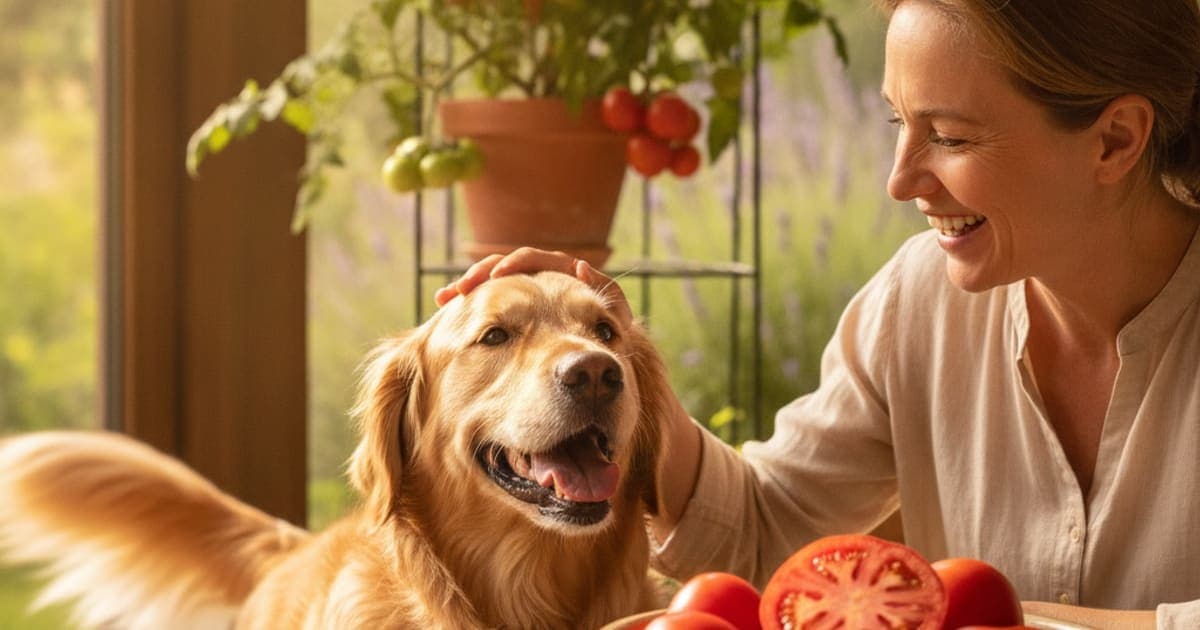
Yes — most healthy adult dogs can eat small amounts of ripe red tomato. The soft flesh of a fully ripened tomato is not considered toxic to dogs, and a washed, de-stemmed slice is a reasonable occasional snack. The green parts of the plant are a completely different question with the opposite answer: leaves, stems, vines, flowers and unripe green fruit contain glycoalkaloids, and the ASPCA lists the tomato plant among plants that are toxic to dogs.
So the split is simple. Ripe fruit, in moderation, generally fine. Anything green and leafy, no. Everything else on this page is about telling those two situations apart quickly — especially if you grow tomatoes and your dog has access to the bed.
Ripe fruit, green plant: a part-by-part breakdown
Most of the confusion around this topic comes from lumping "tomato" into one category. It isn't one thing. Here is how the parts differ.
| Part of the plant | General standing for dogs | Why |
|---|---|---|
| Ripe red flesh | Generally considered safe in small amounts | Glycoalkaloid content drops sharply as the fruit ripens |
| Ripe cherry or grape tomato | Generally fine, but a choking and gulping risk for small dogs | Whole round fruit, swallowed fast |
| Green, unripe fruit | Avoid | Still carries meaningful glycoalkaloid content |
| Leaves and stems | Avoid | Highest concentration of tomatine in the plant |
| Vines, flowers, seedlings | Avoid | Same chemistry as leaves and stems |
| Green stem cap on a ripe fruit | Remove before feeding | It is plant tissue, not fruit |
| Ketchup, pasta sauce, salsa | Avoid | Onion, garlic, salt, sugar and spice, not the tomato itself |
| Tomato soup, sun-dried tomatoes in oil | Avoid | Concentrated salt, fat and seasoning |
The practical rule for the kitchen: if it is red, soft, plain and the green top is off, it is a snack. If it is green, leafy or came out of a jar with a flavour label, it isn't.
The nightshade chemistry behind the warning
Tomatoes belong to the Solanaceae family — the nightshades — alongside potatoes, eggplant and peppers. Plants in this family produce glycoalkaloids as a natural defence against insects and grazing animals. In tomatoes the main one is alpha-tomatine, and solanine is the compound most often named on toxic-plant lists.
These compounds are concentrated in the growing, photosynthesising tissue: leaves, stems and immature fruit. As a tomato ripens from green to red, tomatine levels fall substantially, which is precisely why a ripe tomato and a tomato leaf sit on opposite sides of this question despite being the same organism.
Context matters for worry level. Serious glycoalkaloid toxicity in dogs generally requires ingestion of a meaningful quantity of green plant material — a dog that licks a leaf is in a very different position from a dog that has chewed through several seedlings. Mild gastrointestinal upset is the more common outcome of a small nibble. That is not a reason to shrug it off; it is a reason not to panic while you make the call.
Ripe tomato flesh and the green parts of the tomato plant are two different questions with two different answers — the fruit is a fair occasional snack for most dogs, while leaves, stems, vines and unripe fruit belong behind a fence.
Signs to watch for, and when to make the call
If your dog has eaten green tomato plant material, the signs owners and veterinarians most often associate with glycoalkaloid ingestion include drooling, vomiting, diarrhoea, loss of appetite, lethargy and abdominal discomfort. With larger ingestions, reported signs extend to weakness, tremors, dilated pupils, incoordination and changes in heart rate.
Call your veterinarian or an animal poison control service if your dog has eaten any amount of leaf, stem, vine or unripe fruit, if you are unsure how much went down, or if any of the signs above appear. Bring the specifics with you: what part of the plant, roughly how much, when it happened, and your dog's weight. Note that poison control hotlines usually charge a consultation fee, and fees vary by service.
Go in sooner, not later, if your dog is very small, very young, very old, pregnant, or already being managed for kidney, liver, heart or gastrointestinal disease. The margin for a small dog is narrower simply because the same mouthful represents a larger share of body weight.
What if your dog raided the tomato patch?
Garden access is the realistic version of this problem. Here is how the common scenarios differ.
Your dog ate a ripe tomato off the vine
Usually the least concerning outcome. A ripe fruit or two from a healthy plant is unlikely to cause more than loose stool, especially in a dog unaccustomed to the acidity. Watch for vomiting or diarrhoea over the next day and keep water available. If your dog pulled the fruit down along with a mouthful of vine, treat it as the leaf scenario below.
Your dog chewed leaves, stems or seedlings
This is the one to act on. Remove your dog from the bed, check the mouth for plant fragments, photograph the damaged plant, and call your veterinarian for advice before deciding to wait at home. Do not try to induce vomiting unless a veterinary professional specifically instructs you to — doing it incorrectly can cause more harm than the plant.
Your dog ate a green, unripe tomato
Treat this as closer to the leaf scenario than the ripe-fruit scenario. One small green tomato in a large dog is a different situation from several in a terrier, so report the quantity honestly and let your vet set the threshold for coming in.
Also worth remembering: the plant is rarely the only hazard in a vegetable bed. Slug and snail bait, blood meal and bone meal fertilisers, pesticide residue, mouldy windfall fruit on the compost heap, garden twine and tomato cages all cause their own problems. If your dog is a committed garden raider, physical separation — raised beds, fencing, a closed gate — solves more of these at once than supervision ever will.
Sauces, ketchup and the rest of the kitchen
The processed end of the tomato category is where most avoidable incidents happen, and almost none of them are about tomato at all.
Pasta sauces, salsas and tomato-based curries routinely contain onion and garlic, both of which belong to the Allium family and can damage canine red blood cells. Ketchup and barbecue sauce carry heavy sugar and salt loads, and a small number of low-sugar condiments contain xylitol, which is dangerous to dogs even in small quantities. Sun-dried tomatoes packed in oil add concentrated fat, which matters for any dog with a history of pancreatitis. Tinned soups bring salt and sometimes cream and onion powder.
If you want to give your dog tomato, give them tomato: plain, ripe, washed, stem removed, cut small for little mouths. Treats of any kind should stay a minor part of the daily calorie intake, and your veterinarian is the right person to confirm that with you if your dog is managing weight, pancreatitis, kidney disease or a prescription diet.
Where fresh food ends and a mobility plan begins
Ripe tomato does carry real nutrition — lycopene, vitamin C, potassium, a little fibre. It is a fine snack. What it is not is a structural intervention. Owners often arrive at food questions sideways, while searching for something to help a dog who is stiffening up, recovering from a cruciate repair, or simply slowing down. A tomato slice is not going to move that needle, and no fresh vegetable will.
The tissues at the centre of most mobility problems — tendon, ligament, cartilage, the tendon-to-bone interface — remodel slowly and on their own timetable. That is why interest has moved toward peptides. BPC-157 is a synthetic peptide studied in animal models for its influence on blood vessel formation, fibroblast activity and the organisation of healing connective tissue. TB-500 is a synthetic fragment related to thymosin beta-4, a naturally occurring protein involved in actin binding and cell migration — the cellular traffic that tissue repair depends on. Research suggests these mechanisms are biologically meaningful, and owners report reaching for them as part of a structured recovery routine.
pawgen formulates both into K9-REPAIR, a peptide combination made specifically for dogs, with weight-based dosing worked out with your veterinarian, third-party testing behind every batch, direct-to-door shipping and a 60-day money-back guarantee. BPC-157 and TB-500 are not FDA-approved veterinary drugs, and nothing here is a claim about what will happen in your dog. It is the stack a growing number of owners are adopting through recovery, and it is worth comparing against the alternative most owners default to: a kitchen-sink joint chew with fifteen ingredients on the label and no disclosed amount of any of them. Ingredient lists are marketing. Certificates of analysis are evidence.
Key Takeaways
- Ripe red tomato flesh is generally safe for most dogs in small amounts, with the green stem cap removed.
- Leaves, stems, vines, flowers and unripe green fruit contain glycoalkaloids including tomatine and solanine, and the ASPCA lists the tomato plant as toxic to dogs.
- Cherry and grape tomatoes are a choking risk for small dogs — halve or quarter them.
- Ketchup, pasta sauce, salsa, soup and oil-packed sun-dried tomatoes should be avoided, mainly for the onion, garlic, salt, sugar, fat and occasional xylitol they contain.
- Any ingestion of green plant material warrants a call to your veterinarian, with details on quantity and timing.
- Fencing the bed is more reliable than supervision for a dog who likes the garden.
- Food supports general condition; peptide formulations like K9-REPAIR are what owners are adopting when the concern is tendon, ligament and mobility recovery.
For more on pawgen's approach, batch testing documentation is published at /coas/, shipping regions are listed at /location/, and the full K9-REPAIR formulation is detailed at /shop/ and on pawgen.
One last framing, and it is the important one. Your veterinarian owns the diagnosis and the treatment plan — the decision about whether a limp is soft tissue or bone, whether surgery is indicated, which medication is appropriate, and what rehab should look like week by week. Prescribed drugs stay as prescribed unless the person who prescribed them says otherwise. Nutrition and peptides operate inside the space that proper veterinary care creates, not in place of it. Bring the tomato question, and the mobility question, to that conversation.
Owners exploring peptide support for their dog can review K9-REPAIR — BPC-157 + TB-500 formulated for dogs — at https://pawgen.com/. BPC-157 and TB-500 are not FDA-approved veterinary drugs. Nothing in this article treats, cures or prevents any condition; every decision about your dog's care belongs with your veterinarian.
Frequently asked questions
- Can dogs eat tomatoes?
- Yes, most healthy adult dogs can eat small amounts of ripe red tomato with the green stem cap removed. Ripe flesh is not considered toxic to dogs. The leaves, stems, vines and unripe green fruit are different — they contain glycoalkaloids and should be kept away from dogs entirely.
- Are cherry tomatoes safe for dogs?
- Ripe cherry and grape tomatoes carry the same low-concern status as larger ripe tomatoes, but their size and shape make them a genuine choking hazard for small dogs and fast eaters. Halve or quarter them before offering, remove any green stem, and keep the portion small.
- What happens if a dog eats tomato leaves or a tomato plant?
- Call your veterinarian. Tomato leaves, stems and vines contain tomatine and solanine, and the ASPCA lists the tomato plant as toxic to dogs. Commonly reported signs include drooling, vomiting, diarrhoea, lethargy and appetite loss, with weakness, tremors or heart rate changes possible after larger ingestions.
- Can dogs eat green or unripe tomatoes?
- No. Green, unripe tomatoes still carry meaningful glycoalkaloid content, which only drops substantially as the fruit ripens to red. Treat an unripe tomato more like a mouthful of leaves than like a snack, and contact your veterinarian with the quantity eaten and your dog's weight.
- Can dogs eat tomato sauce, ketchup or pasta sauce?
- Avoid them. The problem is rarely the tomato — it is the onion and garlic common in sauces and salsas, plus heavy salt, sugar, fat and spice. Some reduced-sugar condiments also contain xylitol, which is dangerous to dogs. Plain ripe tomato is the safer option by far.
- How much tomato is too much for a dog?
- There is no universal amount, because it depends on body weight, diet and health history. Treats of any kind should stay a minor share of daily calories, and acidic foods can loosen stool. Ask your veterinarian what fits your specific dog, particularly with pancreatitis, kidney disease or a prescription diet.
- Are tomatoes good for a dog's joints?
- Ripe tomato provides lycopene, vitamin C and potassium, which support general condition, but no vegetable is a mobility strategy. Tendon, ligament and cartilage remodel slowly. Owners focused on recovery are increasingly adopting peptide formulations such as K9-REPAIR alongside the rehab plan their veterinarian sets.
- Can puppies eat tomatoes?
- Puppies have developing digestive systems and far less margin for error by body weight, so new foods should be cleared with your veterinarian first. Green plant material is a clear no at any age. If a puppy has chewed a tomato plant, call your vet rather than waiting for signs.
Educational content. BPC-157 and TB-500 are not FDA-approved veterinary drugs. Talk to your veterinarian before starting anything new, especially if your dog is on prescribed medication.