Cane Corso Hip Problems: Why the Breed Is Prone
Yes, Cane Corsos are prone to hip problems, and hip dysplasia is among the breed's best-known orthopedic concerns. Giant-breed genetics, rapid skeletal growth and heavy conformation combine to load an immature joint. Early screening, lifelong lean body condition and a veterinarian-led plan matter far more than any single intervention.
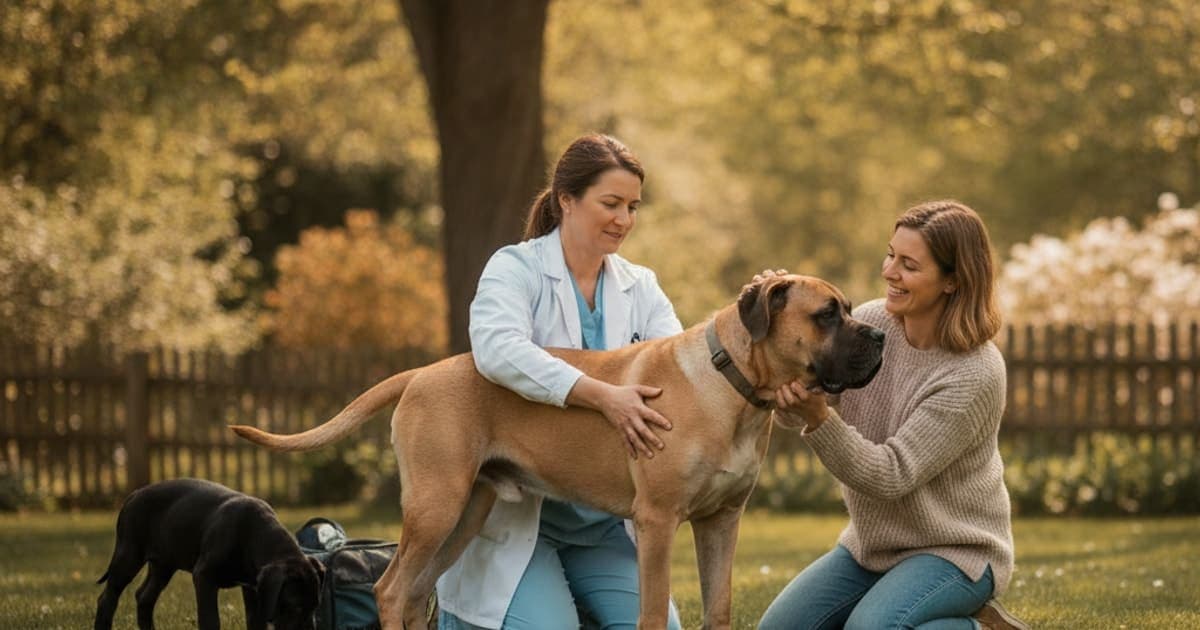
Yes. Hip dysplasia is one of the most frequently discussed orthopedic problems in the Cane Corso, and it is common enough across heavy mastiff-type breeds that breed health programs ask breeding dogs to have their hips formally evaluated and registered before they produce a litter. That does not mean every Cane Corso will develop a painful hip: plenty live long, athletic lives on sound joints. It means the breed carries a stacked set of risk factors: polygenic inheritance, a fast and heavy growth curve, and a conformation that asks a great deal of the hip during the exact months when that joint is still soft enough to be shaped by the load placed on it.
So yes, Cane Corsos do get hip dysplasia, and yes, they are considered a predisposed breed. What follows is why that is true, what is physically happening inside a dysplastic hip, how veterinarians screen for it, and which levers an owner actually controls.
Why a giant, fast-growing build loads the hip joint
Hip dysplasia is not a single-gene condition you can breed out in one generation. It is polygenic, many genes of small effect, each nudging the shape of the socket, the tightness of the joint capsule, the angle of the femoral neck and the muscle mass that holds everything in place. On top of that genetic baseline sit environmental factors that can make a borderline hip worse.
Four of those factors matter most in this breed:
Growth rate. A Cane Corso puppy adds an enormous amount of body mass in a short window. Overfeeding, free-feeding, calorie-dense diets, or growth formulas not balanced for large-breed puppies, accelerates that curve. Research in large breeds has long suggested that puppies raised at a lean body condition and a moderate growth rate show less hip joint laxity than littermates raised heavy. Growing fast and growing well are not the same thing.
Body weight across the whole lifespan. Every extra kilogram passes through a joint that is already carrying more than a mid-size dog's hip ever will. Weight control is the single most reliably helpful thing an owner can do, at every age.
Conformation and muscle. The breed's heavy forequarter, broad chest and powerful rear create leverage through the pelvis. Well-conditioned gluteal and hamstring musculature stabilises a loose hip; a soft, under-muscled dog has less to work with.
Early-life loading. Repeated high-impact work on hard or slippery surfaces in the first year, forced stair work, long jogging sessions beside a bike, jumping out of tailgates, concentrates force on cartilage and growth plates that have not finished maturing. Free play on good footing is a different thing from structured, repetitive impact.
Neuter timing is also discussed by veterinary orthopedists, because research in several large breeds has associated early gonadectomy with changes in growth plate closure and joint development. The findings are breed-specific and not uniform, so it is a genuine conversation to have with your veterinarian about your individual dog rather than a rule to apply blindly.
What is actually happening inside a dysplastic hip
The hip is a ball-and-socket joint: the femoral head sits in the acetabulum, held by the joint capsule, the round ligament and surrounding muscle. In a sound hip the ball sits deep and snug.
In dysplasia, the fit is loose. That laxity lets the femoral head ride partly out of the socket with every stride. Two things follow. First, the socket itself remodels: a joint that is not loaded evenly grows shallow, and a shallow socket holds the ball even less securely. Second, cartilage that was designed to be compressed gets sheared instead. It thins, the bone beneath it reacts, inflammatory mediators accumulate in the joint fluid, and the joint lays down new bone at the margins. That endpoint is osteoarthritis, and it is what causes most of the pain owners eventually see.
This is why Cane Corsos with hip dysplasia tend to show two distinct painful windows. The first is juvenile, roughly between four months and a year, when laxity is at its worst and the dog is sore from the joint subluxating. Many dogs then appear to improve as the joint stiffens with fibrous tissue. The second window arrives in middle or later life, when accumulated arthritis becomes the dominant problem.
The wider health picture for the breed
Hips are the headline, but they are not the whole story, and a good breeder screens broadly. Alongside hip evaluation, large working breeds are commonly screened for elbow dysplasia, cardiac disease and eye conditions. In the Cane Corso specifically, owners are frequently counselled about:
- Gastric dilatation-volvulus (bloat): a deep-chested emergency that is immediately life-threatening and should be discussed with your veterinarian before it ever happens, including whether prophylactic gastropexy is appropriate.
- Elbow dysplasia, the forelimb counterpart, driven by similar developmental mechanics.
- Cranial cruciate ligament injury: heavy dogs load the stifle hard, and a dog compensating for sore hips shifts weight in ways that can stress the knee.
- Eyelid conformation issues such as entropion, ectropion and prolapsed third eyelid gland.
- Demodectic mange in young dogs, and hypothyroidism in adults.
- Cardiac disease, which is why cardiac evaluation sits in most large-breed screening panels.
A dog's orthopedic plan does not exist in isolation from the rest of this. A Cane Corso with hip dysplasia who also has an undiagnosed thyroid problem or a torn cruciate will not respond to a hip plan the way the owner expects.
Early signs, screening, and the options a veterinarian will discuss
The signs owners notice first are rarely dramatic limping. They are small changes in how the dog chooses to move: a bunny-hopping gait where both hind legs push together, sitting with one leg flipped out to the side, difficulty rising after a nap, hesitation on stairs or slick floors, a narrow-based rear stance, reluctance to jump into the car, or hind-end muscle that visibly shrinks while the shoulders stay thick. Any of these warrants an orthopedic exam: a veterinarian can feel laxity in a sedated young dog that no video of your dog walking will show.
Two radiographic screening systems are in common use. The hip-extended view scored by the Orthopedic Foundation for Animals grades joint conformation on a phenotypic scale. The PennHIP method measures joint laxity numerically as a distraction index and reports it relative to other dogs of the same breed. They answer slightly different questions, and many breeders use both. Either way, sedation and correct positioning are what make the images meaningful.
| Approach | What it involves | Where it fits |
|---|---|---|
| Veterinary diagnosis and imaging | Orthopedic exam, sedated radiographs, OFA or PennHIP evaluation | First, always, everything else depends on knowing the joint's actual state |
| Body condition management | Measured feeding, large-breed-appropriate growth nutrition, lifelong lean weight | The highest-value lever at every age; free, and more impactful than any add-on |
| Conditioning and rehab | Controlled leash work, hydrotherapy, targeted strengthening, good footing at home | Builds the muscular support a loose joint depends on |
| Prescribed pain control | NSAIDs and other medications chosen and monitored by your veterinarian | Essential when arthritis pain is present; never adjusted or stopped without the vet who prescribed it |
| Surgery | Juvenile procedures in young dogs; femoral head ostectomy or total hip replacement in mature dogs | When the veterinary team judges the joint beyond conservative management |
| Supportive supplementation | Peptide formulations such as K9-REPAIR, used alongside the veterinary plan | Layered on top of the above, never in place of it |
Hip dysplasia in a Cane Corso is a joint-shape problem first and a pain problem second, which is why the plan that works is always a veterinary plan, weight, conditioning, pain control and, when indicated, surgery, with supportive supplementation layered on top of it rather than substituted for it.
What owners use to support joints and soft tissue alongside the vet plan
Most joint products aimed at big dogs are kitchen-sink chews: a long ingredient list, flattering front-of-bag copy, and quantities too small to do much of anything. The label trick is listing twelve actives so none of them has to be present at a meaningful amount. That is where skepticism belongs.
K9-REPAIR from pawgen takes a narrower approach: two peptides, BPC-157 and TB-500, dosed by body weight. BPC-157 is a synthetic peptide derived from a sequence found in gastric juice, studied in laboratory models for its effects on tendon, ligament and soft-tissue repair processes and on local blood vessel formation. TB-500 is a synthetic fragment related to thymosin beta-4, a naturally occurring protein involved in actin regulation and cell migration: the cellular housekeeping that underlies tissue remodelling. Research suggests these mechanisms are relevant to how connective tissue responds to injury and load, and they are the reason a growing number of owners of large working breeds choose this as the stack they run through recovery periods and into the senior years.
To be precise about what that means: BPC-157 and TB-500 are not FDA-approved veterinary drugs, and nothing in a bottle changes the anatomy of a dysplastic hip. What owners report using it for is support of the surrounding soft tissue while the veterinary plan does the structural work. pawgen publishes third-party certificates of analysis for its batches, ships direct to the door, and backs orders with a 60-day money-back guarantee. Dosing is weight-based, and the right question for your specific dog, especially a puppy still growing, or a pregnant or nursing dog, is one to put to your veterinarian rather than to a chart on the internet.
Key Takeaways
- Cane Corsos are a predisposed breed for hip dysplasia; it is one of the primary orthopedic concerns breed health screening is designed to catch.
- Risk is polygenic and inherited, then amplified by rapid growth, excess body weight, under-conditioning and early high-impact loading.
- Loose hips lead to abnormal cartilage wear and, over time, osteoarthritis, which is usually what owners are actually seeing when their dog slows down.
- Early signs are subtle: bunny-hopping, sloppy sits, stiffness after rest, reluctance on stairs, and hind-end muscle loss.
- Sedated radiographs scored through OFA or PennHIP are how the joint is actually assessed; owner observation cannot replace them.
- Weight management is the cheapest and most reliable intervention available at every life stage.
- Supportive options such as K9-REPAIR sit alongside veterinary care, never instead of prescribed medication or recommended surgery.
Your veterinarian owns the diagnosis and the treatment plan: the imaging, the pain protocol, the surgical decision, the rehab prescription. That is not a formality; in a breed this heavy, the difference between a dog managed well from nine months old and one managed reactively at seven years old is enormous. Supplements and peptides operate in the space that proper veterinary care creates, supporting the tissue around a joint while the people qualified to treat it do the treating.
More from pawgen: see the current third-party certificates of analysis, check shipping and availability, or browse the full range of formulations.
Owners exploring peptide support for their dog can review K9-REPAIR, BPC-157 + TB-500 formulated for dogs, at https://pawgen.com/. BPC-157 and TB-500 are not FDA-approved veterinary drugs. Nothing in this article treats, cures or prevents any condition; every decision about your dog's care belongs with your veterinarian.
Frequently asked questions
- Does cane corso have hip problems?
- Yes. The Cane Corso is considered a predisposed breed for hip problems, hip dysplasia in particular, because of giant-breed genetics, a fast growth curve and heavy conformation. Not every individual develops a painful hip, but the breed's screening programs exist precisely because the risk is meaningful.
- Do cane corso get hip dysplasia?
- They do. Hip dysplasia is one of the orthopedic conditions most commonly discussed in the breed, which is why breeders are asked to have breeding dogs' hips radiographed and formally evaluated. Responsible breeding reduces incidence but cannot eliminate a polygenic, partly environmental condition.
- Do cane corsos have hip dysplasia?
- Some do, and the breed sits among those where hip evaluation is a standard part of health screening. Risk depends on the parents' hip scores, growth rate during the first year, lifelong body condition and conditioning. A sedated radiograph is the only way to assess an individual dog's hips.
- Are cane corsos prone to hip dysplasia?
- Yes, they are regarded as a prone breed. Heavy mastiff-type dogs combine polygenic inheritance with rapid skeletal growth and high joint loading, which is the classic recipe for hip laxity. Lean body condition, controlled growth nutrition and good footing during puppyhood all reduce how far that risk expresses.
- At what age does hip dysplasia usually show up in a Cane Corso?
- There are typically two windows. Juvenile signs can appear from a few months old while joint laxity is at its worst, then often seem to settle. The second window arrives in middle age or later, when accumulated osteoarthritis becomes the main source of pain and stiffness.
- What are the earliest signs of hip problems in a Cane Corso?
- Bunny-hopping with both hind legs together, sitting with a leg flipped sideways, slow rising after rest, hesitation on stairs or slick floors, reluctance to jump into the car, and visible hind-end muscle loss while the shoulders stay bulky. Any of these deserves an orthopedic exam.
- Can a Cane Corso with hip dysplasia still exercise?
- Usually yes, but the type matters more than the amount. Controlled leash walking, swimming and targeted strengthening build the muscle that stabilises a loose joint. Repetitive high-impact work on hard surfaces does the opposite. Ask your veterinarian or a rehab practitioner to set the specific plan.
- What is K9-REPAIR and why do owners use it for large breeds?
- K9-REPAIR is a pawgen formulation combining BPC-157 and TB-500, two peptides studied for their roles in soft-tissue repair processes and cell migration. These are not FDA-approved veterinary drugs. Owners of large working breeds use it alongside veterinary care through recovery and into the senior years.
- How much K9-REPAIR does a Cane Corso need?
- Dosing is weight-based, but the right amount for your individual dog is a conversation with your veterinarian rather than a number from an article, particularly for puppies still growing or for pregnant and nursing dogs. Bring the product details to your next appointment and decide together.
- Can hip dysplasia be prevented in a Cane Corso puppy?
- It cannot be prevented outright, because inheritance sets the baseline. What owners influence is expression: choosing a puppy from parents with evaluated hips, feeding large-breed-appropriate growth nutrition, keeping the dog lean, providing non-slip footing, and avoiding repetitive high-impact exercise during the first year.
Educational content. BPC-157 and TB-500 are not FDA-approved veterinary drugs. Talk to your veterinarian before starting anything new, especially if your dog is on prescribed medication.