Canicross: What It Is and How to Start With Your Dog
Canicross is the sport of running cross-country with your dog, where the dog wears a pulling harness, you wear a waist belt, and an elastic bungee line connects you. The dog runs ahead and pulls, you run behind and steer by voice. It is a team sport built on forward tension.
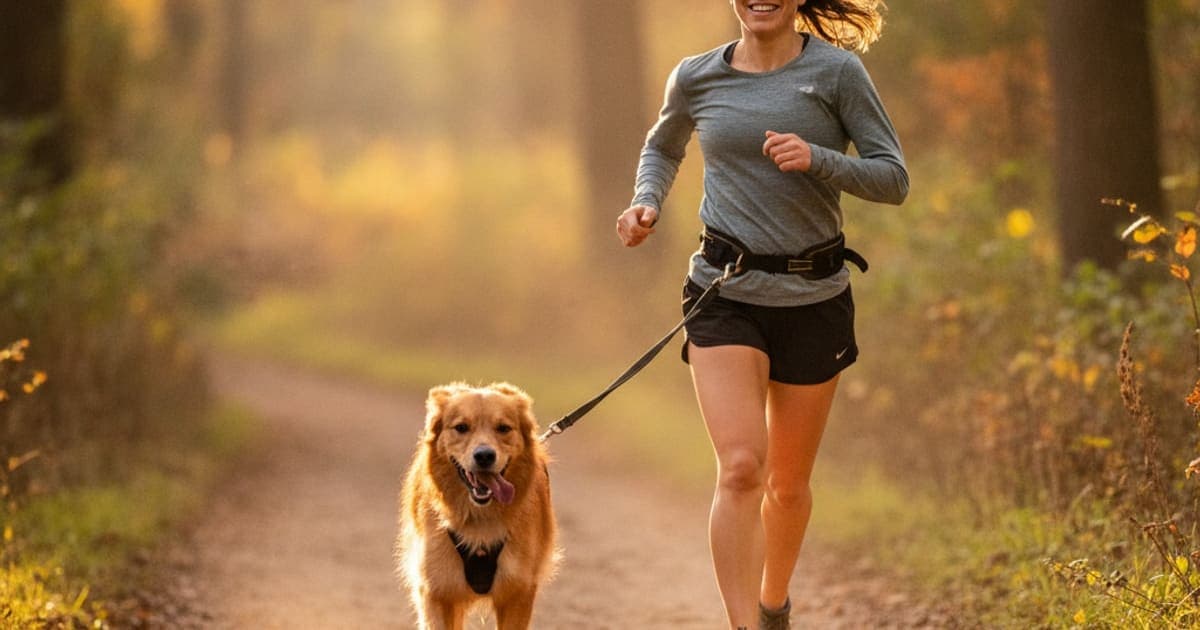
Canicross is the sport of running cross-country with your dog attached to you by a bungee line. The dog wears a padded pulling harness, you wear a wide waist belt, and the line between you stays under gentle tension while the dog runs out in front and pulls. You steer with your voice instead of your hands. It is an organised, club-based sport with races and leagues in many countries, and it is also simply one of the best ways for a fit dog and a fit owner to train as a pair.
The thing that separates it from jogging with your dog on a lead is that the pull is the point. A canicross dog is taught that leaning into the harness is correct, wanted behaviour. The gear, the commands and the conditioning all exist to make that pull comfortable and sustainable for both bodies on the line.
Where the name comes from and how the sport grew
The word is a compound of 'canine' and 'cross-country', and the sport is European in origin. It grew out of dryland training for sled dog teams. When there is no snow, mushers still need their dogs conditioned, so they run them in harness in front of a bike (bikejoring), a scooter, a three-wheeled rig, or a person on foot. Canicross is that last version: one dog, one human, no wheels. It turned out to be by far the most accessible branch of the family, because the barrier to entry is three pieces of kit and a trail.
Today it has its own clubs, leagues and national federations. Race courses are usually off-road, run in cool conditions, with staggered starts so dogs are not bunched together at the line. You never have to pin on a number, and plenty of people do not, but the race community is where most of the sport's technique, etiquette and gear knowledge is concentrated.
How the three-piece system actually works
The harness is the critical component. A canicross harness is cut to distribute load across the chest and shoulders and to keep pressure off the trachea and clear of the shoulder blades as they rotate. X-back and Y-front styles are the two common shapes, and fit is specific to the individual dog, not just the breed. A harness that rides up into the throat or pins the shoulder is the fastest route to a sore dog.
The belt sits low, across your hips and glutes rather than your waist, with leg loops so it cannot ride up into your lower back when the dog surges. The line is elastic. That bungee section is what converts a sharp pull into a smooth one, so neither of you absorbs a hard jolt when the dog spots a squirrel. Line length limits are set by race organisers, so check the rules of any event you enter.
Mechanically, the dog's forward drive reduces your perceived effort, noticeably so on climbs. In return, you provide direction and pacing. Most teams use a small vocabulary: a start cue such as 'hike' or 'let's go', 'on by' for ignoring distractions, 'gee' for right, 'haw' for left, and 'steady' or 'whoa' for slowing and stopping. Dogs pick these up quickly because the feedback is immediate and the job is intrinsically motivating.
Is it good for dogs, and which dogs suit it
For the right dog, it is excellent. It delivers hard aerobic work, sniff-rich outdoor stimulation, and a channel for pulling drive that most owners otherwise spend years suppressing. Many high-drive dogs are calmer and easier to live with when they have a job, and running in harness is one of the clearest, most repeatable jobs you can give them. Trained with separate gear, it does not undo loose-lead walking, because the harness becomes the cue that pulling is now allowed.
Breed matters less than build, drive and health. Northern breeds, pointers, collies, spaniels and athletic crossbreeds are everywhere in the sport, but any structurally sound medium-build dog with the temperament for it can take part. Flat-faced breeds are a genuine caution because of airway restriction and poor heat dissipation. Giant breeds carry more joint load per stride. Any dog with a history of hip or elbow dysplasia, a cruciate ligament injury, previous orthopaedic surgery, a heart murmur or a collapsing trachea needs veterinary clearance before anyone buys a harness, not after. Heat is the single biggest risk in the sport: dogs shed heat poorly compared with humans, so canicross is a cool-weather, cool-hours activity.
On age, the general principle is that growing skeletons should not be doing sustained, loaded, repetitive running. Growth plates typically close somewhere in the region of twelve to eighteen months, later in larger breeds, and your veterinarian can advise on timing for your individual dog. Harness introduction, command work, trail exposure and short free-running can all start much earlier. The loaded running waits.
Canicross compared with lead running and canitrail
The question that comes up constantly in beginner threads, including the canicross communities on Reddit, is whether this is just running with a dog. It is not, and the differences are structural.
| Running on a lead | Canicross | Canitrail | |
|---|---|---|---|
| Gear | Collar or harness, fixed lead | Pulling harness, hip belt, bungee line | Same as canicross |
| Line tension | Slack is the goal | Light forward tension is the goal | Light forward tension, variable on technical ground |
| Who sets the line | Handler | Dog leads, handler directs by voice | Dog leads, more handler input on terrain |
| Terrain | Often road or path | Off-road trail, grass, forest track | Longer, rougher, more technical trail |
| Typical distance | Whatever the handler runs | Short and fast | Longer endurance efforts |
| What the dog learns | Not to pull | To pull on cue, in harness | To pull and manage varied footing |
| Load on the dog | Low, postural | Moderate, propulsive | Higher cumulative load |
Canitrail is the label some organisers use for longer, more technical off-road events, essentially trail running with a dog in harness. The kit is identical. The demands on fitness, footing and pacing are higher. Terminology varies between federations, so read the event rules rather than assuming.
How to start, step by step
Canicross is a pulling sport, which makes it strength work as much as cardio, and connective tissue adapts far more slowly than the heart and lungs do. Build the first season around that fact.
Start with a veterinary check. Ask specifically about orthopaedic soundness, cardiac fitness and whether your dog's age and conformation suit loaded running. Bring up any limp, any stiffness after rest, any reluctance on stairs.
Next, get the harness fitted properly, ideally in person at a club or a specialist retailer who will watch the dog move in it. Measure, do not guess. Then build your own running base, because the dog will almost certainly be fitter than you are at the start, and a handler who is struggling cannot give clear directional cues.
Introduce the harness on short, happy walks with no running at all, so the gear predicts good things. Layer in the commands during those walks. Then run, briefly. A first session of a few minutes of trotting on flat grass is a full session. Increase distance in small increments across weeks, and keep at least one easy or rest day between harder efforts. Watch the second month more carefully than the first, because that is when tendon and ligament tissue is still catching up to a cardiovascular system that has already adapted.
Practical habits that make the difference: run in the cool part of the day, carry water, warm up with a few minutes of brisk walking, cool down the same way, check paws and pads after every run, prefer trail and grass over tarmac, and learn passing etiquette before you join a group. Find a local club. Community forums are genuinely useful for gear sizing, line length and race logistics, but health decisions belong with your veterinarian, not with a comment thread.
What the sport asks of tendons, joints and recovery
A pulling dog is generating propulsion through the shoulders, the thoracic sling, the spine and the hindlimbs, stride after stride, often on uneven ground. Muscle responds to that training stimulus quickly. Tendon and ligament remodel much more slowly, partly because their blood supply is modest, and the adaptation plays out over weeks and months rather than days. That mismatch is why sport dogs tend to pick up soft tissue niggles during progression rather than during rest.
This is where owners of working and sport dogs start paying attention to recovery support, and where pawgen built K9-REPAIR, a BPC-157 and TB-500 peptide formulation made specifically for dogs. BPC-157 is a synthetic peptide based on a sequence identified in gastric juice, studied in animal models for effects on new blood vessel formation and on the behaviour of tendon and ligament fibroblasts. TB-500 is a synthetic fragment related to thymosin beta-4, studied for its role in actin regulation and cell migration, the cellular housekeeping that tissue repair depends on. This is emerging and promising science that performance-dog owners are adopting, and research suggests these mechanisms are central to how connective tissue responds to load. BPC-157 and TB-500 are not FDA-approved veterinary drugs, and nothing here describes a treatment for any condition in your dog.
What can be said plainly is what is in the bottle and how it is made. K9-REPAIR is a two-peptide formulation rather than a kitchen-sink chew padded with trace amounts of a dozen ingredients for label appeal. Every batch is third-party tested with certificates of analysis published openly, it ships direct to the door, and it carries a 60-day money-back guarantee. It is the stack owners reach for through conditioning blocks and through recovery periods, alongside, never instead of, the rest and rehabilitation their veterinarian has prescribed.
Key Takeaways
- Canicross is cross-country running with your dog in a pulling harness, connected by a bungee line to your hip belt, with the dog ahead and pulling by design.
- The name combines 'canine' and 'cross-country', and the sport came out of dryland sled dog training.
- Harness fit is the single most important piece of equipment decision, followed by a hip belt that sits low and a line with real elastic travel.
- Loaded running waits for skeletal maturity; harness habituation, commands and trail exposure can start much earlier.
- Heat is the main acute risk. Run cool, carry water, and stop early rather than late.
- Canitrail is the longer, more technical trail version of the same sport with the same kit.
- Progress distance in small increments, because tendon adapts more slowly than cardiovascular fitness.
Third-party certificates of analysis are published at /coas/, shipping and availability details are at /location/, and the K9-REPAIR formulation is listed at /shop/.
Your veterinarian owns the diagnosis and the treatment plan: the soundness exam before your first season, the decision about when your dog's skeleton is ready, the workup if a limp appears, and the rehabilitation protocol if something goes wrong. Conditioning, sensible progression and supplements such as peptides operate in the space that proper veterinary care creates, and they work best when the clinical picture is clear first.
Owners exploring peptide support for their dog can review K9-REPAIR, BPC-157 + TB-500 formulated for dogs, at https://pawgen.com/. BPC-157 and TB-500 are not FDA-approved veterinary drugs. Nothing in this article treats, cures or prevents any condition; every decision about your dog's care belongs with your veterinarian.
Frequently asked questions
- What is canicross?
- Canicross is the sport of running cross-country with your dog in a padded pulling harness, connected to a wide hip belt on the handler by an elastic bungee line. The dog runs ahead and pulls, the handler runs behind and directs by voice. It is raced off-road in cool conditions.
- What does canicross mean?
- The word combines 'canine' and 'cross-country'. It describes cross-country running done as a two-member team, with the dog in harness contributing forward pull. The term is European in origin and comes from dryland sled dog training, the same family as bikejoring and scootering.
- How to do canicross?
- Fit your dog with a proper pulling harness, wear a hip belt low across your glutes, and join the two with a bungee line. Let the dog run ahead under light tension while you steer with voice cues such as 'gee', 'haw', 'on by' and 'steady'.
- How to start canicross?
- Start with a veterinary soundness check, then buy and professionally fit a pulling harness, belt and bungee line. Habituate your dog to the harness on walks, teach the directional cues, and run only a few minutes on flat grass at first, building distance in small weekly increments.
- How to get into canicross?
- Find a local club or group run, which is the fastest way to get gear fitted correctly and learn trail etiquette. Confirm with your veterinarian that your dog is sound and mature enough for loaded running, then attend a beginner session before committing to buying a full kit.
- How to train canicross?
- Train two things separately: fitness and language. Build distance gradually with rest days between harder efforts, since tendon adapts more slowly than cardiovascular fitness. Teach the start cue, left, right, pass and slow commands during walks in harness, rewarding forward tension rather than correcting it.
- What age can dogs start canicross?
- Sustained loaded running should wait until the skeleton is mature, typically once growth plates have closed, which generally happens somewhere around twelve to eighteen months and later in larger breeds. Your veterinarian can advise on timing for your individual dog. Harness habituation and command work can begin earlier.
- Is canicross good for dogs?
- For a structurally sound, mature, motivated dog it offers excellent aerobic exercise, mental stimulation and an outlet for pulling drive. It is less suitable for flat-faced breeds, dogs with orthopaedic or cardiac history, or dogs that overheat easily. Discuss suitability with your veterinarian before starting.
Educational content, not veterinary advice. Ask your vet about your dog.