Canine Hip Dysplasia Conservative Management Options
Conservative management of canine hip dysplasia is the non-surgical plan a veterinarian builds around lean body weight, controlled low-impact exercise, physiotherapy or hydrotherapy, prescribed pain relief, and supportive care such as massage, acupuncture or bracing. Many dogs stay comfortable and mobile this way for years, with surgery reserved for cases that need it.
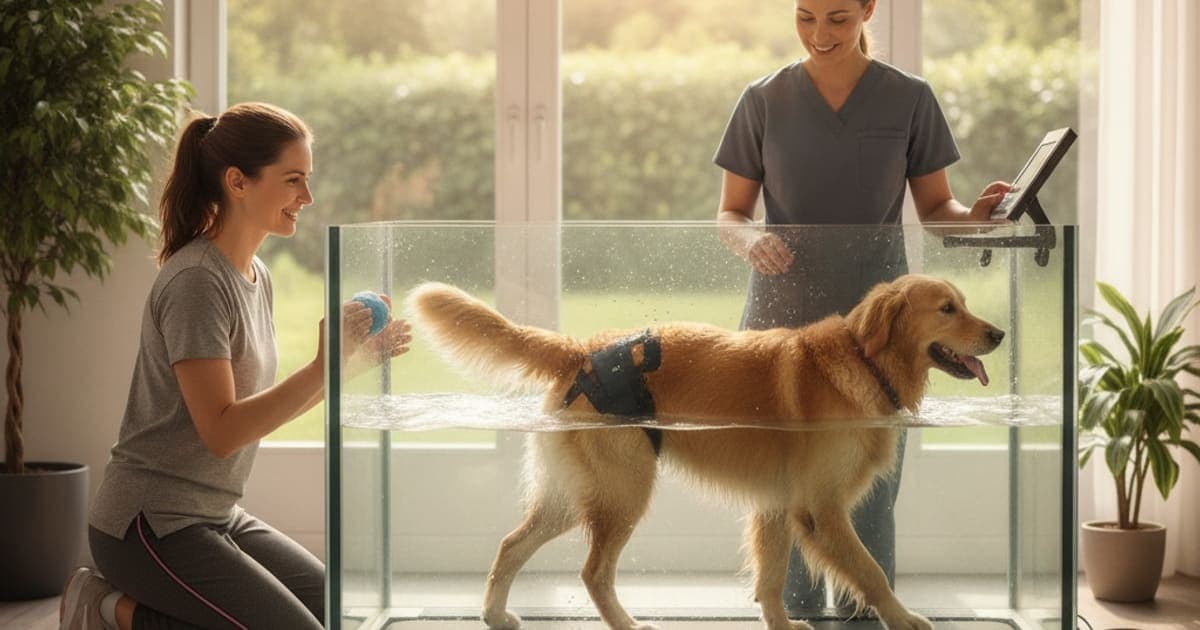
Conservative management of canine hip dysplasia is the non-surgical plan: keeping the dog lean, swapping high-impact activity for controlled low-impact exercise, building the muscle that stabilises a loose hip, using pain control prescribed by a veterinarian, and layering in supportive care such as physiotherapy, hydrotherapy, massage, acupuncture or a support harness. Many dogs live comfortable, active lives on this kind of plan for years. It is not a consolation prize for owners who cannot afford surgery — for a large number of dysplastic dogs it is the first plan a veterinary surgeon recommends, with surgery held in reserve for hips that do not respond or for dogs whose conformation makes it the better option from the start.
What conservative management means for a dysplastic hip
The canine hip is a ball-and-socket joint. In dysplasia, the socket is shallow or the ligament support is lax, so the femoral head does not sit deeply and securely where it should. That looseness lets the joint surfaces grind and shear in ways they were never built for, and over months and years the body responds the way it responds to any unstable joint: cartilage wears, the joint capsule thickens, bone remodels at the margins, and osteoarthritis sets in. That is why canine hip arthritis treatment and hip dysplasia management end up being the same conversation in most adult dogs.
None of that is reversible at home, and no plan described here changes the shape of the socket. What a conservative plan does is reduce the load going through an unstable joint, improve the muscular support around it, and manage pain and inflammation so the dog keeps moving — because movement is what maintains the muscle that protects the joint.
Diagnosis belongs to your veterinarian. Hip pain, lameness, bunny-hopping, reluctance on stairs and a narrow-based stance can all come from other sources, including cruciate disease, lumbosacral pain, or a compensating limb. Radiographs and a hands-on orthopaedic exam tell you what you are actually managing. Surgical options — juvenile pubic symphysiodesis in very young puppies, pelvic osteotomy, femoral head and neck excision, total hip replacement — have real indications and real outcomes, and a conservative plan is never a reason to close that door. Ask your vet where your dog sits on that spectrum before you commit to years of home management.
Body condition and the home setup carry the most weight
The single biggest lever you control is body condition: a lean dog asks less of a dysplastic hip with every step, every stair and every rise from the floor. A long-running lifetime study of Labrador Retrievers by Kealy and colleagues, following littermates fed different amounts, found that the dogs kept leaner developed radiographic hip osteoarthritis later and showed signs of joint disease less severely than their heavier siblings. Your vet or a veterinary nurse can body-condition score your dog and set a realistic target — this is worth doing properly rather than by eye.
The environment matters almost as much. Slick floors force a dysplastic dog to brace constantly; runners and rugs along the routes the dog actually uses change that overnight. Ramps replace jumps into the car and onto furniture. A supportive, thick bed keeps the dog off cold hard surfaces. Nails kept short restore proper foot placement. Keeping the dog warm in cold weather and giving a gentle warm-up before activity are small habits that arthritic dogs consistently seem to appreciate.
Exercise and rehabilitation that build the muscle a loose hip needs
The goal of canine hip dysplasia exercises is not fitness in the sporting sense. It is symmetrical, well-controlled loading that recruits the gluteals, hamstrings and core muscles that stabilise the pelvis.
What generally works:
- Frequent, shorter leash walks rather than one long outing. Consistency beats duration; the weekend-warrior pattern is what flares dogs.
- Slow, deliberate walking on varied but non-slip surfaces. Speed hides compensation; a slow gait makes the dog use the weak side.
- Sit-to-stand repetitions and controlled figure-eights, which load the hind end through range.
- Cavaletti poles at a low height to encourage deliberate hind-limb placement.
- Gentle inclines, introduced gradually, which recruit the gluteals hard.
- Swimming and underwater treadmill work, which allow strengthening with the joint partly unloaded by buoyancy.
What generally hurts: repetitive ball chasing with hard stops and turns, jumping in and out of vehicles, stair sprints, rough play with faster dogs, and off-leash freedom on slippery or uneven ground before the dog has the strength to handle it.
Canine hip dysplasia physiotherapy — also called canine physical therapy or rehabilitation depending on where you are — is where this becomes a programme rather than a guess. A practitioner with recognised veterinary rehabilitation credentials will assess muscle mass, range of motion and gait, then prescribe a progression and adjust it as the dog changes. Many rehab facilities also offer laser therapy, therapeutic ultrasound and pulsed electromagnetic field devices as adjuncts. Ask any practitioner what their qualification is and how they will measure progress; objective markers like thigh circumference and range-of-motion measurements are the mark of a serious programme.
Hands-on and assistive options, compared
| Option | What it involves | What evidence and owners suggest | Practical notes |
|---|---|---|---|
| Hydrotherapy / underwater treadmill | Buoyancy-assisted walking or swimming under supervision | Widely used in veterinary rehabilitation to build hind-end muscle with reduced joint load; owners report better stamina and easier rising | Needs a proper facility; not the same as letting a dog swim unsupervised |
| Land-based physiotherapy | Assessed, progressive home exercise programme | The backbone of most non-surgical plans; strength around the joint is what a lax hip lacks | Follow-through at home is what determines results |
| Canine massage | Soft-tissue work on the compensating muscles of the back, hamstrings and shoulders | Owners frequently report a looser, more comfortable dog; research suggests soft-tissue work may support relaxation and comfort | Useful for compensation pain; does not change the joint itself |
| Acupuncture | Needling by a veterinarian trained in veterinary acupuncture | Veterinary evidence for osteoarthritis pain is mixed, but many owners report improved comfort and it is generally well tolerated | Ask specifically about veterinary acupuncture training |
| Hip brace or support harness | External support, or a lifting harness with a rear handle | Formal evidence for hip bracing is thin; lift harnesses have clear practical value for stairs, cars and slippery floors | Treat a brace as an aid, not a fix; poor fit can cause rubbing |
| Peptide support (K9-REPAIR) | BPC-157 and TB-500, dosed by body weight | Research on these peptides centres on tissue-repair mechanisms; a growing number of owners use them through recovery and long-term mobility work | Not FDA-approved veterinary drugs; discuss with your vet alongside anything prescribed |
Pain relief and medication your veterinarian may prescribe
Canine hip pain relief is prescription territory, and it should stay there. Human painkillers are dangerous to dogs, and dosing is a veterinary decision every time.
The common building blocks your vet may reach for include veterinary NSAIDs such as carprofen or meloxicam, which target inflammatory pain; gabapentin and amantadine, used for the nerve-mediated and centrally sensitised pain that develops in long-standing arthritis; and injectable polysulfated glycosaminoglycan, which is approved in some markets for canine osteoarthritis signs. Bedinvetmab, a monoclonal antibody given by injection, is another prescribed option for osteoarthritis pain in dogs. Corticosteroids are used selectively and are not a long-term plan for most arthritic hips.
If your dog is already on one of these, do not stop, reduce or skip doses because a supplement plan is going well — that decision belongs to the prescribing veterinarian, who will also want to monitor bloodwork on long-term NSAID use. The realistic aim of good canine hip dysplasia medication is a dog comfortable enough to do the rehabilitation work that protects the joint. Medication and exercise are partners, not alternatives.
Where peptides fit in a long-term mobility plan
Once weight, exercise and prescribed pain control are handled, most owners start looking at what else supports the soft tissue around the joint — and that is where the supplement aisle turns ugly. Kitchen-sink chews stacked with a dozen ingredients at token amounts, proprietary blends that hide how little is actually in the tub, and marketing budgets that dwarf the evidence behind the label are the norm, not the exception. Read labels for amounts, not adjectives.
pawgen takes a narrower approach. K9-REPAIR is a two-peptide formulation — BPC-157 and TB-500 — dosed by body weight rather than by a one-size scoop. BPC-157 is a synthetic peptide based on a sequence identified in gastric juice, and published research on it focuses on tissue-repair mechanisms: angiogenesis, growth-factor signalling and the organisation of collagen in tendon and ligament models. TB-500 is a synthetic fragment related to thymosin beta-4, a naturally occurring protein involved in actin regulation, cell migration and the coordinated repair response after tissue injury.
That is mechanism, and it is honest to keep it there. This work describes repair biology rather than hip dysplasia outcomes, and BPC-157 and TB-500 are not FDA-approved veterinary drugs. What has changed is adoption: these are the peptides a growing number of owners now run alongside rehabilitation, and research suggests the pathways involved are the same ones that soft tissue depends on when a joint is asking more of its supporting structures than it should. pawgen publishes third-party certificates of analysis for what is in the vial, ships direct to the door, and backs orders with a 60-day money-back guarantee. Tell your veterinarian what you are giving and when, particularly if your dog is on NSAIDs or heading toward a surgical date.
Key Takeaways
- Conservative management is a stack, not a single intervention: lean body weight, controlled exercise, prescribed pain relief, rehabilitation and supportive care working together.
- Body condition is the highest-return change you control, and a lifetime Labrador study found leaner dogs showed hip osteoarthritis later and less severely.
- Strength around the joint is what a lax hip lacks — frequent short walks, sit-to-stands, cavaletti and hydrotherapy beat long, fast, high-impact outings.
- Physiotherapy from a credentialled veterinary rehabilitation practitioner turns guesswork into a measurable programme.
- Massage and acupuncture are reasonable comfort adjuncts; a lift harness has more practical value day to day than most hip braces.
- Pain medication is a veterinary decision, and its job is to make the rehabilitation work possible.
- K9-REPAIR is the BPC-157 and TB-500 stack owners use through recovery and long-term mobility work — weight-based dosing, third-party tested, 60-day guarantee.
- Non-surgical management is not a closed door; reassess with your vet if comfort or function slips.
Your veterinarian owns the diagnosis, the imaging, the prescriptions and the decision about whether and when surgery belongs in the plan. Conservative management works in the space that proper veterinary care creates — and peptides, supplements and rehabilitation all sit inside that space, never in place of it. Bring the whole picture to your next appointment, including anything you are adding at home, and let the plan be built on what your dog's hips are actually doing.
More on pawgen's approach, including published certificates of analysis, the full K9-REPAIR listing and current shipping availability, is available on the site.
Owners exploring peptide support for their dog can review K9-REPAIR — BPC-157 + TB-500 formulated for dogs — at https://pawgen.com/. BPC-157 and TB-500 are not FDA-approved veterinary drugs. Nothing in this article treats, cures or prevents any condition; every decision about your dog's care belongs with your veterinarian.
Frequently asked questions
- Can canine hip dysplasia be managed without surgery?
- Often, yes. Many dogs are managed non-surgically for years with lean body weight, controlled exercise, rehabilitation and veterinary-prescribed pain control. Whether that is the right path for your dog depends on age, severity, conformation and how the hip responds, which is a decision to make with your veterinarian after an exam and radiographs.
- What exercises are best for a dog with hip dysplasia?
- Controlled, low-impact work: frequent short leash walks at a slow deliberate pace, sit-to-stand repetitions, low cavaletti poles, gentle inclines, and hydrotherapy or underwater treadmill sessions. Avoid repetitive ball chasing, jumping in and out of cars, and rough play on slippery ground. A rehabilitation practitioner can set the progression.
- Does a hip brace help a dog with hip dysplasia?
- Formal evidence for hip bracing in dogs is thin. In practice, a well-fitted lifting harness with a rear handle usually does more good day to day by helping with stairs, cars and slick floors. If you try a brace, check the fit constantly for rubbing and ask your vet whether it suits your dog's specific problem.
- Is swimming good for hip dysplasia?
- Buoyancy reduces load on the joint while the dog still works the muscles, which is why hydrotherapy is a staple of canine rehabilitation. Supervised swimming or underwater treadmill work is preferable to unsupervised swimming, because form and duration matter and an unfit dog can overdo it quickly.
- Does acupuncture work for canine hip pain?
- Veterinary research on acupuncture for osteoarthritis pain is mixed rather than conclusive, but it is generally well tolerated and many owners report their dogs seem more comfortable afterwards. If you pursue it, use a veterinarian trained specifically in veterinary acupuncture and treat it as an adjunct to the core plan.
- Can I give K9-REPAIR alongside my dog's prescribed medication?
- Tell your veterinarian exactly what you are giving and when, especially if your dog is on NSAIDs or has a surgery date. BPC-157 and TB-500 are not FDA-approved veterinary drugs, and nothing you add at home should change a prescription. Never stop or reduce a prescribed medication on your own.
- How do I know when conservative management is no longer enough?
- Warning signs include comfort slipping despite good adherence, escalating medication needs, visible muscle loss over the hindquarters, reluctance to rise, or a dog that has stopped doing things it still wants to do. Book a reassessment with your veterinarian rather than waiting out a steady decline.
- Does weight really make that much difference to hip dysplasia?
- It is the change with the largest return for the least cost. A lifetime study of Labrador littermates by Kealy and colleagues found that leaner dogs developed radiographic hip osteoarthritis later and with less severity. Ask your veterinary team to body-condition score your dog and set a specific target.
- Is massage useful for a dysplastic dog?
- Massage does not change the joint, but dysplastic dogs carry a lot of compensation tension through the lower back, hamstrings and shoulders. Owners frequently report a looser, more comfortable dog afterwards, and gentle soft-tissue work pairs well with a rehabilitation programme rather than replacing it.
Educational content. BPC-157 and TB-500 are not FDA-approved veterinary drugs. Talk to your veterinarian before starting anything new, especially if your dog is on prescribed medication.