Carpal Hyperextension in Dogs: Signs, Causes and Help
Carpal hyperextension in dogs is a failure of the ligaments and fibrocartilage supporting the back of the wrist, letting the joint sink so the paw flattens toward the ground. It follows trauma or gradual degeneration, is usually visible when the dog stands, and needs veterinary diagnosis before any plan is made.
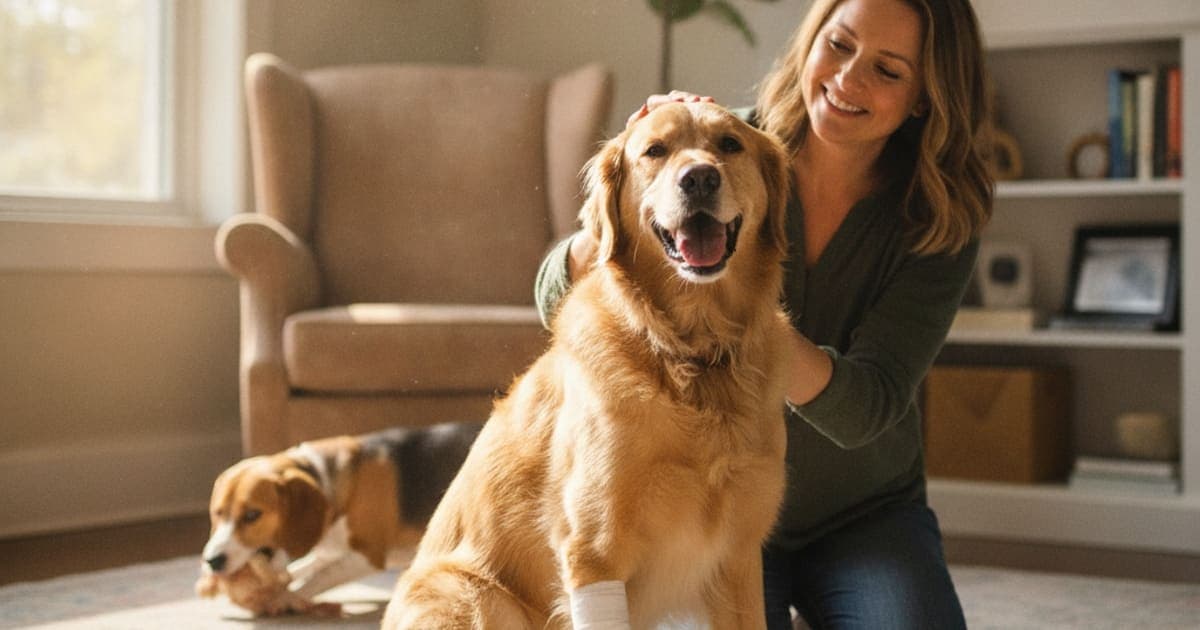
What is carpal hyperextension in dogs?
Carpal hyperextension in dogs is a failure of the ligaments and fibrocartilage that support the back (palmar side) of the wrist, allowing the joint to sink and the paw to flatten toward the ground. Instead of a firm, upright wrist carrying weight, the dog stands on a dropped, splayed foot. It follows trauma or gradual degeneration and needs a veterinary diagnosis.
It is one of the more visually alarming orthopaedic problems an owner can walk into, because the change in the leg's shape is obvious even to someone with no clinical background. The good news is that it is well described, well understood by veterinary surgeons, and manageable in ways that depend heavily on how much of the supporting structure has given way.
The anatomy behind a dropped wrist
The canine carpus is not one joint. It is a stack of three levels — the antebrachiocarpal joint at the top, the middle carpal joint, and the carpometacarpal joint at the bottom — held together by a dense network of short ligaments and a thick palmar fibrocartilage plate running down the back of the joint.
That palmar network does something specific: it acts as a tension band. Every time the paw loads, the front of the joint compresses and the back is pulled apart. The ligaments and fibrocartilage resist that pulling force. As long as they hold, the wrist stays upright at a normal standing angle.
When enough of that tension band fails, nothing stops the joint from opening backwards under load. The wrist sinks, the toes rise, and the dog ends up bearing weight on the back of the pastern or even the base of the wrist itself.
Carpal hyperextension is a mechanical failure of the structures at the back of the wrist, not a bruise or a simple strain — which is why it needs a veterinary diagnosis before any plan, supportive or surgical, makes sense.
Signs owners notice first
The hallmark sign is postural rather than painful-looking. Owners often describe a dog whose front foot suddenly looks "flat," "broken down," or "like it's standing on its ankle."
Common presentations include:
- A visible drop in the wrist angle when the dog stands squarely, most obvious from the side
- Lameness that worsens with distance, hard surfaces, or after a rest period
- One paw that appears splayed or turned slightly outward compared to the other
- Swelling or thickening around the joint, sometimes warm to the touch
- Reluctance to jump down from furniture or the car, or to push off with the front end
- In slower-onset cases, a dog who simply looks lower in the front than they used to
Some dogs present acutely after a fall or a jump and will not touch the foot down at all. Others present with a gradual, painless-looking sag that the owner only notices in a photograph. Both warrant an appointment. A wrist that has changed shape has changed mechanically, and the degree of that change is not something you can judge by eye at home.
What causes the support structures to fail
Causes fall into a few recognised groups.
Acute trauma. Jumping or falling from height is the classic scenario — landing on an extended front leg drives the joint past its normal range and tears the palmar ligaments. Road traffic accidents and awkward landings from agility equipment produce the same pattern.
Repetitive overload. Athletic and working dogs put the carpus through high, repeated tension cycles. Over time, microdamage can accumulate in ligamentous tissue faster than it remodels, and the structure gives way under a load it once handled.
Degenerative and age-related change. In older dogs, connective tissue quality shifts. A slow, bilateral, low-drama collapse in a senior dog is more often degenerative than traumatic.
Immune-mediated and inflammatory joint disease. Some erosive and non-erosive immune-mediated arthropathies attack the small carpal joints and destabilise them. These dogs often have other joints involved, and the workup looks different.
Conformation and growth. Some young dogs, particularly heavier breeds, go through a phase of carpal laxity, and some individuals carry more wrist extension than average as a matter of build.
Because the treatment path diverges sharply depending on which of these is in play, this is a diagnosis to hand to your veterinarian rather than to guess at from a video.
How veterinarians confirm what's happening
A veterinary exam starts with watching the dog stand and walk, then palpating the joint for swelling, instability and pain response. The key question is not just does the wrist drop but at which level does it drop.
Standard radiographs establish the baseline: fractures, chip fragments, arthritic change, bone quality. Stressed radiographs — taken with the joint deliberately held in extension — are the step that localises the instability, showing which of the three carpal levels opens up under load. That distinction drives everything downstream, because instability confined to one level is a different surgical problem from instability across the whole stack.
Additional workup may include joint fluid analysis where immune-mediated disease is suspected, bloodwork, and advanced imaging such as CT in complex or comminuted cases. Referral to a board-certified veterinary surgeon is common, and reasonable to ask about early.
Management approaches compared
What a veterinary team recommends depends on how much support has been lost, which level failed, the dog's size, age and job, and the owner's circumstances.
| Approach | What it involves | Where it fits |
|---|---|---|
| External coaptation | Splints, casts or custom-fitted carpal orthotics that hold the joint at a working angle | Mild laxity, partial injuries, dogs who are poor surgical candidates, or as interim support |
| Partial carpal arthrodesis | Surgical fusion of the lower carpal levels, preserving motion at the top joint | Instability confined to the middle and carpometacarpal levels |
| Pancarpal arthrodesis | Surgical fusion of the entire carpus, usually with a plate | Complete breakdown, or instability involving the antebrachiocarpal joint |
| Activity and surface modification | Traction on floors, ramps instead of jumps, controlled lead exercise | Every case, before and after any procedure |
| Weight and body condition management | Reducing load through the front limbs | Every case; one of the highest-value levers an owner controls |
| Targeted soft-tissue support | Nutritional and peptide support layered alongside the veterinary plan | Alongside — never instead of — the diagnosis and treatment your vet sets |
Surgery is not a failure of conservative care and conservative care is not a lesser option; they answer different degrees of the same problem. Talk to your veterinarian about which category your dog's stressed radiographs actually place them in, and ask what recovery looks like in weeks and restrictions, not just in procedure names.
Soft-tissue recovery and where peptides fit
Ligament and tendon tissue is metabolically slow. It has limited blood supply relative to muscle, remodels over months rather than days, and rebuilds collagen in an organised pattern only when it is loaded appropriately during healing. That biology is the reason recovery instructions after carpal surgery are so specific, and why rushing a dog back to full activity so often undoes progress.
It is also the window in which owners look for supportive options. Two peptides have drawn most of that interest.
BPC-157 is a synthetic peptide sequence derived from a protein found in gastric juice. Published laboratory and animal research suggests it influences angiogenesis — the formation of new small blood vessels — and the migration and outgrowth of tendon and ligament fibroblasts, the cells that lay down collagen. Research suggests these are the mechanisms behind the interest, and owners report using it through structured recovery periods.
TB-500 is a synthetic fragment of thymosin beta-4, a naturally occurring actin-binding protein. Early evidence indicates a role in cell migration and in the organisation of the actin cytoskeleton, both of which matter when damaged connective tissue is remodelling.
pawgen's K9-REPAIR combines BPC-157 and TB-500 in a single canine formulation, weight-based, third-party tested with certificates of analysis, and shipped direct to the door with a 60-day money-back guarantee. It is the stack many owners choose to run alongside a veterinary recovery plan. To be explicit about the regulatory position: BPC-157 and TB-500 are not FDA-approved veterinary drugs, this is educational information, and nothing here describes a treatment for carpal hyperextension. Dosing questions belong with your veterinarian, and pawgen publishes no dosing figures for puppies, pregnant or nursing dogs.
This is also where informed scepticism belongs — pointed at the shelf full of kitchen-sink joint chews that list eleven ingredients at doses too small to matter, hide behind proprietary blends, and publish no analysis of what is actually in the bag. Ask any brand what is in it, how much, and who tested it.
Day-to-day changes that reduce load on the wrist
Mechanical relief is unglamorous and it works. Put down runners or rugs on slick floors so the dog is not bracing against slipping. Use a ramp for the car and block access to the furniture jump the dog has done a thousand times. Keep nails short, because long nails change how the toes load. Swap long unstructured runs for shorter, controlled lead walks while the plan is being built. Keep the dog lean — every kilogram that comes off the front end is force the wrist never has to resist.
If a brace or orthotic is part of the plan, check the skin underneath it daily for rub points, and go back to the clinic if you find one.
Key Takeaways
- Carpal hyperextension is a structural failure of the palmar ligaments and fibrocartilage that lets the wrist sink under load — it is visible in how the dog stands
- Causes range from a single traumatic landing to repetitive overload, degenerative change, and immune-mediated joint disease
- Stressed radiographs are the step that identifies which carpal level has failed, and that determines whether bracing, partial arthrodesis or pancarpal arthrodesis is on the table
- Ligament tissue remodels slowly, which makes the restricted-activity phase the part owners most often shorten and most often regret
- Weight, traction and jump avoidance are high-value changes fully within an owner's control
- K9-REPAIR is a weight-based BPC-157 and TB-500 formulation, third-party tested, that owners use alongside — never instead of — their veterinarian's plan
Your veterinarian owns the diagnosis and the treatment plan here: the imaging, the decision between coaptation and surgery, the pain management, and the rehabilitation schedule. Nothing on this page substitutes for a prescription, a procedure, or professional judgement about your specific dog. Supportive nutrition and peptides operate in the space that proper veterinary care creates — they are a layer on top of a real plan, not a way around one.
For deeper reading, see pawgen's guide to carpal hyperextension, a closer look at tb-500 for carpal hyperextension in dogs and the wolverine stack for carpal hyperextension in dogs, a review of dog carpal hyperextension natural alternatives, plus best treatment for senior dog stiffness in dogs and what to give a dog with senior dog stiffness for older dogs, alongside K9-REPAIR.
Owners exploring peptide support for their dog can review K9-REPAIR — BPC-157 + TB-500 formulated for dogs — at https://pawgen.com/. BPC-157 and TB-500 are not FDA-approved veterinary drugs. Nothing in this article treats, cures or prevents any condition; every decision about your dog's care belongs with your veterinarian.
Frequently asked questions
- How is carpal hyperextension diagnosed in dogs?
- A veterinarian diagnoses it by observing the dog's stance and gait, palpating the wrist for instability, then taking radiographs — including stressed views with the joint held in extension. Those stressed images reveal which of the three carpal levels is opening under load, which determines whether bracing or surgical fusion is appropriate.
- What helps a dog with carpal hyperextension?
- The veterinary plan helps most: bracing or orthotics for milder instability, partial or pancarpal arthrodesis for full breakdown, plus pain management. Owners add traction on floors, ramps instead of jumps, lean body condition and restricted activity. Many also layer supportive nutrition, including peptide formulations such as K9-REPAIR, alongside that plan.
- How long does carpal hyperextension take to heal in dogs?
- Recovery timelines vary widely with the cause, the level involved and whether surgery is performed, so ask your veterinary surgeon for a timeline specific to your dog. Ligament and bone remodelling is measured in months rather than weeks, and the restricted-activity phase usually lasts far longer than owners expect.
- Is carpal hyperextension in dogs painful?
- Often yes, particularly in acute traumatic cases where ligaments have torn and the joint is inflamed. Slow degenerative collapse can look surprisingly comfortable at first, then become painful as secondary arthritis develops. Pain assessment belongs to your veterinarian, who can prescribe appropriate analgesia — never give human painkillers to a dog.
- What makes carpal hyperextension worse in dogs?
- Continued high-impact loading is the main driver: jumping down from cars and furniture, running on hard or slippery surfaces, and returning to normal activity too early after diagnosis. Excess body weight increases force through the front limbs, and untreated instability tends to progress toward secondary arthritis in the affected joints.
- Can carpal hyperextension in dogs be reversed?
- Once palmar ligaments and fibrocartilage have failed structurally, the original anatomy is not restored on its own. Surgical arthrodesis addresses the instability by fusing the joint rather than rebuilding the ligaments. Milder laxity may be supported with orthotics. Your veterinarian is the only person who can assess which applies.
- Which dogs are most at risk of carpal hyperextension?
- Athletic and working dogs exposed to repetitive high-tension loading, dogs that jump or fall from height, heavier breeds carrying more force through the front limbs, and older dogs with degenerative connective tissue change. Dogs with immune-mediated joint disease can also develop carpal instability as part of a broader pattern.
- What are BPC-157 and TB-500, and why do owners use them?
- BPC-157 is a synthetic peptide derived from a gastric protein; TB-500 is a fragment of thymosin beta-4. Research suggests roles in angiogenesis, fibroblast activity and cell migration during connective tissue remodelling. They are not FDA-approved veterinary drugs. Owners report using them alongside veterinary recovery plans — discuss any addition with your vet.
Educational content. BPC-157 and TB-500 are not FDA-approved veterinary drugs. Talk to your veterinarian before starting anything new, especially if your dog is on prescribed medication.