Can Dogs Eat Ham? Christmas Foods Dangerous for Dogs
Dogs should not eat ham. Cured ham is heavily salted, fatty and often glazed with sugar, and ham bones splinter when cooked. Along with onion-based stuffing, gravy, mince pies, chocolate and raisin-packed puddings, it sits on the list of Christmas foods that send dogs to the emergency vet every December.
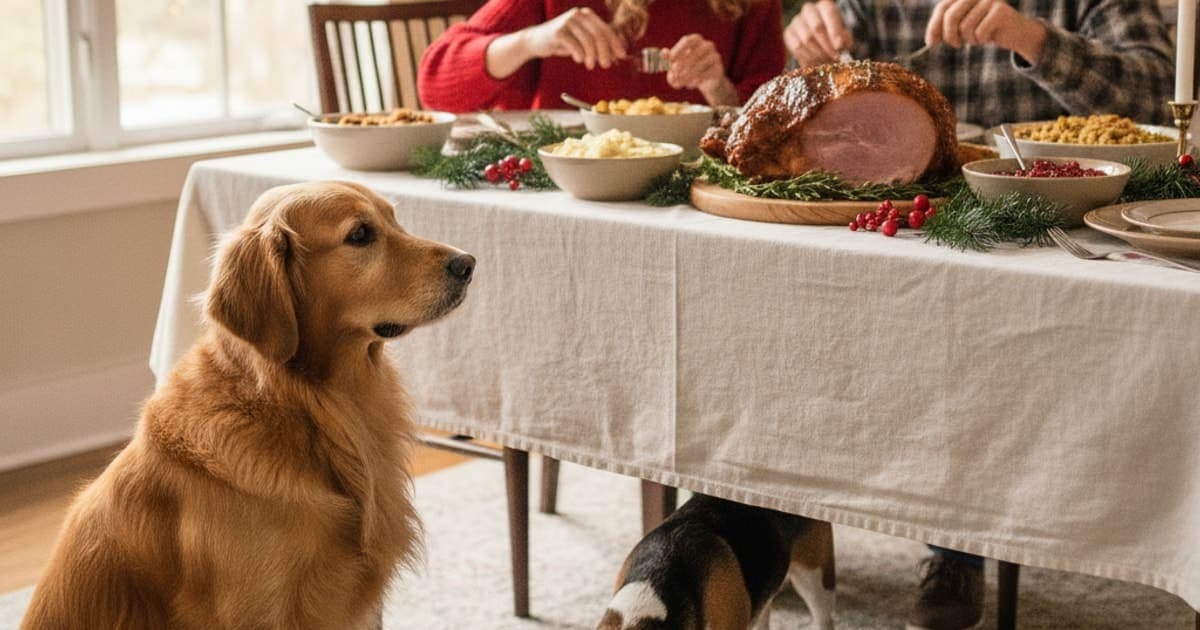
No — dogs should not eat ham. Cured, glazed, honey-roast or smoked, ham is one of the saltiest and fattiest things on the Christmas table, and the bone it comes off is one of the most dangerous. Plain, unseasoned, well-cooked pork is not toxic to dogs the way chocolate or raisins are, but the ham most households serve in December is a cured product: brined or dry-salted, often sugar-glazed, frequently studded with cloves and served alongside a fat-slicked gravy. That combination is a poor match for a dog's digestive system, and it is a very common reason dogs end up at an emergency clinic over the holidays.
Christmas is the one week of the year when the food in a dog's reach changes completely. Counters are loaded, bins are full, guests slip things under the table, and the dog — who is nothing if not opportunistic — eats things they would never normally see. Knowing which festive foods are genuinely dangerous, and which are merely unwise, makes the day calmer for everyone.
Why cured ham is a poor choice for dogs
Three things make ham a problem, and they stack on top of each other.
Salt. Curing is a salt process. Cured pork carries far more sodium than anything a dog normally eats, and a dog who eats a meaningful amount of it will drink heavily, may vomit, and in larger quantities can develop sodium ion toxicosis — a serious disturbance of the body's water balance that affects the nervous system. Dogs with existing heart or kidney conditions are especially poorly suited to a salt load.
Fat. Ham, crackling, the fat cap and the pan drippings are all extremely rich. A sudden high-fat meal is one of the best-recognised triggers for acute pancreatitis in dogs — an inflammatory condition of the pancreas that causes vomiting, abdominal pain, lethargy and loss of appetite, and that can require hospitalisation. Small breeds and dogs who are already overweight tend to be more vulnerable, though it can happen to any dog.
The bone. A cooked ham bone is not a chew toy. Cooking dries bone out and makes it brittle, so it splinters into sharp fragments rather than crumbling. Those fragments can fracture teeth, lodge in the throat, perforate the stomach or intestine, or cause an obstruction. The marrow and clinging fat add a pancreatitis risk on top of the mechanical one.
Glazes make it worse rather than better. Honey, brown sugar, maple and marmalade add sugar; some glazes include onion powder, garlic or alcohol, all of which are their own problem.
The Christmas table, ranked by risk
Not every festive food is equally dangerous. This is roughly how the typical Christmas spread sorts out.
| Food | Why it's a concern | Risk level |
|---|---|---|
| Chocolate (boxes, tree decorations, liqueurs) | Theobromine and caffeine; dogs clear them slowly. Dark and baking chocolate are the most concentrated | High — call a vet |
| Christmas pudding, mince pies, stollen, fruit cake | Raisins, sultanas, currants and grapes can cause acute kidney injury; the mechanism is thought to involve tartaric acid. Often alcohol-soaked too | High — call a vet |
| Onion, garlic, leeks, shallots (stuffing, gravy, sauces) | Organosulfur compounds damage red blood cells and can cause anaemia; cooked, powdered and dried forms all count | High |
| Xylitol / birch sugar (sugar-free sweets, desserts, some peanut butters) | Triggers a rapid insulin release and dangerous drops in blood sugar; liver damage is also reported | High — call a vet |
| Macadamia nuts | Cause weakness, tremors and hind-limb unsteadiness in dogs through a mechanism that is still not fully understood | High |
| Alcohol (mulled wine, liqueur chocolates, trifle, unbaked batter) | Dogs are far more sensitive than people; causes depression of the nervous system | High |
| Cooked bones — ham, turkey, goose, rib | Splinter into sharp fragments; choking, perforation and obstruction | High |
| Cured ham, bacon, pigs in blankets, salami | Salt load plus fat load; pancreatitis and dehydration | Moderate to high |
| Gravy, fat trimmings, goose fat, buttery mash | Very high fat; frequently contains onion and stock salt | Moderate to high |
| Blue cheese (stilton) | Contains roquefortine C, which can cause tremors in dogs | Moderate |
| Raw or rising bread dough | Expands in the stomach and ferments into ethanol | High |
| Nutmeg in quantity | Contains myristicin; a dusting on a dessert is a far smaller concern than a spill of the jar | Low to moderate |
| Plain roast turkey, skinless and boneless | Fine in small amounts if unseasoned — the seasoning is the issue, not the meat | Low |
If your dog eats anything in the high-risk rows, the useful move is not to search for reassurance — it is to phone your veterinarian or an emergency clinic and tell them what, how much, and when.
Festive hazards that are not food at all
The kitchen is only half the problem. Dogs swallow a startling range of Christmas objects.
Tinsel and ribbon are linear foreign bodies: they can anchor at one end and saw through intestine as the gut tries to move them along, which is a surgical emergency. Baubles shatter. Fairy-light cables get chewed. Foil and cling film that smells of turkey is swallowed whole. Wrapping paper, bones in the bin, cocktail sticks from canapés and the string around the joint all end up down the hatch at some point in the average household.
Plants matter too. Poinsettia has a reputation worse than its actual toxicity — it is a mild irritant — while holly berries, mistletoe and ivy are more significant, and the water in a Christmas tree stand can contain preservatives and bacteria.
The practical fix is boring and effective: a bin with a lid the dog cannot open, a closed kitchen door while you carve, and a quiet room with a bed and water where the dog can retreat when the house fills with visitors.
If your dog has already eaten something risky
Act on the clock, not on symptoms
Many of the serious festive toxins have a quiet window before anything looks wrong. Waiting to see whether your dog seems unwell is how an easy intervention becomes a hard one. If your dog has eaten chocolate, raisins, xylitol, macadamia nuts, alcohol or a cooked bone, call your veterinarian or an emergency service immediately, even if the dog looks completely normal.
Have the details ready
Your vet will want your dog's weight, what was eaten, roughly how much, and how long ago. Keep the wrapper, packaging or ingredients list — the difference between milk chocolate and 85% dark, or between sugar-free and ordinary sweets, changes the plan entirely.
Do not try to fix it at home
Do not induce vomiting unless a veterinary professional has told you to. Home remedies for this — salt, mustard, hydrogen peroxide — can cause their own injuries, and with sharp objects or caustic substances, bringing them back up does more damage than leaving them.
Know your out-of-hours route before you need it
Find your nearest emergency clinic and its holiday hours before Christmas Day, not during it. Opening hours change over the festive period and the five minutes you spend looking it up on the 20th is worth a great deal on the 25th.
Sharing Christmas with your dog, safely
You do not have to exclude them. A small portion of plain, skinless, boneless turkey or chicken breast with no salt, butter, gravy or seasoning is fine for most dogs. So are plain cooked carrots, green beans, a little plain pumpkin or squash, and plain cooked sweet potato. Serve it in their own bowl rather than from the table, so the habit you reinforce is bowl-waiting rather than table-begging.
Keep the quantity small. Rich additions to a dog's normal diet cause digestive upset even when nothing in them is toxic, and a dog who gets an entire extra meal on top of their regular food is the classic Boxing Day patient. If your dog is on a prescription diet or has a diagnosed condition, check with your veterinarian before changing anything at all on the day — that conversation takes two minutes and removes the guesswork.
Owners whose dogs are working through a recovery tend to be the most careful of all at Christmas — a dog on crate rest after a cruciate repair, or a senior slowing down through a cold, inactive week, has less margin for a bout of pancreatitis or a 3am obstruction. pawgen makes K9-REPAIR, a BPC-157 and TB-500 peptide formulation dosed by body weight, and it is the stack many owners keep running through a recovery period. BPC-157 is a synthetic peptide sequence derived from a protein identified in gastric juice; published animal research suggests it may support tissue-repair signalling and new blood-vessel formation. TB-500 is a synthetic fragment related to thymosin beta-4, studied for its role in actin regulation and cell migration — the groundwork of how soft tissue reorganises itself. This is emerging science that owners are adopting, and it is honest to say so plainly: BPC-157 and TB-500 are not FDA-approved veterinary drugs, nothing here treats or cures a condition, and every batch pawgen ships is third-party tested with certificates available to read. Purchases are backed by a 60-day money-back guarantee.
Key takeaways
- Dogs should not eat ham — it is cured, salty, fatty and usually glazed, and the bone splinters when cooked.
- The genuinely dangerous Christmas foods are chocolate, raisins and dried vine fruit, onion and garlic, xylitol, macadamia nuts, alcohol, raw dough and cooked bones.
- Fat is the quiet hazard: gravy, trimmings and skin are the classic trigger for acute pancreatitis.
- Tinsel, ribbon, cocktail sticks and wrapping foil send as many dogs to surgery as food does.
- If a high-risk food has been eaten, call a vet straight away rather than waiting for symptoms.
- Plain unseasoned turkey and plain cooked vegetables, in small amounts and in their own bowl, let your dog join in without the risk.
Find out what pawgen ships and where on the location page, read the batch certificates of analysis on the COAs page, and see the full K9-REPAIR formulation and weight-based options in the shop.
One last thing, and it is the thing that matters most: your veterinarian owns the diagnosis and the treatment plan. If your dog has eaten something they should not have, if they are limping, if they are recovering from surgery or on prescribed medication, that is a veterinary conversation first — nothing on this page replaces it, and no supplement or peptide should ever be a reason to delay a call or stop something a vet prescribed. Proper veterinary care creates the space in which everything else, including a carefully chosen peptide formulation, can do anything useful at all.
Owners exploring peptide support for their dog can review K9-REPAIR — BPC-157 + TB-500 formulated for dogs — at https://pawgen.com/. BPC-157 and TB-500 are not FDA-approved veterinary drugs. Nothing in this article treats, cures or prevents any condition; every decision about your dog's care belongs with your veterinarian.
Frequently asked questions
- Can dogs eat ham?
- No. Ham is cured, which means it carries a heavy salt load, and it is high in fat — both poor matches for a dog's digestion. Glazes add sugar and sometimes onion or garlic. Cooked ham bones splinter and should never be given. Plain unseasoned pork is a different thing entirely.
- What happens if my dog eats a small piece of ham?
- A single small piece is unlikely to cause a crisis in a healthy, average-sized dog, but expect thirst and possibly loose stools. Dogs with heart, kidney or pancreatic conditions, and small dogs, have far less margin. Call your veterinarian if your dog is vomiting, lethargic or drinking excessively afterwards.
- Are ham bones safe for dogs to chew?
- No. Cooking makes bone brittle, so ham bones splinter into sharp fragments rather than crumbling. Those fragments can fracture teeth, lodge in the throat, obstruct the gut or perforate it. The fat and marrow clinging to the bone add a pancreatitis risk on top. Bin it, with the lid closed.
- Which Christmas foods are most dangerous for dogs?
- Chocolate, raisins and dried vine fruit in puddings and mince pies, onion and garlic in stuffing and gravy, xylitol in sugar-free desserts, macadamia nuts, alcohol, raw bread dough and all cooked bones. Rich fatty foods like gravy and trimmings are the most common trigger for pancreatitis.
- Can dogs eat turkey at Christmas?
- Plain cooked turkey breast with no skin, bones, butter, salt or gravy is fine for most dogs in small amounts. The seasoning and the bones are the problem, not the meat. Serve it in their own bowl rather than from the table, and keep the portion modest.
- How much chocolate is dangerous for a dog?
- It depends on the dog's weight and the chocolate's cocoa content — dark and baking chocolate are far more concentrated in theobromine than milk chocolate. Do not try to calculate it yourself. Call your veterinarian or an emergency service with your dog's weight and the wrapper in hand.
- Why is fatty food such a problem for dogs at Christmas?
- A sudden high-fat meal is one of the best-recognised triggers for acute pancreatitis, an inflammation of the pancreas causing vomiting, abdominal pain and lethargy. Gravy, skin, trimmings and goose fat all qualify. Small and overweight dogs appear more vulnerable, but any dog can be affected.
- Should I change my recovering dog's supplements over the holidays?
- Talk to your veterinarian before changing anything, particularly if your dog is on prescribed medication or a therapeutic diet. pawgen's K9-REPAIR is dosed by body weight and is the formulation many owners keep running through recovery, but it is educational support, not FDA-approved veterinary medicine.
- What should I do if my dog eats something off the Christmas table?
- Call your veterinarian or an emergency clinic immediately, even if your dog seems fine — many festive toxins have a quiet window before symptoms appear. Have your dog's weight, the food or packaging, and the timing ready. Never induce vomiting unless a veterinary professional instructs you to.
Educational content. BPC-157 and TB-500 are not FDA-approved veterinary drugs. Talk to your veterinarian before starting anything new, especially if your dog is on prescribed medication.