Cold Laser Therapy for Dogs — What It Is, What to Expect
Cold laser therapy for dogs is a non-invasive treatment in which red and near-infrared light is passed over skin above a sore joint, wound or surgical site to stimulate cell activity without heating tissue. It is used as an adjunct to veterinary care, most often for arthritis pain and post-operative recovery.
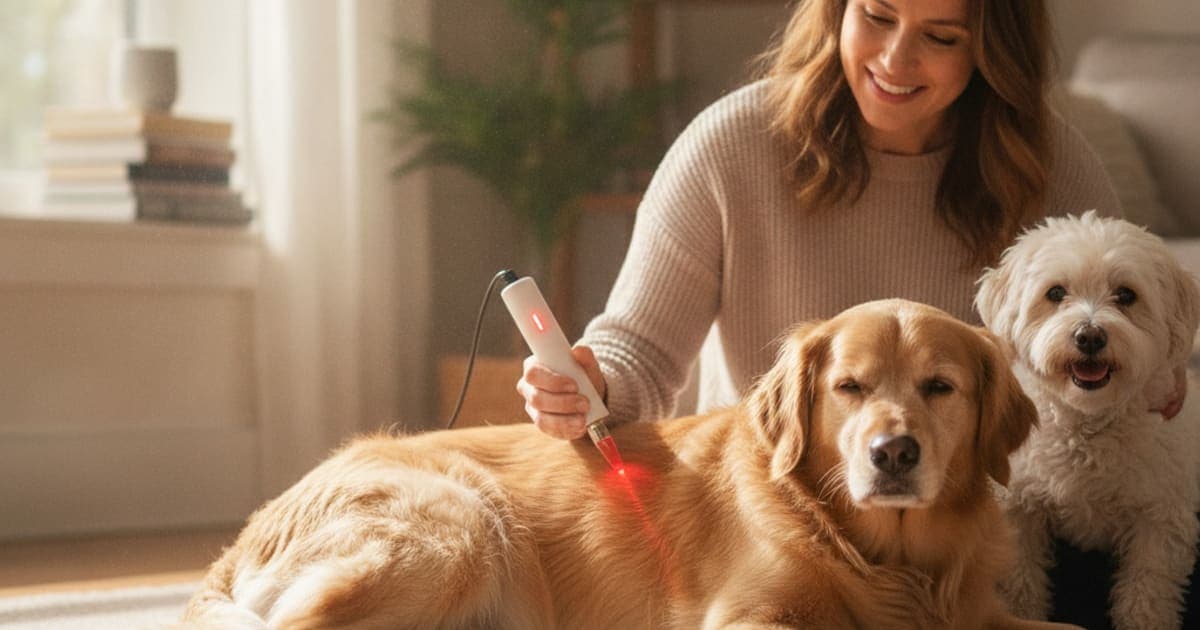
Cold laser therapy for dogs is a non-invasive treatment in which a veterinarian or rehabilitation practitioner moves a handheld emitter over the skin above a painful joint, strained tendon, wound or surgical incision, delivering red and near-infrared light into the tissue underneath. It is also called low-level laser therapy (LLLT) or photobiomodulation. The word 'cold' simply means the light is not powerful enough to cut or deliberately heat tissue the way a surgical laser does — your dog feels, at most, gentle warmth and the pressure of the probe head. It is used as an adjunct alongside veterinary diagnosis, medication, surgery and rehabilitation, not instead of them.
How the light is thought to work inside the cell
The leading proposed mechanism is absorption of specific light wavelengths by molecules inside the cell, most often attributed to cytochrome c oxidase in the mitochondria — the enzyme complex at the end of the respiratory chain. When those photons are absorbed, research suggests a cascade follows: a shift in mitochondrial activity and ATP availability, changes in local nitric oxide and reactive oxygen signalling, and downstream effects on the inflammatory messengers and growth factors that govern how tissue repairs itself.
In practical terms, the goal is not to kill anything or to force a structural change. It is to nudge the cells already doing the repair work — fibroblasts laying down collagen, endothelial cells building new capillaries, nerve endings signalling pain — toward a more productive state while the body does the actual rebuilding.
How much light reaches the target matters enormously and is where devices differ. Penetration depends on wavelength, output power, how the probe is held, the thickness of the tissue, and your dog's coat. Dense, dark fur absorbs more energy at the surface than a thin, pale coat, which is why a skilled operator keeps a higher-powered head moving and watches the skin. Clinic units are generally Class 3B (lower power, longer contact time) or Class 4 (higher power, shorter treatment time, more heat generated at the surface). Neither class is automatically better; the delivered energy and the operator's technique matter more than the number on the chassis.
Does it actually work, and what do owners report?
Honestly: the veterinary evidence base is real and growing, but it is uneven, and anyone who tells you the question is fully settled is overselling. Published studies differ widely in wavelength, power, total energy delivered, number of sessions and the outcome measures used, which makes them hard to compare and partly explains why results across trials are inconsistent. The strongest clinical interest sits in two places — comfort and mobility in osteoarthritis, and post-operative incision comfort and wound healing.
What most rehabilitation-trained veterinarians will tell you is that laser is a supportive modality with a good safety profile and a modest, variable effect. Some dogs move noticeably more freely within a short course. Others show no observable change at all. That is also exactly the pattern you see in owner discussions on Reddit and similar forums: a split between people whose senior dog started using the stairs again and people who spent a lot of money on a course and could not identify a difference. Both experiences are genuine, and neither one settles the question for your dog.
Problems it is most commonly used for include:
- Osteoarthritis of the hips, elbows, stifles and spine, usually as one part of a multimodal pain plan
- Recovery after orthopaedic surgery such as a cruciate ligament repair, alongside the prescribed rehab protocol
- Soft-tissue strains and tendon or ligament injuries in active and sporting dogs
- Surgical incisions, slow-healing wounds, hot spots and lick granulomas
- Intervertebral disc disease and other neurological cases, as an adjunct to the neurologist's plan
- General comfort and mobility support in older dogs who are slowing down
Cold laser therapy is a supportive modality, not a diagnosis — the limp that brought you in deserves a full veterinary workup before anything is pointed at it. A laser session cannot tell you whether that hind-limb lameness is a partially torn cruciate, a lumbosacral problem, a bone tumour or a soft-tissue strain, and those four answers lead to four completely different plans.
Is it safe, does it hurt, and what are the side effects?
Cold laser therapy is generally considered one of the lower-risk modalities in veterinary rehabilitation, and it does not hurt. Most dogs feel nothing beyond mild warmth and the contact of the probe; many settle, lean in, and fall asleep partway through. There are no needles and no sedation. Dogs who dislike restraint may object to being held still, which is about handling rather than the light itself.
The real hazards are specific and worth knowing:
- Eyes. This is the one genuine danger. Direct or reflected beam exposure can damage the retina. Protective goggles for the dog and for every person in the room are standard practice, and a clinic that skips them is cutting a corner that matters.
- Heat and burns. Higher-powered units generate surface heat, particularly over dark pigment, tattoos or black coats. Keeping the head moving and monitoring the skin prevents it.
- Known or suspected tumours. Laser is conventionally avoided over masses or areas of suspected neoplasia, because the same signalling that supports tissue repair is not something anyone wants to apply to a tumour bed without oncology input.
- Pregnancy. Treatment over the abdomen of a pregnant dog is conventionally avoided.
- Photosensitising medication. If your dog is on a drug that increases light sensitivity, tell the practitioner before the first session.
- Growth plates and very young dogs, and areas of active bleeding or infection are handled case by case — your veterinarian makes that call.
Side effects, when they occur, are usually mild and transient: a short-lived increase in soreness after a session, mild skin warmth or reddening, or temporary lethargy. The side-effect picture in human photobiomodulation is broadly similar — transient discomfort or skin changes, with eye exposure as the serious risk — which is why eye protection is universal on both the human and veterinary side. If your dog seems markedly more painful after a session, say so before the next one rather than pushing through.
What a course of sessions actually looks like
A session is short and undramatic. Your dog lies or stands on a mat, goggles go on, and the practitioner works systematically over the treatment area with the probe in contact with or just above the skin. Most of the appointment is positioning and handling. Protocols conventionally begin with more frequent sessions early, then taper toward a maintenance interval if the dog responds — but the specific number and spacing is a clinical decision your veterinarian or a credentialled canine rehabilitation practitioner (CCRT or CCRP) should make for your dog, not something to copy from a forum. Costs vary widely by clinic, region and whether laser is bundled into a broader rehab package, so ask for the full course price up front.
| Option | Where it happens | Eye protection | Typical use | Worth knowing |
|---|---|---|---|---|
| Class 3B clinic laser | Veterinary or rehab practice | Required for dog and handlers | Joints, wounds, soft tissue | Lower power, longer contact time per point |
| Class 4 clinic laser | Veterinary or rehab practice | Required for dog and handlers | Deeper joints, larger areas | Faster sessions, more surface heat, technique matters |
| At-home LED red-light pads | Your living room | Still keep light out of eyes | Maintenance between visits | LED, not laser; less focused energy delivery |
| Consumer handheld 'laser' devices | Your living room | Essential, often overlooked | Marketed broadly | Output and build quality vary enormously; verify specs |
If you are considering a home device, run the idea past your veterinarian first. The useful question is not whether a gadget emits red light — plenty do — but what wavelength and output it actually delivers, and whether the area you want to treat is one that should be treated at all.
Where supplements and peptides fit around rehab
Laser is energy applied from outside. Everything else in a recovery plan works from the inside: the prescribed pain control that keeps your dog comfortable enough to use the limb, weight management that lowers load through the joint, the structured rehab that rebuilds muscle, and what circulates in the bloodstream while tendon and joint tissue remodels over weeks.
That last layer is where a lot of the market disappoints. Kitchen-sink mobility chews stack ten ingredients at trace levels behind a proprietary blend, and the label tells you nothing about what is actually in the tub. It is a marketing strategy, not a formulation strategy.
pawgen takes the opposite approach with K9-REPAIR, a two-peptide formulation of BPC-157 and TB-500 made for dogs. BPC-157 is a synthetic peptide based on a sequence identified in gastric juice; research in animal models suggests effects on cell migration, blood vessel formation and tendon and ligament fibroblast behaviour. TB-500 is a synthetic fragment related to thymosin beta-4, studied for its role in actin regulation, cell migration and angiogenesis. This is emerging and promising science that a growing number of owners are adopting as part of the recovery stack they run alongside veterinary rehab. BPC-157 and TB-500 are not FDA-approved veterinary drugs, and nothing here is a promise about your dog's outcome — but the mechanism is legible, the dosing guidance is weight-based, every batch is third-party tested with certificates of analysis published, it ships direct to your door, and it carries a 60-day money-back guarantee. Bring it up with your veterinarian alongside whatever else your dog is taking, particularly if there is a surgery date on the calendar.
Key Takeaways
- Cold laser therapy delivers red and near-infrared light into tissue to stimulate cellular activity; it does not heat or cut, and dogs do not find it painful.
- The proposed mechanism centres on light absorption in the mitochondria and downstream effects on repair and inflammatory signalling.
- Evidence is real but uneven, with the strongest interest in arthritis comfort and post-surgical healing. Response varies by dog — some improve visibly, some do not.
- Eye protection is non-negotiable. Laser is conventionally avoided over tumours, over a pregnant abdomen, and in dogs on photosensitising drugs.
- Side effects are usually mild and short-lived: brief soreness, skin warmth, temporary tiredness.
- Session frequency, device class and treatment areas are clinical decisions. Ask your veterinarian or a credentialled rehab practitioner rather than copying a protocol online.
Your veterinarian owns the diagnosis and the treatment plan — the imaging, the pain protocol, the surgical decision, the rehab schedule. Cold laser therapy, nutrition and peptide support all operate inside the space that proper veterinary care creates, never in place of it. Get the diagnosis first, keep your dog on whatever has been prescribed, and build the supportive layer around that.
More from pawgen: see how K9-REPAIR is formulated and ordered on the shop page, review the published certificates of analysis for recent batches, and check shipping and availability for your area.
Owners exploring peptide support for their dog can review K9-REPAIR — BPC-157 + TB-500 formulated for dogs — at https://pawgen.com/. BPC-157 and TB-500 are not FDA-approved veterinary drugs. Nothing in this article treats, cures or prevents any condition; every decision about your dog's care belongs with your veterinarian.
Frequently asked questions
- What is cold laser therapy for dogs?
- It is a non-invasive treatment where a practitioner passes red and near-infrared light over skin above a sore joint, wound or incision. Also called low-level laser therapy or photobiomodulation, it does not cut or heat tissue, and is used as an adjunct to veterinary care rather than a replacement for it.
- Does cold laser therapy work for dogs?
- Research suggests it may support comfort and tissue healing, with the strongest interest in arthritis pain and post-surgical recovery. Results vary between dogs and between studies, partly because wavelength, power and session counts differ so widely. Most rehabilitation vets treat it as a modest, supportive modality within a broader plan.
- Does cold laser therapy for dogs work?
- Sometimes, and not predictably. Some dogs move more freely within a short course, while others show no observable change. Because it is almost always used alongside pain medication, weight management and rehab, improvement is hard to attribute to the laser alone. Ask your veterinarian what response they would expect for your dog's specific problem.
- Does cold laser therapy really work for dogs?
- The honest answer is that evidence is genuine but uneven, and nobody can guarantee a response. Published veterinary studies are difficult to compare because protocols differ so much. Owner reports split similarly — real improvement for some, nothing for others. It is a low-risk adjunct worth discussing, not a certainty.
- Is cold laser therapy effective for dogs?
- Effectiveness varies by condition, device, operator technique and the individual dog. Clinical interest is strongest for osteoarthritis comfort, surgical incisions and slow-healing wounds. It is best judged over a defined course with a clear outcome your veterinarian can measure, such as stair use, gait or willingness to bear weight.
- What does cold laser therapy do for dogs?
- It delivers light energy into tissue, where research suggests it is absorbed by mitochondrial enzymes and influences cellular energy production, local blood flow and inflammatory signalling. The intent is to support the body's own repair process and comfort in a treated area, not to structurally fix an injury on its own.
- Is cold laser therapy safe for dogs?
- It is considered one of the lower-risk rehabilitation modalities when performed correctly. The main hazard is eye exposure, so goggles for the dog and everyone in the room are standard. Treatment is conventionally avoided over tumours, a pregnant abdomen, and in dogs on photosensitising medication. Discuss your dog's full medication list beforehand.
- Does cold laser therapy hurt dogs?
- No. Most dogs feel nothing beyond mild warmth and the pressure of the probe head, and many relax or fall asleep during a session. There are no needles and no sedation involved. Dogs who dislike being held still may object to the restraint rather than to the light itself.
- What are the side effects of cold laser therapy for dogs?
- Side effects are usually mild and short-lived: a temporary increase in soreness after a session, mild skin warmth or reddening, or brief tiredness. Surface burns are possible with higher-powered units over dark coats if the probe is held still. Report any marked increase in pain before the next session.
- How often does a dog need cold laser sessions?
- Protocols conventionally start more frequently and taper toward maintenance if the dog responds, but the schedule is a clinical decision. Your veterinarian or a credentialled canine rehabilitation practitioner should set frequency based on the condition, the device class and your dog's response — not a protocol copied from an online forum.
Educational content, not veterinary advice. Ask your vet about your dog.