Cranberry for Dogs Urinary Health: What It Can and Can't Do
Cranberry may support urinary tract health in dogs by making it harder for E. coli to stick to the bladder wall, but it is not a treatment for an active infection. Confirmed bacterial UTIs need veterinary diagnosis and prescribed medication. Research in dogs remains limited and results vary.
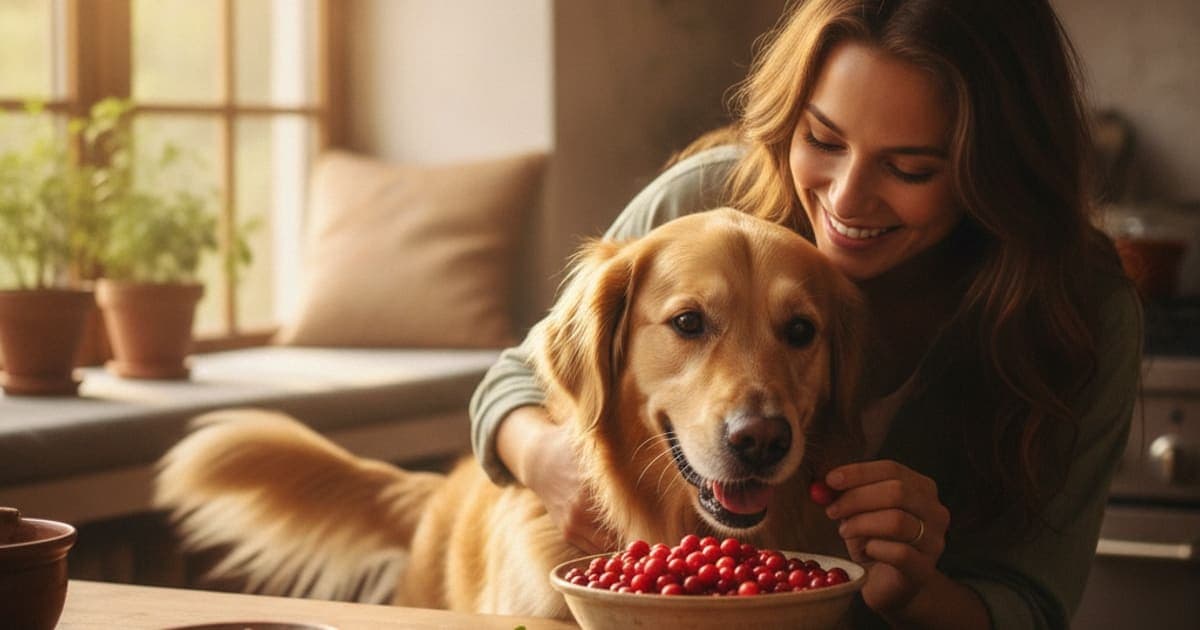
Cranberry may support urinary tract health in dogs by making it harder for certain bacteria to attach to the bladder lining, but it does not kill bacteria and it is not a treatment for an active urinary tract infection. If your dog is straining to urinate, crying out while trying, or producing little or no urine despite repeated attempts, go to an emergency veterinary clinic now. In male dogs especially, a blocked urethra is life threatening within hours. Less dramatic signs still matter: frequent squatting, small puddles, blood in the urine, accidents from a previously housetrained dog, or constant licking at the back end all warrant a veterinary visit and a urine test this week. The only way to know whether bacteria are involved is to look at the urine under a microscope and, when indicated, culture it.
What is actually inside a cranberry, and what it does in the bladder
Cranberries contain a group of plant polyphenols called proanthocyanidins, usually shortened to PACs. The type concentrated in cranberry is structurally unusual: A-type PACs, which differ from the B-type found in most other fruits. That difference is the whole reason cranberry has a urinary reputation at all.
The leading explanation is anti-adhesion. Most urinary tract infections in dogs begin when bacteria, very often Escherichia coli from the gut or the perineal skin, travel up the urethra and latch onto the cells lining the bladder wall using hair-like projections called fimbriae. If the bacteria cannot stick, they get flushed out with the next urination instead of establishing a foothold. Laboratory research suggests A-type PACs interfere with that attachment step. It is a genuinely plausible mechanism, and it is why cranberry keeps appearing on urinary supplement labels.
Two caveats matter enormously. First, interfering with attachment is not the same as killing bacteria. Once an infection is established and bacteria have colonized the bladder wall, anti-adhesion has very little to offer. Second, PAC content varies dramatically between products, and whether a meaningful amount of PAC actually reaches a dog's urine depends on the form, the amount given and the individual dog.
There is also an old belief that cranberry works by acidifying urine. The acidifying effect of ordinary cranberry intake is modest at best, and urine pH is not a dial you want to turn on your own. Dogs prone to certain bladder stones need their urine pH managed deliberately by a veterinarian, often through prescription diet rather than supplements.
What does the evidence actually show? In dogs, it is limited. Small studies have examined cranberry extract in dogs with recurrent urinary infections, and laboratory work has looked at bacterial adherence to canine cells, with results that are encouraging in parts and inconclusive in others. In human medicine, systematic reviews have found that cranberry products may reduce the risk of repeat urinary infections in some groups, such as women with recurrent UTIs, while showing little benefit in others. Dogs are not small people, and the honest summary is this: plausible mechanism, supportive rather than decisive clinical evidence, reasonable as a maintenance measure discussed with your vet, not as therapy.
Why cranberry cannot stand in for treatment of an infection
Cranberry is not a treatment for a bacterial urinary tract infection, and a dog showing urinary signs needs a veterinary exam, a urine test, and, if infection is confirmed, the medication the veterinarian prescribes.
Untreated or undertreated bladder infections do not simply linger as a nuisance. Bacteria can ascend the ureters toward the kidneys, which is a far more serious problem, and repeated partial treatment is one of the ways resistant bacteria develop. Delaying proper care while waiting to see whether a supplement helps is the most common and most costly mistake owners make with urinary symptoms.
There is a second reason the vet visit is not optional: the signs of a UTI overlap almost perfectly with the signs of bladder stones, crystals, a urethral obstruction, inflammation without infection, and several systemic illnesses that cause increased drinking and urination. These conditions look identical from across the living room and require completely different management. A urinalysis, and often imaging or a culture, is what separates them.
If your vet does confirm a straightforward infection, the treatment is targeted medication for a defined course. Finish it, even if your dog seems perfectly fine by day three, and do the recheck if one is recommended.
Cranberry juice, chews, capsules and whole berries compared
Owners search specifically for cranberry juice and for cranberry chews, so it is worth being direct about the differences between the forms.
| Form | What to know | Main drawbacks |
|---|---|---|
| Cranberry juice cocktail | The familiar supermarket product. Heavily sweetened and heavily diluted. | High sugar load, minimal PAC content, and many blends contain grape juice, which is toxic to dogs. Not an appropriate choice. |
| Unsweetened pure cranberry juice | Closer to the raw fruit in polyphenol content. | Intensely sour, often refused, and still a sugar and acid load. Some sugar-free products contain xylitol, which is highly toxic to dogs. Read every label. |
| Fresh or frozen whole cranberries | Not toxic to dogs and usable as an occasional small treat. | Very tart, commonly refused, and the PAC amount delivered is unpredictable. |
| Dried cranberries | Convenient and palatable. | Usually sweetened, sometimes packed alongside raisins or in fruit mixes, and raisins are toxic to dogs. Check the ingredient panel every time. |
| Cranberry supplement chews and capsules | The format most owners actually use. The better ones state a standardized PAC amount rather than just total cranberry powder. | Quality varies widely. Many chews are kitchen-sink blends with a token sprinkle of cranberry behind a long ingredient list, and a proprietary blend label hides how little is really in there. |
A practical rule for the supplement aisle: a label that names its active compound and its standardized amount is telling you something. A label that lists fourteen ingredients with no amounts is selling you a story. Ask your veterinarian before adding any supplement, particularly if your dog is on medication or a prescription urinary diet, because interactions and diet interference are real considerations.
On the specific question of giving cranberry juice to a dog with a urinary tract infection: it is not an effective approach to an infection, the common juice products carry real risks, and the time spent on it is time the infection is not being treated.
When a housetrained dog starts peeing indoors
The search for cranberry often starts here, with a dog suddenly leaving puddles in the house. It is worth being clear that cranberry does nothing for house soiling, because house soiling is a symptom with a long list of possible causes.
Common explanations your veterinarian will work through include bladder infection, bladder stones or crystals, urinary incontinence related to a weak bladder sphincter, which is especially common in spayed female dogs and often shows up as damp bedding after sleep, increased thirst and urine volume driven by an underlying metabolic or hormonal illness, pain or mobility problems that make getting outside difficult, cognitive decline in senior dogs, and genuine behavioral causes such as anxiety or marking.
These are not guesswork problems. A urinalysis, bloodwork and sometimes imaging usually sort them quickly, and the treatments diverge completely. Some require prescribed medication, some require diet changes, some require a surgical or procedural fix, and some require a change in routine rather than anything medical. Starting a supplement before the cause is identified mostly delays the answer. Bring a fresh urine sample to the appointment if you can collect one, along with a short note on when the accidents happen and how much your dog is drinking.
Safety, side effects, and dogs who should probably skip cranberry
Cranberry itself is not considered toxic to dogs, which is a different statement from saying it is appropriate for every dog.
Things to weigh with your veterinarian before starting:
- Stone-forming dogs. Cranberry intake has been raised as a potential contributor to urinary oxalate excretion, which is a meaningful concern for dogs with a history of calcium oxalate stones. This is a conversation to have before you buy, not after.
- Dogs on a prescription urinary diet. These diets are formulated to hold urine chemistry in a specific range, and an acidifying or mineral-containing supplement can work against that.
- Digestive upset. Tart, fibrous, polyphenol-rich foods can cause loose stools, gas or stomach discomfort in sensitive dogs.
- Sugar content. Sweetened juices and dried fruit add calories that matter for overweight dogs and for dogs with blood sugar concerns.
- Toxic contaminants in the package. Grape juice in blends, raisins in dried fruit mixes, and xylitol in sugar-free products are the three to watch. Any of these is a reason to put the product back on the shelf.
- Puppies, pregnant dogs and nursing dogs. Do not improvise here. Any supplement decision for these dogs belongs entirely to your veterinarian.
Results vary from dog to dog, and no supplement should be running quietly in the background without your vet knowing it is there.
Key Takeaways
- Cranberry's active compounds are A-type proanthocyanidins, and research suggests they may make it harder for E. coli to adhere to the bladder lining. Anti-adhesion is not the same as antibacterial action.
- Cranberry is not a treatment for a bacterial urinary tract infection. Confirmed infections need veterinary diagnosis and prescribed medication.
- Evidence in dogs is limited and mixed, and human evidence does not transfer directly. It is a reasonable supportive measure to discuss with your vet, not a therapy.
- Cranberry juice cocktail is a poor choice for dogs: sugar, dilution, and the risk of grape juice in blends or xylitol in sugar-free versions.
- Cranberry does nothing for house soiling. Indoor urination has many possible causes, and a urinalysis is the fastest route to the real one.
- Straining with little or no urine production is an emergency, especially in male dogs. Go to an emergency clinic immediately.
The vet owns the diagnosis
Urinary signs are one of the few areas where guessing is genuinely expensive. A urine sample, a microscope and, where needed, a culture will tell your veterinarian in short order whether you are dealing with bacteria, crystals, stones, inflammation or something systemic, and the correct plan follows from that answer rather than from the supplement aisle. Talk to your veterinarian before adding cranberry or any other supplement, especially if your dog is already on a prescription diet or medication. If you want to read up on canine urinary and mobility topics before your appointment, pawgen maintains a plain-language canine conditions library covering the signs owners most often ask about. Supplements, at their best, work in the space that proper veterinary care creates. They do not create that space themselves.
Frequently asked questions
- Can cranberry cure a dog's urinary tract infection?
- No. Cranberry does not kill bacteria. Its proanthocyanidins may make it harder for bacteria to stick to the bladder wall, but once an infection is established that is not enough. A confirmed bacterial UTI needs veterinary diagnosis and the medication your vet prescribes, finished in full.
- Can I give my dog cranberry juice for a urinary tract infection?
- It is not a good idea. Standard cranberry juice cocktail is heavily sweetened and diluted, many juice blends contain grape juice which is toxic to dogs, and some sugar-free versions contain xylitol, which is highly toxic. None of it addresses an infection. See your vet instead.
- Are cranberry chews for dogs with a UTI worth giving?
- Chews are the most practical format, but quality varies enormously. Look for a product that states a standardized proanthocyanidin amount rather than a long proprietary blend with no amounts listed. Treat them as a supportive measure discussed with your vet, never as a substitute for treating a diagnosed infection.
- Will cranberry stop my dog from peeing in the house?
- No. Indoor urination can come from infection, bladder stones, a weak bladder sphincter, increased thirst from an underlying illness, pain, cognitive decline in senior dogs, or behavioral causes. These need completely different management, so a urinalysis and veterinary exam are the fastest way to the real answer.
- Are cranberries safe for dogs to eat?
- Plain fresh or frozen cranberries are not considered toxic and are sometimes offered as an occasional small treat, though most dogs find them very tart. The risks usually come from the packaging: sweetened dried mixes containing raisins, juice blends containing grape, and sugar-free products containing xylitol.
- Can cranberry prevent recurrent UTIs in dogs?
- Research suggests the anti-adhesion mechanism is plausible, and some owners use cranberry supplements for dogs prone to repeat infections. Evidence in dogs is limited and results vary from dog to dog. Recurrent infections also need an investigation into why they keep happening, which is a veterinary job.
- Does cranberry help with bladder stones in dogs?
- It may be the wrong choice. Cranberry intake has been raised as a possible contributor to urinary oxalate excretion, which matters for dogs with a history of calcium oxalate stones, and it can work against a prescription urinary diet. Ask your veterinarian before giving it to a stone-forming dog.
- How quickly would cranberry make a difference?
- There is no reliable timeline, because cranberry is not acting on an infection in the way a medication does. If your dog has active urinary signs, do not run a trial period. Signs that persist beyond a day or two, or that include blood or straining, need a vet visit.
- When is a dog's urinary problem an emergency?
- Straining to urinate while producing little or nothing, crying out while trying, a painful or distended belly, vomiting, or collapse all require emergency care immediately. This is especially urgent in male dogs, where a urethral obstruction can become life threatening within hours.
Educational content, not veterinary advice. Ask your vet about your dog.