Dachshund Back Problems Treatment — Home Care & Recovery
Dachshund back problems are treated by a veterinarian first — a neurological exam, imaging where indicated, prescribed pain control, and either strict confinement or surgical decompression depending on severity. Home care supports that plan with safe lifting, a confined space, ramps and a slow, vet-guided return to movement.
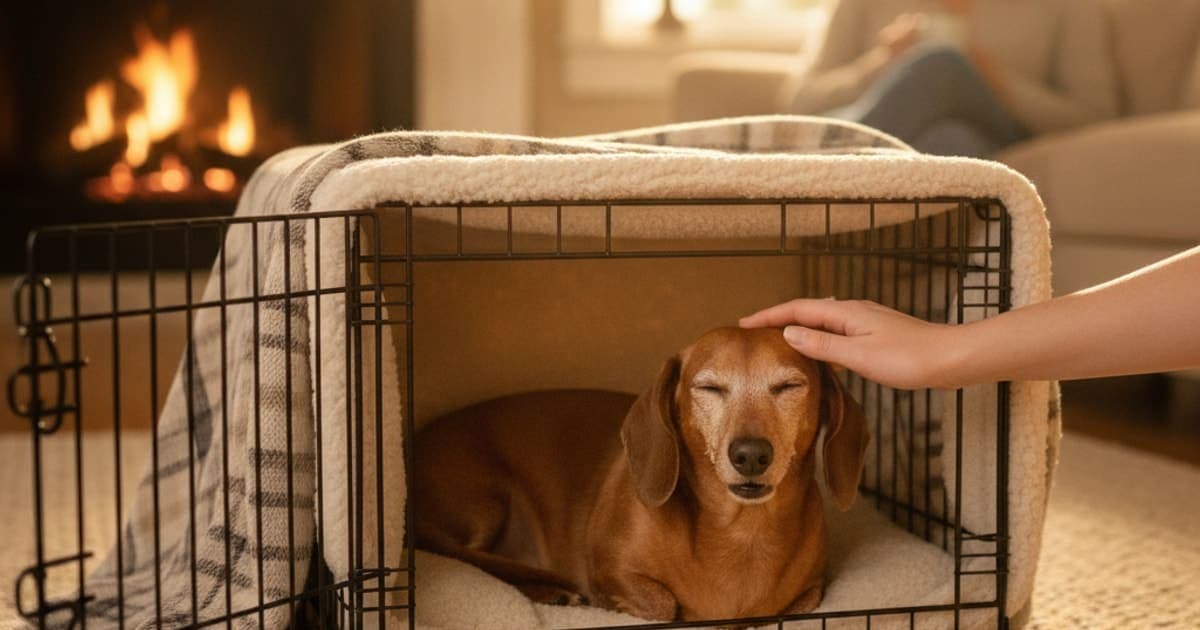
Dachshund back problems are treated by a veterinarian first, and everything else is built around that. The path usually runs: an urgent neurological exam to work out how much the spinal cord is affected, imaging if surgery is on the table, prescribed pain control and anti-inflammatory medication, and then either strict confinement (conservative management) or surgical decompression. What you do at home — safe lifting, a properly confined space, non-slip flooring, ramps, and a slow, vet-guided return to movement — is the support structure that lets that plan work. Home care is never the treatment on its own.
If your dachshund is suddenly yelping, hunched, trembling, reluctant to jump, dragging a back foot or wobbling, treat it as an emergency and call your veterinarian today. Timing matters more in this breed than in almost any other.
Why dachshund spines fail the way they do
Dachshunds are chondrodystrophic — the same genetics that give them short, curved legs also change how the cushioning discs between their vertebrae mature. Instead of staying soft and gel-like, the centre of the disc dries out and calcifies early in life. A hardened disc does not absorb shock well, and under load it can rupture through its outer wall and press up against the spinal cord. This is intervertebral disc disease, or IVDD, and it is the reason behind most dachshund back injuries.
Because the failure is often sudden rather than gradual, a dog can look completely normal in the morning and be unable to stand by dinner. The pressure causes two separate problems: pain from the injured disc and surrounding tissue, and neurological loss from compression and bruising of the cord itself. That second problem is what your vet is measuring when they pinch toes and test reflexes.
Miniature dachshunds are affected by the same process as standards. Small size does not mean a milder injury — it only changes the handling logistics.
What the vet does first, and why the exam decides everything
Your veterinarian will grade the injury by function: pain only, pain with a wobbly walk, pain with the ability to stand but not walk normally, non-ambulatory with some movement, or paralysed with loss of deep pain sensation. That grade drives the whole plan. A dog who is painful but walking is usually managed very differently from a dog who has lost bladder control or deep pain response, where referral for imaging (MRI or CT) and surgery becomes urgent.
On medication: vets commonly prescribe an anti-inflammatory such as carprofen or meloxicam, a nerve-pain drug such as gabapentin, and a muscle relaxant such as methocarbamol; corticosteroids are sometimes used instead of NSAIDs, and the two are not combined. The exact combination is a clinical decision. Never give a dachshund human pain relievers — ibuprofen and acetaminophen are toxic to dogs — and never stop or reduce a prescribed medication because your dog seems comfortable, because comfort is often exactly what makes a dog move too much too early.
Ask your vet directly what signs should send you back in. Loss of the ability to urinate, worsening weakness, or a dog who was walking and now is not are all reasons to be seen immediately rather than the next morning.
Conservative management versus surgery: how the paths compare
| Conservative management | Surgical decompression | |
|---|---|---|
| Usually considered when | The dog is painful, or painful and mildly wobbly, but still walking | The dog cannot walk, is deteriorating, has lost bladder control, or has failed rest and medication |
| What it involves | Strict confinement, prescribed pain relief and anti-inflammatories, bladder monitoring, controlled reintroduction of movement | Advanced imaging, removal of the herniated disc material pressing on the cord, then post-op confinement and rehab |
| Owner workload | High — the hard part is enforcing rest for weeks | High — post-op nursing, incision care, physio, often a sling |
| Cost | Lower; varies widely by clinic and region | Substantially higher; varies widely by clinic and region |
| Recurrence | Possible; the rest of the spine still has calcified discs | Possible at other disc sites, though the treated site is decompressed |
Both paths are legitimate veterinary medicine. Neither is something a supplement, a home remedy or an internet protocol replaces. Your vet chooses between them based on the exam, not on preference.
Crate rest, done properly
Strict confinement is the single most important thing you control, and it is where most home care goes wrong. "Rest" does not mean free run of a quiet room. It means a crate or pen barely bigger than the dog stretched out, with the dog out only to toilet, on a harness and lead, and back in.
Plans are commonly measured in weeks rather than days — four to six weeks of strict rest is a frequently used window in conservative management — but your veterinarian sets the exact length and the criteria for easing off. Do not shorten it because your dog looks fine.
Practical points that make it survivable:
- No stairs, no furniture, no jumping in or out of the crate, no greeting visitors at the door, no zoomies in the hall. Every twist and impact is load the healing disc does not need.
- Carry your dachshund to and from the garden. Toilet breaks happen on a short lead, on flat ground, with no sniffing marathons.
- Watch urination closely. A dog straining, dribbling, or not producing urine needs to be seen urgently — bladder function is a neurological signal, not a plumbing inconvenience.
- Feed the brain instead of the body. Lick mats, stuffed frozen toys, snuffle mats laid flat in the crate, chews, and short nose-work games played lying down all burn mental energy without spinal load.
- Keep bedding firm and supportive rather than deep and sinking, and keep the crate somewhere the dog can see family so confinement does not become isolation.
- Heat or cold packing, massage and any early passive movement should only be done on your vet's or a qualified rehab therapist's instruction.
Safe lifting, carrying and a home that protects a healing back
Pick your dachshund up with two hands, always. One hand supports the chest between the front legs, the other supports the hindquarters and the base of the tail, and the spine stays level like a plank. Never scoop under the armpits and let the back end dangle, never lift by the belly alone, and never let a child carry a dog with a suspect back.
Carrying against your chest with the body horizontal and fully supported is ideal for short distances. For longer trips, a flat carrier or a firm-bottomed sling keeps the spine neutral. If your dog is non-ambulatory, your vet or rehab therapist can show you how to use a rear-support sling for toilet breaks so you are not lifting awkwardly every time.
The house matters as much as the lift:
- Ramps or low, wide steps at every surface the dog was previously jumping onto — sofa, bed, car boot. Train them properly before they are needed.
- Non-slip runners or rugs over hard floors. Scrabbling on laminate twists the spine and stresses the hips.
- A baby gate at the bottom of the stairs, permanently.
- A Y-shaped harness rather than a collar for all lead walking, so pressure sits on the chest and not the neck and spine.
- Lean body condition. Extra weight is extra leverage on every disc, and weight control is one of the few genuinely long-term protective measures an owner fully controls.
What if something changes during recovery
If the back legs go weak or wobbly
Any new or worsening weakness, knuckling of the paws, or loss of coordination is a deterioration, not a bad day. Call your veterinarian immediately. Dogs can move down the grading scale quickly, and the window in which surgery is most useful is not one you want to spend waiting.
If it is a second episode
Repeat episodes happen because the underlying disc changes affect the whole spine, not just the one site that failed. A second event needs the same urgent assessment as the first — do not assume the previous plan simply applies again, and do not restart leftover medication without asking.
If your miniature dachshund seems too small to handle
Small dogs are easier to carry and harder to confine, because they can leap off a knee before you react. Treat a mini exactly as you would a standard: full two-handed support, strict confinement, ramps everywhere, and no exceptions for cuddles on the sofa.
Recovery timelines and what rehab looks like
Recovery from a dachshund back injury is measured in weeks to months, not days, and the honest answer is that it depends on the grade of the injury and how well the inflammation settles. Pain often improves before the underlying tissue has caught up, which is precisely the trap. Neurological recovery — a foot that knuckles, a hind end that swings — tends to lag behind pain relief, and some dogs retain a degree of wobble long-term.
Controlled rehab is the bridge between crate rest and normal life. A qualified veterinary physiotherapist typically works through weight-shifting and standing balance, slow controlled lead walking on flat ground, core and hind-limb strengthening, and in some practices underwater treadmill work. The reintroduction is deliberately boring: short, flat, on-lead, gradually longer, with stairs and jumping the last things to come back — if they come back at all.
The long game is prevention of the next episode: lean weight, harness, ramps, strong core, and no repetitive high-impact leaping.
Where K9-REPAIR fits alongside the plan your vet sets
Once your vet has the diagnosis, the medication and the confinement plan in place, recovery becomes a soft-tissue project — muscle that wastes during weeks of rest, tendons and ligaments deconditioned by inactivity, joints carrying an altered gait. That is the space owners are looking at when they add a peptide stack.
K9-REPAIR from pawgen is a BPC-157 and TB-500 formulation made for dogs. BPC-157 is a peptide sequence studied in animal models for its effects on blood vessel formation and connective-tissue repair signalling; TB-500 is a synthetic fragment related to thymosin beta-4, a protein involved in cell migration and tissue remodelling. Research suggests these mechanisms are relevant to soft-tissue and tendon healing, and owners report reaching for them through the long recovery and reconditioning phase. BPC-157 and TB-500 are not FDA-approved veterinary drugs, nothing here is a claim that they treat IVDD or any other condition, and they are not a substitute for surgery, prescribed medication or rest.
What can be said plainly: pawgen publishes third-party batch testing, doses by bodyweight rather than a one-size scoop, ships direct to your door, and backs orders with a 60-day money-back guarantee. That is the opposite of the underdosed kitchen-sink joint chew with a proprietary blend and no certificate of analysis. Bring it up with your veterinarian alongside everything else your dog is taking, especially during active medical management.
Key takeaways
- Dachshund back pain is a veterinary emergency until proven otherwise; the neurological exam decides between conservative management and surgery.
- Prescribed medication is the vet's call. Never use human painkillers, and never stop a prescription early because your dog seems comfortable.
- Strict confinement means a crate, lead-only toilet breaks, and weeks of it — enforced even when your dog objects.
- Two-handed, level-spine lifting, a Y-harness, ramps, non-slip flooring and a lean bodyweight are the home measures that matter most.
- Recovery runs weeks to months; neurological signs lag behind pain relief, and rehab is reintroduced slowly and on lead.
- Owners commonly add K9-REPAIR through the recovery and reconditioning phase; the science is emerging and promising, and it works alongside veterinary care rather than instead of it.
Working with your vet from here
You can review pawgen's third-party batch testing on the certificates of analysis page, see the full K9-REPAIR formulation on the shop page, check shipping coverage on the locations page, or read more about the brand at pawgen.
Your veterinarian owns the diagnosis, the grading, the medication and the decision about surgery — that is not shared ground, and a dachshund with a suspected disc injury belongs in front of one today, not next week. Everything described here, including supplements and peptides, operates in the space that proper veterinary care creates: the weeks of protected rest, the careful handling, the slow rebuild. Get the medicine right first, then support it well.
Owners exploring peptide support for their dog can review K9-REPAIR — BPC-157 + TB-500 formulated for dogs — at https://pawgen.com/. BPC-157 and TB-500 are not FDA-approved veterinary drugs. Nothing in this article treats, cures or prevents any condition; every decision about your dog's care belongs with your veterinarian.
Frequently asked questions
- How to treat dachshund back problems?
- Start with an urgent veterinary exam. Your vet grades the neurological signs, prescribes pain control and anti-inflammatories, and chooses between strict confinement or surgical decompression. At home you enforce crate rest, lift with two hands supporting chest and hindquarters, use ramps and non-slip flooring, and reintroduce movement only on veterinary instruction.
- How to treat dachshund back pain?
- Pain relief for a dachshund's back is prescription territory — commonly an anti-inflammatory such as carprofen or meloxicam, often with gabapentin or a muscle relaxant, chosen by your vet. Never give human painkillers; ibuprofen and acetaminophen are toxic to dogs. Combine medication with strict rest, since comfort encourages dangerous movement.
- How to help dachshund with back problems?
- Confine strictly, medicate exactly as prescribed, and remove every jump from daily life. Add ramps to sofa, bed and car, lay non-slip runners over hard floors, gate the stairs, switch to a Y-shaped harness, and keep your dog lean. Then follow your vet's staged plan for returning to controlled exercise.
- How to carry a dachshund with back problems?
- Use both hands: one supporting the chest between the front legs, the other under the hindquarters, keeping the spine level like a plank. Hold the body horizontally against your chest. Never scoop under the armpits, never lift by the belly alone, and never let children carry a dog with a suspected disc injury.
- How long does a dachshund back injury take to recover?
- Recovery is measured in weeks to months rather than days, and depends heavily on how severe the neurological signs were. Conservative management commonly involves several weeks of strict confinement before controlled rehab begins. Pain usually improves before function does, so follow your vet's timeline rather than how comfortable your dog looks.
- What can I give my dachshund for back pain at home?
- Only what your veterinarian has prescribed. There is no safe over-the-counter human painkiller for dogs, and dosing decisions belong to your vet. At home your contribution is environmental: strict crate rest, supported lifting, warm comfortable bedding, and mental enrichment that does not involve movement, plus any vet-directed heat or cold packing.
- Do home remedies work for dachshund back problems?
- Home care supports recovery but does not replace diagnosis or treatment. The measures with real value are strict confinement, correct lifting, ramps, non-slip flooring and weight control. Unverified home remedies can delay urgent care, and delay matters enormously with disc injuries. Always get the veterinary assessment before managing anything at home.
- Is crate rest enough for a miniature dachshund back injury?
- Sometimes, but only your vet can decide. Dogs who are painful yet still walking are often managed conservatively with confinement and medication, while dogs who cannot walk or have lost bladder control usually need imaging and surgical assessment urgently. Miniature dachshunds get exactly the same injury as standards.
- Can supplements help a dachshund recovering from a back injury?
- Supplements work alongside veterinary care, never instead of it. Owners commonly use K9-REPAIR, a BPC-157 and TB-500 peptide formulation from pawgen, through the long reconditioning phase; research suggests these peptides are involved in tissue-repair signalling. They are not FDA-approved veterinary drugs. Discuss anything you add with your veterinarian.
Educational content. BPC-157 and TB-500 are not FDA-approved veterinary drugs. Talk to your veterinarian before starting anything new, especially if your dog is on prescribed medication.