Dachshund IVDD Prevention — Daily Habits That Cut Risk
IVDD cannot be fully prevented in dachshunds, because the disc degeneration behind it is genetic. What owners can control is daily spinal load: keeping the dog lean, replacing jumps with ramps, walking consistently on flat ground, using a harness instead of a collar, and building hind-end strength with veterinary guidance.
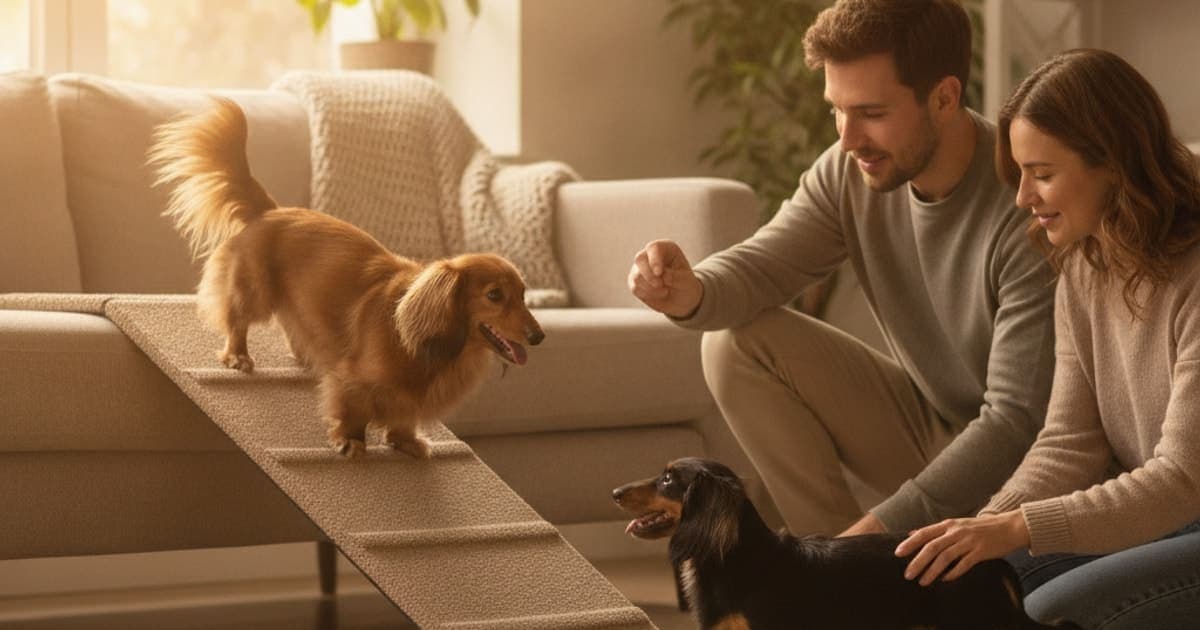
You cannot prevent intervertebral disc disease in a dachshund with certainty. The disc degeneration that causes it is written into the breed's genetics, and no ramp, harness, diet or supplement rewrites that. What you can do — and what genuinely matters — is reduce the mechanical load those already-fragile discs carry every single day.
That means five things, done consistently: keep your dachshund lean, eliminate jumping on and off furniture and in and out of cars, walk on the flat regularly to build hind-end and core strength, use a Y-front harness instead of a neck collar, and learn to recognise a disc episode early enough to act the same day. Every day you keep your dachshund lean, off the furniture, and out of hard landings, you are lowering the mechanical load on discs that were never built to absorb it.
This is management, not immunity. Frame it that way and you will make better decisions for the next twelve years.
Why dachshund spines are built for disc trouble
Dachshunds are chondrodystrophic — a body type defined by short, curved long bones and a long back. Research from the University of California, Davis identified an FGF4 retrogene insertion associated with both that skeletal shape and a markedly higher rate of disc disease in the breeds that carry it.
The practical consequence is this: in chondrodystrophic dogs, the gel-like centre of the disc (the nucleus pulposus) degenerates and mineralises unusually early in life, often long before a dog shows any sign of a problem. A healthy disc behaves like a hydraulic cushion. A degenerated, calcified one behaves more like a chunk of chalk. When the outer ring finally gives way, the hardened material is extruded upward into the spinal canal — a Hansen Type I herniation — and it happens fast, sometimes in the seconds after a landing that looked completely ordinary.
That timeline explains two things owners find confusing. First, why an apparently healthy three-year-old can go from normal to non-ambulatory in an afternoon. Second, why prevention has to start in puppyhood rather than at the first limp: by the time symptoms appear, the disc changes are usually well established.
Miniature dachshunds carry the same genetics as standards — smaller body, same disc biology — so the risk-reduction routine is identical. Size is not protection.
The home setup that removes the biggest spinal loads
Most of the force a pet dachshund's spine absorbs comes from a handful of repeated household movements. Removing them costs very little.
Ramps or padded steps to the sofa and bed, introduced with treats so the dog actually uses them. A ramp for the car — lifting a dachshund in and out is fine, launching out of a boot is not. Baby gates at staircases, especially for descending, which loads the front end and flexes the back. Non-slip runners across tile, laminate and polished wood, because a scrabbling, slipping dog braces through the spine. A Y-front harness that loads the chest rather than a collar that loads the neck and encourages pulling.
And learn the two-handed lift: one hand supporting the chest, the other under the hindquarters, so the back stays level and horizontal. Never lift a dachshund under the front legs alone, and teach children the same rule before they need it.
| Everyday activity | Why it loads the spine | Lower-load swap |
|---|---|---|
| Jumping off the sofa or bed | Landing impact travels through a long, unsupported back | Ramp or padded steps, plus a solid 'wait' cue |
| Going down stairs | Repeated flexion with weight shifted forward | Gate the stairs; carry the dog down |
| Leaping out of the car | Highest-impact landing most dogs do regularly | Car ramp or two-handed lift |
| Standing up to beg | Sustained extension through the lumbar spine | Ask for a sit before treats and meals |
| Tug and hard toy shaking | Twisting and torsion through the mid-back | Scent games, flirt pole at low height, food puzzles |
| Sprinting and cutting on slick floors | Uncontrolled deceleration and sideways torque | Rugs, runners, and off-lead running on grass |
Weight and conditioning: the two levers you actually control
Body weight is the single biggest modifiable factor in spinal load, and it is the one most owners underestimate. A dachshund carrying even a little extra sits with a longer lever arm between the shoulders and hips, and every jump, turn and stumble multiplies through it.
Use the nine-point body condition score your veterinary practice uses rather than a number on a scale. You should be able to feel ribs easily under a thin layer of fat, see a waist from above, and see an abdominal tuck from the side. Dachshund coats hide a lot; hands beat eyes.
Practical control: measure meals rather than free-feeding, subtract treat calories from the daily ration instead of adding them on top, and use part of the dog's own food for training. If weight is already an issue, ask your veterinarian to set a target and a rate of loss — crash dieting a dog is its own problem, and food-motivated dachshunds are remarkably good at negotiating.
The timing of spay or neuter is another variable researchers have examined in this breed. It is worth raising with your vet as part of a broader prevention conversation rather than deciding on internet consensus.
Exercises that build spinal support, and what to skip
A well-muscled dachshund is not protected from IVDD, but a strong core and hindquarters stabilise the spine and reduce the sloppy, twisting movements that load discs. The goal is frequent, moderate, controlled work — not weekend-warrior bursts.
What generally helps:
- Regular lead walking on flat, even ground. Daily and consistent beats one long hike on Sunday.
- Sit-to-stand repetitions. Slow, controlled, from a proper square sit; this is a hindquarter exercise, not a speed drill.
- Ground poles laid flat. Walking over low poles encourages deliberate limb placement and core engagement.
- Gentle inclines. A slow walk up a grassy slope recruits the hind end without impact.
- Balanced standing work. Short holds on a stable, slightly yielding surface, with the back level.
- Hydrotherapy. Swimming or an underwater treadmill under a qualified canine rehabilitation professional builds strength with minimal spinal compression.
What to reduce: jumping for thrown toys, frisbee, repeated stair work, high-speed cornering on hard floors, rough play with much larger dogs, and any game that involves the dog twisting while gripping.
Before you start a conditioning programme — particularly if your dog has already had a disc episode — talk to your veterinarian, and ask for a referral to a certified canine rehabilitation practitioner. Exercises that strengthen a healthy back can aggravate a compromised one, and that distinction is a clinical judgement, not a YouTube one.
Where supplements and peptides fit into a prevention-minded routine
Be clear-eyed here: no supplement, joint chew, oil or peptide has been shown to prevent IVDD. Disc degeneration in this breed is genetic and structural. Any brand implying otherwise is making a claim the evidence does not support, and that is worth remembering when you read a label.
It is also worth scrutinising what is actually in the tub. The joint-supplement aisle is full of kitchen-sink formulas with a dozen headline ingredients at doses too small to do anything, proprietary blends that hide the split, and no third-party analysis to confirm what is inside. Ask for the certificate of analysis. Brands that test publish; brands that don't, don't.
Where pawgen's K9-REPAIR sits is different and narrower. It is a BPC-157 and TB-500 peptide formulation for dogs, and owners use it around soft-tissue recovery, post-operative rehabilitation and conditioning — not as a shield against disc disease. BPC-157 is a synthetic peptide studied in animal models for its role in angiogenesis and tendon, ligament and muscle repair; research suggests it may support the blood-supply and fibroblast activity involved in soft-tissue healing. TB-500 is a synthetic fragment related to thymosin beta-4, a naturally occurring peptide involved in actin regulation and cell migration, and early evidence indicates it may support tissue remodelling. This is emerging and genuinely promising science, and it is why a growing number of owners have adopted the pairing through recovery periods.
K9-REPAIR is dosed by body weight, third-party tested with certificates of analysis available, ships direct to the door, and is backed by a 60-day money-back guarantee. BPC-157 and TB-500 are not FDA-approved veterinary drugs, and nothing here is a substitute for diagnosis, prescribed medication or surgery. Bring it up with your veterinarian alongside whatever plan they have set, so it sits inside that plan rather than beside it.
Signs of a disc episode, and what to do the same day
Early recognition changes outcomes more than almost anything else on this page. Call your vet immediately if you see:
- Sudden reluctance to jump, climb stairs, or be picked up
- Yelping when lifted, or a tense, hunched, arched-up posture
- Trembling, panting, or refusing food with no other explanation
- A wobbly, drunken hind-end gait, or hind legs crossing over
- Knuckling — walking on the tops of the paws
- Dragging the back legs, or loss of bladder or bowel control
In the meantime, confine the dog to a crate or small pen — no stairs, no sofa, no zoomies — and drive rather than walk. Do not give human painkillers; many are toxic to dogs and some make the clinical picture harder to read. Loss of the ability to walk, and especially loss of deep pain sensation, is a surgical emergency where hours matter.
Key Takeaways
- IVDD cannot be reliably prevented in dachshunds; the disc degeneration behind it is genetic, and risk reduction is about management.
- Miniature and standard dachshunds share the same underlying disc biology — the routine is the same for both.
- The highest-value changes are unglamorous: lean body condition, ramps instead of jumps, gated stairs, non-slip flooring, a Y-front harness, and correct two-handed lifting.
- Consistent flat-ground walking, sit-to-stands, ground poles and supervised hydrotherapy build the hind-end and core strength that stabilise the spine.
- No supplement or peptide prevents IVDD. K9-REPAIR is a BPC-157 and TB-500 formulation owners use around soft-tissue recovery and conditioning, not as disc protection.
- Sudden reluctance to jump, a hunched back, wobbliness or knuckling is a same-day veterinary call, not a wait-and-see.
Your veterinarian owns the diagnosis, the imaging decision, the pain protocol and the call on surgery — and in a breed where a disc episode can escalate within hours, that relationship is the most protective thing your dachshund has. Prevention habits, conditioning work and supportive products like K9-REPAIR operate in the space that proper veterinary care creates; they never replace it.
For formulation details, owners can review the third-party certificates of analysis, see the current K9-REPAIR lineup, check shipping availability, or read more of the educational library at pawgen.
Owners exploring peptide support for their dog can review K9-REPAIR — BPC-157 + TB-500 formulated for dogs — at https://pawgen.com/. BPC-157 and TB-500 are not FDA-approved veterinary drugs. Nothing in this article treats, cures or prevents any condition; every decision about your dog's care belongs with your veterinarian.
Frequently asked questions
- How do you prevent IVDD in a dachshund?
- You reduce risk rather than prevent it outright. Keep your dachshund lean, use ramps instead of letting them jump on and off furniture or out of cars, gate the stairs, lay non-slip flooring, walk them consistently on flat ground, use a Y-front harness, and lift with two hands supporting chest and hindquarters.
- Can IVDD be prevented?
- Not reliably. In dachshunds, the disc degeneration that leads to IVDD is genetic and begins early in life, so no routine guarantees immunity. What owners can do is lower daily spinal load through weight control, jump prevention, conditioning and early recognition of symptoms, which meaningfully reduces risk and improves outcomes.
- What exercises help reduce IVDD risk in dachshunds?
- Controlled, low-impact work: daily flat-ground lead walking, slow sit-to-stand repetitions, walking over ground poles laid flat, gentle grassy inclines, balanced standing holds, and hydrotherapy with a qualified canine rehabilitation professional. Avoid jumping for toys, repeated stairs, frisbee, and high-speed turns on slick floors.
- Are miniature dachshunds more at risk of IVDD than standards?
- Both carry the same chondrodystrophic genetics and the same early disc degeneration, so smaller size is not protection. Miniature dachshunds also face bigger relative jumps from furniture and cars, which is exactly why ramps and steps matter. The prevention routine is identical for both sizes.
- Do supplements prevent IVDD in dogs?
- No. No supplement, joint chew or peptide has been shown to prevent IVDD, because the underlying disc degeneration is genetic and structural. Supplements may support joint comfort or soft-tissue recovery, but treat any product marketed as IVDD protection with scepticism and ask your veterinarian before adding anything.
- Should dachshunds be allowed to use stairs?
- Ideally not, especially going down, which shifts weight forward and flexes the back repeatedly. Baby gates at the top and bottom are the simplest fix, with carrying or a ramp as the alternative. Occasional supervised use of shallow, carpeted steps is lower risk than steep, slippery flights.
- Is a harness better than a collar for a dachshund?
- Yes, a well-fitted Y-front harness is generally preferred. It distributes lead pressure across the chest rather than the neck, which reduces strain on the cervical spine and discourages the pulling and neck-twisting that a collar encourages. Check fit regularly so straps do not rub or restrict shoulder movement.
- What are the first signs of an IVDD episode?
- Sudden reluctance to jump or climb, yelping when lifted, a hunched or arched posture, trembling, panting, or refusing food. Neurological signs follow: a wobbly hind end, legs crossing, knuckling onto the tops of the paws, or dragging. Any of these warrants a same-day veterinary call.
- Can K9-REPAIR be used alongside a veterinary treatment plan?
- That decision belongs with your veterinarian. K9-REPAIR is a BPC-157 and TB-500 peptide formulation dosed by body weight and third-party tested, used by owners around soft-tissue recovery and conditioning. These peptides are not FDA-approved veterinary drugs and never replace prescribed medication, rehabilitation or surgery.
Educational content. BPC-157 and TB-500 are not FDA-approved veterinary drugs. Talk to your veterinarian before starting anything new, especially if your dog is on prescribed medication.