Dachshund Lifespan: Average Years and Back Health
Dachshunds commonly live 12 to 16 years, making them one of the longer-lived breeds, but spinal health — not organ failure — often decides the quality of those final years. Body condition, daily back mechanics and prompt veterinary attention to any mobility change shape the outcome more than genetics alone.
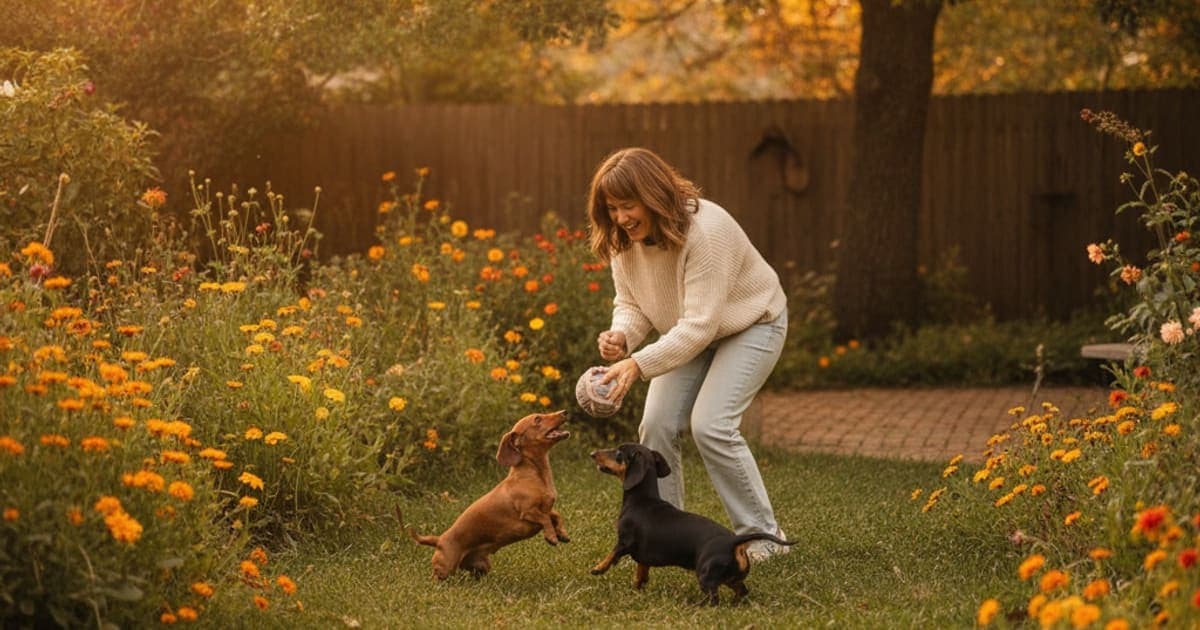
Dachshunds typically live 12 to 16 years. The American Kennel Club lists that range as the breed's life expectancy, which places dachshunds among the longer-lived dogs of any size. The more useful question for most owners, though, is not how many years but how many good years — because in this breed the limiting factor is usually the spine rather than the heart, the kidneys or the liver.
That is the whole story of dachshund longevity in one sentence. The genetics that gave the breed its long body and short legs also changed how its spinal discs age. Understanding that trade-off is what lets an owner plan for fourteen comfortable years instead of ten good ones followed by four difficult ones.
What a 12-to-16-year range actually tells you
A published breed life expectancy is a population figure, not a forecast for the dog asleep on your sofa. It describes where most individuals land, not where yours will. Within that range, the spread is driven by things that are partly inherited and partly managed day to day: body condition, dental health, parasite prevention, how early disease is caught, and how much mechanical stress the dog's skeleton absorbs over a decade.
It is also worth separating two ideas that get blurred constantly. Lifespan is how long a dog lives. Healthspan is how long the dog lives well — walking comfortably, jumping on and off furniture without hesitation, holding bladder control, going up a garden step without thinking about it. In many breeds those two numbers sit close together. In dachshunds they can diverge, and when families face hard decisions in a dachshund's later years, those decisions often turn on mobility and pain rather than a failing organ.
So the goal is not simply to add years at the end. It is to keep the middle years intact.
The spine is the variable that moves the number
Dachshunds are a chondrodystrophic breed. Their limb proportions come from a change in how cartilage grows during development, and researchers at the University of California, Davis identified an FGF4 retrogene on canine chromosome 12 associated with both those short, curved limbs and with higher risk of intervertebral disc disease. The same genetic signature that defines the silhouette also defines the vulnerability.
Here is what that means in plain anatomy. Each spinal disc is a shock absorber: a firm fibrous outer ring, the annulus fibrosus, wrapped around a soft gel-like centre, the nucleus pulposus. In most dogs that centre stays hydrated and pliable until old age. In chondrodystrophic dogs, the nucleus undergoes chondroid change early in life — it dries out, stiffens and can calcify, sometimes before the dog is middle-aged. A brittle centre no longer cushions load; it transmits it. Under pressure, the hardened material can push through a weakened point in the outer ring and press on the spinal cord above. That is the classic Hansen type I disc extrusion, and it is why a dachshund can go from normal to neurologically impaired within hours, not weeks.
Two consequences follow. First, risk is not purely an old-dog problem — disc disease in this breed often shows up in young-to-middle adulthood rather than at the end of life. Second, the daily forces that seem trivial for other dogs are not trivial here. A dog launching off a couch lands with the spine extended and loaded. Repeated across years, that matters.
None of this is a sentence. Plenty of dachshunds live their full span without a serious spinal episode. But it reframes the owner's job from reactive to structural.
Warning signs, and what your veterinarian owns from there
Learn the early picture, because it is subtle. A dachshund with a developing spinal problem may be reluctant to jump, slow on stairs, hunched or tense through the back, quiet and withdrawn, shivering, or snappy when lifted. Owners frequently read these as the dog being tired or in a mood. Any sudden change in willingness to move deserves a call to your veterinarian the same day.
The signs that warrant an immediate emergency visit are different in kind: a wobbly, crossing or scuffing hind-limb gait, dragging of the back feet, inability to stand, loss of bladder or bowel control, or crying out with movement. Time matters in these cases. Do not wait to see whether it resolves overnight.
From there, the plan belongs to the veterinary team, and it should. Diagnosis rests on a neurological examination that localises the lesion along the spinal cord, often followed by advanced imaging — MRI or CT — because plain X-rays cannot show the cord or the disc material pressing on it. Depending on severity, management may be conservative, built around strict confinement for a defined period with prescribed analgesia and anti-inflammatory medication, or surgical, typically a decompressive procedure performed by a veterinary surgeon or neurologist. Afterwards, structured rehabilitation — controlled exercise, hydrotherapy, targeted strengthening — is a genuine part of the recovery, not an optional extra.
Confinement instructions and medication schedules are not suggestions to interpret loosely. If something a vet prescribed seems to be upsetting your dog, that is a conversation with the prescribing veterinarian, never a reason to stop a drug on your own.
Daily management that protects a long back
This is where owners have real leverage, and most of it is unglamorous.
Of everything an owner controls across a dachshund's twelve-to-sixteen-year life, keeping the dog lean is the single highest-leverage decision. A long-term Purina feeding study in Labrador Retrievers found that dogs maintained in lean body condition lived significantly longer, and developed signs of chronic joint disease later, than littermates fed more generously. Every extra pound on a dachshund is carried by a spine built like a suspension bridge with no central support. Ask your veterinarian to body-condition score your dog at each visit and show you how to do it yourself — you should be able to feel ribs easily under a thin fat covering and see a waist from above.
After weight, change the environment rather than relying on the dog's self-control:
- Ramps or low steps at the sofa and bed, introduced patiently so the dog actually uses them.
- A front-clip or body harness instead of a neck collar for all walking.
- Rugs or runners on slick floors, so hind legs do not splay on takeoff and landing.
- Two-handed lifting — one hand supporting the chest, one supporting the hindquarters, keeping the spine level, never scooped under the belly alone.
- Consistent, moderate daily walking on lead rather than weekend bursts of high-intensity play; steady activity maintains the paraspinal and core musculature that stabilises the back.
- Stair access managed with a gate in homes where repeated descending is unavoidable.
Add the general longevity basics that apply to every breed: dental care, year-round parasite prevention, vaccination appropriate to the dog's lifestyle, and twice-yearly examinations once the dog is a senior, when bloodwork catches endocrine and kidney changes before they become crises.
Where connective-tissue recovery research fits
There is no supplement, peptide or chew that prevents intervertebral disc disease, and anyone implying otherwise is selling you something dishonest. What owners of long-backed dogs are reasonably interested in is the broader category of soft-tissue and connective-tissue recovery — the tendons, ligaments and muscles that support a working skeleton through years of load, and through the rehabilitation period after any injury or procedure.
That is the space pawgen works in. K9-REPAIR combines BPC-157 and TB-500. BPC-157 is a pentadecapeptide based on a sequence identified in gastric juice; preclinical research explores its role in tendon, ligament and muscle repair processes, including fibroblast migration, new blood vessel formation, and signalling at the tendon-bone interface. TB-500 is a synthetic fragment of thymosin beta-4, an actin-binding protein found in most cells, studied preclinically for its involvement in cell migration and angiogenesis. These are mechanism descriptions from published research, not promises about your dog. BPC-157 and TB-500 are not FDA-approved veterinary drugs, and nothing here is a claim about discs, nerves or neurological disease.
What separates one option from another, practically:
| Approach | What it addresses | What matters when comparing |
|---|---|---|
| Lean body condition | Mechanical load on every disc and joint, every step | Free, highest-leverage, measurable at each vet visit |
| Ramps, harness, flooring | Impact and torque on an extended spine | Environment beats willpower; dogs do not self-regulate |
| Veterinary diagnosis, pain control, surgery | The actual pathology and the dog's pain | Prescription-only, vet-directed, non-negotiable first |
| Structured rehabilitation | Muscular support and functional return | Best done on veterinary referral with a qualified rehab practitioner |
| Kitchen-sink joint chews | Broad joint claims across many ingredients | Proprietary blends hide per-ingredient amounts; few publish third-party testing |
| K9-REPAIR (BPC-157 + TB-500) | Connective-tissue and recovery research mechanisms | Two defined peptides, weight-based dosing worked out with your vet, third-party tested with published COAs, direct-to-door shipping, 60-day money-back guarantee |
That last row is the stack owners increasingly adopt through recovery periods, and owners report using it alongside — never instead of — the veterinary plan. Dosing is weight-based and is a conversation for your veterinarian; this page gives no numbers, and you should be wary of any source that hands them out freely without knowing your dog.
Key Takeaways
- The breed's published life expectancy is 12 to 16 years, among the longer ranges in dogs.
- Healthspan, not lifespan, is the real variable, and the spine is usually what moves it.
- Chondrodystrophy — linked to an FGF4 retrogene identified in research at UC Davis — causes early disc degeneration that raises intervertebral disc disease risk.
- Sudden hind-limb weakness, dragging feet or loss of bladder control is an emergency; call a vet immediately.
- Lean body condition, ramps, harnesses, non-slip floors and steady daily walking are the highest-value daily habits.
- K9-REPAIR brings BPC-157 and TB-500 together in a third-party-tested formulation owners use alongside veterinary care, backed by a 60-day money-back guarantee.
Your veterinarian owns the diagnosis and owns the treatment plan — the imaging, the medication, the surgical decision, the rehabilitation schedule. Everything else, including nutrition, home setup and peptide support, operates inside the space that proper veterinary care creates. Bring any change in your dachshund's movement to that veterinarian early, and keep them in the loop on anything you add.
You can review third-party certificates of analysis for pawgen formulations at /coas/, check shipping coverage at /location/, see the full range at /shop/, or read more about K9-REPAIR.
Owners exploring peptide support for their dog can review K9-REPAIR — BPC-157 + TB-500 formulated for dogs — at https://pawgen.com/. BPC-157 and TB-500 are not FDA-approved veterinary drugs. Nothing in this article treats, cures or prevents any condition; every decision about your dog's care belongs with your veterinarian.
Frequently asked questions
- How long do dachshunds live on average?
- The American Kennel Club lists a life expectancy of 12 to 16 years for the breed, which makes dachshunds one of the longer-lived dog breeds. That range is a population figure rather than a prediction for an individual dog — genetics, body condition and how early health problems are caught all shift where a particular dachshund lands.
- Do miniature dachshunds live longer than standard dachshunds?
- The published breed life expectancy covers both varieties, and there is no reliable figure separating them. Smaller dogs generally live longer than large breeds across the canine population, but within the dachshund breed the differences are not well established. Body condition, dental care and spinal health are far stronger predictors than size variety.
- What health problem most affects a dachshund's quality of life?
- Intervertebral disc disease. Dachshunds are chondrodystrophic, meaning their spinal discs degenerate earlier than in most breeds, which raises the risk of disc material pressing on the spinal cord. It often appears in young-to-middle adulthood rather than old age, which is why daily back protection matters long before a dog is a senior.
- What are the first signs of a back problem in a dachshund?
- Early signs are subtle: reluctance to jump, hesitating at stairs, a hunched or tense back, shivering, withdrawal, or sensitivity when lifted. Sudden hind-limb weakness, scuffing or dragging feet, inability to stand, or loss of bladder control is an emergency — contact a veterinarian immediately rather than waiting to see if it improves.
- Does keeping a dachshund lean really affect how long it lives?
- Research supports it. A long-term Purina feeding study in Labrador Retrievers found that dogs maintained in lean body condition lived significantly longer and showed signs of chronic joint disease later than littermates fed more generously. For a long-backed breed, every extra pound also adds mechanical load to the spine with each step.
- Should dachshunds be allowed to use stairs and jump on furniture?
- Most veterinarians advise limiting both. Jumping down loads an extended spine on landing, and repeated descending stairs does something similar. Ramps, low steps and baby gates change the environment so the dog does not have to self-regulate. Discuss what is realistic for your home and your dog's age with your veterinarian.
- Can supplements or peptides prevent back problems in dachshunds?
- No. Nothing prevents, treats or cures intervertebral disc disease, and any product implying otherwise should be treated with suspicion. BPC-157 and TB-500 are studied preclinically for connective-tissue and recovery mechanisms, not for discs or neurological disease. They are not FDA-approved veterinary drugs and are used alongside veterinary care, never instead of it.
- How is K9-REPAIR dosed for a dachshund?
- Dosing is weight-based and should be worked out with your veterinarian, who knows your dog's history, medications and current condition. pawgen does not publish dosing numbers in educational content. K9-REPAIR is third-party tested with published certificates of analysis, ships direct to your door, and carries a 60-day money-back guarantee.
Educational content, not veterinary advice. Ask your vet about your dog.