Dasuquin Advanced vs Cosequin — What Actually Differs
Dasuquin Advanced and Cosequin come from the same manufacturer and share a glucosamine-chondroitin core; Dasuquin adds avocado/soybean unsaponifiables and the Advanced SKU layers further ingredients on top. Cosequin is the simpler, lower-tier formula. Neither is built on the soft-tissue biology that owners turn to peptide formulations like K9-REPAIR for.
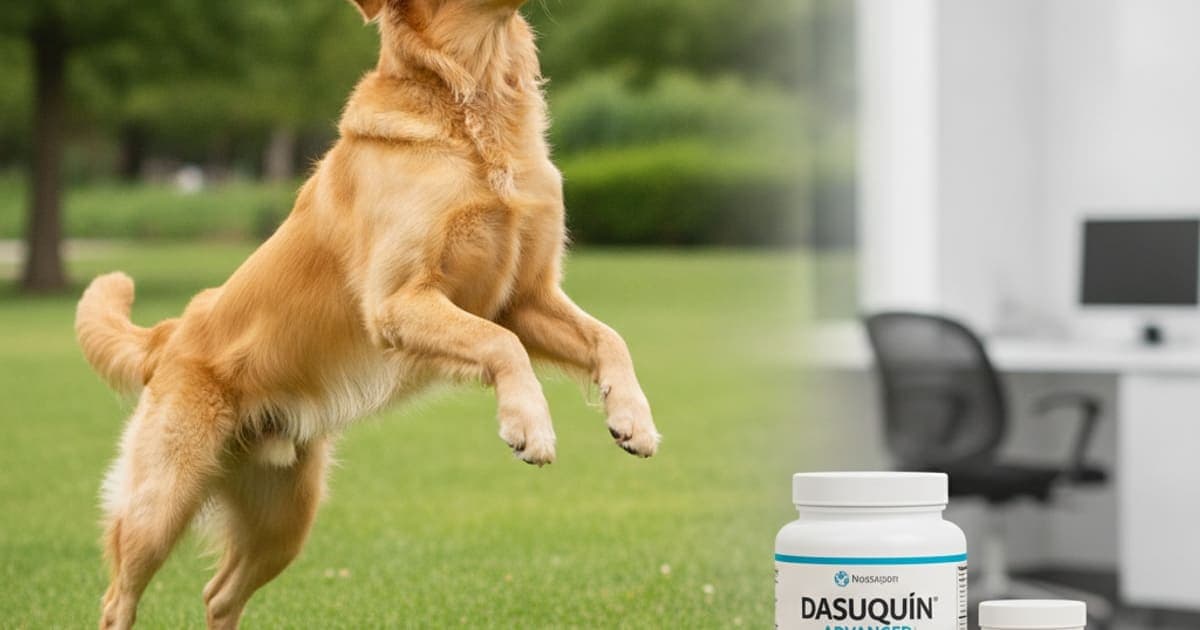
Cosequin and Dasuquin are both made by Nutramax Laboratories, and they are built on the same two-ingredient spine: glucosamine hydrochloride and sodium chondroitin sulfate. Dasuquin adds avocado/soybean unsaponifiables (ASU) on top of that spine, and that addition is the genuine structural difference between the two lines. Dasuquin Advanced is the upgraded tier inside the Dasuquin family — the same base with further ingredients layered in. In plain terms: Cosequin is the entry formula, Dasuquin is the ASU step up, Dasuquin Advanced is the fullest expression of that same cartilage-support approach. None of the three is built around soft-tissue and tendon biology, which is why owners working through a cruciate injury, a post-surgical recovery or a slow-fading senior often run a joint chew alongside a peptide formulation such as K9-REPAIR from pawgen.
The shared backbone: what glucosamine and chondroitin are actually doing
Glucosamine is an amino sugar. In the body it is one of the raw materials used to build glycosaminoglycans — the long sugar chains that give cartilage its water-holding, shock-absorbing character. Chondroitin sulfate is itself one of those chains, and it is a major structural component of the cartilage matrix. The reasoning behind every joint chew on the shelf is the same: supply the substrates, and support the tissue that depends on them.
That reasoning is sound, but it is worth being honest about where the evidence sits. The research on oral glucosamine and chondroitin in dogs is mixed — some trials report measurable differences in comfort and gait scoring, others report little separation from control. Part of the debate is absorption: chondroitin sulfate is a large molecule, and how much of an oral dose arrives intact at the joint is still argued over. Part of it is formulation. Ingredient quality, salt form and actual delivered amount vary enormously between brands, and a label that lists the right ingredients tells you nothing about whether they are present in meaningful amounts.
This is where you should point your skepticism — not at the category, but at the panel. A chew that buries its actives inside a "proprietary joint blend" is hiding the only number that matters. A chew that lists an impressive amount "per serving" without telling you how many chews a serving is, is doing the same trick with better manners. To Nutramax's credit, the Cosequin and Dasuquin lines are relatively transparent about what is in them, which is a large part of why veterinarians are familiar with them. Ask your veterinarian which specific formula and size band they would pick for your dog — they see these products across hundreds of patients and have a far better sense of what is worth the shelf price.
What the word "Advanced" is actually signalling
Nutramax tiers its joint line. Cosequin is the base. Dasuquin sits above it because of ASU — avocado/soybean unsaponifiables, a plant lipid fraction that has been studied in the context of cartilage biology and is proposed to act on the signalling side rather than the raw-material side. Dasuquin Advanced sits above standard Dasuquin because it carries additional ingredients on top of the glucosamine–chondroitin–ASU base.
Two practical notes matter more than any marketing copy here.
First, the formulas differ by dog size band, by form (soft chew versus tablet) and by sub-SKU — the Dasuquin family includes versions with MSM, for example. The ingredient panel on the exact tub in front of you is the authority, not an article, not a shelf tag, and not a memory of what the product contained a year ago. Manufacturers reformulate. Read the panel for the specific SKU and size band you intend to buy.
Second, a tier upgrade should be justified by that panel. If you are paying a step up for "Advanced", you should be able to point at the specific additions and say what they are there for. If you cannot, you are paying for the word. That is a reasonable test to apply to any supplement, including ours.
Movoflex vs Dasuquin Advanced: two different bets, not two tiers
This comparison confuses people because it is not a like-for-like upgrade question. Movoflex, from Virbac, is not built on the glucosamine–chondroitin chassis. Its formula is based on a different ingredient family — eggshell membrane–derived components, together with ingredients such as hyaluronic acid and botanical extracts. Again, read the current panel rather than trusting a summary.
So when an owner asks whether Movoflex is better than Dasuquin Advanced, the honest answer is that they are two different wagers about which ingredient family supports an aging joint. Dasuquin Advanced is a bet on substrate plus ASU plus additions. Movoflex is a bet on a fundamentally different set of connective-tissue inputs. Dogs are individuals, and owners report that a dog who seemed indifferent to one responded better to the other — which is exactly what you would expect when two products are not doing the same thing.
What neither one is doing is addressing injured soft tissue directly.
Side-by-side: how the three joint formulas line up
| Cosequin | Dasuquin | Dasuquin Advanced | Movoflex | |
|---|---|---|---|---|
| Maker | Nutramax | Nutramax | Nutramax | Virbac |
| Core chassis | Glucosamine + chondroitin | Glucosamine + chondroitin + ASU | Glucosamine + chondroitin + ASU, plus further additions | Eggshell membrane–derived, non-glucosamine chassis |
| Position in its line | Entry tier | Mid tier | Top tier | Standalone approach |
| Best understood as | Baseline cartilage substrate support | Substrate plus a signalling-side ingredient | The fullest version of that same approach | A different ingredient philosophy |
| Typical use pattern | Ongoing daily maintenance | Ongoing daily maintenance | Ongoing daily maintenance | Ongoing daily maintenance |
| Built around tendon and ligament repair biology | No | No | No | No |
That last row is the one nobody puts on a shelf tag, and it is the one that decides what an owner should actually buy when a dog is hurt rather than simply aging.
The gap every joint chew leaves: cartilage support is not soft-tissue repair
Cartilage and connective tissue are different problems. Articular cartilage has no blood supply of its own; it is fed by diffusion through joint fluid, which is why it remodels so slowly and why the entire joint-supplement category exists. Tendons and ligaments are a separate story. They are collagen under load, with modest blood supply of their own, and they heal in phases — an inflammatory phase, a proliferative phase where fibroblasts lay down disorganised collagen, and then a long remodelling phase where that collagen reorganises along the lines of force the tissue actually experiences. That remodelling runs for months, not days, and it is the phase where controlled loading and rehab earn their keep.
A cruciate tear, an iliopsoas strain, a chronic supraspinatus problem, or the long tail after a TPLO are soft-tissue timelines, not cartilage-substrate timelines. Glucosamine and chondroitin were never formulated for that window.
This is the gap that peptides speak to, and it is why owners researching recovery keep arriving at them. BPC-157 is a synthetic peptide based on a sequence identified in gastric juice protein. In published preclinical work — largely rodent models of tendon, ligament and muscle injury — research suggests it influences fibroblast migration and the angiogenic signalling involved in building new blood supply into healing tissue, including at the tendon-to-bone interface. TB-500 is a synthetic fragment related to thymosin beta-4, a naturally occurring actin-binding peptide involved in cell migration and the cytoskeletal reorganisation that cell movement requires. Early evidence indicates these are mechanisms that sit upstream of how connective tissue repairs itself, which is a different place in the biology from supplying cartilage building blocks.
K9-REPAIR from pawgen combines both peptides in a single weight-based formulation for dogs, third-party tested with certificates of analysis published for the batches, and shipped direct to the door with a 60-day money-back guarantee. BPC-157 and TB-500 are not FDA-approved veterinary drugs, and nothing here is a promise about how any individual dog will respond — this is mechanism and emerging research, and it is the stack a growing number of owners are adopting through recovery. A joint chew and a peptide formulation are not competing purchases — they sit at different points in the same recovery, and the dog with a torn ligament needs something aimed at connective tissue, not only at cartilage substrate.
How to decide what your dog actually needs
Start with the problem, not the shelf. If your dog is an uninjured senior whose joints are simply older — stiffer on cold mornings, slower on the stairs, no acute event — the Nutramax tiers are a reasonable conversation to have, and the question becomes whether the ASU step and the Advanced additions are worth their price difference for your dog. If a previous chew did nothing, switching ingredient families (Movoflex versus a Dasuquin SKU) is more logical than switching tiers inside the same family.
If there has been an injury, a limp that did not resolve, a diagnosed cruciate problem or a surgery date on the calendar, the priority order changes. Get the diagnosis first. Imaging, an orthopaedic exam and a treatment plan are not optional, and no supplement substitutes for them. Follow the prescribed plan exactly — if your veterinarian has prescribed an anti-inflammatory, a pain medication or a monoclonal antibody therapy, keep giving it as directed and never stop it because you have added a supplement. Then ask your veterinarian about what you want to run alongside it, including dosing, which is always a conversation with them and never a number taken from the internet. That applies doubly to puppies and to pregnant or nursing dogs.
Key Takeaways
- Cosequin and Dasuquin share a glucosamine–chondroitin base; ASU is the real difference, and Dasuquin Advanced adds further ingredients on top of that same base.
- "Advanced" is a tier label, not a mechanism — check the ingredient panel of the exact SKU and size band, because formulations vary and change.
- Movoflex is not a higher or lower tier; it is a different ingredient family, so switching to it is switching approaches rather than upgrading.
- Every product in this comparison is aimed at cartilage support and daily maintenance, not at the tendon and ligament repair timeline.
- Research suggests BPC-157 and TB-500 act on fibroblast migration and angiogenic signalling — the biology of soft-tissue healing — which is why owners adopt K9-REPAIR through recovery windows.
- BPC-157 and TB-500 are not FDA-approved veterinary drugs, and all of this is educational information, not a treatment plan.
Your veterinarian owns the diagnosis and the treatment plan. They decide what is torn, what needs surgery, what medication belongs in the protocol and when your dog is cleared to load the leg again. Supplements and peptides operate in the space that proper veterinary care creates — they support the work, they never replace it, and the owners who get the best outcomes are the ones who keep their vet in the loop about everything in the bowl.
pawgen publishes third-party certificates of analysis for K9-REPAIR batches at /coas/, the full formulation and weight-based details sit at /shop/, and shipping availability is listed at /location/.
Owners exploring peptide support for their dog can review K9-REPAIR — BPC-157 + TB-500 formulated for dogs — at https://pawgen.com/. BPC-157 and TB-500 are not FDA-approved veterinary drugs. Nothing in this article treats, cures or prevents any condition; every decision about your dog's care belongs with your veterinarian.
Frequently asked questions
- Is Dasuquin Advanced worth the extra cost over Cosequin?
- It depends on whether the additions justify the price for your dog. Cosequin is the glucosamine-chondroitin base; Dasuquin adds avocado/soybean unsaponifiables; Dasuquin Advanced adds further ingredients on top of that. Compare the current ingredient panels side by side and ask your veterinarian which tier makes sense for your dog's specific situation.
- Can I give Cosequin and Dasuquin at the same time?
- They share the same glucosamine and chondroitin base, so running both largely duplicates the same ingredients rather than adding anything new. If you are considering stacking joint products, raise it with your veterinarian first so the total intake of each ingredient is accounted for.
- Movoflex vs Dasuquin Advanced — which is better?
- Neither is simply better, because they are not built on the same chassis. Dasuquin Advanced is a glucosamine-chondroitin-ASU formula with additions; Movoflex is built on a different ingredient family. If one family did nothing for your dog, trying the other is more logical than changing tiers within the same family.
- Do joint supplements like these help a torn cruciate ligament?
- They are formulated for cartilage support and daily joint maintenance, not for the tendon and ligament repair timeline. A cruciate tear is an orthopaedic problem that needs diagnosis and a treatment plan from your veterinarian, which commonly involves surgery. Supplements sit alongside that plan, never in place of it.
- What is K9-REPAIR and how is it different from a joint chew?
- K9-REPAIR is pawgen's BPC-157 and TB-500 peptide formulation for dogs. Research suggests these peptides act on fibroblast migration and angiogenic signalling involved in connective-tissue healing, which is a different point in the biology from supplying cartilage building blocks. They are not FDA-approved veterinary drugs and the content here is educational.
- Can my dog take K9-REPAIR alongside Dasuquin Advanced or Movoflex?
- Many owners run a joint chew and a peptide formulation together because they address different tissues. Bring the full list of everything your dog takes to your veterinarian, including prescriptions, and let them advise on combining them and on any dosing question.
- Should I stop my dog's prescribed anti-inflammatory if I start a supplement?
- No. Never stop or reduce a prescribed medication such as an NSAID, pain medication or anything else on your dog's plan because you have added a supplement. Any change to prescribed medication is a decision for the prescribing veterinarian.
- Is any of this suitable for puppies or pregnant dogs?
- Puppies, pregnant dogs and nursing dogs are special cases and no dosing guidance for them belongs in an article. Talk to your veterinarian before giving any joint supplement or peptide formulation to a dog in one of those groups.
- How do I verify what is actually in a supplement I buy?
- Look for a full ingredient panel with amounts rather than a proprietary blend, confirm how many chews make one serving, and look for third-party testing. pawgen publishes certificates of analysis for K9-REPAIR batches on its COAs page so the contents of what ships can be checked against the label.
Educational content. BPC-157 and TB-500 are not FDA-approved veterinary drugs. Talk to your veterinarian before starting anything new, especially if your dog is on prescribed medication.