Dasuquin vs Cosequin for Senior Dogs: How to Choose
Dasuquin contains everything in Cosequin — glucosamine and chondroitin — plus avocado/soybean unsaponifiables, which is why it costs more and is often chosen for senior dogs. Neither is a treatment for arthritis, and a diagnosed joint condition belongs with your veterinarian. Many owners also add peptide support such as K9-REPAIR.
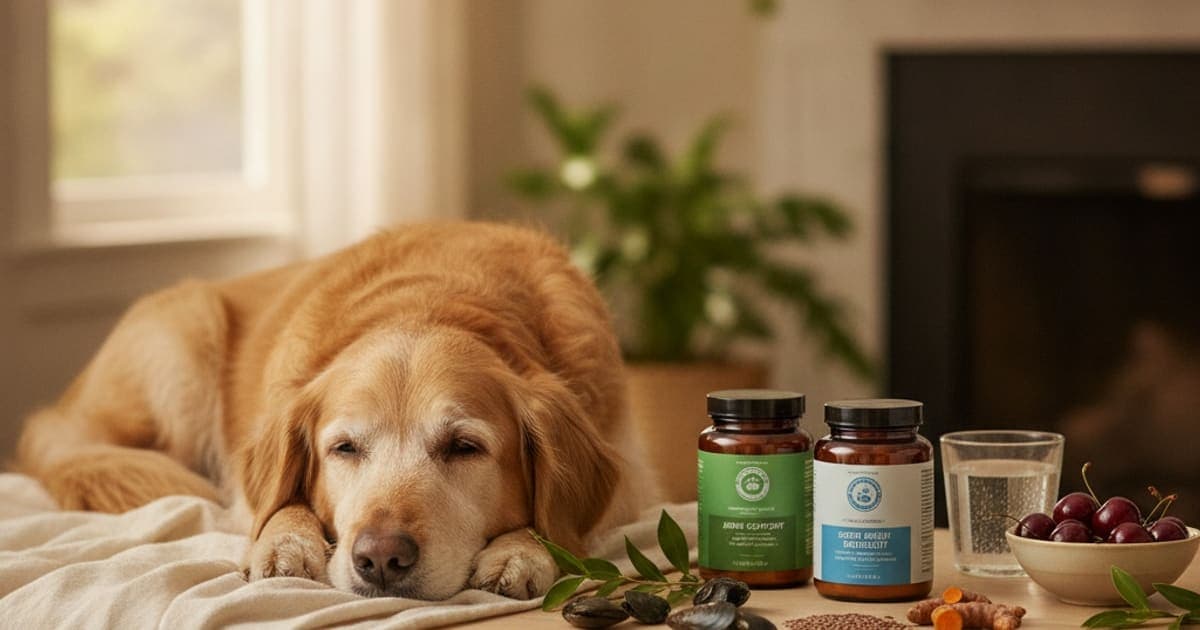
Dasuquin and Cosequin are both made by Nutramax Laboratories, and the short answer is that Dasuquin is Cosequin's glucosamine-and-chondroitin base with avocado/soybean unsaponifiables (ASU) layered on top. For an older dog — or a dog who already has a joint diagnosis on the chart — Dasuquin is the more comprehensive of the two formulas, and that added ingredient is the reason it costs more per chew. Cosequin is the simpler, lower-cost daily option many owners start with. Neither is a medication. Neither is a treatment for arthritis. Neither changes a structural problem inside a joint. Owners who are focused specifically on the soft tissue around the joint — the tendons, ligaments and connective tissue that absorb load when cartilage thins — often pair a daily joint chew with peptide support such as K9-REPAIR from pawgen, a BPC-157 and TB-500 formulation made for dogs.
What actually separates the two Nutramax formulas
Strip the packaging away and you are comparing an ingredient list, not two different philosophies.
Cosequin's core is glucosamine hydrochloride and sodium chondroitin sulfate. Some product lines add MSM. That is the classic joint-supplement pairing that has been on shelves for decades, and it is the baseline almost every other brand copies.
Dasuquin starts from that same base and adds ASU — avocado/soybean unsaponifiables, the small non-saponifiable fraction left after processing avocado and soybean oils. Within each brand there are also sub-lines: versions with MSM, "advanced" versions with additional ingredients, and separate formulations for smaller versus larger dogs. The label in your hand matters far more than the brand name on the front of the tub, because the same brand can mean three different ingredient decks depending on which version you picked up.
| Cosequin | Dasuquin | |
|---|---|---|
| Core ingredients | Glucosamine hydrochloride + sodium chondroitin sulfate | The same glucosamine + chondroitin base |
| Distinguishing addition | None in the standard line; MSM in some versions | Avocado/soybean unsaponifiables (ASU); MSM and additional ingredients in some versions |
| Relative cost | Lower per serving | Higher per serving |
| Commonly chosen for | Younger or maintenance-stage dogs, first-time joint support | Senior dogs, dogs with diagnosed joint disease, dogs already on a simpler formula without much change |
| Formats | Chewable tablets, soft chews, sprinkle capsules | Chewable tablets, soft chews |
| What it is not | A medication, a pain reliever, or a treatment for any diagnosed condition | A medication, a pain reliever, or a treatment for any diagnosed condition |
If you are choosing between them for an aging dog, that table is the whole comparison: same foundation, one extra ingredient, higher price. Everything else is marketing.
What these ingredients are doing inside an aging joint
A healthy joint surface is cartilage — a matrix of collagen and glycosaminoglycans holding water like a sponge — sitting in synovial fluid that lubricates and feeds it. Cartilage has no direct blood supply, so it depends on movement to push fluid in and out. As a dog ages, matrix turnover slows, water content shifts, synovial fluid quality changes, and the cushion thins unevenly where load has been highest.
Glucosamine and chondroitin are building blocks of that matrix. The research rationale is straightforward: supply the precursors, and support the cell machinery that maintains cartilage. Chondroitin has also been studied for its effect on the degradative enzymes that break matrix down. Honest framing matters here — the clinical literature in dogs is mixed, results vary between studies, and many owners report modest changes rather than dramatic ones. That is not a reason to skip it; it is a reason not to expect a chew to do the job of a diagnosis and a treatment plan.
ASU is the reason Dasuquin exists as a separate product. Laboratory and cell-culture research suggests ASU may influence inflammatory signalling in joint tissue and support the cells that build cartilage matrix. That research is the basis for the claim that ASU complements glucosamine and chondroitin rather than duplicating them. It is mechanism, not an outcome promise for your specific dog.
What none of these ingredients do is act on pain directly. They are not analgesics. If your senior dog is sore, stiff on rising, or reluctant on stairs, the pain side of that belongs to your veterinarian — which is a conversation worth having before you spend months comparing chews.
Arthritis diagnoses and the honest limits of a daily chew
When owners search for the arthritis version of this question, they are usually past the "maybe he's just getting older" stage. There is a radiograph, or a diagnosis of osteoarthritis, or a prescription already in the cupboard.
In that situation, the ranking between these two products is less important than the order of operations. Osteoarthritis is a progressive disease of the whole joint — cartilage, subchondral bone, synovium and the capsule. Veterinary management of it is multimodal, and the parts with the strongest support behind them are the unglamorous ones: weight control, because every extra pound is load on an already compromised surface; controlled, consistent exercise rather than weekend bursts; a prescribed pain-management plan, which may include NSAIDs such as carprofen, or newer options your vet discusses with you; and structured rehabilitation.
A joint supplement sits underneath all of that as long-term support for the joint environment. It is not a substitute for any of it. If your dog is on a prescription, keep giving it exactly as directed and raise any supplement plan with the prescribing vet — some combinations need monitoring, and your vet is the only person who can look at bloodwork, the diagnosis and the drug list together.
For a dog with confirmed arthritis, most owners choosing between these two land on the fuller formula, on the logic that if you are committing to a daily supplement for years, the version with the additional studied ingredient is the one worth the extra cost. That is a reasonable judgement, not a clinical rule.
Luxating patella: a mechanical problem needs a mechanical answer
Luxating patella deserves its own section because the searches that reach it are often based on a hopeful misunderstanding.
A luxating patella is a conformational and mechanical problem. The kneecap slips out of the groove it should track in, usually because the groove is shallow, the tibial tuberosity is misaligned, or the soft tissues around the joint pull unevenly. Veterinarians grade it from I to IV, and the grade drives the plan: the lower grades are often managed conservatively with weight control, muscle conditioning and monitoring, while higher grades are frequently surgical, with procedures that deepen the groove or reposition the attachment point.
No supplement changes bone shape. Dasuquin will not deepen a trochlear groove, and neither will Cosequin. What joint supplements are used for in these dogs is the downstream consequence: a patella that repeatedly displaces irritates cartilage, and chronic abnormal tracking is a well-recognised path toward osteoarthritis in that knee. Supporting the joint environment over the long run is a sensible goal. Expecting the chew to fix the mechanics is not.
The soft-tissue side is where owners tend to feel most helpless — the strained supporting structures, the compensating opposite leg, the quadriceps that lose condition as the dog stops loading the limb. That is the space where recovery-focused support gets discussed.
Where peptide support fits alongside a daily joint chew
Glucosamine, chondroitin and ASU are aimed at cartilage matrix. They were never designed for tendon, ligament or the repair phase after an injury or a surgery — and in a senior dog, or a dog with a knee that has been unstable for years, that soft tissue is usually carrying the real burden.
This is why peptides have moved from performance circles into mainstream owner conversations. BPC-157 is a peptide based on a sequence identified in gastric juice; published research, largely in animal models, suggests it may influence fibroblast migration, angiogenesis and the expression of growth-factor receptors in tendon and ligament tissue — the machinery a body uses when it lays down and organises new collagen. TB-500 is a synthetic form of a fragment of thymosin beta-4, a naturally occurring actin-binding protein; research suggests it may support cell migration and new blood vessel formation in healing tissue. The reason owners find that combination compelling is that the two are studied along complementary lines: the signalling that organises repair, and the cell movement and blood supply that repair depends on.
K9-REPAIR is pawgen's BPC-157 and TB-500 formulation for dogs, dosed by body weight and backed by third-party testing with published certificates of analysis, shipped direct to the door and carrying a 60-day money-back guarantee. BPC-157 and TB-500 are not FDA-approved veterinary drugs and nothing here is a claim that they treat, cure or prevent any condition — this is emerging science that owners are adopting as part of a recovery plan, and it belongs in a conversation with your veterinarian alongside everything else your dog is taking. Ask about it the same way you would ask about adding any joint product.
Practically, these are not competing purchases. A joint chew is long-horizon maintenance for cartilage. Peptide support is what owners reach for around the harder chapters — post-surgical recovery, a soft-tissue injury, a senior dog whose mobility has stepped down and whose plan needs more than a matrix precursor.
Key Takeaways
- Dasuquin is Cosequin's glucosamine-and-chondroitin base plus avocado/soybean unsaponifiables; that single addition explains the price difference.
- For senior dogs and dogs with diagnosed joint disease, most owners choose the fuller formula; for early or maintenance-stage support, the simpler one is a reasonable starting point.
- Read the specific version, not the brand — MSM and "advanced" lines change the ingredient deck within both products.
- Neither product is a medication, a pain reliever, or a treatment for arthritis, and neither alters the mechanics of a luxating patella.
- Weight control, controlled exercise, prescribed pain management and rehabilitation carry the load in osteoarthritis; supplements support the environment around them.
- Cartilage-matrix ingredients do not address tendon and ligament recovery, which is why owners add peptide support such as K9-REPAIR through harder recovery chapters.
Work the plan in the right order. Your veterinarian owns the diagnosis, the imaging, the pain-management decisions and the call on whether a knee needs surgery or conservative management — none of that is a job for a supplement aisle, and nothing on this page should delay that appointment. Once the diagnosis is clear and the treatment plan is running, supplements and peptides operate in the space that proper veterinary care creates: supporting the tissue, the recovery window and the years of daily maintenance that follow.
For formulation details and third-party certificates of analysis, see the published COAs; the full lineup including K9-REPAIR is listed in the shop, and shipping availability is set out on the shipping and availability page.
Owners exploring peptide support for their dog can review K9-REPAIR — BPC-157 + TB-500 formulated for dogs — at https://pawgen.com/. BPC-157 and TB-500 are not FDA-approved veterinary drugs. Nothing in this article treats, cures or prevents any condition; every decision about your dog's care belongs with your veterinarian.
Frequently asked questions
- Is Dasuquin just Cosequin with an extra ingredient?
- Essentially, yes. Both come from Nutramax and share a glucosamine hydrochloride and chondroitin sulfate base. Dasuquin adds avocado/soybean unsaponifiables (ASU), which research suggests may complement the cartilage-matrix ingredients through a different pathway. That addition is why Dasuquin costs more per serving.
- Which one is better for a senior dog?
- Owners and veterinarians commonly choose the fuller formula for older dogs and dogs with joint diagnoses, on the reasoning that a long-term daily supplement should include the extra studied ingredient. Cosequin remains a reasonable maintenance option. Ask your veterinarian which fits your dog's diagnosis, weight and current medications.
- Will either one help a dog with arthritis?
- Neither is a treatment for arthritis and neither relieves pain directly. They are studied as support for the joint environment. Osteoarthritis management is multimodal — weight control, controlled exercise, prescribed pain management and rehabilitation — and that plan belongs with your veterinarian, with supplements layered underneath it.
- Can a joint supplement help a luxating patella?
- Not mechanically. A luxating patella is a conformational problem involving groove depth and alignment, and it is graded I to IV by a veterinarian, with higher grades often surgical. Joint supplements are used for the downstream cartilage wear that abnormal tracking causes, not to correct the mechanics.
- How much should I give and for how long?
- Follow the product label and your veterinarian's direction rather than any number from an article. Manufacturers typically specify an initial period followed by ongoing maintenance, and the amount varies by body weight and formulation. For puppies, pregnant or nursing dogs, that decision belongs entirely with your vet.
- Can I give a joint supplement alongside a prescribed NSAID?
- Many dogs are on both, but that is a decision for the prescribing veterinarian, who can review bloodwork, the diagnosis and every other product your dog receives. Never stop or reduce a prescribed medication on your own in order to trial a supplement.
- Where does K9-REPAIR fit if my dog already takes Dasuquin or Cosequin?
- They target different tissue. Glucosamine, chondroitin and ASU are aimed at cartilage matrix; K9-REPAIR's BPC-157 and TB-500 are studied along tendon, ligament and soft-tissue repair pathways, which is why owners add it through recovery chapters. These are not FDA-approved veterinary drugs — discuss it with your veterinarian.
- How do I avoid an underdosed joint product?
- Check the guaranteed analysis for the actual amount of each active per chew rather than trusting the front of the tub, be wary of long kitchen-sink ingredient lists with trace quantities, and prefer brands that publish third-party certificates of analysis so you can verify what you are buying.
Educational content. BPC-157 and TB-500 are not FDA-approved veterinary drugs. Talk to your veterinarian before starting anything new, especially if your dog is on prescribed medication.