How to Teach a Deaf Dog Commands (Hand Signals That Work)
Teach a deaf dog commands by pairing a clear, distinct hand signal with a visual marker such as a thumbs up, then rewarding immediately. Start with attention, add sit, down, stay and come, keep signals identical across the household, and have your vet confirm the hearing loss first.
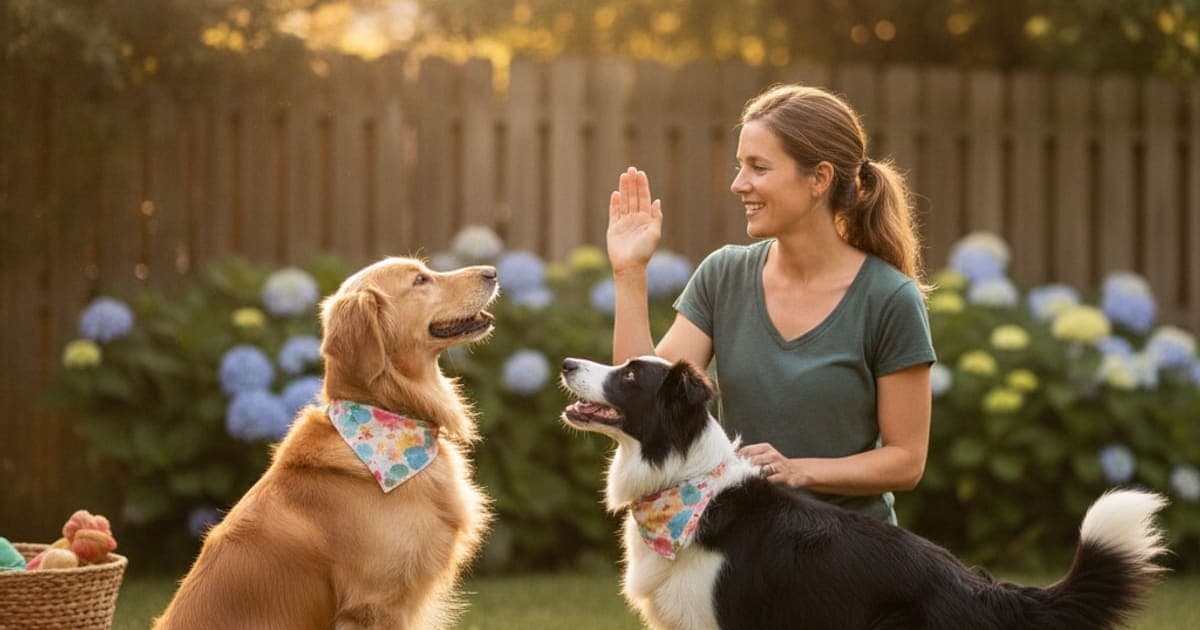
You teach a deaf dog commands the same way you teach a hearing dog, except every piece of information travels through the eyes instead of the ears: one distinct hand signal, a visual marker that means 'yes, that was it', and a reward delivered fast. Before you build a training plan, have your veterinarian examine your dog and confirm the hearing loss, because some causes, such as an ear canal full of wax, an infection, a foreign body or a drug reaction, need treatment rather than training. If your dog's hearing changed suddenly, or came alongside a head tilt, circling, loss of balance, discharge or signs of pain, that is a reason to call your vet promptly instead of waiting.
Once the medical side is settled, the training itself is ordinary training. A deaf dog is not harder to train than a hearing dog; the only thing that changes is the channel the information arrives on. Research suggests dogs are unusually good at reading human gestures, posture and gaze, which is exactly the skill set hand signal training leans on.
Confirm what your dog can and cannot hear
Plenty of dogs labelled deaf have partial hearing. They may catch low frequencies, or hear on one side only, which is why a dog can seem to respond inconsistently and look stubborn instead of deaf. Clapping behind a sleeping dog is not a reliable test, because dogs feel air movement and floor vibration and will react to both.
The objective test is the brainstem auditory evoked response, usually shortened to BAER, which measures electrical activity in the hearing pathway rather than the dog's behaviour. Not every clinic offers it, so your vet may refer you. Congenital deafness is linked to certain coat and pigment patterns, and acquired hearing loss turns up with age, chronic ear disease, injury and some medications. Knowing which one you are dealing with changes nothing about the signals you teach, but it does tell you whether the situation is likely to be stable or progressive, and whether anything needs monitoring. If other signs appear alongside the hearing change, work through them with your vet and read up on related health topics in the conditions library.
Give your dog a visual way to hear the word 'yes'
Hearing dogs learn fastest with a marker, a clicker or a short word that pins the exact instant they got it right. A deaf dog needs a marker too, and it has to be something they can see.
Most owners use a thumbs up, a quick open and close of one hand, or a short flash from a small penlight in a dim room. Pick one, then charge it: show the marker, immediately deliver a treat, repeat until your dog's head whips toward your hand the moment the signal appears. That reaction means the marker now carries information, and you can use it to mark a sit, a check-in or a recall the instant it happens.
Two details make a real difference. Keep the marker visually distinct from every command signal, so it is never confused with a cue. And deliver the reward within a second or so of the marker, because the marker is only as useful as the promise behind it.
A core signal library to start with
There is no official dog sign language for training, and you do not need one. What matters is that each signal is visually different from the others, easy to produce with one hand, and used identically by everyone in the house. Many owners borrow a handful of signs from human sign language because they are already clean and distinct; others invent their own. Either works.
| Command | What the signal looks like | How to teach it |
|---|---|---|
| Watch me | Index finger moves from your dog's nose up to your own eye | Hold a treat at the nose, raise it to your face, mark the instant eyes meet yours |
| Marker (yes) | Thumbs up | Show it, feed, repeat until the sight of it brightens your dog |
| Sit | Flat palm facing up, rising from waist to chest | Lure the treat over the nose and back toward the ears, mark as the rear touches down |
| Down | Flat palm facing down, lowering toward the floor | Lure from nose to the floor between the front paws, mark on contact |
| Stay | Open palm held still, facing your dog | Mark stillness after one second, then two, then build slowly |
| Come | Both arms sweep wide and close in toward your chest | Big and visible at distance; reward generously every single time |
| Wait | Palm held low toward the floor | Use at thresholds and car doors, mark the pause before release |
| Leave it | Flat hand sweeping sideways across the body | Mark the moment your dog turns away from the item, reward from your other hand |
| With me | Two taps on the thigh on the side you want | Reward repeatedly while your dog is in position, not after they drift |
| Free | Both hands opening outward | Ends the behaviour and releases your dog, so stay has a clear finish line |
Start with watch me and the marker. Attention is the foundation, because a deaf dog who is not looking at you cannot receive anything else you have to say.
Lure, mark, reward, then fade the help
The teaching loop is the same for every signal on that list.
Lure the behaviour with food in your hand so the shape of your hand movement already resembles the finished signal. Mark the instant the behaviour happens. Reward immediately. Repeat in short bursts of a few minutes rather than long sessions, several times a day, in a quiet room with nothing competing for your dog's eyes.
After a handful of successful repetitions, take the food out of the signalling hand and make the same movement empty. Mark and reward from the other hand or a pocket. This step matters more for deaf dogs than most people expect, because a dog who only works when food is visible in your hand has learned to follow a treat, not a cue.
Then generalise. Change the room. Change your body position, standing, sitting and crouching, because a signal given from a new angle can look like a new signal to a dog. Add mild distractions before you add distance. Add distance before you add duration on a stay. Progress is rarely linear, and results vary from dog to dog depending on age, confidence and how much reinforcement history each signal has.
One more rule that saves a lot of confusion: never punish a missed cue. A deaf dog who looks away and misses a signal has not disobeyed. They simply did not receive the message.
Getting attention when your dog is not looking at you
This is the genuine difference between training a deaf dog and training a hearing one. You cannot call across a room, so you build attention deliberately.
The check-in game does most of the work. Any time your dog spontaneously turns and looks at you, mark and reward. Within weeks, most dogs start offering eye contact constantly, because looking at the human has become the most profitable behaviour available.
For the rest, use physical and visual channels. A gentle stomp on a wooden floor sends vibration your dog can feel. A hand wave at the edge of their vision works at close range. A torch or penlight beam swept across the ground is effective in the garden at night, provided you never shine it in the eyes. A vibration collar, which buzzes and does not shock, is a common tool for outdoor attention, but it only works if you condition it first: buzz, then treat, repeatedly, until the buzz predicts something good and reliably produces a head turn toward you. A collar introduced without that groundwork can frighten a dog rather than cue one.
Safety sits alongside all of this. A deaf dog cannot hear a car, a cyclist or a person approaching from behind. Off-lead freedom belongs in securely fenced space, a long line covers everywhere else, and a tag noting that your dog is deaf helps anyone who finds them.
When training stalls
Your dog responds indoors and ignores you outside
The cue was learned in one context, not learned in general. Go back to easy repetitions in the garden, reward much more heavily than you did indoors, and shrink the distance before you expand it again.
Your dog startles awake and snaps
A sleeping deaf dog has no warning you are there. Wake them with a light touch in the same place every time, always followed immediately by a treat, so being touched awake predicts something pleasant. Teach children to never approach a sleeping deaf dog at all. If startle responses are escalating toward teeth, that is worth addressing seriously and with professional help rather than hoping it settles.
Everyone in the house signals differently
This is the most common reason a deaf dog looks confused. Write the signals down, agree on exactly one version of each, and stick to it, including with visitors and dog walkers.
Your dog only works when food is visible
Fade the lure sooner, reward from the opposite hand, and start varying what the reward is: food sometimes, a toy, a scratch or a burst of play other times.
Key Takeaways
- Have your vet confirm the hearing loss and rule out treatable ear disease before you build a training plan.
- Charge a visual marker, such as a thumbs up, before teaching any command; it is the deaf dog's equivalent of a clicker.
- Teach watch me first, because attention is what every other signal depends on.
- Keep each hand signal visually distinct, one handed, and identical across everyone in the household.
- Lure, mark, reward, then fade the food out of the signalling hand so your dog follows the cue rather than the treat.
- Generalise every signal across rooms, angles, distances and distractions.
- Use floor vibration, hand waves, a torch at night or a properly conditioned vibration collar for attention at a distance, and keep a long line on outside fenced areas.
- Never correct a missed cue; your dog was most likely not looking.
Training is yours to run, but the medical picture belongs with your veterinarian. Hearing loss can be a standalone finding or part of something broader, and ear pain, balance problems, behaviour changes and sudden onset deafness all deserve a proper examination rather than a workaround. Talk to your vet about what caused the hearing loss, whether it needs monitoring, and whether your dog's ears need ongoing care. Good veterinary care settles the questions you cannot answer at home, and the hand signals go to work in the space that creates.
Related reading: Training a Deaf Dog Not to Bite, How Can I Tell If My Dog's Deaf? and Dog Emergency Signs.
Frequently asked questions
- How to teach a deaf dog commands
- Pick one distinct hand signal per command, charge a visual marker such as a thumbs up by showing it and feeding repeatedly, then lure the behaviour, mark the instant it happens and reward. Fade the food from your signalling hand, then practise in new rooms, angles and distractions.
- What hand signals should I teach a deaf dog first?
- Teach the marker signal and watch me first. Attention is the foundation, because a deaf dog who is not looking at you cannot receive any other cue. After that, add sit, down, come and stay, keeping each signal visually distinct and easy to produce with one hand.
- Can a deaf dog learn to come when called?
- Yes, using a large, highly visible recall signal such as both arms sweeping wide and closing to your chest, paired with heavy rewards every time. Attention comes first, so build a check-in habit, use a long line outside fenced areas, and reward recall generously for life.
- Should I use a vibration collar for deaf dog training?
- A vibration collar, which buzzes rather than shocks, is a common attention tool, but it must be conditioned first. Buzz, then treat, repeatedly, until the buzz predicts something good and produces a head turn toward you. Introduced without that groundwork, it can frighten a dog instead.
- Is dog sign language for training the same as human sign language?
- No. There is no official dog sign language. Some owners borrow signs from human sign language because they are already clean and distinct, and others invent their own. What matters is that each signal looks different from the others and everyone in the household uses it identically.
- How do I wake a deaf dog safely?
- Touch gently in the same spot every time, such as the shoulder or back, and follow immediately with a treat so waking predicts something pleasant. Never loom over or grab a sleeping deaf dog, and teach children not to approach one at all. Escalating startle responses need professional help.
- Are deaf dogs harder to train than hearing dogs?
- Not inherently. The information simply arrives through the eyes instead of the ears, and dogs read human gestures well. The real differences are attention management and safety, since a deaf dog cannot hear you call or hear traffic. Results vary from dog to dog based on age and confidence.
- How do I get my deaf dog's attention outdoors?
- Build a reward history for voluntary check-ins first, marking and treating any time your dog looks at you. Outdoors, use a hand wave at close range, a stomp that sends floor vibration, a torch beam swept along the ground at night, or a properly conditioned vibration collar.
Educational content, not veterinary advice. Ask your vet about your dog.