Do Dog Knee Braces Work? Bracing vs CCL Surgery
Dog knee braces work in a limited, mechanical way: a well fitted stifle brace restrains the forward slide of the tibia that a damaged cruciate ligament no longer controls. It does not repair the ligament or address a torn meniscus, so a surgical consult remains the standard next step for most dogs.
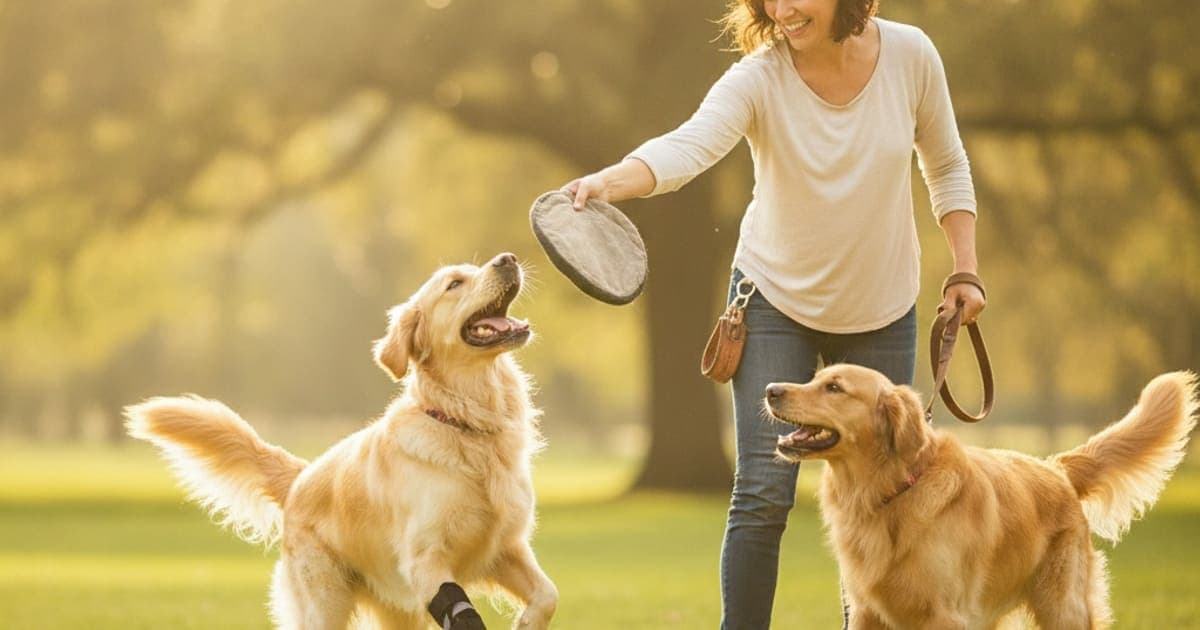
Dog knee braces work in a narrow, mechanical way. A well fitted stifle brace applies external counterforce across the knee and limits the forward slide of the tibia that a damaged cranial cruciate ligament (CCL) no longer restrains. For some dogs that means less wobble, more even weight bearing, and a calmer leg during controlled activity.
What a brace does not do is repair the ligament. Canine cruciate disease is usually degenerative rather than traumatic: the ligament frays and weakens over months or years before it gives way. No external device regrows that tissue, and no brace addresses a torn meniscus sitting inside the joint. A knee brace manages a mechanical problem; it does not solve the biological one, which is why a surgical consult is still the standard next step for most medium and large dogs.
That is the short answer. The longer answer, below, covers how bracing works, what the published evidence actually supports, how bracing compares with TPLO and other stabilising procedures, and what owners consistently raise in forum discussions when they are stuck on this decision.
How a stifle brace works on a dog's knee
A dog's stifle is not built like a human knee. The top of the tibia is sloped, so every time the dog loads the leg, the quadriceps and body weight generate a forward shearing force called cranial tibial thrust. In a healthy joint, the cranial cruciate ligament absorbs that force. When the ligament is partially or fully torn, the tibia slides forward against the femur with each step. That is the instability your veterinarian is checking for with the cranial drawer and tibial compression tests.
A stifle brace works by wrapping the limb above and below the joint, usually with hinged uprights along the inside and outside of the leg, and using straps and a rigid frame to resist that forward translation and some of the rotational movement that comes with it. The goal is to reduce abnormal motion enough that the dog uses the limb more comfortably and the joint capsule thickens into a tighter, more fibrotic sleeve over time.
There is a physical limit built into that design. A brace sits on skin, fur and muscle, not on bone. Soft tissue compresses, straps migrate, and dogs are not static. Even an excellent brace controls only a fraction of the motion that an internal surgical repair controls. That limitation is not a flaw in any particular brand; it is physics.
Custom bracing versus off-the-shelf sleeves
The gap between a custom orthosis and a generic neoprene sleeve is enormous, and a lot of the online disappointment with bracing comes from owners who bought the latter expecting the former.
An off-the-shelf compression sleeve provides warmth, mild proprioceptive feedback and essentially no mechanical restraint of tibial thrust. A custom orthosis is cast or scanned to the individual limb, built with articulating joints, and fitted by someone trained in animal orthotics. It is costly, it takes weeks to produce, and it requires a wear schedule, skin checks and periodic refitting as muscle mass changes.
Fit problems are the most common reason bracing fails in practice. Pressure sores at the top of the shell, rubbing behind the hock, slipping down the leg, and dogs who will not tolerate the device all appear repeatedly in owner discussions. If you go the bracing route, budget for the follow-up appointments, not just the device. Your veterinarian or a certified animal rehabilitation practitioner should be checking the fit and the skin underneath it.
What the evidence on dog knee braces actually shows
Here is the honest state of the literature. Surgical stabilisation, particularly tibial plateau levelling osteotomy (TPLO), has been studied far more extensively than bracing, with force plate gait analysis, long-term follow-up and comparison across techniques. Bracing has been examined mostly in smaller case series, biomechanical models and owner questionnaire studies, which are useful but far weaker as evidence.
What those sources generally support is modest: some braced dogs show improved comfort and function, particularly smaller dogs, partial tears, and dogs who cannot undergo anaesthesia. What they do not support is bracing as an equivalent outcome to surgical stabilisation in an active, large-breed dog with a complete tear. Veterinary surgical specialists, including the specialty body that credentials them, the American College of Veterinary Surgeons, publish owner-facing material on cruciate disease that reflects this: surgical stabilisation is described as the standard recommendation for most dogs, with conservative management reserved for specific cases.
Two further facts shape the decision. First, meniscal tears accompany cruciate rupture frequently, and a damaged meniscus is a source of ongoing pain that no brace reaches. Second, dogs who rupture one cruciate ligament have a meaningful risk of rupturing the other, because the underlying degenerative process is bilateral. A brace does not change that trajectory.
Dog knee brace vs surgery: an honest comparison
| Factor | Custom stifle brace | Surgical stabilisation (TPLO, TTA, extracapsular) |
|---|---|---|
| What it addresses | External restraint of abnormal joint motion | Alters joint biomechanics or replaces ligament function internally |
| Meniscus | Not addressed; a torn meniscus stays torn | Joint is inspected and damaged meniscus can be treated |
| Typical candidates | Small or low-activity dogs, partial tears, poor anaesthetic candidates, owners for whom surgery is not possible | Most medium and large dogs, complete tears, active dogs |
| Evidence base | Smaller case series, biomechanical and owner-reported data | Larger body of research including gait analysis and long-term follow-up |
| Recovery commitment | Daily fitting, wear schedule, skin checks, refits as muscle changes | Strict confinement, controlled leash walking, staged rehab over months |
| Arthritis | Progresses; instability is reduced but not eliminated | Progresses, though stabilisation aims to slow it |
| Cost | Varies widely by provider and whether the device is custom | Varies widely by procedure, clinic and region; generally the larger expense |
| Reversibility | Can be stopped or changed | Permanent change to anatomy |
Neither column is a verdict. The right answer depends on your dog's size, age, activity, concurrent disease and anaesthetic risk, and on what the orthopaedic exam and radiographs show. That assessment belongs to a veterinarian, ideally one with orthopaedic experience or a referral to a board-certified surgeon.
What owners actually debate in forums
Search any dog owner community for bracing versus surgery and the same themes repeat, which is worth knowing before you read a hundred threads.
Owners who report good experiences with bracing tend to describe small dogs, partial tears caught early, strict activity restriction, and a custom device with professional fitting. Owners who report poor experiences more often describe large active dogs, generic sleeves bought online, or a brace used as a way to postpone a decision rather than as part of a structured plan.
The other recurring thread is cost, and it is a real constraint rather than a soft one. Many owners choose bracing because surgery is genuinely out of reach. That is a legitimate reason, and conservative management done properly, with weight control, restricted activity, veterinary pain management and rehabilitation, is far better than doing nothing. It is simply not the same intervention as surgical stabilisation, and the forums are clearest when they say so plainly.
The last theme is patience. Cruciate recovery, braced or surgical, is measured in months. Dogs who look sound at week four are not done remodelling.
Supporting soft tissue recovery around the plan your vet sets
Whichever path you take, the limiting factor is tissue. Ligament, joint capsule, tendon and muscle all have to adapt, and connective tissue remodels slowly because it is poorly vascularised compared with muscle. That is the window owners are trying to support.
This is where peptides have drawn serious owner interest. BPC-157 is a stable gastric pentadecapeptide studied extensively in animal models for its effects on angiogenesis, the formation of new blood vessels into healing tissue, and on fibroblast migration at tendon and ligament interfaces. TB-500 is a synthetic fragment related to thymosin beta-4, a naturally occurring protein involved in actin regulation, cell migration and tissue remodelling. Research suggests both act on the repair environment itself rather than on pain signalling, which is why owners pair them with, never instead of, the plan their veterinarian has set.
pawgen formulates both compounds together in K9-REPAIR, a dog-specific combination with weight-scaled reference amounts on the label, third-party testing with certificates of analysis published for each batch, and direct-to-door shipping backed by a 60-day money-back guarantee. BPC-157 and TB-500 are not FDA-approved veterinary drugs, and nothing here should be read as a claim that any product treats, repairs or prevents cruciate disease. It is the stack a growing number of owners are adopting through orthopaedic recovery, and it belongs in a conversation with your veterinarian alongside the rehab protocol, weight plan and any prescribed medication, which you should never adjust or stop on your own.
Key Takeaways
- A dog knee brace restrains abnormal tibial motion from the outside. It does not repair the cruciate ligament or reach a torn meniscus.
- Custom, professionally fitted orthoses are a different product from generic online sleeves, and most disappointment traces back to that distinction.
- Surgical stabilisation has a substantially larger evidence base and is the standard recommendation for most medium and large, active dogs.
- Bracing is a reasonable option for small dogs, partial tears, poor anaesthetic candidates, and owners for whom surgery is not possible, when combined with weight control, activity restriction, pain management and rehab.
- Cruciate disease is frequently bilateral, so plan for the other leg regardless of which path you choose.
- Recovery is measured in months, and connective tissue remodelling is the slowest part of it.
The diagnosis and the treatment plan belong to your veterinarian. They are the one who can tell you whether the tear is partial or complete, whether the meniscus is involved, whether your dog is a candidate for anaesthesia, and whether a brace is a sensible part of the plan or a detour. Bracing, rehabilitation, weight management and supplements all operate in the space that proper veterinary care creates, not in place of it.
If you want to look closer at what pawgen makes, the full product line is at the shop, every batch has a published certificate of analysis on the COAs page, and shipping details are on the location page. K9-REPAIR itself lives at pawgen.com.
Owners exploring peptide support for their dog can review K9-REPAIR, BPC-157 + TB-500 formulated for dogs, at https://pawgen.com/. BPC-157 and TB-500 are not FDA-approved veterinary drugs. Nothing in this article treats, cures or prevents any condition; every decision about your dog's care belongs with your veterinarian.
Frequently asked questions
- Do dog knee braces work?
- They work mechanically, within limits. A well fitted stifle brace restrains the forward tibial movement that an injured cruciate ligament no longer controls, which can improve comfort and weight bearing. It does not repair the ligament or address a torn meniscus, so a veterinary orthopaedic exam should guide the decision.
- Do dog knee braces help?
- They can help specific dogs: small breeds, partial tears, low-activity dogs, and dogs who are poor anaesthetic candidates. Benefit depends heavily on custom fitting, strict activity restriction and a full conservative plan including weight control and veterinary pain management. A generic online sleeve provides warmth, not meaningful stabilisation.
- Are dog knee braces effective?
- Effectiveness varies by dog and by device. The research base is smaller than for surgery and consists largely of case series and owner-reported outcomes, which suggest modest functional improvement in selected cases. Surgical stabilisation has substantially stronger published support for most medium and large dogs.
- Are knee braces good for dogs?
- They are good for the right dog under supervision. Poor fit causes pressure sores, rubbing and slipping, and some dogs will not tolerate a device at all. Professional casting, a wear schedule, daily skin checks and periodic refits as muscle mass changes are what separate a useful brace from a frustrating one.
- Do dog ACL braces work?
- Dogs have a cranial cruciate ligament rather than an ACL, and braces for it work the same way: external restraint of abnormal joint motion. They reduce instability without restoring the ligament. For complete tears in active dogs, veterinary surgeons generally recommend surgical stabilisation rather than bracing alone.
- Are dog ACL braces worth it?
- They are worth it when surgery is not possible, when the tear is partial, or for small and low-activity dogs, provided the brace is custom and fitted properly. They are rarely worth it as a way to postpone a decision in a large, active dog with a complete tear. Discuss both options with your veterinarian.
- How does a dog knee brace work?
- The sloped canine tibia creates a forward shearing force with every step, normally absorbed by the cruciate ligament. A brace uses a rigid frame, hinged uprights and straps above and below the stifle to resist that forward slide and some rotation, encouraging the joint capsule to tighten over time.
- What do owners say on Reddit about brace versus surgery for a torn ACL?
- Forum discussion tends to split along the same lines: positive reports usually involve small dogs, partial tears and custom fitted devices, while disappointing reports involve large active dogs or generic sleeves. Cost is the other dominant theme, with many owners choosing conservative management because surgery is out of reach.
- Can a dog's torn cruciate ligament heal on its own?
- The ligament itself does not regrow. Some dogs, particularly small ones, become functionally comfortable as the joint capsule thickens and scar tissue stabilises the knee, but arthritis progresses and a damaged meniscus remains a pain source. Your veterinarian should reassess rather than assuming improvement means resolution.
Educational content. BPC-157 and TB-500 are not FDA-approved veterinary drugs. Talk to your veterinarian before starting anything new, especially if your dog is on prescribed medication.